
Meaning of Pharmaceutical Analysis
Pharmaceutical analysis is the branch of analytical science concerned with examining drugs, pharmaceutical substances, excipients and dosage forms. It provides dependable information about what a sample contains and how much of each relevant component is present.
Simple meaning: It is the systematic testing of medicines and their ingredients to establish identity, purity, strength and quality.
Technical meaning: It applies chemical, physical, physicochemical, instrumental and biological methods to identify substances, determine their amount, detect impurities and evaluate compliance with specified standards.
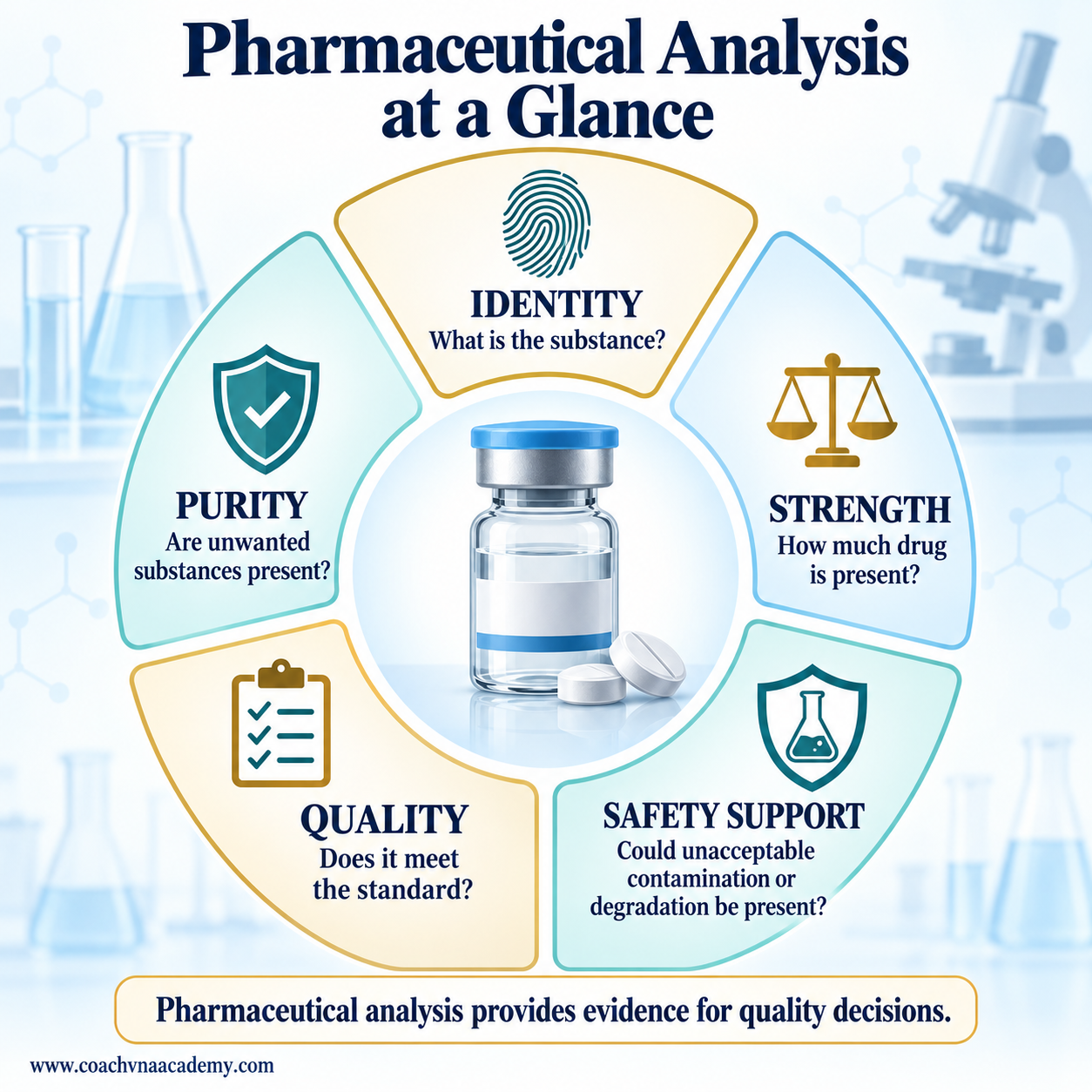
Key Questions Answered by Analysis
| Question | Analytical purpose | Simple pharmacy example |
| What is present? | Identification or qualitative analysis | Confirm that a raw material is sodium chloride. |
| How much is present? | Assay or quantitative analysis | Determine the percentage purity of sodium bicarbonate. |
| What unwanted material is present? | Purity or impurity testing | Check chloride or sulphate as an impurity. |
| Does it meet the standard? | Specification and compliance testing | Compare a result with a pharmacopoeial limit. |
| Is the method/result dependable? | Quality assurance of measurement | Use blanks, standards and replicate measurements. |
Important Terms
| Term | Meaning |
| Analyte | The substance or component that has to be identified or measured. |
| Sample | The portion of material submitted or selected for analysis. |
| Matrix | All other components surrounding the analyte in the sample. |
| Method | A defined procedure used to perform an analysis. |
| Result | The reported analytical finding, usually with a unit and suitable precision. |
| Specification | A documented set of tests, procedures and acceptance limits for a material or product. |
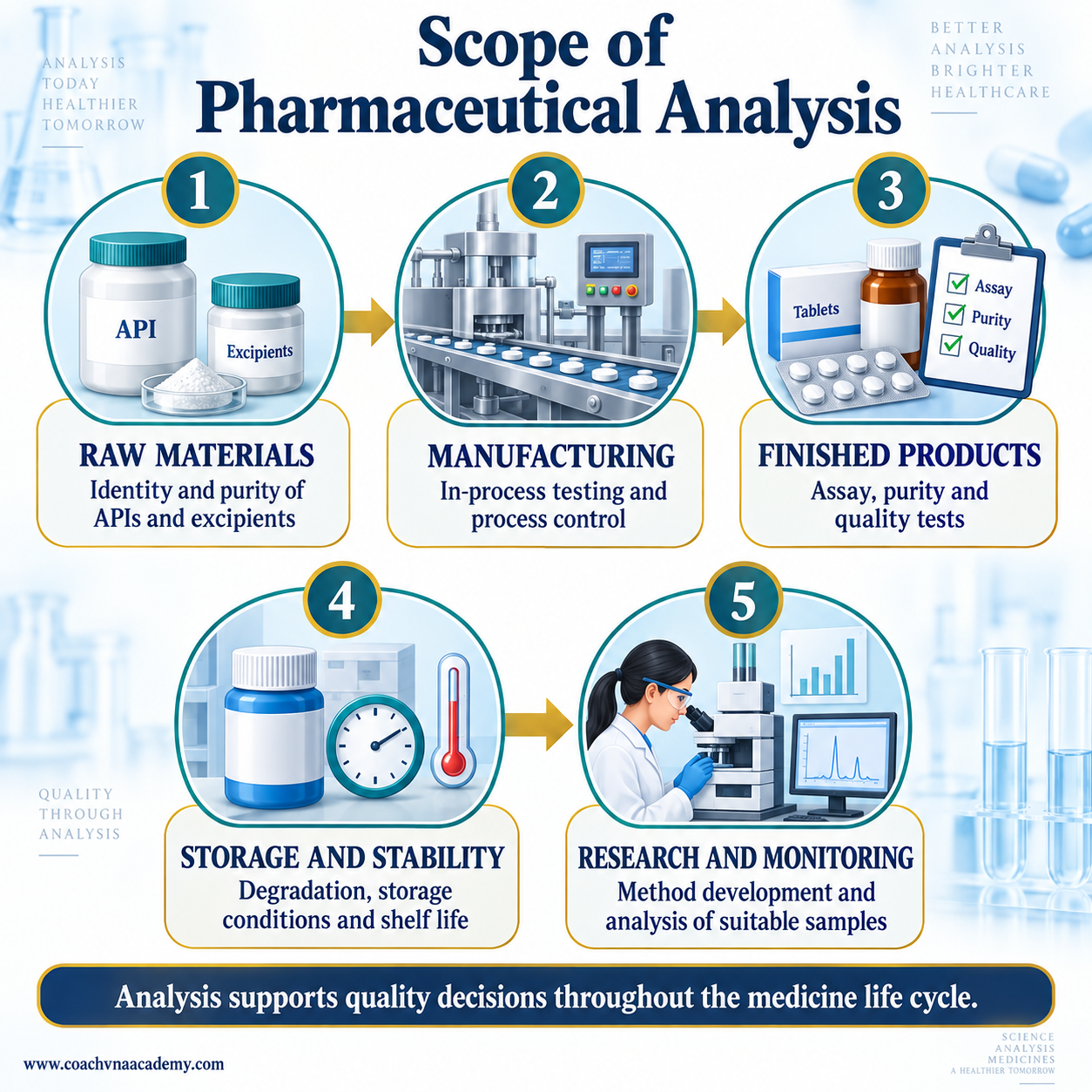
Scope of Pharmaceutical Analysis
The scope of pharmaceutical analysis extends across the complete life cycle of a medicine, from the selection of a raw material to the testing of the finished product and the monitoring of its stability. The same analytical principle may serve different purposes at different stages.
Raw materials: Confirms the identity, purity and quality of active pharmaceutical ingredients, excipients, solvents and packaging-related materials.
In-process samples: During manufacturing, analysts monitor critical stages. Therefore, they can recognize and control variations before completing the product.
Finished dosage forms: Determines identity, drug content, uniformity, impurities and other product-specific quality attributes.
Stability studies: Analysts track changes during storage. Consequently, the results help them establish suitable storage conditions, retest periods and shelf life.
Research and development: Supports drug discovery, formulation development, method development, compatibility studies and comparison of prototypes.
Quality control and quality assurance: Provides measured evidence that materials and products comply with approved specifications and that results are generated through controlled procedures.
Pharmacopoeial and regulatory work: Analysts apply official or validated methods. Thus, they demonstrate compliance with recognized standards and regulatory requirements.
Clinical and biological samples: In addition, analysts measure drugs or related substances in biological matrices during pharmacokinetic, bioavailability, bioequivalence or therapeutic investigations.
Environmental and cleaning samples: Detects residues or contaminants in water, equipment-rinse samples and manufacturing environments.
Importance of Pharmaceutical Analysis
Visual appearance and labelling alone cannot establish the quality of a medicine. Instead, analysts use appropriate tests to confirm its quality. Therefore, pharmaceutical analysis supports scientific decisions whenever the identity, purity, strength or performance of a pharmaceutical material may affect the final product.
| Importance | How analysis contributes |
| Patient safety | Helps detect wrong materials, harmful impurities, contamination or unacceptable degradation. |
| Correct strength | Verifies that the amount of active ingredient agrees with the stated or specified value. |
| Consistent quality | Compares raw materials, batches and stability samples using defined procedures. |
| Purity control | Detects and, where required, measures impurities, degradation products or residual substances. |
| Manufacturing control | Provides information for process adjustment, investigation and release decisions. |
| Legal and regulatory compliance | Generates documented evidence that applicable specifications and official requirements are met. |
| Research decisions | Allows scientists to compare formulations, conditions and experimental results objectively. |
| Prevention of substandard products | Supports the recognition of products that do not satisfy identity, strength, purity or quality requirements. |
Remember: Analysis does not create quality by itself; it measures selected quality attributes and provides evidence for sound quality decisions.
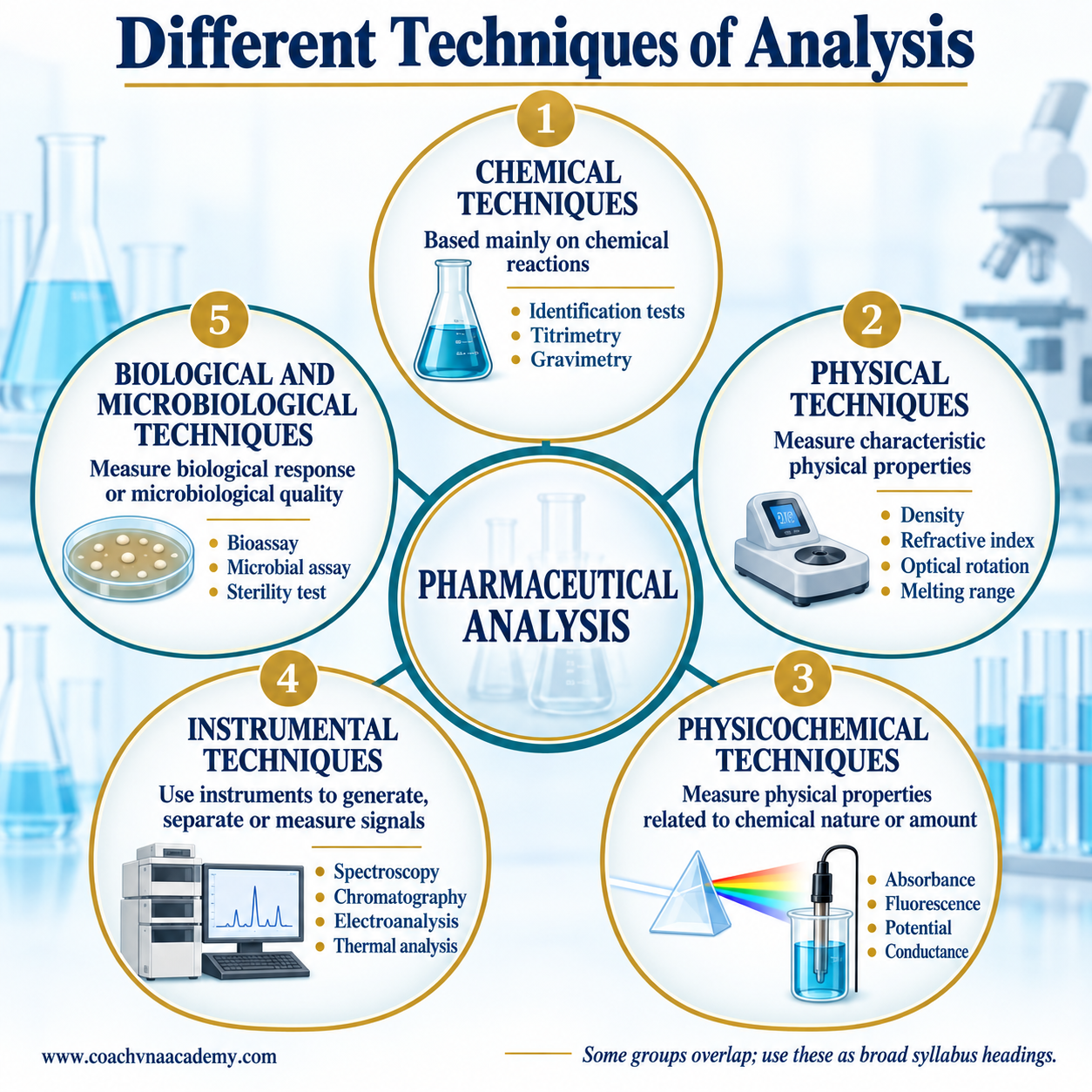
Different Techniques of Analysis
No single type of measurement can answer every analytical question. Therefore, pharmaceutical analysis uses different techniques for different purposes. First, students classify these techniques according to the nature of the test or response. Next, they study each analytical technique individually.
| Broad technique | What it is based on | Representative examples |
| Chemical techniques | A definite chemical reaction involving the analyte. The result is observed directly or calculated from mass or volume. | Identification reactions, limit tests, titrimetry and gravimetry. |
| Physical techniques | Measurement of a characteristic physical property without depending mainly on a chemical reaction. | Melting range, density, refractive index, optical rotation and particle size. |
| Physicochemical techniques | Measurement of a physical property that depends on the chemical nature, concentration or interaction of the analyte. | Absorbance, fluorescence, electrode potential, conductance and thermal behaviour. |
| Instrumental techniques | Use of an instrument to generate, resolve or measure an analytical signal. This practical group can include physicochemical and separation methods. | Spectroscopy, chromatography, electroanalysis and thermal analysis. |
| Biological and microbiological techniques | Measurement of a biological response or microbiological quality attribute. | Bioassay, microbial assay, sterility test and microbial-limit test. |
These headings describe different ways of obtaining analytical information, but they are not completely isolated. For example, UV–visible spectrophotometry is both physicochemical and instrumental, while chromatography is an instrumental separation approach. Students should use this classification as the broad syllabus framework and study by the named techniques individually.
Chemical Techniques
Chemical techniques use a characteristic reaction. A colour, precipitate or gas may support qualitative identification, while the measured volume of a standard solution or the measured mass of a product may provide a quantitative result.
Physical Techniques
Physical techniques measure properties such as density, refractive index, optical rotation, melting range or particle size. These properties may support identity, purity assessment or product characterization when the method and acceptance criteria are properly defined.
Physicochemical Techniques
Physicochemical techniques measure a physical property that changes according to the chemical nature or amount of the analyte. Examples include absorbance, fluorescence, electrode potential, conductance and heat-flow behaviour. The measured property is converted into qualitative or quantitative information.
Instrumental Techniques
Instrumental techniques use an instrument to generate, separate, detect or measure an analytical signal. Important groups include spectroscopic, chromatographic, electroanalytical and thermal techniques. Correct sampling, calibration, controlled conditions and interpretation remain essential even when an advanced instrument is used.
Biological and Microbiological Techniques
Biological and microbiological techniques are used when the required information depends on biological activity or microbiological quality. Their broad examples include bioassays, microbial assays, sterility testing and microbial-limit testing.
Qualitative and Quantitative Analysis
Qualitative Analysis
This approach establishes the identity or presence of a substance, ion, functional group or component. Therefore, it usually provides a descriptive result, such as present, absent, positive, negative or identified.
- Examples: colour reactions, precipitation reactions, flame tests, identification by infrared spectrum and comparison of chromatographic retention behaviour.
- Main question: What is present in the sample?
- Typical report: The test complies, the ion is present, or the identity is confirmed.
Quantitative Analysis
Quantitative analysis determines the amount or concentration of an analyte. The result must be expressed with an appropriate numerical value and unit, for example percentage purity, mg per tablet, mol/L or parts per million.
- Examples: acid–base titration, redox titration, UV–visible spectrophotometric assay and chromatographic assay.
- Main question: How much analyte is present?
- Typical report: 99.2% purity, 498 mg per tablet or 10.4 mg/L.
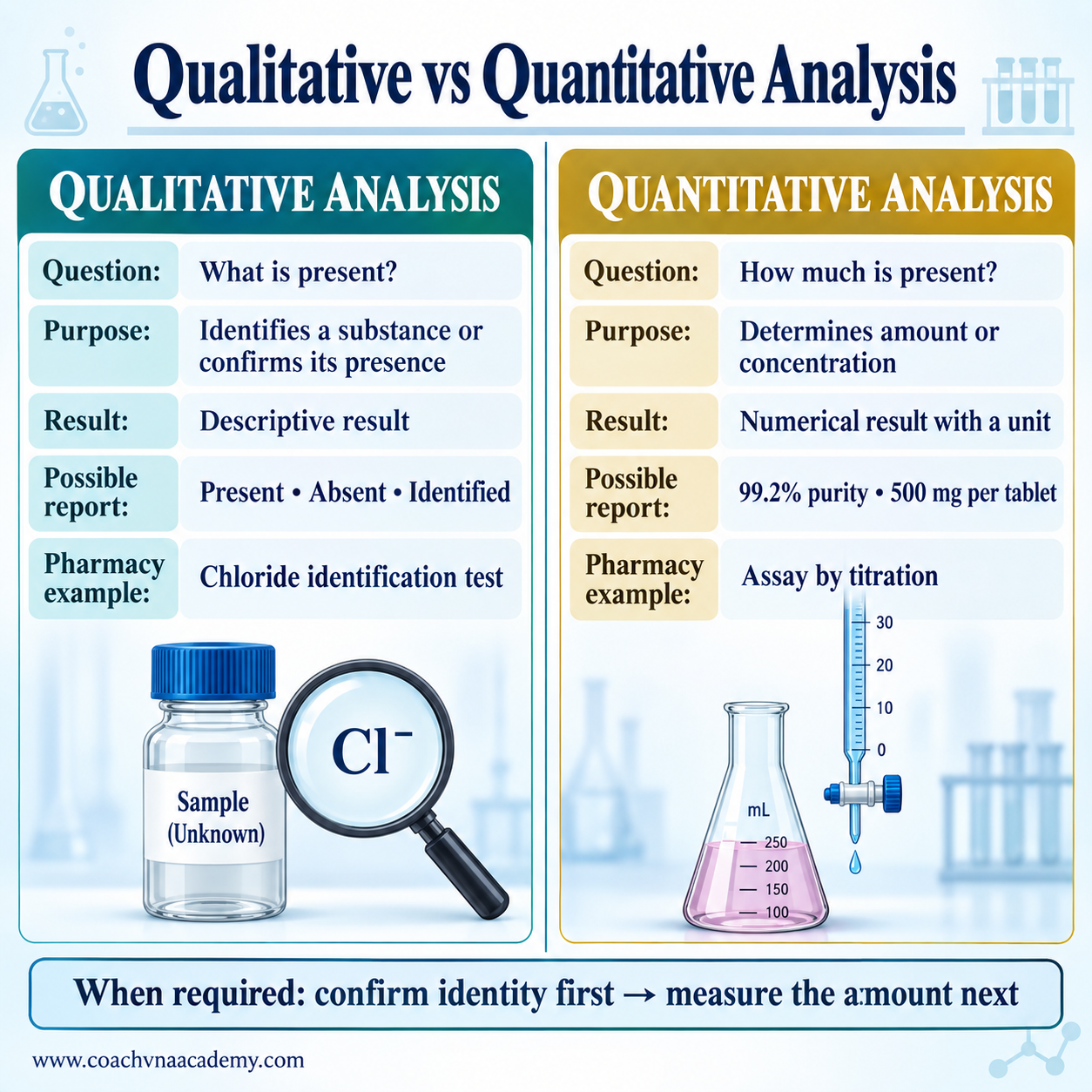
Qualitative and Quantitative Analysis Compared
| Feature | Qualitative analysis | Quantitative analysis |
| Purpose | Identify a substance or establish presence/absence. | Determine amount, concentration or content. |
| Nature of result | Descriptive or comparative. | Numerical and accompanied by a unit. |
| Typical question | What is present? | How much is present? |
| Example | Identification test for chloride. | Assay of chloride by titration. |
| Common requirement | Selective response or characteristic property. | Calibration or stoichiometric relationship and controlled measurement. |
| Relationship | Often confirms identity before measurement. | Measures the identified analyte accurately enough for the intended purpose. |
Overview of Analytical Techniques
This section does not create a second classification. It gives a brief, student-oriented overview of the individual techniques already placed within the broad groups in Section 4. An analytical technique is a general scientific approach used to obtain information from a sample, whereas a method is the detailed procedure for applying that technique to a particular analyte and sample. For example, titrimetry is a technique, while a specified acid–base titration of a particular drug is a method.
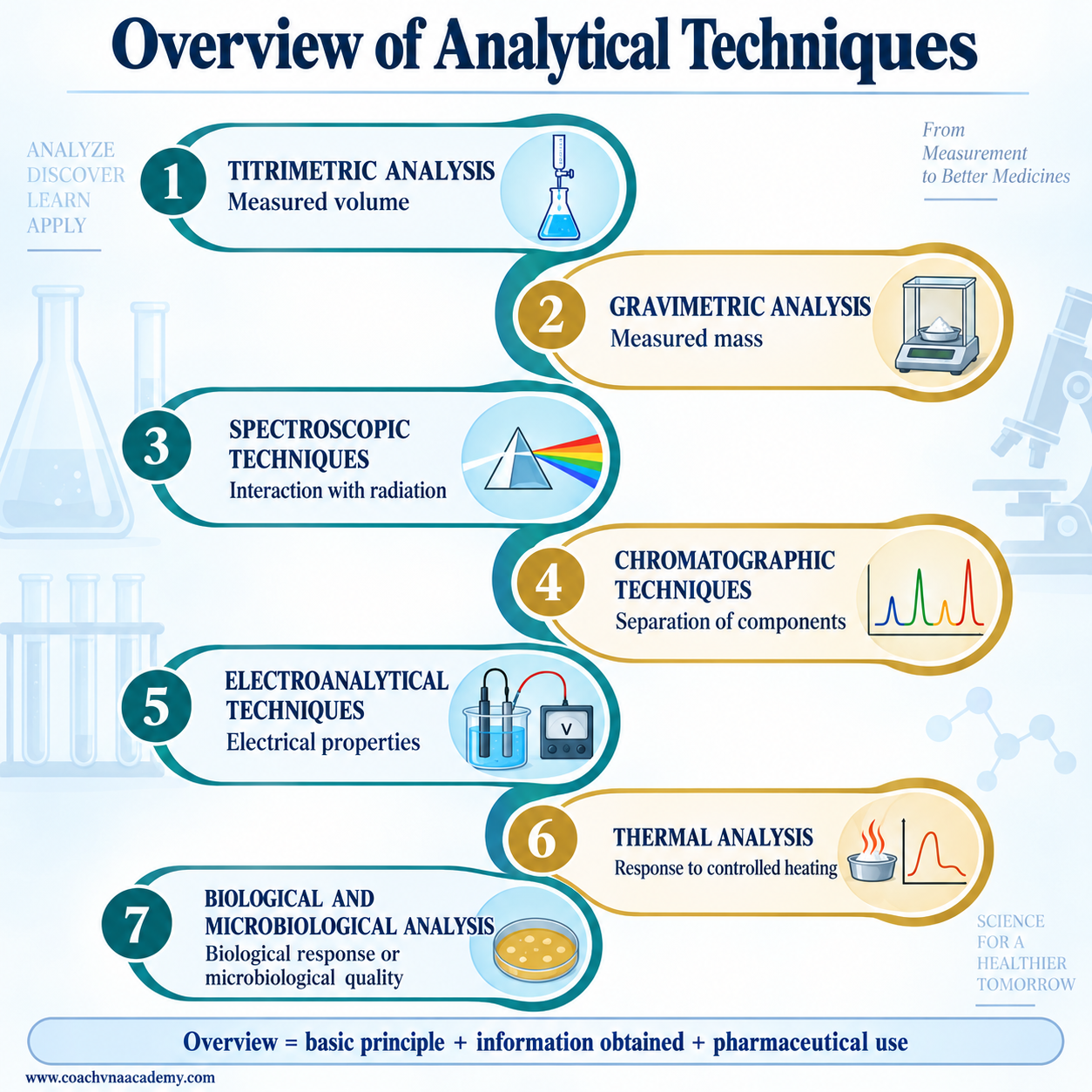
Titrimetric Analysis
| Technique | Basic principle | Common pharmaceutical use |
| Titrimetric or volumetric analysis | A measured volume of a standard solution reacts stoichiometrically with the analyte. | Assay by acid–base, redox, precipitation or complexometric titration. |
Principle of Titrimetric Analysis
Titrimetric analysis determines an analyte by allowing it to react with a standard solution called the titrant. The titrant is added until the reaction reaches its endpoint. Because the reaction follows a known stoichiometric relationship, the volume and concentration of titrant can be used to calculate the amount of analyte. Titrimetry is mainly quantitative and remains important because it is direct, economical and suitable for many routine pharmaceutical assays.
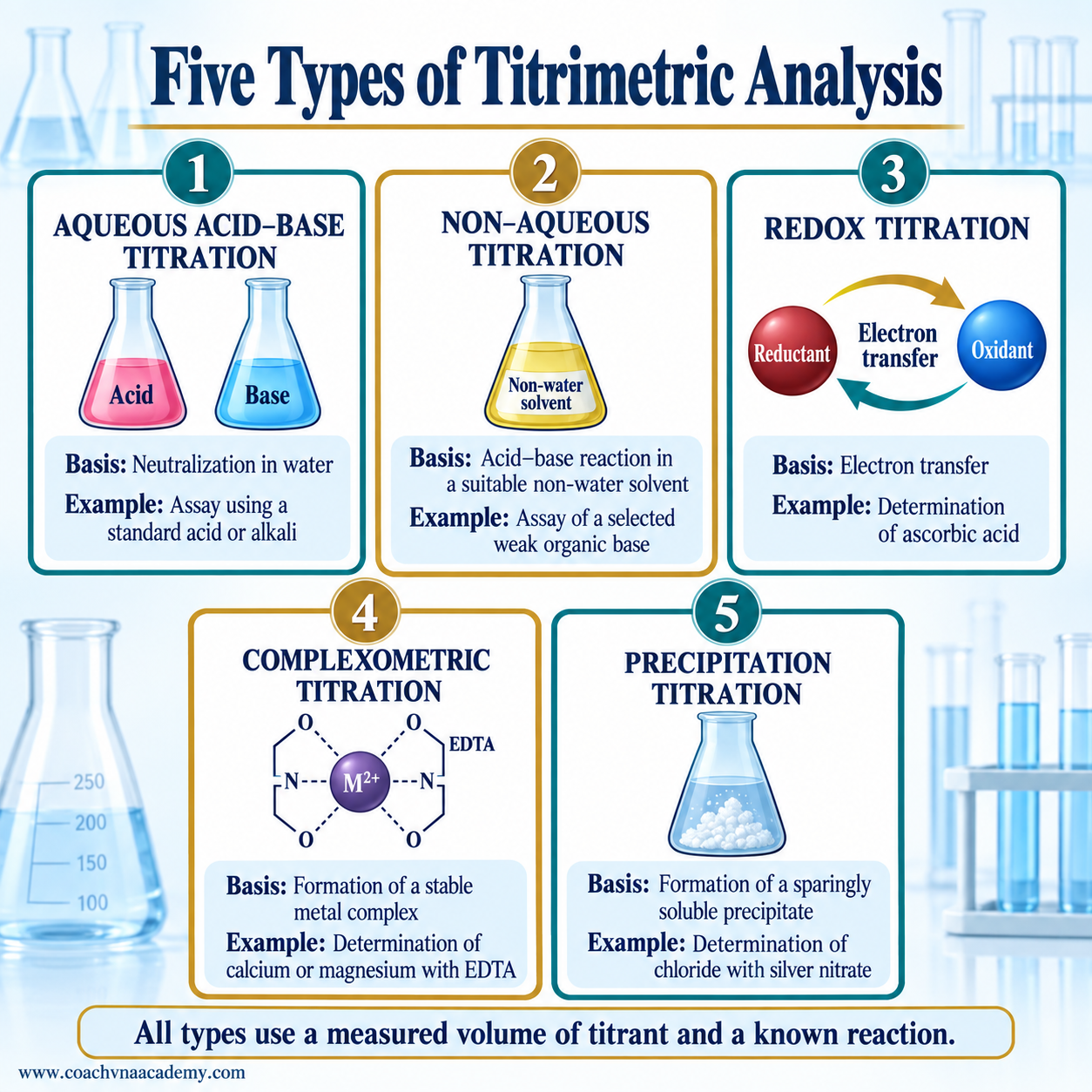
| Type of titration | Basis of reaction | Introductory pharmaceutical example |
| Aqueous acid–base titration | Neutralization between an acid and a base in an aqueous medium. | Assay of a suitable acidic or basic pharmaceutical substance using a standardized acid or alkali. |
| Non-aqueous titration | Acid–base reaction in a solvent other than water when the analyte is weakly acidic, weakly basic or insufficiently soluble in water. | Assay of selected weak organic bases using standard perchloric acid in glacial acetic acid, with suitable pharmaceutical examples such as caffeine, ephedrine, lidocaine and atropine. |
| Redox titration | Electron transfer between an oxidizing agent and a reducing agent. | Determination of ascorbic acid using a suitable oxidizing titrant such as Ceric ammonium sulfate. |
| Complexometric titration | Formation of a stable, soluble complex between a metal ion and a complexing agent such as EDTA. | Determination of calcium or magnesium ions. |
| Precipitation titration | Formation of a sparingly soluble precipitate during reaction with the titrant. | Determination of chloride using silver nitrate under suitable conditions. |
Endpoint and equivalence point: The equivalence point is the theoretical stage at which chemically equivalent amounts have reacted. The endpoint is the experimentally observed change used to indicate that the titration should stop. A suitable indicator or instrument helps keep the endpoint close to the equivalence point.
Gravimetric Analysis
Gravimetric analysis determines an analyte from an accurate mass measurement. In a common form, the analyte is converted into a pure, stable compound of known composition, separated, dried or ignited as required, and weighed. The method can provide accurate results but generally needs careful handling and more time than many routine titrations.
| Technique | Basic principle | Common pharmaceutical use |
| Gravimetric analysis | The analyte or a related compound is separated and accurately weighed. | Determination based on the mass of a pure, stable product. |
Spectroscopic Techniques
Spectroscopic techniques study the interaction of electromagnetic radiation with matter. The resulting absorption, emission or other response can reveal identity, structure or amount.
| Technique | Signal or region | Main use |
| UV–visible spectrophotometry | Absorption of ultraviolet or visible radiation | Quantitative assay and some identification applications. |
| Infrared spectroscopy | Absorption associated mainly with molecular vibrations | Functional-group information and identity confirmation. |
| Fluorimetry | Light emitted after excitation | Sensitive measurement of naturally fluorescent or derivatized substances. |
| Atomic spectroscopy | Absorption or emission by atoms | Determination of metals and elemental impurities. |
| Nuclear magnetic resonance | Response of selected nuclei in a magnetic field | Structure elucidation, identity and quantitative applications. |

How the Main Spectroscopic Techniques Differ
| Technique | What is examined | Nature of information | Simple pharmacy relevance |
| UV–visible spectroscopy | Absorption of ultraviolet or visible radiation by a suitable substance. | Often quantitative; absorbance can be related to concentration within an appropriate range. | Assay of a drug solution after suitable preparation and calibration. |
| Infrared spectroscopy | Absorption associated mainly with molecular vibrations. | Mainly qualitative identification and functional-group information. | Comparison of a sample spectrum with a reference spectrum. |
| Fluorimetry | Emission of light after excitation. | Sensitive quantitative measurement for suitable fluorescent substances. | Measurement when fluorescence provides adequate selectivity and sensitivity. |
| Atomic spectroscopy | Absorption or emission involving free atoms. | Element-specific qualitative or quantitative information. | Determination of metals or elemental impurities. |
| NMR spectroscopy | Behaviour of selected nuclei in a magnetic field. | Detailed structural and chemical-environment information; quantitative use is also possible. | Characterization and confirmation of molecular structure. |
| Mass spectrometry | Mass-to-charge ratios of gas-phase ions formed from a sample. | Molecular-mass and structural information; sensitive detection with suitable methods. | Confirmation of a drug or investigation of an unknown impurity, often after chromatographic separation. |
UV–visible spectroscopy is commonly introduced through the Beer–Lambert relationship, which connects absorbance with concentration under suitable conditions. IR spectra can act like molecular fingerprints because different structures produce characteristic absorption patterns. NMR and mass spectrometry provide richer structural information, but at this stage students only need to recognize their broad purpose.
Chromatographic Techniques
Chromatography separates sample components because they interact differently with a stationary phase and a mobile phase. After separation, components can be detected, identified and measured.
Essential Chromatographic Terms
| Term | Meaning |
| Stationary phase | The phase that remains fixed in place and interacts with sample components. |
| Mobile phase | The liquid or gas that moves through or over the stationary phase. |
| Separation | Different components travel at different rates because their interactions with the two phases differ. |
| Retention | The extent or time for which a component is held within the chromatographic system. |
| Chromatogram | The recorded result of a chromatographic separation; instrumental methods commonly show peaks. |
| Detector | The part of an instrumental chromatographic system that responds to components leaving the separation region. |
Different Chromatographic Techniques
| Technique | Simple description | Typical role |
| Thin-layer chromatography | Components travel different distances on a coated plate. | Identification, reaction monitoring and screening. |
| High-performance liquid chromatography | A liquid mobile phase carries the sample through a packed column under pressure. | Assay, impurity profiling and stability-indicating analysis. |
| Gas chromatography | A gas carries volatile components through a column. | Residual solvents and other volatile substances. |
| Ion chromatography | Ionic components are separated according to their interactions in an ion-exchange system. | Analysis of selected anions and cations. |
| Electrophoresis | Charged species migrate under an electric field. | Separation of suitable ionic or biological molecules. |
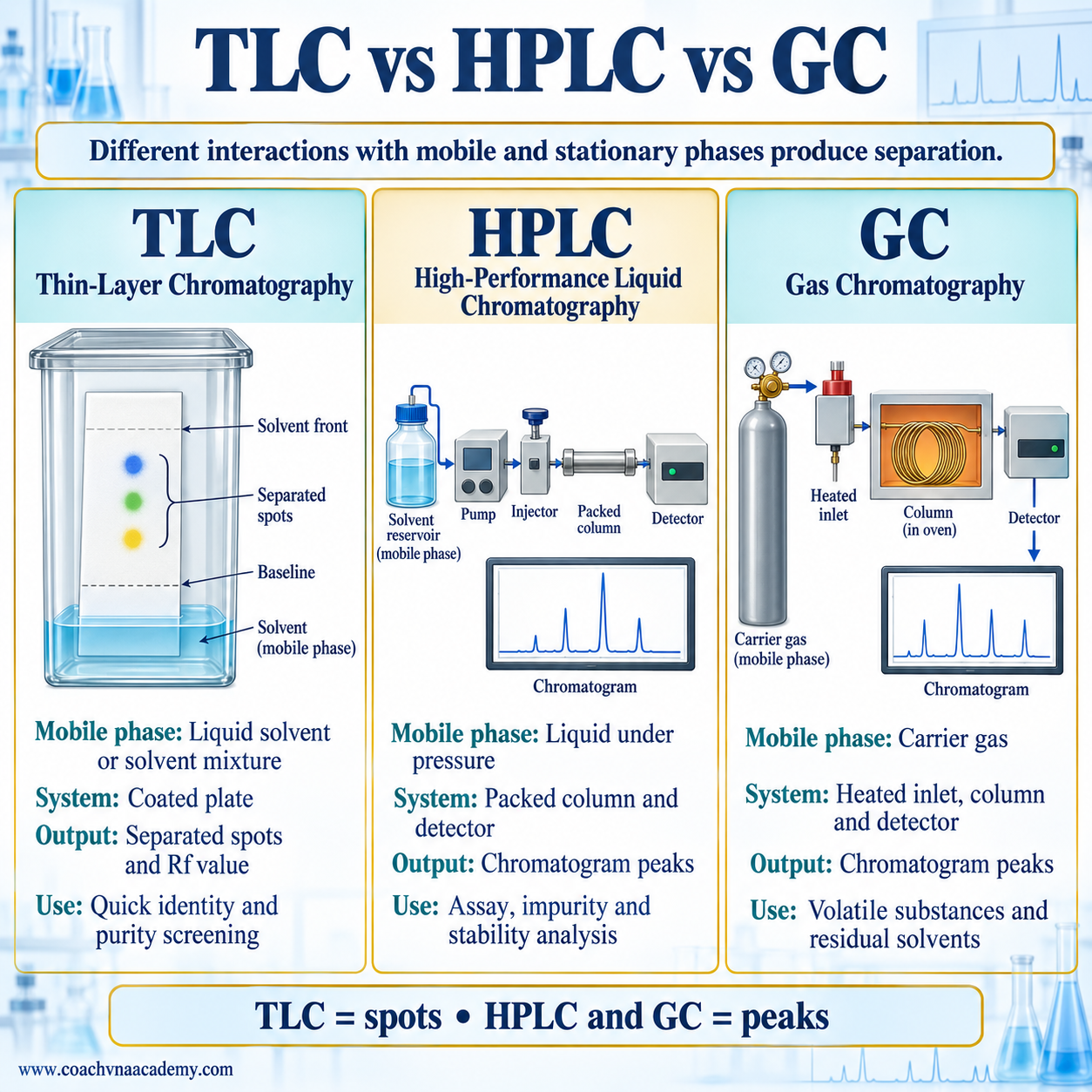
Essential Chromatographic Terms
TLC, HPLC and GC at a Glance
| Feature | TLC | HPLC | GC |
| Mobile phase | Liquid solvent or solvent mixture. | Liquid delivered through a packed column under pressure. | Carrier gas. |
| Stationary phase | Thin adsorbent layer on a plate. | Small particles packed inside a column. | Stationary phase located within a column. |
| Suitable samples | Useful for rapid screening of many non-volatile substances. | Useful for many non-volatile or thermally sensitive substances that can be handled in a liquid system. | Useful for volatile and sufficiently thermally stable substances. |
| Typical output | Separated spots and an Rf value under defined conditions. | A chromatogram containing retention times and peak responses. | A chromatogram containing retention times and peak responses. |
| Introductory use | Identity or purity screening. | Separation, assay and impurity or stability-related analysis. | Residual-solvent and other volatile-component analysis. |
For example, an HPLC method may separate several active ingredients and related impurities before the detector measures them. GC is particularly useful when the analytical problem involves volatile residual solvents. TLC provides a quick visual comparison and is valuable for preliminary identification or screening.
Electroanalytical Techniques
| Technique | Measured property | Typical application |
| Potentiometry | Electrical potential at negligible current | pH measurement and potentiometric titration. |
| Conductometry | Electrical conductance of a solution | Conductometric titration and ionic solution assessment. |
| Voltammetry or polarography | Current response as applied potential changes | Determination of electroactive substances and trace analysis. |
Potentiometry and Conductometry
Potentiometry measures the potential difference between suitable electrodes under conditions where negligible current flows. The pH meter is the most familiar example. Potentiometric measurement can also locate the endpoint of a titration when a suitable indicator electrode is used.
Conductometry measures the ability of a solution to conduct electric current. Conductance depends on the ions present, their concentration, mobility and the measurement conditions. It can support conductometric titrations and the assessment of ionic contamination in suitable water samples. A conductivity result indicates total ionic behaviour; it does not identify every individual ion by itself.
Thermal Analysis
| Technique | Basic principle | Introductory information obtained |
| Differential scanning calorimetry | Measures heat-flow differences as sample and reference undergo a controlled temperature program. | Thermal transitions and compatibility-related information. |
| Thermogravimetric analysis | Measures change in sample mass during a controlled temperature program. | Loss of water or volatile matter and decomposition behaviour. |
Biological and Microbiological Analysis
| Group | Examples | Information obtained |
| Biological and microbiological methods | Bioassays, microbial assays, sterility and microbial-limit tests | Biological response, potency or microbiological quality where relevant. |
Classical and Instrumental Methods Compared
| Feature | Classical methods | Instrumental methods |
| Measurement basis | Mass, volume or visible chemical change. | Electrical, optical, thermal or other instrument-generated signal. |
| Typical examples | Titrimetry and gravimetry. | Spectroscopy, chromatography and electroanalysis. |
| Sensitivity | Often suitable for major components. | Frequently suitable for low concentrations and complex mixtures. |
| Selectivity | May require separation or careful control of interference. | Can provide high selectivity, especially with separation and specific detection. |
| Cost and resources | Often lower equipment cost but may require more manual work. | Higher equipment and maintenance needs; can support automation. |
| Data handling | Usually simpler calculations. | May require calibration, software and more complex interpretation. |
| Best choice | When a reliable simple method meets the purpose. | When sensitivity, selectivity, speed or multi-component measurement is needed. |
Neither group is automatically superior. The best technique is the one that produces a reliable result for the intended analytical purpose while remaining practical, safe and scientifically justified.
General Steps in Pharmaceutical Analysis
| Step | What happens | Why it matters |
| 1. Define the analytical question | State whether identity, amount, impurity, performance or another attribute is required. | A clear purpose guides every later decision. |
| 2. Select a representative sample | Obtain a portion that reflects the material or batch being tested. | A perfect measurement cannot correct poor sampling. |
| 3. Prepare the sample | Dissolve, dilute, extract, filter, digest or otherwise treat the material as needed. | Places the analyte in a measurable form and controls matrix effects. |
| 4. Select or follow a suitable method | Use an official, validated or scientifically justified procedure. | The method must fit the analyte, matrix, range and required performance. |
| 5. Calibrate or standardize | Relate the measured response to known standards or establish reagent strength. | Provides the basis for a quantitative result. |
| 6. Perform the measurement | Control specified conditions and record observations carefully. | Good technique reduces avoidable error. |
| 7. Calculate and evaluate | Apply the correct formula, units, significant figures and acceptance criteria. | Transforms observations into a defensible conclusion. |
| 8. Document and report | Record the procedure, data, calculations, result and relevant observations. | Makes the work traceable, reviewable and reproducible. |
Selecting an Appropriate Technique
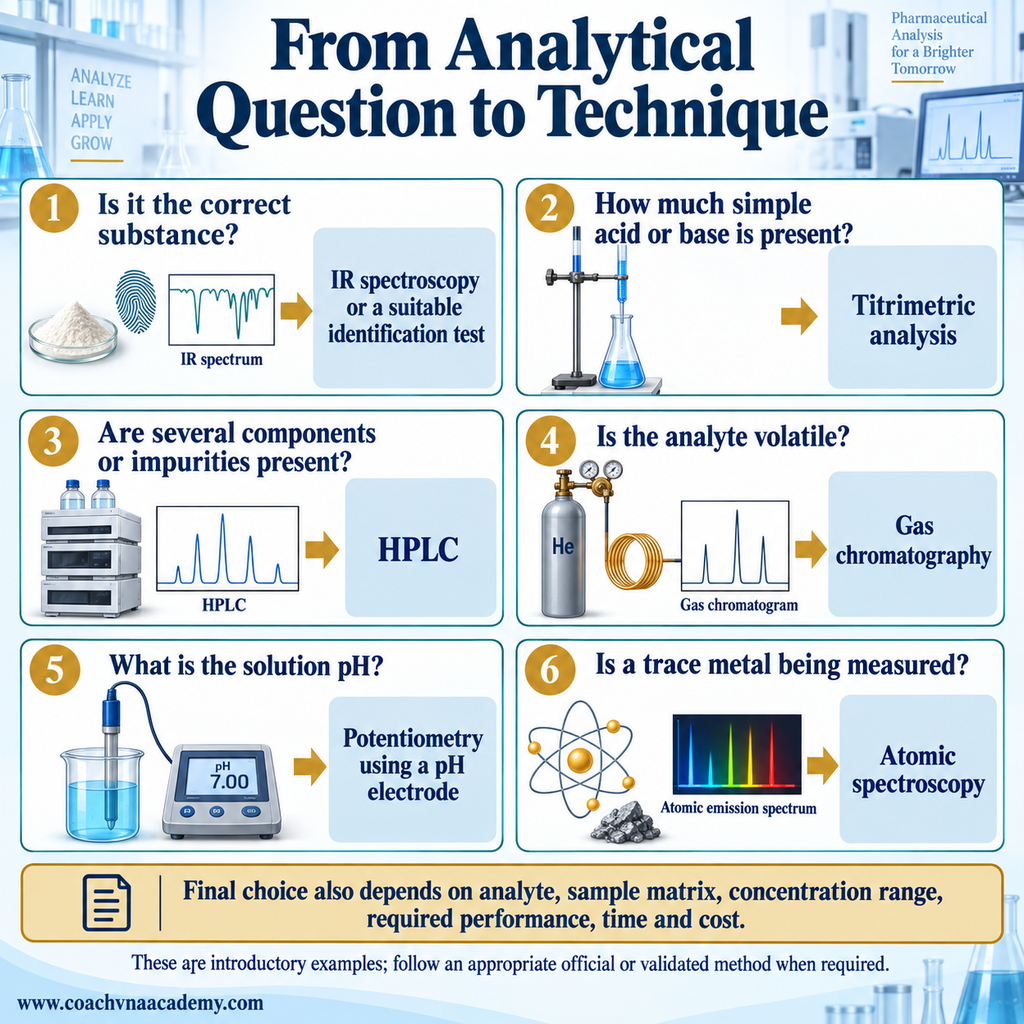
Technique selection begins with the analytical problem, not with the instrument available. A suitable method must provide performance that is adequate for its intended use.
- Nature and expected concentration of the analyte.
- Complexity of the sample matrix and possible interferences.
- Required selectivity, sensitivity, accuracy and precision.
- Amount of sample available and whether it can be consumed.
- Speed, cost, safety, equipment, trained personnel and sample throughput.
- Need for an official or pharmacopoeial procedure.
- Purpose of the result, such as identification, release testing, impurity control or stability study.
Simple Selection Examples
| Analytical problem | Likely broad choice | Reason |
| Routine assay of a suitable acid or base in a simple raw material | Acid–base titrimetry | Direct stoichiometry, simplicity and adequate performance. |
| Identification of a functional group | Infrared spectroscopy | Characteristic absorption pattern supports identity. |
| Several related substances in one sample | HPLC | Separation occurs before measurement. |
| Residual volatile solvent | Gas chromatography | Well suited to volatile components. |
| pH of a solution | Potentiometry with a pH electrode | Direct measurement of an electrochemical response related to hydrogen-ion activity. |
| Trace metal determination | Atomic spectroscopic technique | Sensitive element-specific measurement. |
Reliability of an Analytical Result
A numerical value is useful only when the complete analytical process is controlled. Sampling, sample preparation, reagents, glassware, instrument condition, calibration, calculations and reporting can all influence the final result.
| Concept | Student-friendly meaning |
| Accuracy | Closeness of a result to the accepted or reference value. |
| Precision | Closeness of repeated results to one another. |
| Selectivity | Ability to measure the analyte in the presence of other components. |
| Sensitivity | Ability of a method to produce a useful change in response when analyte amount changes. |
| Detection limit | The lowest amount that can be reliably detected under stated conditions. |
| Robustness | Ability to remain reliable during small deliberate variations in method conditions. |
| Calibration | Establishing the relationship between known values and instrument response. |
| Standardization | Accurately determining the concentration of a solution used as a reagent or titrant. |
| Blank | A preparation containing the relevant reagents but normally no analyte, used to identify background contribution. |
Integrated Pharmacy Example
Consider a batch of sodium bicarbonate raw material. A complete analytical approach may include an identification test to confirm what the substance is, an assay to determine its content, tests for specified impurities, and comparison of every result with the applicable specification. Qualitative information answers the identity question, quantitative information supplies the numerical content, and the specification converts the results into a compliance decision. Thus, pharmaceutical analysis is not a single test; it is a connected system of questions, methods, measurements and documented conclusions.
Quick Recap
- Pharmaceutical analysis establishes identity, purity, strength, quality and other relevant attributes of pharmaceutical materials and products.
- Qualitative analysis answers “what is present?”; quantitative analysis answers “how much is present?”
- Classical techniques mainly include titrimetry and gravimetry.
- Instrumental techniques include spectroscopy, chromatography, electroanalysis and thermal analysis.
- Biological or microbiological methods are necessary when biological response or microbiological quality is the required information.
- Representative sampling and correct sample preparation are as important as the final measurement.
- A reliable result must be properly calculated, evaluated against the relevant standard and documented.