
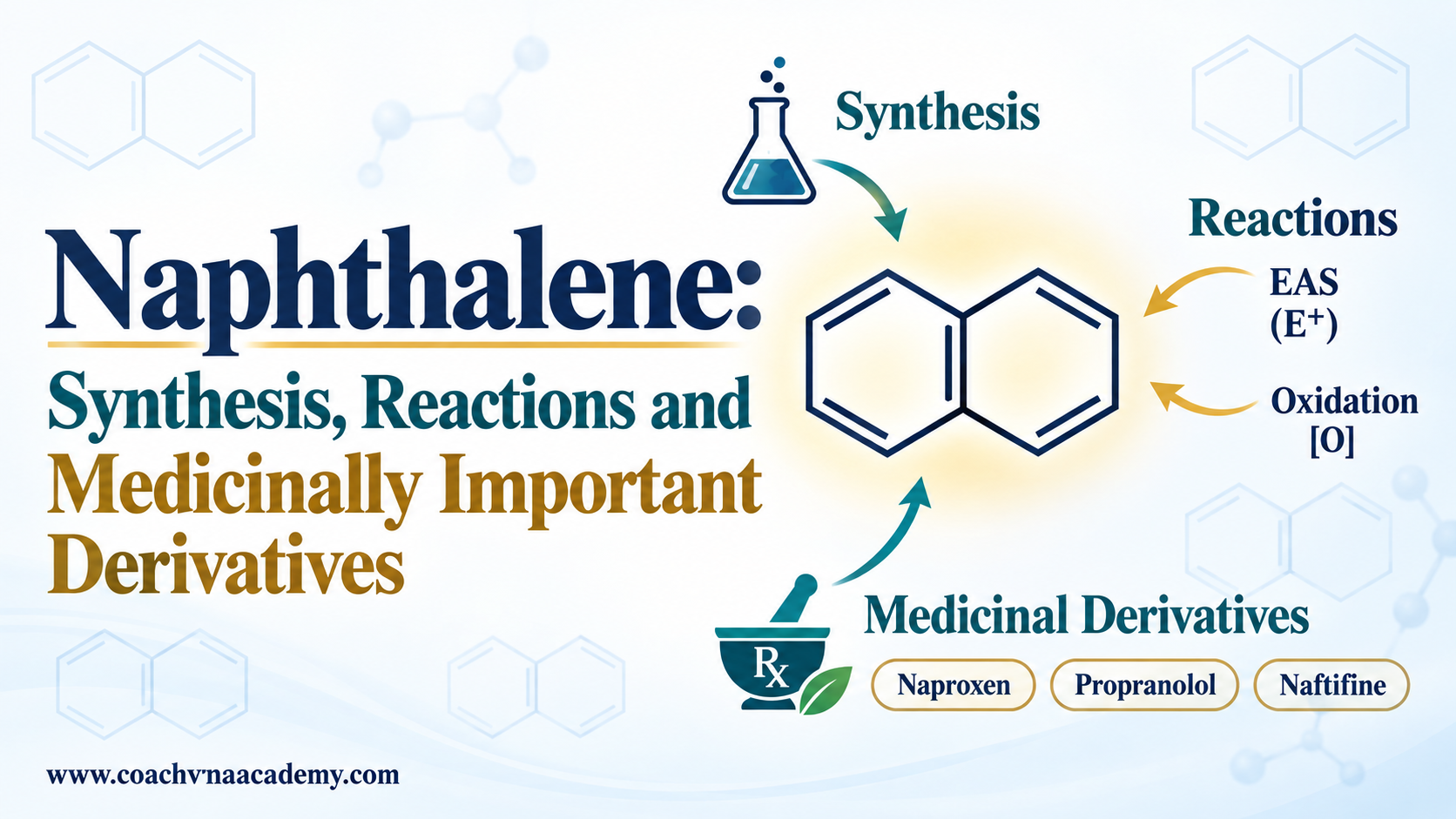
Naphthalene consists of two fused aromatic rings whose electronic structure controls its characteristic reactions. This article explains the Haworth synthesis, α- and β-position reactivity, electrophilic substitution, oxidation, reduction, and medicinally important derivatives such as naproxen, propranolol, naftifine and terbinafine.
Naphthalene: Essential Structural Recall
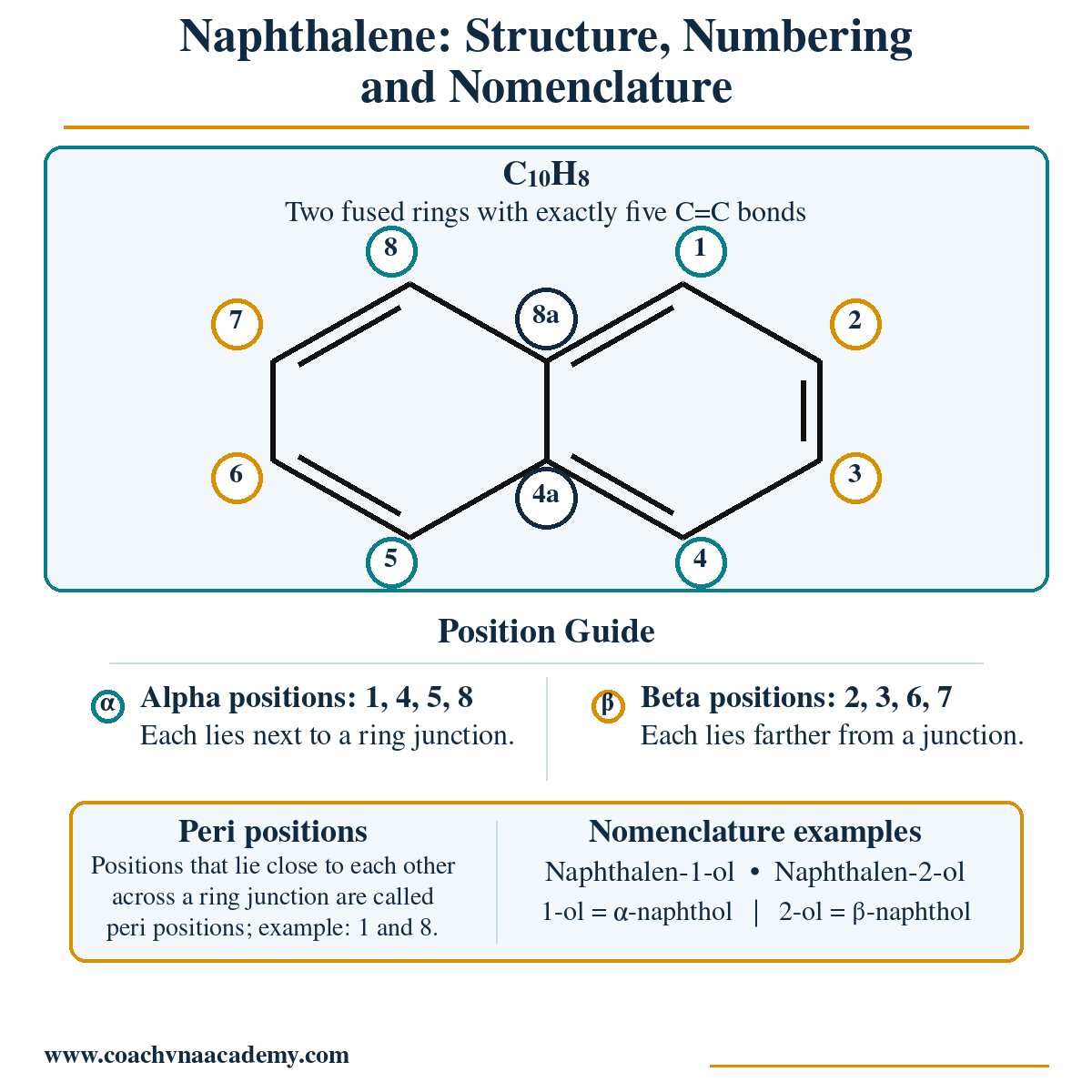
Naphthalene, C₁₀H₈, is a fused aromatic hydrocarbon containing ten delocalized π electrons. Its α positions are 1, 4, 5 and 8; its β positions are 2, 3, 6 and 7; and its ring-junction carbons are 4a and 8a.
The α carbon C-1 lies next to a ring-junction carbon, whereas the β carbon C-2 lies one position farther away. Naphthalene generally undergoes electrophilic substitution more readily than benzene and usually forms the 1-substituted product. However, temperature, reversibility, solvent and reaction conditions may change this orientation.
Sources and Preparation of Naphthalene
Industrial Isolation from Coal Tar
Coal tar, produced during the destructive distillation or carbonization of coal, contains naphthalene. First, the middle-oil fraction is cooled so that crude naphthalene crystallizes. Next, phenolic and basic impurities are removed. Finally, distillation or sublimation produces purified naphthalene. Thus, this procedure represents industrial isolation rather than laboratory synthesis.
Source Distinction
Industrial route: Naphthalene already present in coal tar is separated and purified. Therefore, this method represents isolation rather than chemical synthesis.
Synthetic route: In contrast, the Haworth method constructs the naphthalene ring system from benzene and succinic anhydride.
Haworth Synthesis
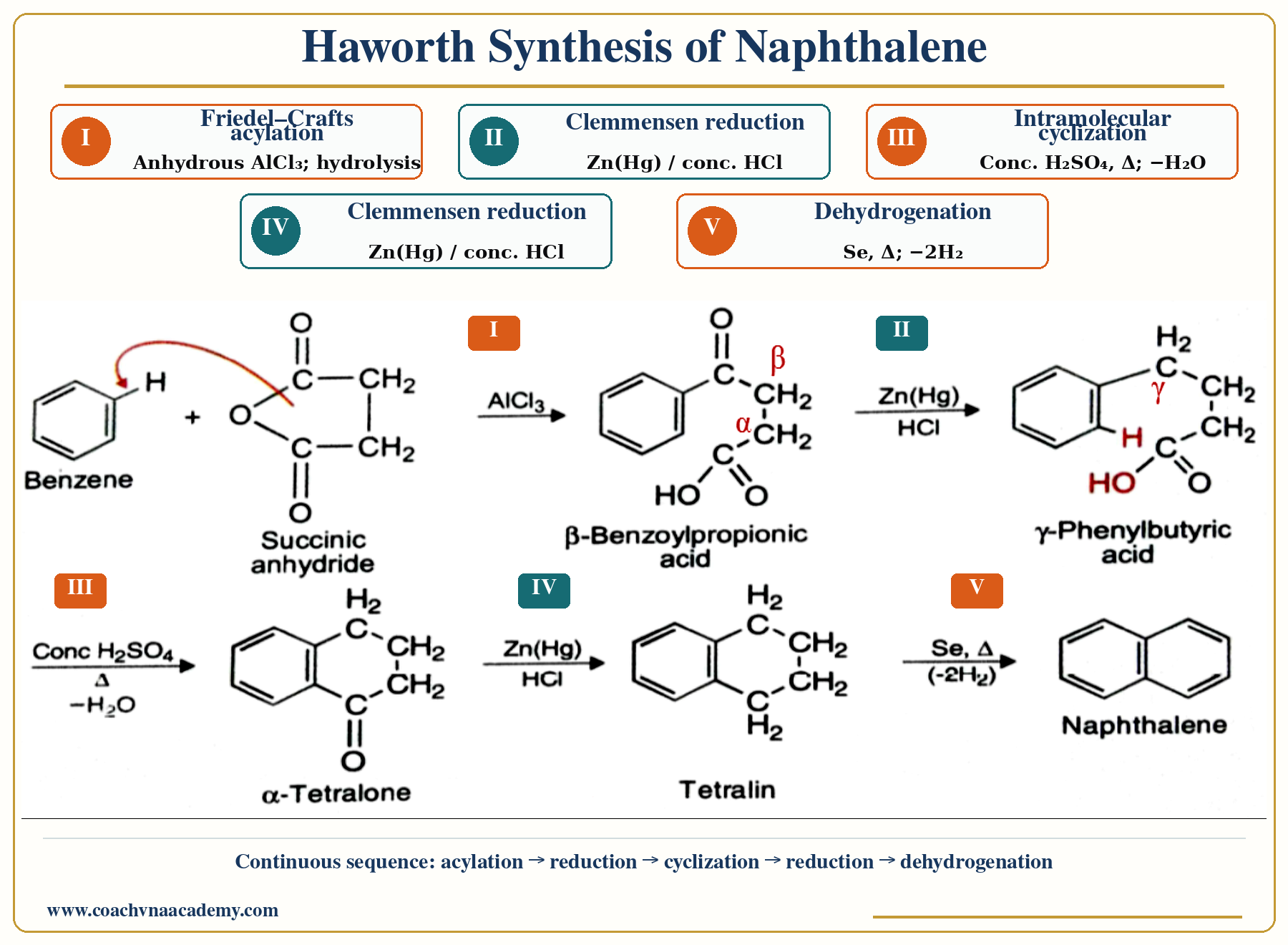
This synthesis builds a second six-membered ring onto benzene through five consecutive reactions. First, Friedel–Crafts acylation introduces the required four-carbon side chain. Reduction then prepares it for intramolecular cyclization. Subsequently, another reduction produces tetralin, while final dehydrogenation forms naphthalene.
The sequence can be remembered as:
Acylation → Reduction → Cyclization → Reduction → Dehydrogenation
| Step 1 — Friedel–Crafts acylation: Benzene + succinic anhydride → C₆H₅COCH₂CH₂COOH [β-benzoylpropionic acid (4-oxo-4-phenylbutanoic acid)] Conditions: anhydrous AlCl₃ (aluminum trichloride ); then hydrolysis. Exam point: The acylium-type electrophile introduces the four-carbon side chain needed for ring formation. |
| Step 2 — Clemmensen Reduction of the keto group: β-benzoylpropionic acid → C₆H₅CH₂CH₂CH₂COOH (γ-phenylbutyric acid) Conditions: Zn(Hg)/concentrated HCl, heat. [Zn(Hg): zinc (Zn) mixed with mercury (Hg), zinc amalgam] Exam point: The aryl ketone carbonyl becomes CH₂; the carboxyl group remains available for cyclization. |
| Step 3 — Intramolecular ring closure: γ-Phenylbutyric acid → 1-tetralone Conditions: concentrated H₂SO₄ or polyphosphoric acid; heat. Exam point: Cyclization forms the second six-membered ring by intramolecular acylation. |
| Step 4 — Clemmensen Reduction: 1-tetralone → tetralin (1,2,3,4-tetrahydronaphthalene) Conditions: Zn(Hg)/concentrated HCl, heat; alternative validated reduction may be used. Exam point: The remaining keto group is converted into CH₂. |
| Step 5 — Dehydrogenation (remove hydrogen): tetralin → naphthalene + 2 H₂ Conditions: Se or Pd/C; strong heating. [Se: Selenium, Pd/C: palladium on charcoal)] Exam point: Removal of four hydrogen atoms restores the fully aromatic naphthalene system. |
SEQUENCE MEMORY BENZENE → keto acid → phenylbutyric acid → tetralone → tetralin → NAPHTHALENE.
Why Electrophilic Substitution Usually Occurs at the α Position
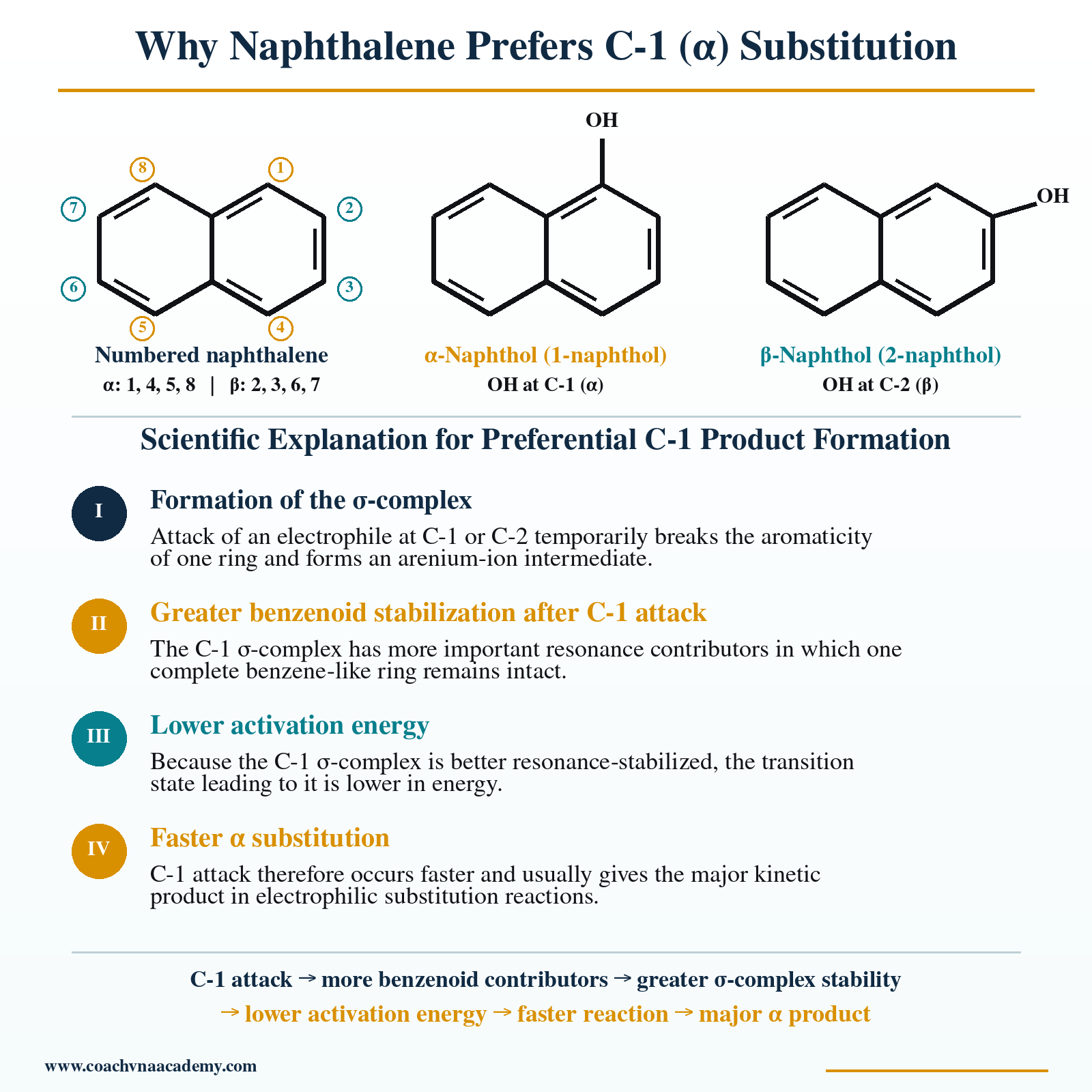
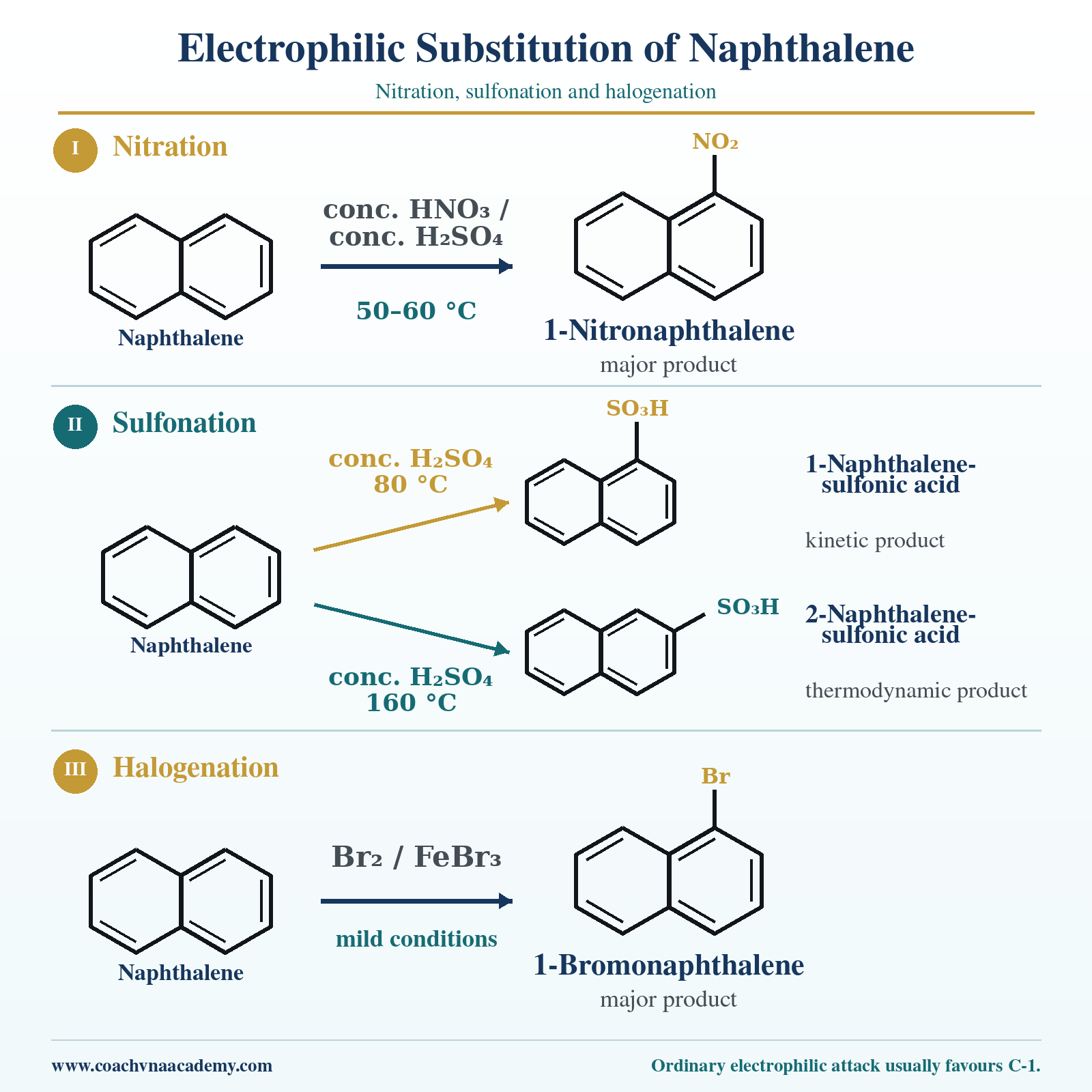
Attack at C-1 and attack at C-2 can both produce sigma complexes. However, the α-attack intermediate has more important resonance contributors in which one complete benzene-like ring remains intact. Consequently, formation of the α sigma complex is usually faster and its activation barrier is lower. Therefore, nitration, halogenation and many Friedel–Crafts reactions mainly give 1-substituted products.
This explanation compares the stability of intermediates, not the number of final resonance structures drawn mechanically. Both routes temporarily disturb aromaticity in one part of the molecule. The preferred route preserves greater aromatic stabilization in the transition state and sigma complex.
EXAM POINT Write: “α substitution is usually kinetically favored because its sigma complex has more important resonance contributors that retain one intact benzene ring.” Do not write only “α is more reactive.”
Electrophilic Substitution Reactions
Nitration
| Naphthalene + HNO₃ → 1-nitronaphthalene + H₂O Conditions: concentrated HNO₃/concentrated H₂SO₄; about 50–60 °C (323–333 K) Exam point: The major product is the α isomer. The electrophile is NO₂⁺. |
The nitrating mixture generates nitronium ion. Electrophilic attack at C-1 gives a sigma complex, deprotonation restores aromaticity, and 1-nitronaphthalene forms predominantly. Vigorous conditions should be avoided because oxidation or further nitration may occur.
Sulfonation: Temperature Controls the Product
| Lower-temperature sulfonation: Naphthalene + H₂SO₄ → naphthalene-1-sulfonic acid (α product) Conditions: concentrated H₂SO₄; about 80 °C (353 K) Exam point: The 1-isomer forms faster and is the kinetic product. |
| Higher-temperature sulfonation: Naphthalene + H₂SO₄ → naphthalene-2-sulfonic acid (β product) Conditions: concentrated H₂SO₄; about 160 °C (433 K) Exam point: Reversible sulfonation allows equilibration; the more stable 2-isomer predominates as the thermodynamic product. |
At lower temperature, the faster α pathway determines the product. At higher temperature, desulfonation and resulfonation permit equilibration, so the thermodynamically more stable β isomer accumulates. Temperature must therefore be written with the product.
Kinetic product: The product that forms faster because its pathway has lower activation energy.
Thermodynamic product: The product that is more stable at equilibrium, although it may form more slowly.
HIGH-YIELD RULE 80 °C (353 K) → 1-sulfonic acid; 160 °C (433 K) → 2-sulfonic acid. Lower temperature = kinetic α product; higher temperature = thermodynamic β product.
Halogenation
| Bromination: Naphthalene + Br₂ → 1-bromonaphthalene + HBr Conditions: Br₂/FeBr₃; room temperature or mild conditions Exam point: Electrophilic bromination mainly occurs at C-1. |
| Chlorination: Naphthalene + Cl₂ → 1-chloronaphthalene + HCl Conditions: Cl₂/FeCl₃; controlled conditions Exam point: Use a Lewis-acid catalyst and identify the α product. |
Naphthalene undergoes ring halogenation more readily than benzene. In examination answers, distinguish electrophilic substitution from addition under vigorous photochemical or other special conditions.
Friedel–Crafts Alkylation and Acylation
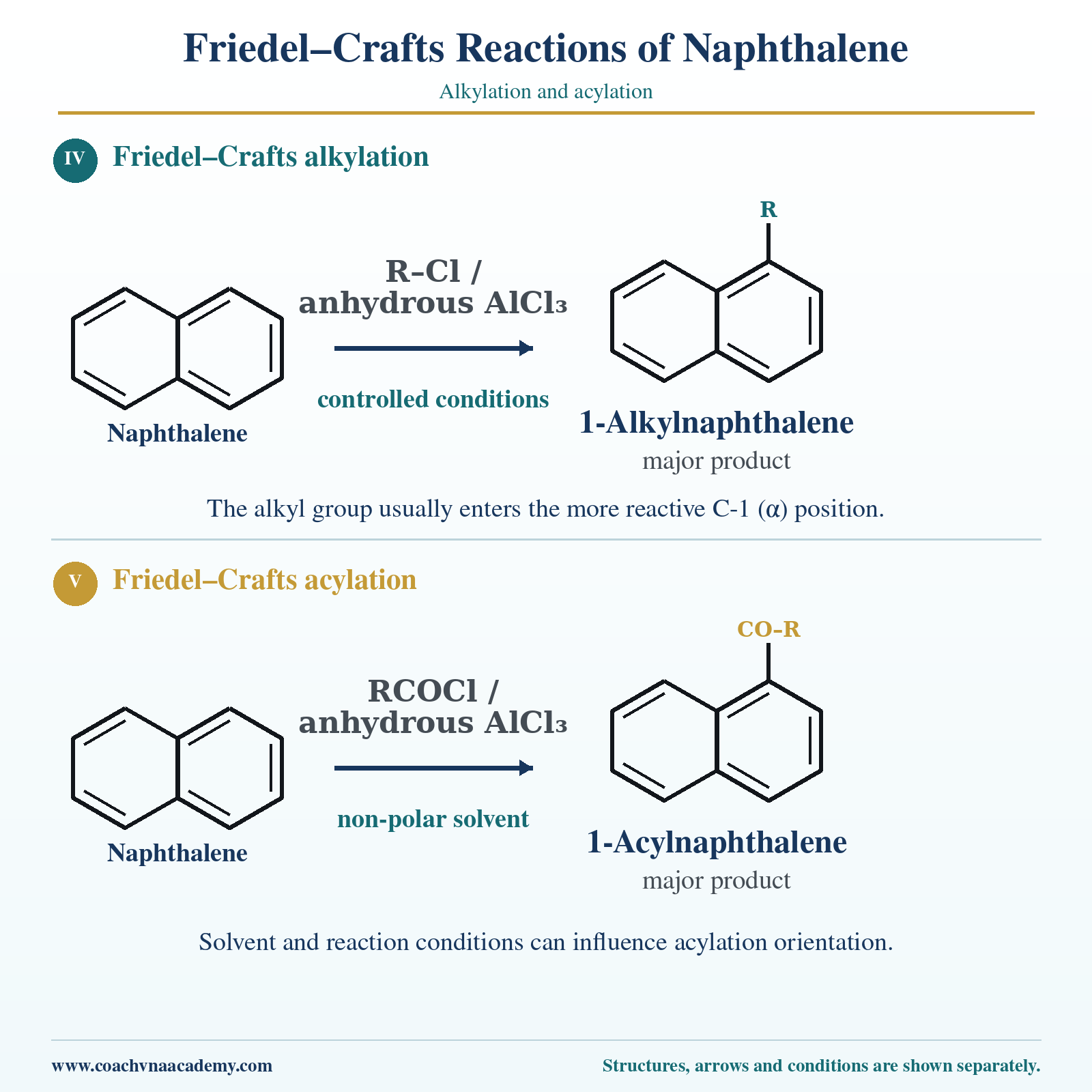
| Alkylation: Naphthalene + R–Cl → mainly 1-alkylnaphthalene + HCl Conditions: anhydrous AlCl₃ Exam point: Carbocation rearrangement and polyalkylation remain possible, as in benzene chemistry. |
| Acylation: Naphthalene + RCOCl → mainly 1-acetylnaphthalene when R = CH₃ Conditions: anhydrous AlCl₃; nonpolar solvent such as CS₂ (carbon disulfide) Exam point: Product orientation can depend on solvent and conditions; state the conditions used. |
Oxidation Reactions
Catalytic Oxidation to Phthalic Anhydride
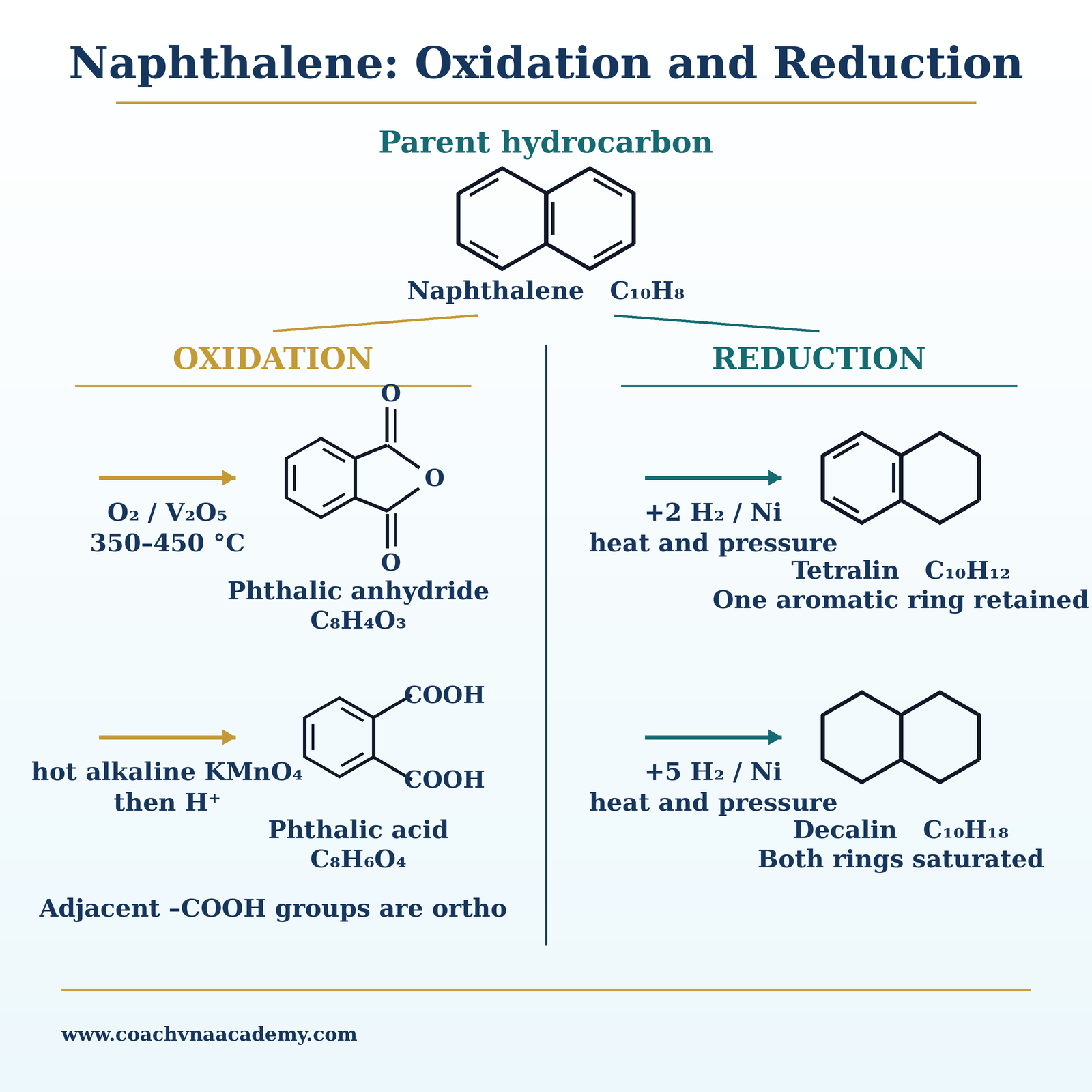
| Industrial oxidation: 2 Naphthalene + 9 O₂ → 2 phthalic anhydride + 4 CO₂ + 4 H₂O Conditions: V₂O₅ catalyst (vanadium pentoxide); about 350–450 °C (623–723 K) Exam point: The fused framework undergoes extensive oxidative cleavage. |
Air oxidation over vanadium(V) oxide converts naphthalene into phthalic anhydride, an important industrial intermediate. This is not a simple substitution reaction: one ring is oxidatively cleaved.
Strong Liquid-Phase Oxidation
| Oxidation with permanganate: Naphthalene → phthalic acid Conditions: hot alkaline KMnO₄ (potassium permanganate); then acidification Exam point: Strong oxidation opens one ring and produces the ortho-dicarboxylic acid. |
PRODUCT LINK Phthalic acid readily forms phthalic anhydride on heating. Draw the ortho relationship of the two –COOH groups correctly.
Reduction and Addition Reactions
Catalytic Hydrogenation
| Partial hydrogenation: Naphthalene + 2 H₂ → tetralin (C₁₀H₁₂) Conditions: Ni, Pt or Pd; controlled pressure and temperature [Nickel (Ni), Platinum (Pt), and Palladium (Pd) used as metal catalysts] Exam point: One ring becomes saturated while the other aromatic ring remains. |
| Complete hydrogenation: Naphthalene + 5 H₂ → decalin (C₁₀H₁₈) Conditions: Ni or Pt; higher pressure and temperature Exam point: Both rings become saturated; cis- and trans-decalin forms are possible. |
Tetralin means tetrahydronaphthalene, whereas decalin means decahydronaphthalene. The hydrogen count is a useful check: C₁₀H₈ + 4 H gives C₁₀H₁₂; adding ten H overall gives C₁₀H₁₈.
| Starting compound | Hydrogen added | Product | Formula |
| Naphthalene | 2 H₂ | Tetralin | C₁₀H₁₂ |
| Naphthalene | 5 H₂ | Decalin | C₁₀H₁₈ |
Medicinally Important Naphthalene Derivatives
The naphthalene ring is a hydrophobic aromatic scaffold in several medicines. However, a nucleus alone does not determine pharmacological action. The complete substituent pattern, stereochemistry and functional groups produce the drug’s activity. Therefore, the therapeutic uses below belong to the named derivatives, not to naphthalene itself.
| Derivative | Structure-identifying feature | Medicinal role |
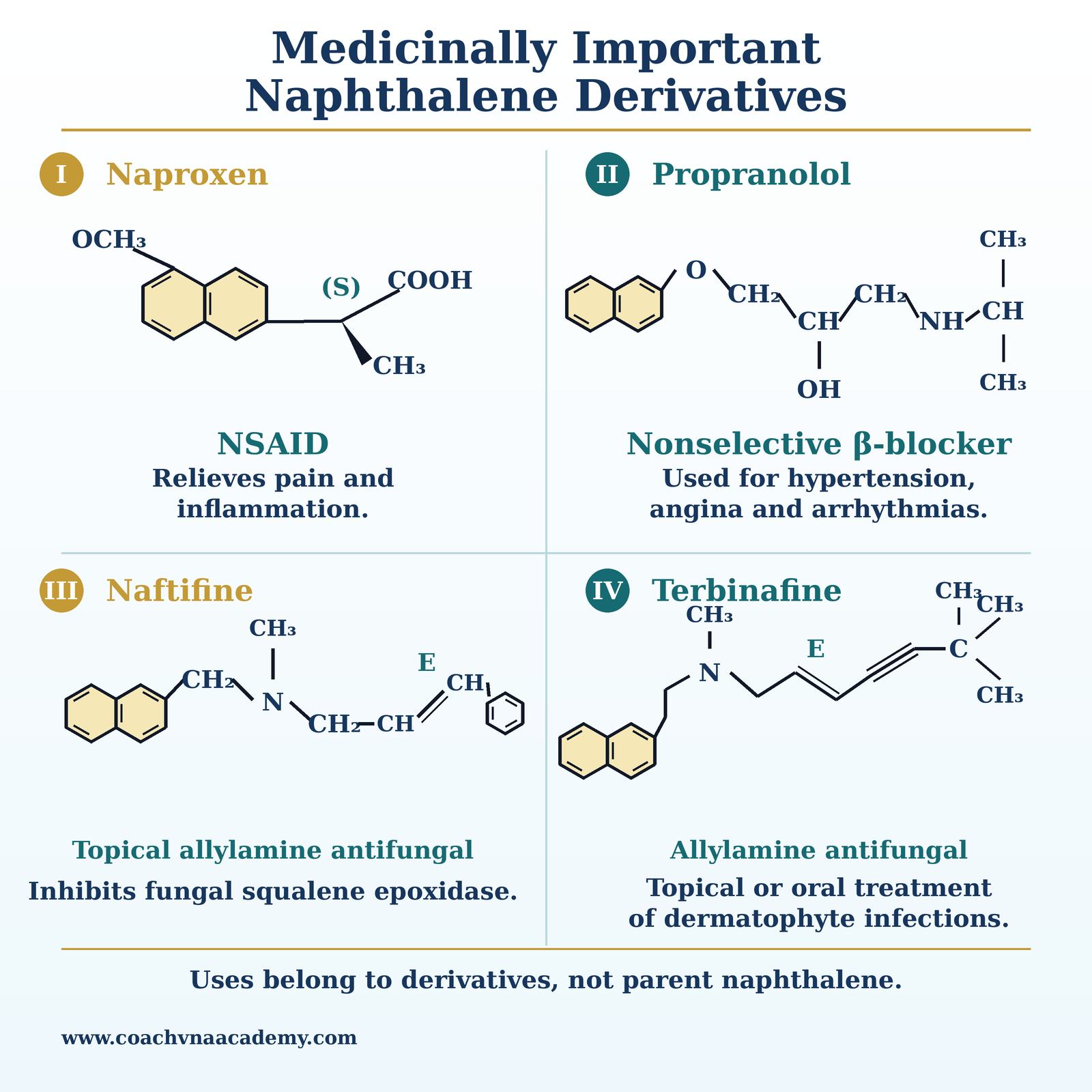
| Naproxen | (S)-2-(6-methoxynaphthalen-2-yl)propanoic acid; C₁₄H₁₄O₃ | NSAID used for pain and inflammatory conditions |
| Propranolol | 1-naphthyloxy–CH₂–CH(OH)–CH₂–NH–CH(CH₃)₂; commonly as HCl salt | Nonselective β-adrenergic blocker used in cardiovascular disorders and migraine prevention |
| Naftifine | (E)-N-cinnamyl-N-methyl-1-naphthalenemethylamine; commonly as HCl salt | Topical allylamine antifungal for dermatophyte infections |
| Terbinafine | N-methyl-1-naphthalenemethanamine bearing an enyne side chain; commonly as HCl salt | Allylamine antifungal; oral formulations treat dermatophyte nail infection and topical forms treat selected skin infections |
Naproxen
Naproxen contains a 2-naphthyl nucleus with a methoxy group at C-6 and an (S)-propanoic-acid side chain. It is a nonsteroidal anti-inflammatory drug. In structure questions, show the stereogenic carbon and do not omit the 6-methoxy substituent. The dextrorotatory S-enantiomer is the medicinal form.
STRUCTURE WRITING Naproxen: naphthalene C-2–CH(CH₃)–COOH, C-6–OCH₃, with S configuration at the side-chain carbon.
Propranolol
Propranolol contains a 1-naphthyloxy group linked to the aryloxypropanolamine chain O–CH₂–CH(OH)–CH₂–NH–CH(CH₃)₂. It is a nonselective β-adrenergic receptor blocker. Its uses include hypertension, angina, selected arrhythmias and migraine prevention. The naphthalene ring is only one component of the pharmacophore.
STRUCTURE WRITING Propranolol: 1-C₁₀H₇–O–CH₂–CH(OH)–CH₂–NH–CH(CH₃)₂; marketed commonly as propranolol hydrochloride.
Naftifine and Terbinafine
Both naftifine and terbinafine are allylamine antifungal drugs containing a naphthalen-1-yl-methyl group. For dermatophyte skin infections, naftifine is mainly applied topically. By comparison, terbinafine contains a different unsaturated side chain and may be administered orally for nail infections or applied topically for selected superficial fungal infections. Although the two drugs share a naphthalene nucleus, their complete structures and therapeutic applications are different.
STRUCTURE WRITING
Naftifine: C₁₀H₇–CH₂–N(CH₃)–CH₂–CH=CH–C₆H₅ (E)
Terbinafine: C₁₀H₇–CH₂–N(CH₃)–CH₂–CH=CH–C≡C–C(CH₃)₃ (E)
SAFETY AND SCOPE
These examples illustrate structure–use relationships in pharmaceutical organic chemistry. However, they do not provide prescribing or self-medication guidance.
Integrated Reaction Map
| Reaction type | Reagent/condition | Principal product | Orientation or change |
| Nitration | conc. HNO₃/conc. H₂SO₄; 50–60 °C (323–333 K) | 1-nitronaphthalene | α substitution |
| Sulfonation | conc. H₂SO₄; 80 °C (353 K) | 1-sulfonic acid | kinetic α product |
| Sulfonation | conc. H₂SO₄; 160 °C (433 K) | 2-sulfonic acid | thermodynamic β product |
| Bromination | Br₂/FeBr₃ | 1-bromonaphthalene | α substitution |
| Friedel–Crafts | RCl or RCOCl/AlCl₃ | mainly 1-substituted product | condition-dependent |
| Oxidation | O₂/V₂O₅; 350–450 °C (623–723 K) | phthalic anhydride | oxidative ring cleavage |
| Partial reduction | 2 H₂/Ni | tetralin | one ring saturated |
| Complete reduction | 5 H₂/Ni | decalin | both rings saturated |
ONE-MINUTE RECAP
Most EAS → C-1. Sulfonation: 80 °C → C-1; 160 °C → C-2. Oxidation → phthalic anhydride/phthalic acid. 2 H₂ → tetralin; 5 H₂ → decalin. Drug uses belong to derivatives.