
Introduction
After the first substituent enters the benzene ring, it changes the rate of the next electrophilic aromatic substitution. Effect of Substituents on reactivity of monosubstituted benzene shall be discussed here. Specifically, the substituent may increase or decrease ring electron density. Consequently, it changes both the ability of the ring to attack an electrophile and the stability of the positively charged sigma complex.
Chemists call a group that increases the reaction rate an activating group. In contrast, they call a group that decreases the rate a deactivating group.
Meaning of Substituent and Reactivity
A substituent is an atom or group already attached to the benzene ring, such as -CH₃, -OH, -Cl, -NO₂, or -COOH. In this lecture, reactivity means the rate at which a monosubstituted benzene undergoes electrophilic aromatic substitution compared with unsubstituted benzene.
| Key Definition Activating group: makes the aromatic ring react faster than benzene. Deactivating group: makes the aromatic ring react more slowly than benzene. |
Reactivity and Orientation Are Different
| Property | Question answered | Example |
| Reactivity | How fast or slow does the ring react compared with benzene? | Toluene reacts faster than benzene. |
| Orientation | At which position does the next electrophile enter? | The methyl group directs mainly to ortho and para positions. |
This lecture focuses on reactivity. By contrast, next lecture explains detailed ortho, meta, and para orientation.
Basic Principle of Reactivity in Electrophilic Aromatic Substitution
Electrophilic aromatic substitution begins when the aromatic pi-electron system attacks an electrophile. Next, the ring forms a positively charged sigma complex or arenium ion. Therefore, the reaction rate depends mainly on two factors:
1. Electron density of the aromatic ring: an electron-rich ring attacks the electrophile more readily.
2. Stability of the sigma complex: a more stable positively charged intermediate forms more easily.
Therefore, an electron-donating substituent raises ring electron density, stabilizes the sigma complex, lowers the activation energy, and accelerates the reaction. In contrast, an electron-withdrawing substituent lowers ring electron density, destabilizes the sigma complex, raises the activation energy, and slows the reaction.
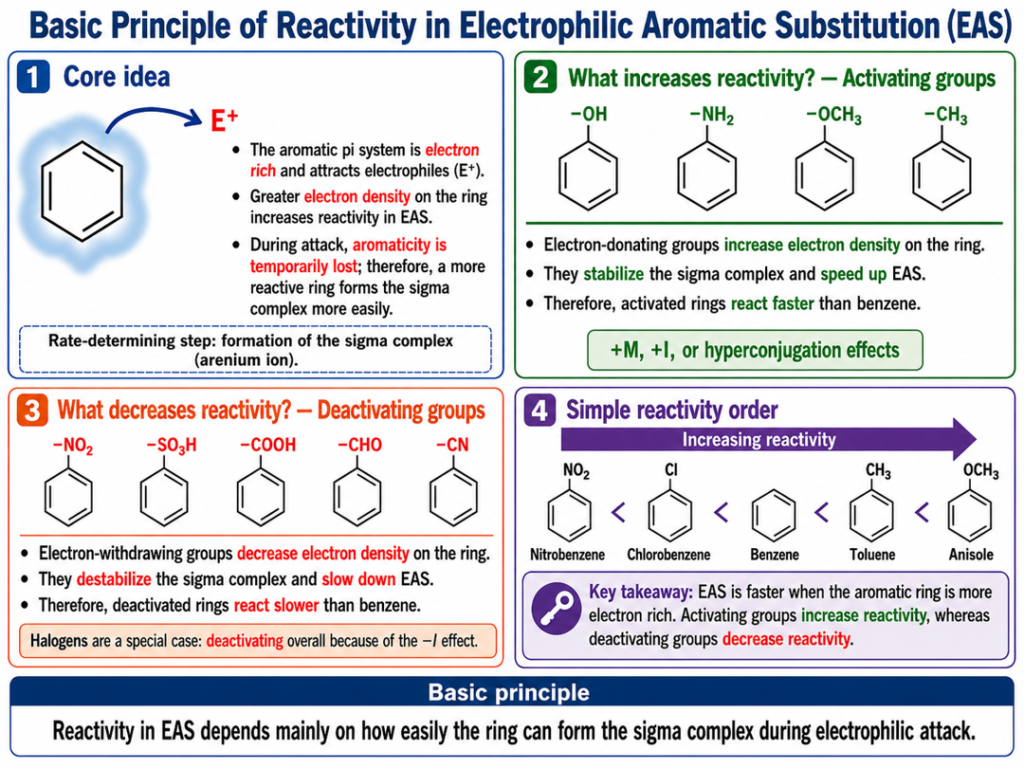
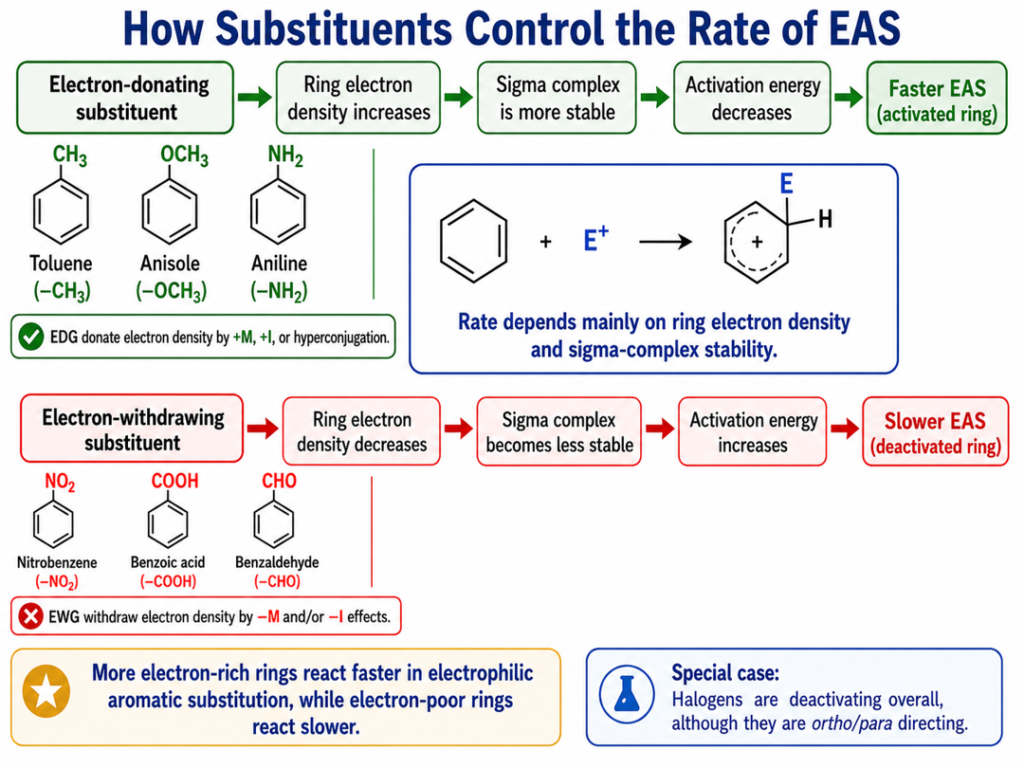
| Exam Memory Chain Electron donation -> higher ring electron density -> more stable sigma complex -> lower activation energy -> faster EAS. Electron withdrawal -> lower ring electron density -> less stable sigma complex -> higher activation energy -> slower EAS. |
Activating Groups
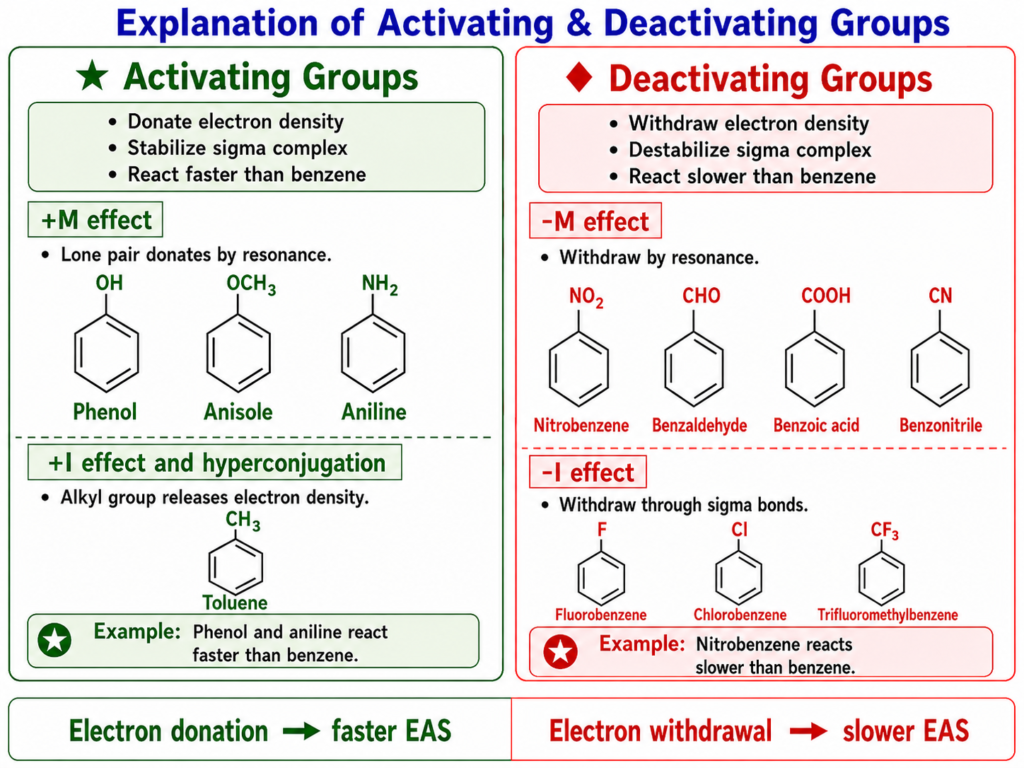
Activating groups increase the rate of electrophilic aromatic substitution relative to benzene. Most of these groups donate electron density through resonance, the inductive effect, or hyperconjugation.
Activation by the Positive Mesomeric (+M) Effect
Groups such as -OH, -OR, -NH₂, -NHR, and -NR₂ contain a lone pair on the atom directly attached to the ring. First, the lone pair overlaps with the aromatic pi system. Then, resonance donation increases ring electron density and stabilizes the sigma complex. Therefore, these groups strongly activate the ring.
For example, phenol and aniline react faster than benzene toward electrophilic substitution in their normal unprotonated forms.
Activation by the Positive Inductive (+I) Effect and Hyperconjugation
Alkyl groups such as -CH₃ release electron density through the +I effect. In addition, adjacent C-H bonds stabilize the ring and the sigma complex through hyperconjugation. Consequently, alkylbenzenes react faster than benzene, although they show weaker activation than strong lone-pair donors.
For example, toluene undergoes electrophilic substitution faster than benzene.
Deactivating Groups
Deactivating groups decrease the rate of electrophilic aromatic substitution relative to benzene. These groups withdraw electron density and make sigma-complex formation less favorable.
Deactivation by the Negative Mesomeric (-M) Effect
Groups such as -NO₂, -CHO, -COR, -COOH, -COOR, and -CN withdraw electron density through resonance. As a result, the -M effect lowers ring electron density and destabilizes the positively charged sigma complex. Consequently, the substituted benzene reacts more slowly than benzene.
For example, nitrobenzene reacts much more slowly than benzene because the nitro group strongly withdraws electron density.
Deactivation by the Negative Inductive (-I) Effect
Electronegative atoms and electron-withdrawing groups pull electron density through sigma bonds. Therefore, the -I effect reduces the ability of the aromatic ring to attack an electrophile. Moreover, many strongly deactivating groups operate through both -I and -M effects.
Important Exception: Halogens
Halogens such as -F, -Cl, -Br, and -I strongly withdraw electron density through the -I effect. Therefore, halobenzenes react more slowly than benzene. However, halogens can also donate a lone pair by resonance. Because inductive withdrawal dominates the overall rate, chemists classify halogens as deactivating groups.
Classification of Substituents According to Reactivity
| Class | Representative groups | Main electronic effect |
| Strongly activating | -NH₂, -NHR, -NR₂, -OH | Strong +M donation |
| Moderately activating | -OR, -NHCOR | Resonance donation |
| Weakly activating | Alkyl groups such as -CH₃ | +I effect and hyperconjugation |
| Weakly deactivating | -F, -Cl, -Br, -I | Strong -I effect; overall deactivation |
| Moderately deactivating | -CHO, -COR, -COOH, -COOR, -CONH₂ | -M and -I effects |
| Strongly deactivating | -NO₂, -SO₃H, -CN | Strong electron withdrawal |
This table gives a qualitative classification suitable for examination answers. Nevertheless, exact rates depend on the electrophile, solvent, catalyst, and reaction conditions.
Qualitative Reactivity Order
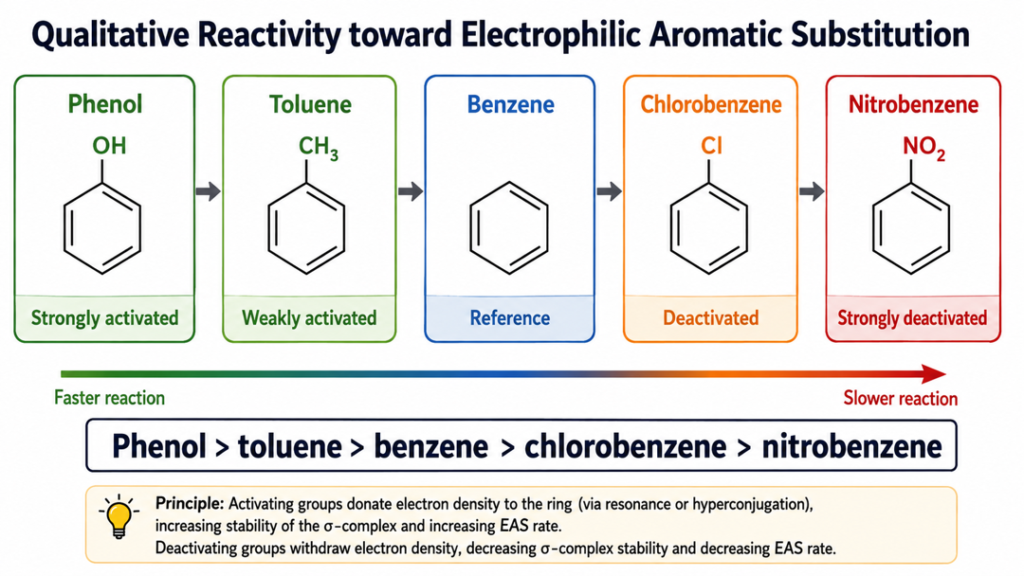
Under comparable conditions, the useful qualitative order is phenol > toluene > benzene > chlorobenzene > nitrobenzene. First, oxygen activates phenol strongly through the +M effect. Next, the methyl group activates toluene weakly through the +I effect and hyperconjugation. Benzene serves as the reference. By contrast, chlorine deactivates chlorobenzene mainly through the -I effect, whereas the nitro group strongly deactivates nitrobenzene through both -M and -I effects.
Effect on the Sigma Complex
The slow step of electrophilic aromatic substitution forms the sigma complex, which carries a positive charge in the ring. An electron-donating substituent disperses and stabilizes this charge. Therefore, the intermediate forms more easily. In contrast, an electron-withdrawing substituent pulls electron density away from the positively charged ring. Consequently, the intermediate becomes less stable and requires more energy to form.
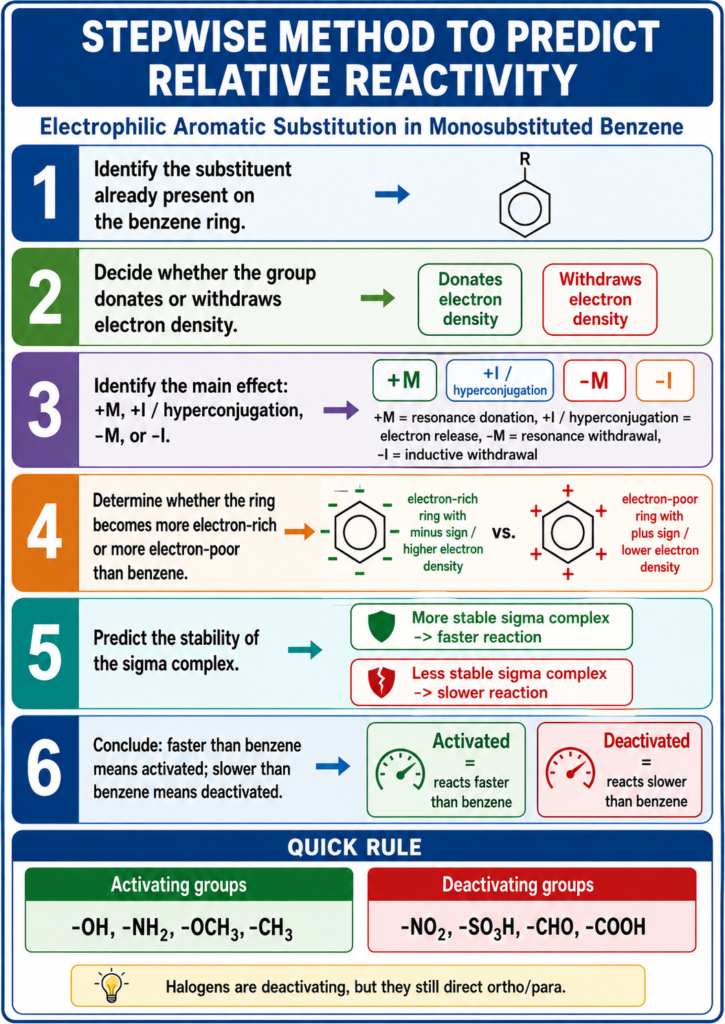
Stepwise Method to Predict Relative Reactivity
1. Identify the substituent already present on the benzene ring.
2. Decide whether the group donates or withdraws electron density.
3. Identify the main effect: +M, +I/hyperconjugation, -M, or -I.
4. Determine whether the ring becomes more electron-rich or more electron-poor than benzene.
5. Predict the stability of the sigma complex.
6. Conclude: faster than benzene means activated; slower than benzene means deactivated.
Activating and Deactivating Groups: Comparison
| Point | Activating group | Deactivating group |
| Electron effect | Donates electron density | Withdraws electron density |
| Ring electron density | Increases | Decreases |
| Attack on electrophile | Easier | More difficult |
| Sigma complex | More stable | Less stable |
| Activation energy | Lower | Higher |
| Relative rate | Faster than benzene | Slower than benzene |
| Examples | -OH, -OR, -NH₂, alkyl | -NO₂, -COOH, -CHO, -CN; halogens |