
Introduction
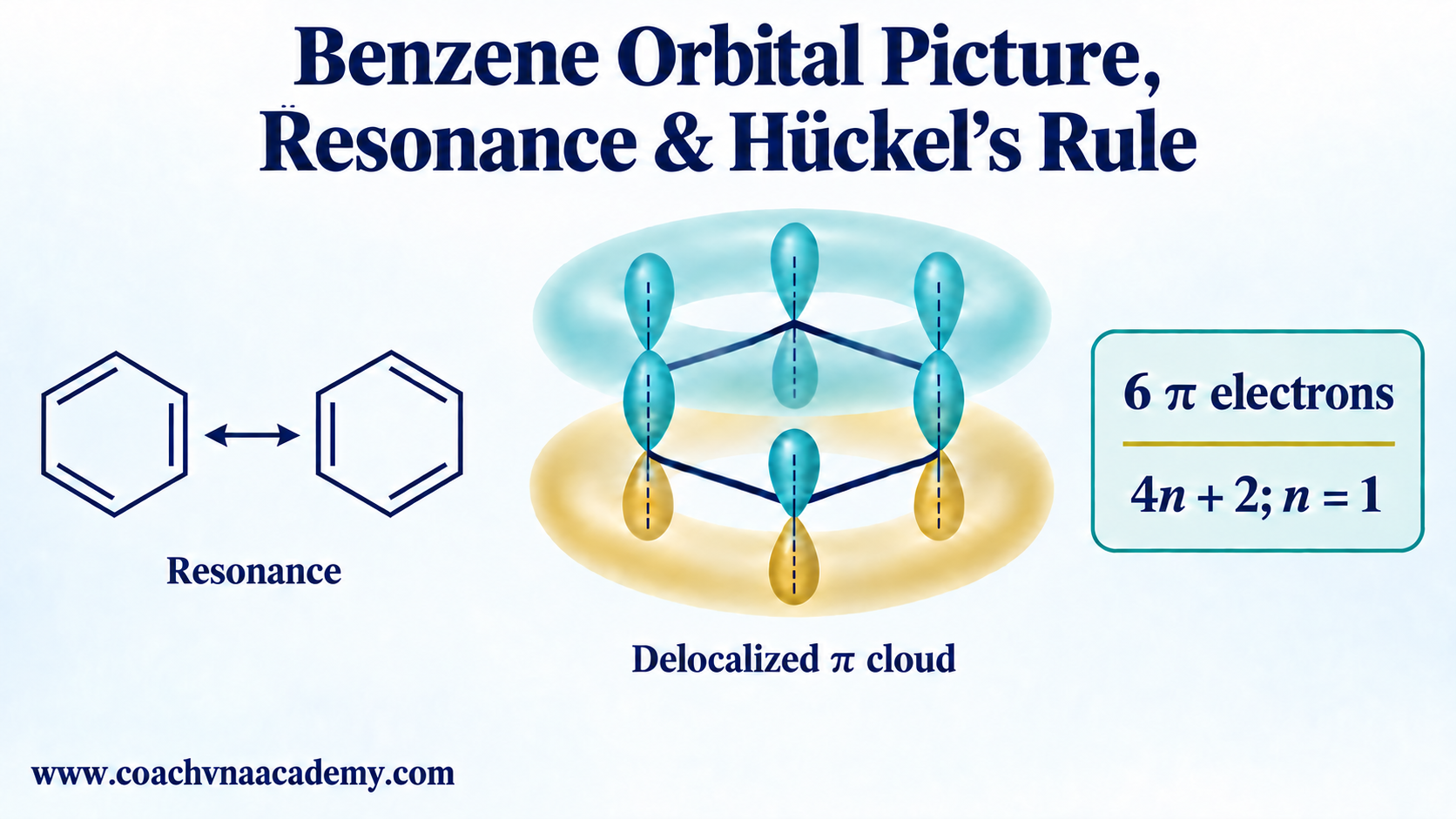
The orbital picture of benzene explains its equal carbon-carbon bond lengths, unusual stability, and aromatic character. First, each carbon atom uses sp² hybridization and contributes one unhybridized p orbital. Next, the six parallel p orbitals overlap continuously above and below the ring. As a result, this overlap spreads six pi electrons over the entire benzene ring. Moreover, resonance and Hückel’s 4n + 2 rule explain why benzene behaves as a stable aromatic compound.
Orbital Picture of Benzene
sp² Hybridization of Carbon Atoms in Benzene
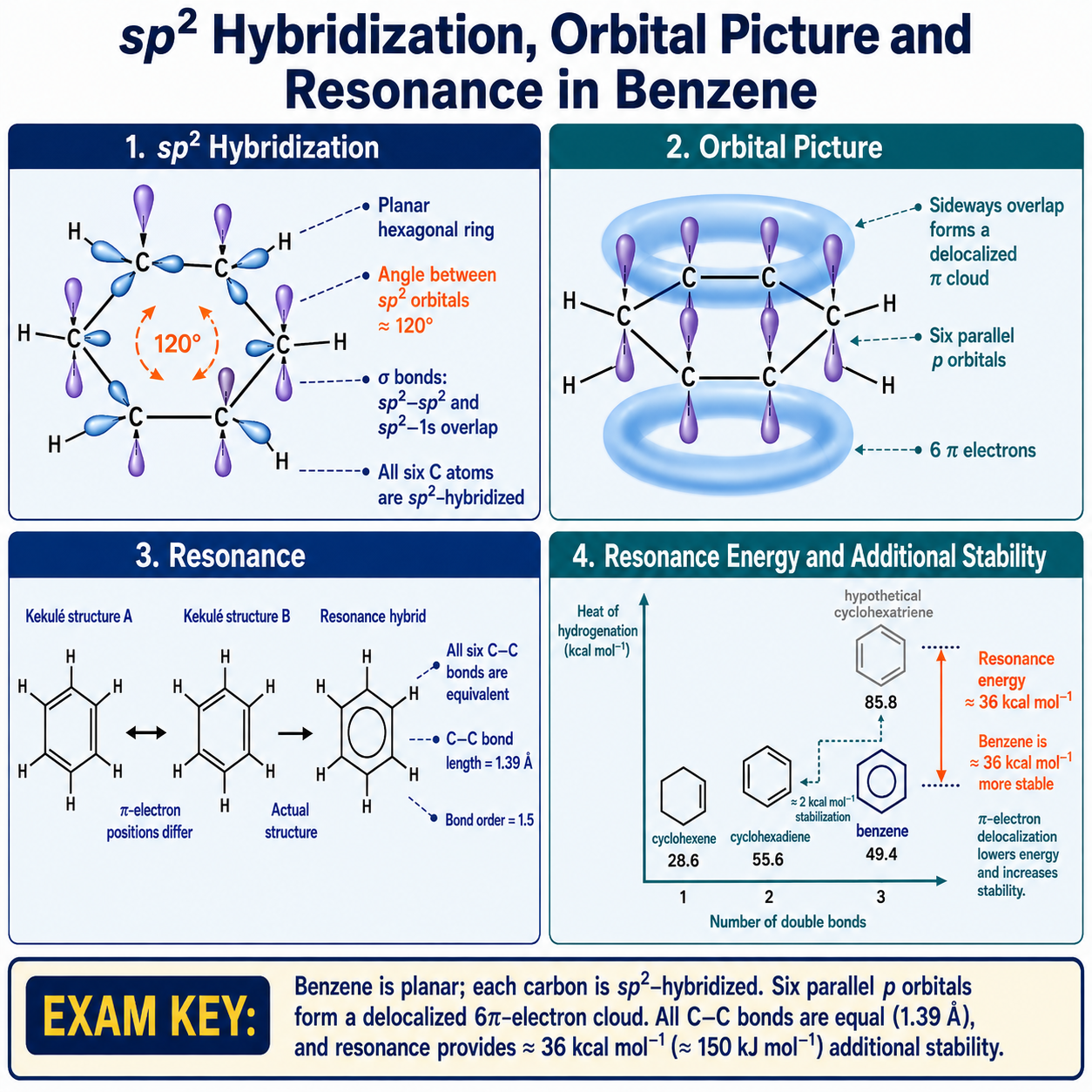
Each of the six carbon atoms in benzene uses sp² hybridization. During this process, one s orbital and two p orbitals combine to form three equivalent sp² hybrid orbitals. These orbitals lie in one plane and maintain bond angles of approximately 120°. Meanwhile, one unhybridized p orbital remains perpendicular to the plane.
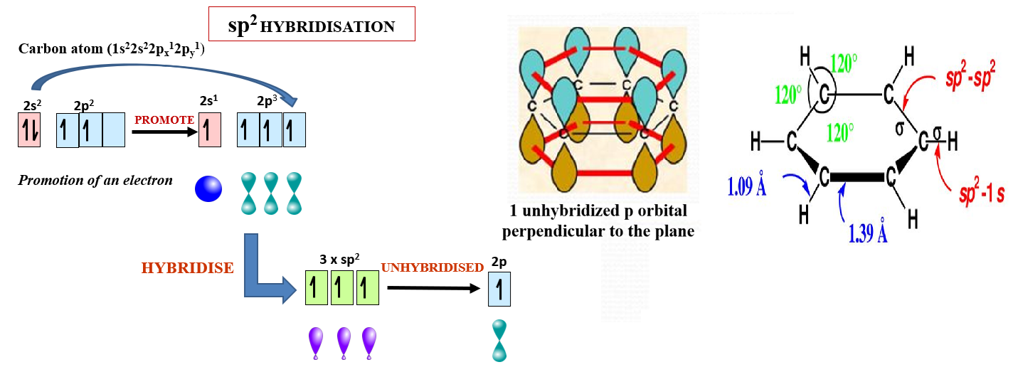
| Examination Statement: Each carbon atom of benzene is sp² hybridized and has trigonal-planar geometry with bond angles of approximately 120°. |
Formation of the Sigma-Bond Framework
Each carbon uses two sp² orbitals to form sigma bonds with its two neighboring carbon atoms. The third sp² orbital forms a sigma bond with one hydrogen atom. As a result, the six carbon atoms create a planar hexagonal skeleton, and each carbon carries one hydrogen atom.
For each carbon atom: two C-C sigma bonds + one C-H sigma bond form the planar framework.
Therefore, the sigma framework determines the basic shape of benzene. All six carbon atoms and all six hydrogen atoms lie approximately in the same plane.
Overlap of Unhybridized p Orbitals
Next, each carbon atom retains one unhybridized p orbital. This orbital remains perpendicular to the ring plane and contains one electron. Moreover, the six p orbitals stay parallel and overlap sideways with the p orbitals on both neighboring carbon atoms.
Because this overlap continues around the entire ring, it creates two continuous regions of pi-electron density: one above and one below the benzene ring. Consequently, the complete ring shares all six pi electrons across its six carbon atoms.
| Meaning of Delocalization: Delocalization means that pi electrons do not remain permanently confined between two particular carbon atoms. Instead, the complete conjugated ring shares them. |
Resonance in Benzene
Equivalent Resonance Structures
Chemists represent benzene by two equivalent Kekule structures. In these structures, the drawn double bonds occupy different positions, whereas the arrangement of atoms remains identical. Therefore, a double-headed resonance arrow connects the two contributors.
The individual Kekule structures are called resonance contributors, canonical structures, or contributing structures. They are not separate benzene molecules and do not exist independently.
| Important Warning: Do not write that benzene rapidly changes, oscillates, or exists in equilibrium between the two Kekule structures. The actual benzene molecule is always the resonance hybrid. |
Resonance Hybrid and Equal Bond Lengths
The actual benzene molecule forms a resonance hybrid of the two equivalent Kekule contributors. Chemists commonly represent this hybrid by a regular hexagon containing a circle. Thus, the circle shows the delocalization of six pi electrons over the complete ring.
In the resonance hybrid, all six carbon-carbon bonds have identical length and strength. Each bond measures approximately 1.39 Å; therefore, it is shorter than a normal carbon-carbon single bond but longer than a normal carbon-carbon double bond.
Characteristics of the Resonance Hybrid
| Characteristic | Explanation |
| Single real structure | The hybrid is the actual benzene molecule; contributors are only representations. |
| Equivalent C-C bonds | All six carbon-carbon bonds have the same length and strength. |
| Intermediate bond character | Each C-C bond has character between a single and a double bond. |
| Delocalized electrons | The complete ring shares six pi electrons. |
| Lower energy | The hybrid is more stable than either individual Kekule contributor. |
| Planar geometry | All carbon atoms use sp² hybridization and maintain continuous p-orbital overlap. |
Resonance Energy and Additional Stability
The resonance hybrid has greater stability than any single contributing structure. Electron delocalization provides this extra stability, which chemists call resonance stabilization or resonance energy. Moreover, the heat-of-hydrogenation comparison shows that benzene is approximately 150-152 kJ mol⁻¹ (36 kcal mol⁻¹) more stable than a hypothetical compound containing three ordinary localized double bonds.
Approximate resonance stabilization of benzene ≈ 150-152 kJ mol⁻¹ (36 kcal mol⁻¹)
Consequently, this additional stability explains why benzene resists ordinary addition reactions and generally undergoes substitution reactions that restore the aromatic ring.
Aromatic Character of Benzene (Aromaticity)
Aromaticity is a special stability shown by certain cyclic, planar, conjugated molecules containing an appropriate number of pi electrons. In modern organic chemistry, the term aromatic does not refer to smell. It refers to a characteristic electronic structure and stabilization.
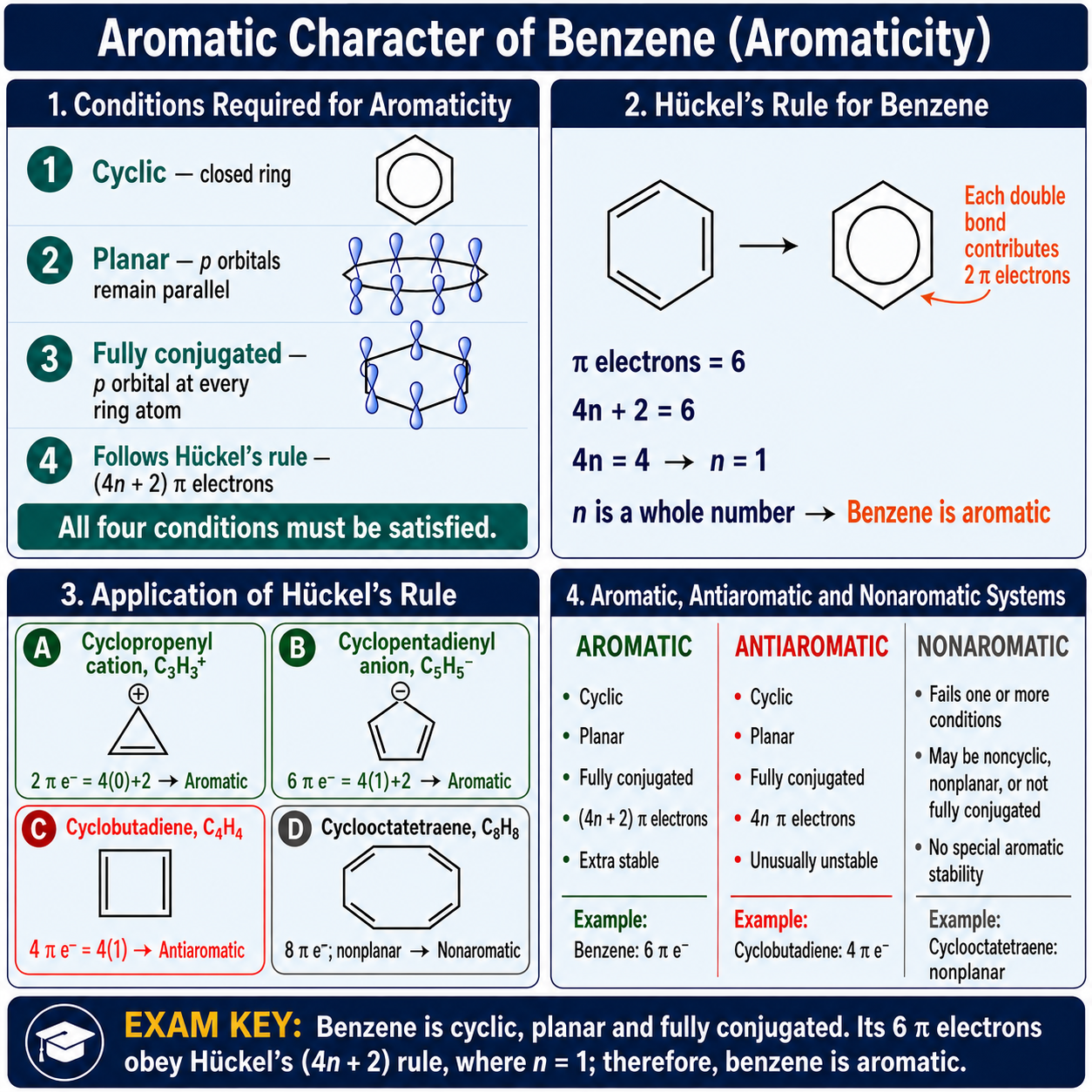
Conditions Required for Aromaticity
| Condition | Explanation | Application to benzene |
| 1. Cyclic | Atoms form a closed ring. | Six carbon atoms form a ring. |
| 2. Planar | The ring atoms lie in one plane so p orbitals can remain parallel. | All six sp² carbons are planar. |
| 3. Fully conjugated | Every ring atom has a p orbital and overlap is continuous. | All six carbons possess p orbitals. |
| 4. Huckel electron count | The ring contains 4n + 2 pi electrons. | Benzene contains six pi electrons, n = 1. |
| Memory aid: C-P-C-E = Cyclic, Planar, Conjugated, Electron count. | ||
Hückel’s Rule for Benzene
According to Huckel’s rule, a cyclic, planar, fully conjugated molecule is aromatic when it contains 4n + 2 pi electrons, where n is a non-negative integer number: 0, 1, 2, 3, and so on.
Permitted aromatic electron counts:
- n = 0 → 2 pi electrons;
- n = 1 → 6 pi electrons;
- n = 2 → 10 pi electrons;
- n = 3 → 14 pi electrons.
However, apply the electron-count rule only after confirming that the compound is cyclic, planar, and fully conjugated.
Application of Huckel’s Rule to Benzene
Benzene contains three pi bonds in the Kekule representations. Since each pi bond contributes two electrons, benzene has six pi electrons. Therefore, apply Hückel’s rule as follows:
4n + 2 = 6; 4n = 6 – 2; n = 4/4 = 1
Since n = 1 is a whole non-negative integer, benzene satisfies Huckel’s electron-count rule. It is also cyclic, planar, and fully conjugated. Therefore, benzene is aromatic.
| Final Examination Conclusion: Benzene is aromatic because it is cyclic, planar, fully conjugated, and contains six pi electrons, which satisfy the 4n + 2 rule for n = 1. |
How Aromaticity Explains the Properties of Benzene
| Observation | Explanation by aromaticity |
| All C-C bonds are equal | The ring distributes pi electrons over all six bonds. |
| Bond length is 1.39 Å | Each bond has intermediate single-double character. |
| Lower heat of hydrogenation | The aromatic reactant already has substantial stabilization. |
| Resistance to addition | Addition would destroy the aromatic pi system. |
| Preference for substitution | Substitution restores aromaticity in the final product. |
| Only one ortho form | All adjacent positions and all C-C bonds are equivalent. |
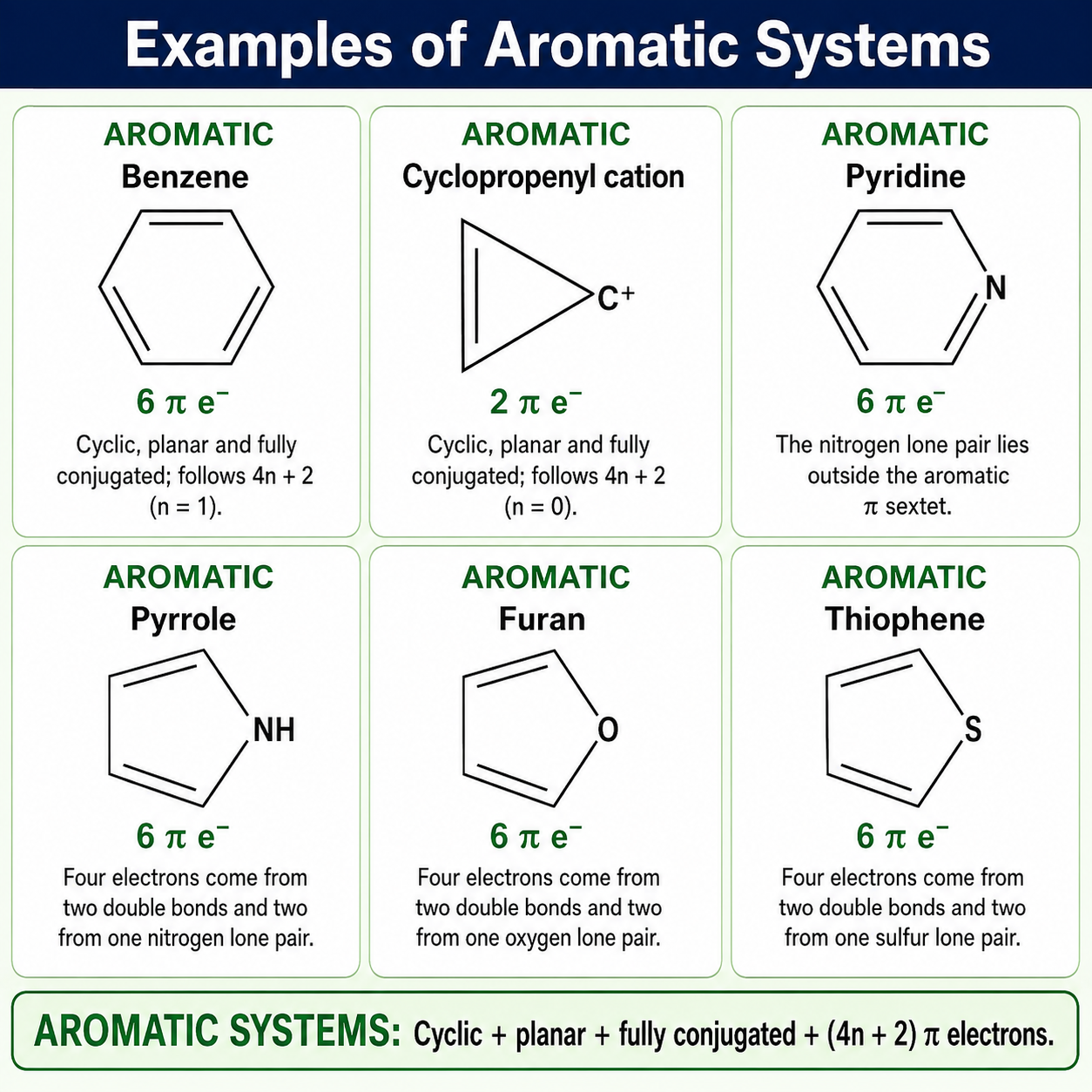
Aromatic, Antiaromatic and Nonaromatic Systems
For comparison, the following distinction helps students apply Hückel’s rule correctly. However, the main examination focus remains the aromatic character of benzene.
| Basis of comparison | Aromatic systems | Antiaromatic systems | Nonaromatic systems |
| Basic definition | Pi electrons circulate around the complete ring and provide extra stability. | Pi electrons circulate continuously around the ring, but an unfavorable electron count makes the system highly unstable. | The system cannot support continuous cyclic pi-electron movement because it lacks cyclicity, planarity, or conjugation. Consequently, it shows ordinary stability. |
| Cyclic structure | Must be cyclic | Must be cyclic | May be cyclic or open-chain |
| Planarity | Must be planar or nearly planar | Must be planar | May be nonplanar; planarity may also be irrelevant in an open-chain system |
| Continuous conjugation | Present around the complete ring | Present around the complete ring | Absent or interrupted |
| Hybridization of ring atoms | Every ring atom has a p-orbital, usually through sp² or sp hybridization | Every ring atom has a p-orbital, usually through sp² or sp hybridization | One or more atoms may be sp³-hybridized, interrupting conjugation |
| π-electron rule | Huckel rule: (4n+2) π electrons, n = 0, 1, 2, 3 … | Contains 4n π electrons, n = 1, 2, 3 … | The electron-count rule is not used because one or more structural conditions are absent |
| Relative stability | Extra stable because of cyclic π-electron delocalization | Strongly destabilized and generally highly reactive | Ordinary stability; neither aromatic stabilization nor antiaromatic destabilization |
| Representative examples | Benzene; cyclopropenyl cation; pyridine; pyrrole; furan; thiophene | Cyclobutadiene; cyclopropenyl anion | Cyclooctatetraene; cyclopentadiene |
| Quick identification | Cyclic + planar + fully conjugated + (4n+2) π electrons | Cyclic + planar + fully conjugated + 4n π electrons | Any essential condition is missing |
| Memory rule: First check cyclicity, planarity and continuous conjugation. Only then count the π electrons. | |||
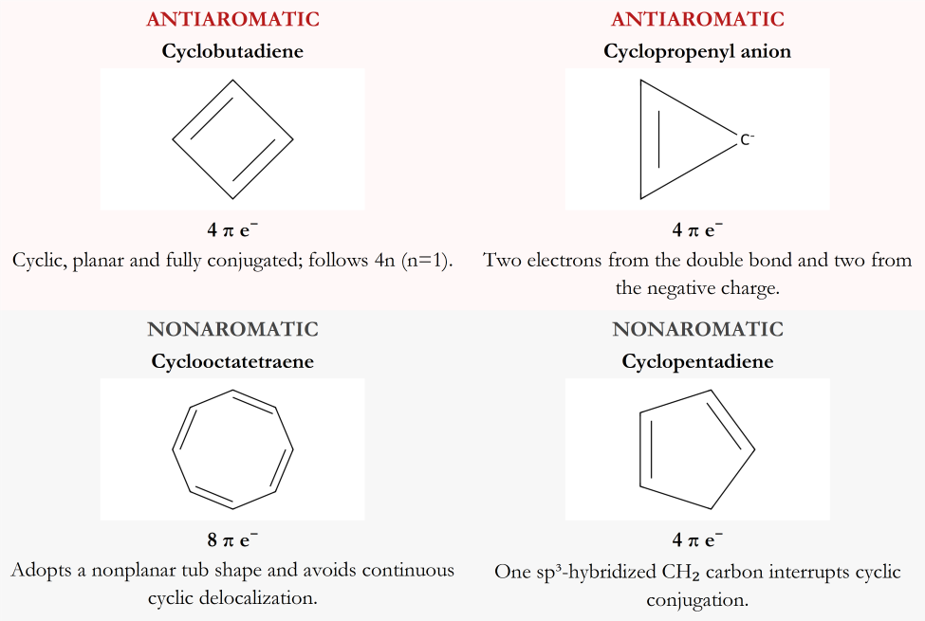
Kekule Contributors versus Resonance Hybrid
| Point | Kekule contributors | Resonance hybrid |
| Nature | Imaginary limiting representations | Actual benzene molecule |
| C-C bonds | Chemists draw alternating single and double bonds. | All six bonds are equivalent |
| Bond length | Would suggest two bond lengths | One intermediate bond length, about 1.39 Å |
| Electron distribution | Pi electrons appear localized in each contributor. | The resonance hybrid distributes six pi electrons over the ring. |
| Stability | Each contributor is less stable | Hybrid is lower in energy and more stable |
| Symbol | A double-headed resonance arrow connects the contributors. | Chemists often draw a circle inside a hexagon. |
Practice & Exam Preparation
Strengthen your understanding through MCQs, model answers, and university-examination preparation resources.