
Common Mechanistic Foundation
In such kind of reaction, an electrophile replaces a benzene hydrogen, and the final step restores the aromatic ring.
Ar-H + E⁺ → Ar-E + H⁺
The common sequence is: (1) generation or activation of the electrophile, (2) slow formation of a non-aromatic sigma complex, and (3) fast removal of H⁺ with restoration of aromaticity.
Sulphonation of Benzene
Sulphonation is the introduction of a sulphonic acid group, -SO₃H, into an aromatic ring. To begin with, benzene reacts with fuming sulfuric acid or oleum, usually on gentle warming, to form benzenesulphonic acid.
C₆H₆ + H₂SO₄ (fuming) ⇌ C₆H₅SO₃H + H₂O
| Point | Examination answer |
| Reaction type | Electrophilic aromatic substitution |
| Reagent | Fuming H₂SO₄ or oleum |
| Effective electrophile | SO₃ |
| Intermediate | Sigma complex / arenium ion |
| Product | Benzenesulphonic acid |
| Special characteristic | Reversible reaction |
Electrophile in Sulphonation
Fuming sulfuric acid (H2S2O7) contains dissolved sulfur trioxide. Because sulfur in SO₃ is electron-deficient, benzene attacks the sulfur atom. Moreover, protonated SO₃ may also participate in a strongly acidic medium; however, chemists generally consider SO₃ the effective electrophile in the usual mechanism.
H2S2O7 ⇌ H2SO4 + SO3
SO3 + H2SO4 ⇌ HSO3+ + HSO4−
Mechanism of Sulphonation
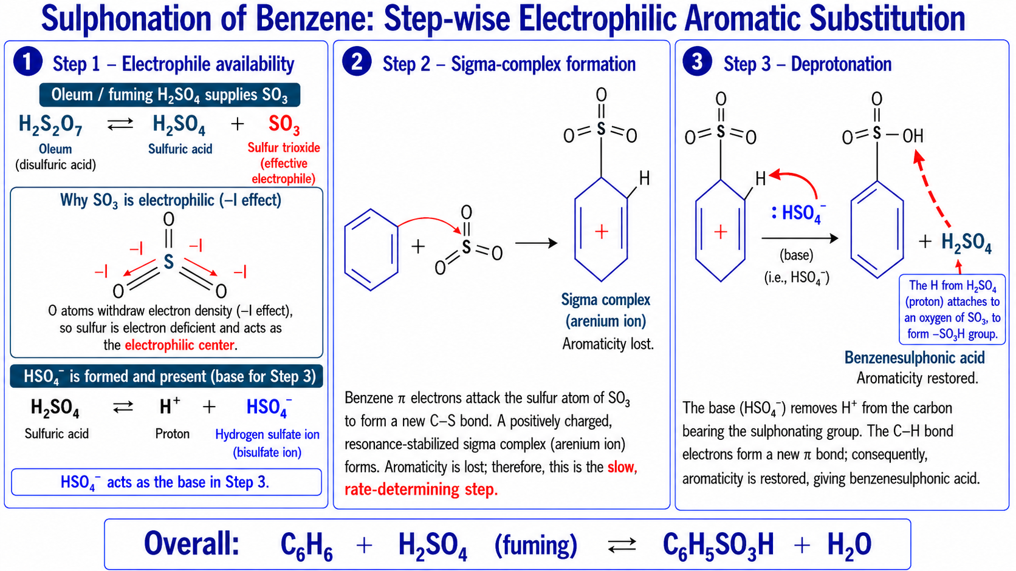
Step 1 – Electrophile availability: Oleum or fuming sulfuric acid supplies SO₃, the effective electrophile.
Step 2 – Sigma-complex formation: Benzene pi electrons attack the sulfur atom of SO₃ and form a new carbon-sulfur bond. A positively charged, resonance-stabilized sigma complex forms. At this stage, the benzene ring temporarily loses aromaticity; therefore, it forms the sigma complex slowly, making this the rate-determining step.
Step 3 – Deprotonation: A base removes H⁺ from the carbon bearing the sulphonating group. Next, electrons from the C–H bond form a new π bond. Consequently, loss of a proton restores aromaticity and forms benzenesulphonic acid.
Reversibility of Sulphonation
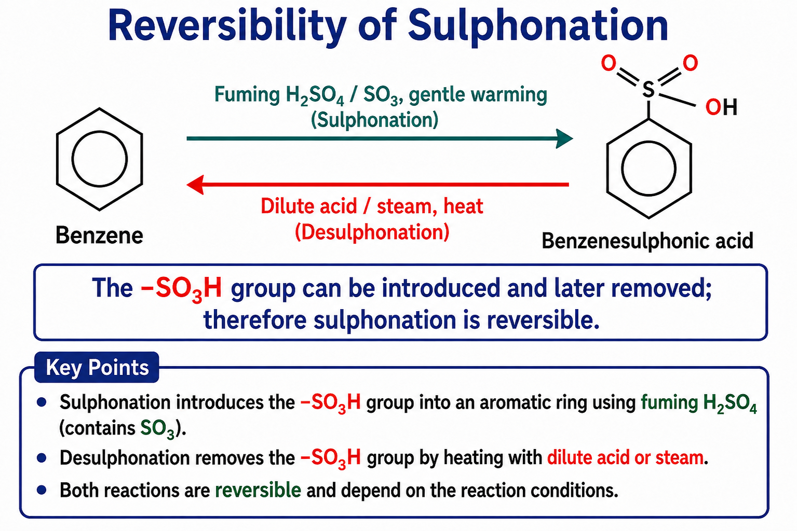
Sulphonation is reversible. Fuming sulfuric acid or oleum shifts the equilibrium toward sulphonation. Moreover, when chemists heat benzenesulphonic acid with dilute aqueous acid or steam, the reaction removes the -SO₃H group and regenerates benzene. Chemists call the reverse process desulphonation.
C₆H₅SO₃H + H₂O ⇌ C₆H₆ + H₂SO₄ (dilute acid / steam, heat)
| Sulphonation | Desulphonation |
| Introduces -SO₃H into benzene | Removes -SO₃H and regenerates benzene |
| Favored by fuming H₂SO₄ or SO₃ | Favored by hot dilute acid or steam |
| Uses electrophilic aromatic substitution | Represents the reverse reaction |
Applications of Sulfonation
Sulphonation introduces a sulfonic acid group (–SO₃H) into an organic compound, particularly an aromatic ring.
Manufacture of detergents and dyes
Sulfonation converts alkylbenzene into alkylbenzene sulfonic acid, and neutralization with sodium hydroxide forms the corresponding sodium salt. These salts act as surfactants in synthetic detergents and cleaning agents. Dye manufacturers also use sulfonation to prepare many azo and textile dyes. The –SO₃H group increases the water solubility of dye molecules and helps them bind effectively to fabrics.
Manufacture of pharmaceuticals
Sulfonation is important in preparing:
- sulfonamide intermediates;
- antiseptic and antibacterial compounds;
- water-soluble drug derivatives;
- pharmaceutical starting materials.
Preparation of phenol, sulfonamides and ion-exchange resins
Fusion of benzenesulfonic acid with sodium hydroxide produces sodium phenoxide, and acidification then yields phenol. Chlorinating agents convert sulfonic acids into sulfonyl chlorides, which react with amines to form sulfonamides. Sulfonamides are important in medicinal and pharmaceutical chemistry. Sulfonated polystyrene contains acidic –SO₃H groups and functions as a cation-exchange resin in:
- water softening;
- water purification;
- demineralization;
- pharmaceutical and chemical processing.
Separation and purification of aromatic compounds
Sulfonation converts some water-insoluble aromatic compounds into water-soluble sulfonic acids. As a result, the –SO₃H group can increase polarity and water solubility, which is useful during the separation and purification of organic compounds.
Introduction of a temporary blocking group
The –SO₃H group can act as a temporary blocking group in electrophilic aromatic substitution. Furthermore, chemists use the –SO₃H group to block a selected position and later remove it through desulphonation.
Manufacture of surfactants and emulsifying agents
Sulfonated organic compounds reduce surface tension and therefore function as:
- shampoos;
- soaps and cleansers;
- emulsifying agents;
- wetting agents;
- industrial cleaning products.
Petroleum and lubricant industries
Sulfonates serve as:
- lubricant additives;
- corrosion inhibitors;
- dispersing agents;
- detergent additives in engine oils.
In summary, sulphonation is widely used in the manufacture of detergents, dyes, pharmaceuticals, phenol, sulfonamides, surfactants, ion-exchange resins, and petroleum additives.
Halogenation of Benzene
Halogenation is the introduction of chlorine or bromine into the benzene ring by electrophilic aromatic substitution. For chlorination, benzene reacts with chlorine in the presence of anhydrous FeCl₃ or AlCl₃. Bromination uses bromine with FeBr₃.
C₆H₆ + Cl₂ (in presence of anhydrous FeCl₃) → C₆H₅Cl + HCl
C₆H₆ + Br₂ (FeBr₃) → C₆H₅Br + HBr
| Point | Chlorination | Bromination |
| Halogen reagent | Cl₂ | Br₂ |
| Lewis-acid catalyst | FeCl₃ or AlCl₃ | FeBr₃ |
| Electrophile | Activated Cl⁺ | Activated Br⁺ |
| Product | Chlorobenzene | Bromobenzene |
| By-product | HCl | HBr |
Role of the Lewis-Acid Catalyst
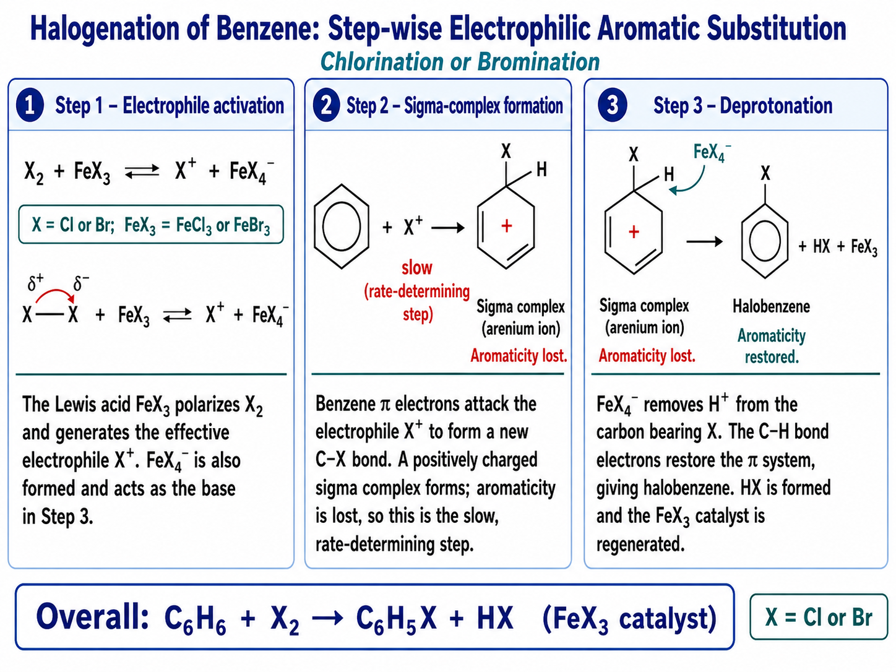
Electron delocalization strongly stabilizes the benzene ring, whereas Cl₂ or Br₂ alone lacks sufficient electrophilicity for efficient attack. Specifically, FeCl₃, FeBr₃, or AlCl₃ accepts electron density from the halogen molecule, polarises the X–X bond, and generates an activated electrophilic halogen species.
X₂ + FeX₃ ⇌ X⁺ + FeX₄⁻ (X = Cl or Br)
Students commonly use the simplified ionic representation in examination mechanisms. More precisely, the electrophile may remain associated with the Lewis acid as a strongly polarised complex rather than existing as a completely free X⁺ ion.
Mechanism
Step 1 – Electrophile activation: First, X₂ interacts with FeX₃ to produce an activated electrophilic species, commonly represented as X⁺, together with FeX₄⁻.
Step 2 – Sigma-complex formation: Benzene pi electrons attack X⁺. A C-X bond forms and a positively charged sigma complex form. During this stage, the benzene ring temporarily loses aromaticity; consequently, it forms the sigma complex slowly, making this the rate-determining step.
Step 3 – Deprotonation: FeX₄⁻ removes H⁺ from the carbon bearing X. The C-H bond electrons restore the aromatic pi system. The reaction forms halobenzene and HX and regenerates FeX₃.
Why Benzene Does Not Behave Like an Ordinary Alkene
An ordinary alkene often reacts with halogens by addition. Because addition would destroy aromatic stabilisation, benzene resists simple addition reactions. Therefore, a Lewis acid activates the halogen, the benzene ring attacks the resulting electrophile, and loss of a proton restores aromaticity.
| Ordinary alkene | Benzene |
| Usually undergoes halogen addition | Undergoes Lewis-acid-catalyzed ring substitution |
| No aromatic stabilization is present | Aromatic stabilization must be preserved or restored |
| Halogen may react without a Lewis acid | Cl₂ or Br₂ requires activation for ring substitution |
Important Condition-Based Distinction
| Reaction conditions | Type of reaction | Product |
| Cl₂ / FeCl₃ | Electrophilic aromatic substitution | Chlorobenzene + HCl |
| Excess Cl₂ / sunlight or UV | Photochemical addition | BHC / benzene hexachloride |
Applications of Halogenation
Halogenation is the introduction of a halogen atom—fluorine, chlorine, bromine, or iodine—into an organic compound. In aromatic chemistry, benzene commonly undergoes chlorination or bromination through electrophilic aromatic substitution.
Manufacture of pharmaceutical compounds
The presence of a halogen may improve the biological activity, stability, or lipid solubility of a drug molecule. Halogenated aromatic compounds serve as important intermediates in the synthesis of:
- antiseptics;
- antibiotics;
- analgesics;
- anti-inflammatory drugs;
- antihistamines;
- antifungal medicines.
Preparation of pesticides and insecticides
Several chlorinated aromatic compounds used in crop-protection chemicals. Halogenation provides an important method for preparing:
- insecticides;
- herbicides;
- fungicides;
- agricultural intermediates.
Manufacture of dyes and pigments
Chlorinated and brominated aromatic compounds serve as intermediates in the preparation of:
- textile dyes;
- printing dyes;
- pigments;
- color-forming chemicals.
Preparation of solvents
Some halogenated compounds serve as industrial solvents in extraction, cleaning, chemical synthesis, and pharmaceutical processing, subject to appropriate safety controls. Examples include: Examples include:
- dichloromethane;
- chloroform;
- carbon tetrachloride;
- chlorobenzene.
Manufacture of polymers and plastics
Manufacturers use halogenated compounds to produce important polymers for pipes, electrical insulation, coatings, seals, and chemical-resistant equipment. Examples include:
- vinyl chloride for polyvinyl chloride, or PVC;
- tetrafluoroethylene for polytetrafluoroethylene, or PTFE;
- chloroprene for synthetic rubber.
Preparation of refrigerants
Certain fluorinated and chlorinated compounds have served as refrigerants and cooling agents. However, modern refrigerant selection must also consider environmental effects, including ozone-depletion potential and global-warming potential.
Preparation of Grignard reagents
Furthermore, reactions with metals convert haloalkanes and haloarenes into organometallic compounds, such as Grignard reagents. Grignard reagents are valuable for forming new carbon–carbon bonds in organic synthesis.
Introduction of functional groups
Substitution reactions can replace a halogen atom with other groups. Therefore, halogenated compounds serve as valuable intermediates for preparing the following products:
- alcohols;
- amines;
- nitriles;
- ethers;
- carboxylic acids;
- organometallic compounds.
Preparation of disinfectants and antiseptics
Manufacturers use halogen-containing compounds in disinfectant and antiseptic formulations. Examples include:
- iodine-based antiseptics;
- chlorine-releasing disinfectants;
- chlorinated phenolic compounds.
In summary, halogenation is important in the production of pharmaceuticals, pesticides, dyes, solvents, polymers, refrigerants, disinfectants, flame retardants, and synthetic intermediates.