
Why Is Aniline Basic?
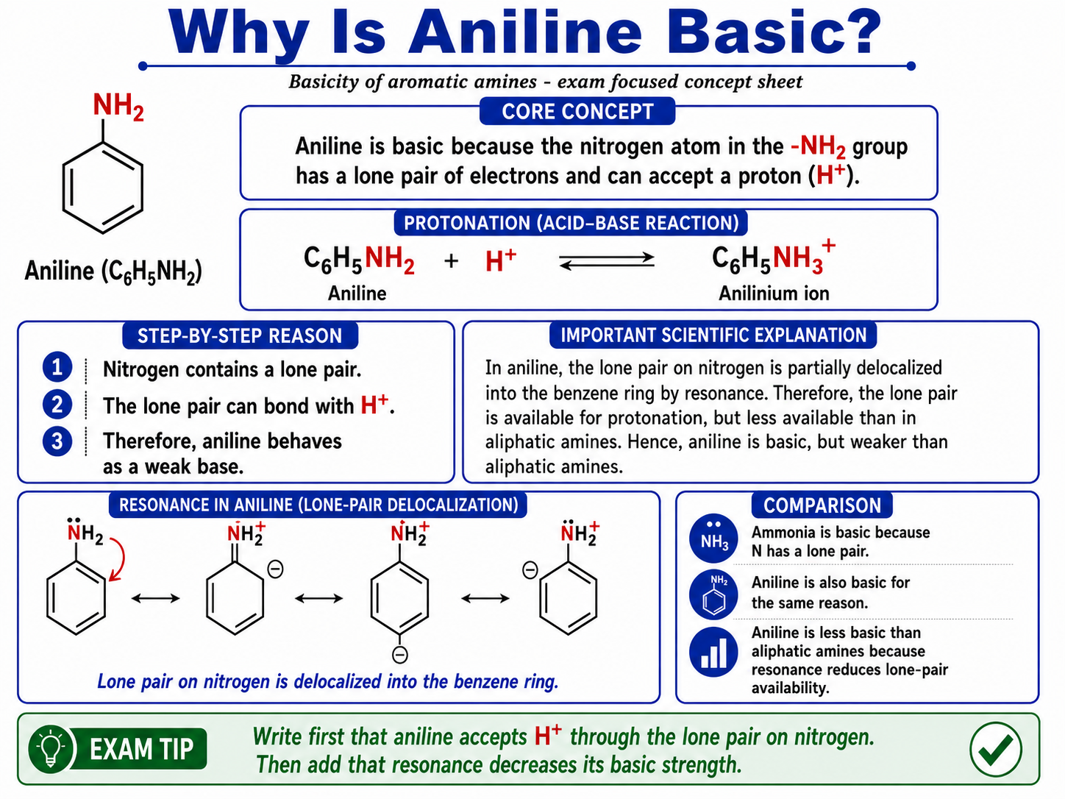
Aniline contains a nitrogen atom with a lone pair of electrons. Nitrogen can use this lone pair to bind a proton and form the anilinium ion. Therefore, aniline shows basic character, although it behaves as a weak base in water.
C6H5NH2 + H2O ⇌ C6H5NH3+ + OH–
Three Core Concepts
The basicity of aromatic amines becomes easier when three ideas are considered separately: proton acceptance by nitrogen, availability of the nitrogen lone pair electron, and the effect of substituents on protonation and conjugate-acid formation.
Concept 1 – Proton-Acceptance Concept
According to the Bronsted-Lowry concept, a base accepts a proton. Aromatic amines such as aniline contain a lone pair of electrons on nitrogen. Nitrogen can therefore accept H⁺ and form an anilinium ion.
C6H5NH2 + H+ ⇌ C6H5NH3+
Key Point: The greater the tendency of nitrogen to accept H⁺, the stronger the base.
Concept 2 – Lone-Pair Availability Concept (Resonance in Aniline)
In aniline, the nitrogen lone pair interacts with the π-electron system of the benzene ring. Consequently, the lone pair becomes delocalized through resonance and is not completely available for protonation. Resonance contributors can therefore be drawn in which nitrogen develops partial positive character while additional electron density appears at the ortho and para positions of the benzene ring. As a result, the lone pair is less localized on nitrogen and becomes less available to bind H⁺.
This lowers the basicity of aniline relative to aliphatic amines whose lone pair remains more localized on nitrogen.
- The nitrogen lone pair becomes delocalized into the aromatic ring.
- Electron density localized on nitrogen decreases.
- Proton acceptance becomes less favorable.
- Aniline therefore behaves as a weaker base than a comparable aliphatic amine.
Core Rule:
Greater lone-pair availability → greater basicity.
Greater lone-pair delocalization → lower basicity.
Concept 3 – Conjugate-Acid Stability Concept
When an aromatic amine accepts H⁺, it forms an ammonium-type conjugate acid. A substituent that raises electron density available to nitrogen usually makes proton acceptance easier and increases basicity. Conversely, an electron-withdrawing group lowers the tendency of nitrogen to accept H⁺ and decreases basicity.
Why Is Aniline Less Basic Than Aliphatic Amines?
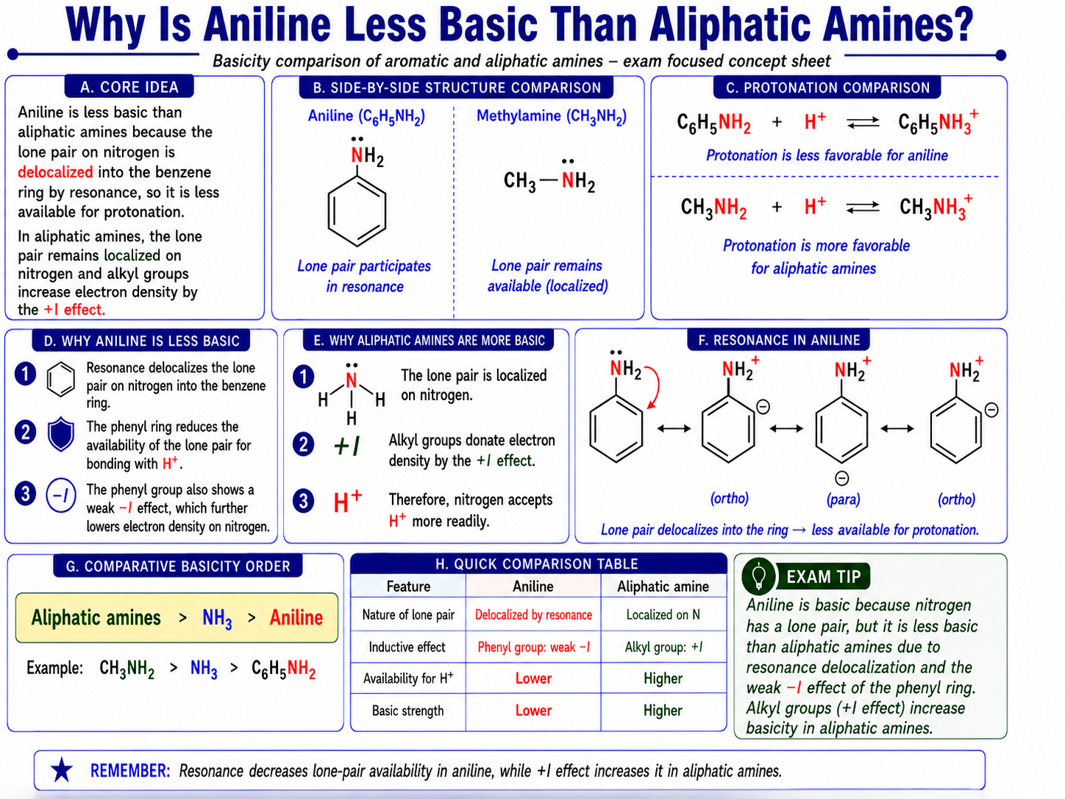
In an aliphatic amine, the nitrogen lone pair remains largely localized on nitrogen. Alkyl groups also release electron density through the +I effect. In aniline, however, resonance delocalization and the electron-withdrawing inductive influence of the phenyl group reduce the electron density available at nitrogen.
CH3NH2 + H+ → CH3NH3+
| Feature | Aniline | Aliphatic amine |
| Lone-pair state | Partly delocalized into aromatic ring | Largely localized on nitrogen |
| Dominant electronic influence | Resonance lowers availability | Alkyl +I effect raises electron density |
| Ease of protonation | Lower | Higher |
| Relative basicity | Weaker base | Stronger base under comparable conditions |
Aniline versus Ammonia
Aniline is less basic than ammonia in aqueous solution because the lone pair in ammonia remains localized on nitrogen, whereas the lone pair in aniline is delocalized into the benzene ring.
NH₃ > C₆H₅NH₂
Effect of Substituents on the Basicity of Aromatic Amines
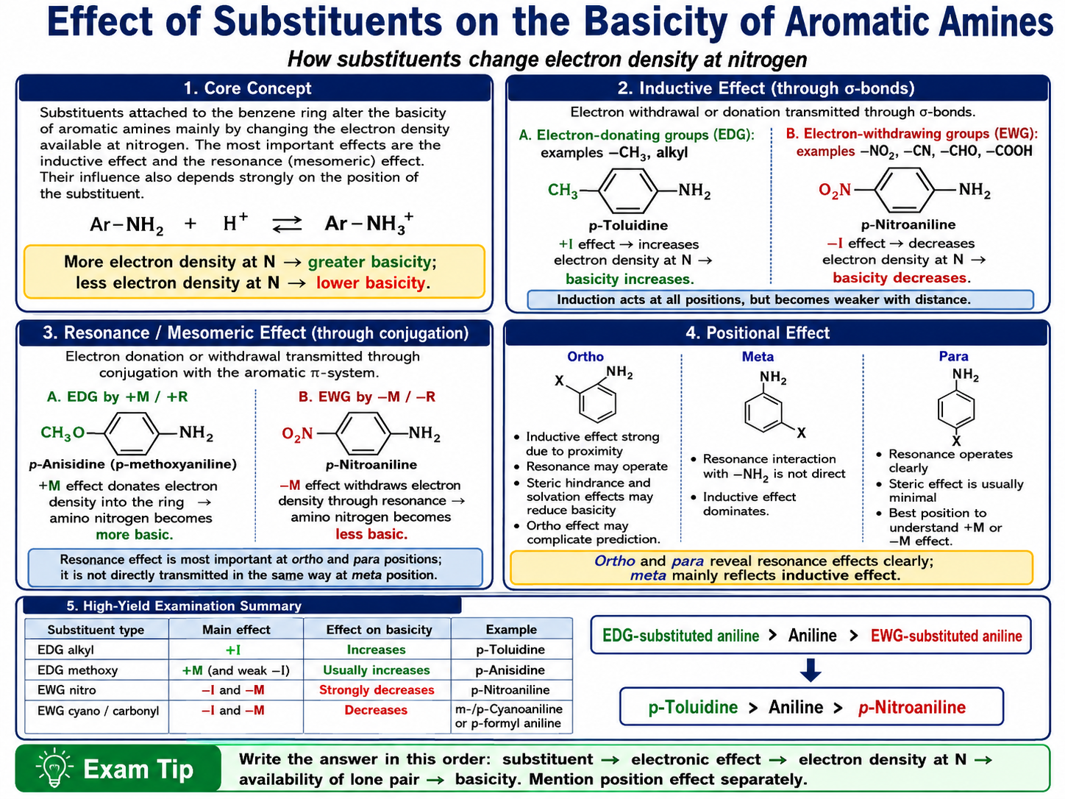
Substituents attached to the benzene ring alter the basicity of aromatic amines mainly by changing the electron density available at nitrogen. The most important effects are the inductive effect and the resonance or mesomeric effect. Their influence also depends strongly on the position of the substituent.
- Inductive effect: electron withdrawal or donation transmitted through σ-bonds.
- Resonance/mesomeric effect: electron donation or withdrawal transmitted through conjugation with the aromatic π-system.
- Positional effect: ortho, meta, and para substitution changes how strongly resonance, induction, steric effects, and solvation influence basicity.
Electron-Donating Groups Increase Basicity
Electron-donating groups generally increase electron density in the aromatic system and can increase the effective electron density available to the amino group. Important examples include –CH₃, other alkyl groups, –OCH₃, and –OH. Their net influence must be interpreted from both inductive and resonance effects.
Effect of Alkyl Groups
A methyl group shows a +I effect and releases electron density. Therefore, methyl-substituted anilines, called toluidines, are generally more basic than aniline when positional and solvation factors do not override the electronic effect.
Effect of Methoxy and Hydroxy Groups
Groups such as –OCH₃ and –OH show opposing effects: a –I effect through σ-bonds and a +M/+R effect through resonance. At ortho and para positions, resonance donation can strongly influence the amino group. At the meta position, resonance communication with the amino group is much less direct, so the inductive effect becomes relatively more important.
Electron-Withdrawing Groups Decrease Basicity
Electron-withdrawing groups reduce electron density in the aromatic ring and at the amino nitrogen. Therefore, the nitrogen lone pair becomes less available for protonation and basicity decreases.
- –NO₂
- –CN
- –CHO
- –COR
- –COOH
- –COOR
- –SO₃H
Effect of Nitro Group
The nitro group is strongly electron withdrawing because it shows both –I and –M/–R effects. Nitroanilines are therefore substantially less basic than aniline.
Ortho and Para Nitro Groups
At the ortho and para positions, –NO₂ withdraws electron density through both induction and resonance. This strongly decreases the availability of the nitrogen lone pair. It decreases the basicity.
Meta Nitro Group
At the meta position, direct resonance withdrawal from the amino group does not operate in the same manner. The effect is therefore dominated largely by the –I effect.
| Exam-Oriented Trend: Aniline > m-nitroaniline > o/p-nitroaniline. The exact order between ortho and para isomers may additionally depend on steric, solvation, and intramolecular interactions. |
Effect of Position of the Substituent
Ortho Position
At the ortho position, the inductive effect acts strongly because of proximity. Resonance may also operate, while steric crowding can disturb planarity and affect solvation of the protonated amine. Ortho-substituted anilines may therefore deviate from a simple electronic-effect order.
Meta Position
At the meta position, direct resonance communication between the substituent and amino group is limited for the key resonance pathway. The inductive effect therefore becomes relatively more important.
Para Position
At the para position, resonance interaction can operate efficiently and steric interference is usually minimal. Para-substituted anilines therefore provide clear examples for studying resonance effects.
The Ortho Effect in Aromatic Amines
An ortho substituent may decrease basicity even when its electronic nature might otherwise suggest an increase. The observed effect can arise from several factors acting together.
- Steric crowding around –NH₂
- Reduced planarity and altered orbital overlap
- Changed resonance interaction
- Hindered solvation of the protonated amine
- Intramolecular interaction when suitable groups are present
| Exam Point: For ortho-substituted aromatic amines, discuss steric and solvation effects in addition to inductive and resonance effects. |
Effect of Halogens
Halogens exhibit a strong –I effect and a weaker +R/+M effect. The inductive effect withdraws electron density and tends to lower aromatic-amine basicity. Although halogens can donate electron density to the ring by resonance, the net effect commonly makes haloanilines less basic than aniline.
General Trend: Aniline > Haloaniline
Comparative Effect of Common Substituents
| Substituent | Major Electronic Effect | Effect on Electron Density | Effect on Basicity |
| –CH₃ | +I | Increases | Increases |
| Alkyl | +I | Increases | Increases |
| –OCH₃ at o/p | Strong +M, opposing –I | Usually increases through resonance | Often increases |
| –OH at o/p | +M, opposing –I | Resonance donation possible | Can increase |
| –NO₂ | –I and –M | Strongly decreases | Strongly decreases |
| –CN | –I and –M | Decreases | Decreases |
| –CHO | –I and –M | Decreases | Decreases |
| –COOR | –I and –M | Decreases | Decreases |
| Halogen | –I and +R | Net withdrawal commonly dominates | Usually decreases |