

| CENTRAL MESSAGE An effective study routine is not the timetable that looks perfect on paper. It is the routine you can follow consistently, review regularly, and adjust when circumstances change. |
Many students genuinely want to study regularly, but they often create timetables that become difficult to follow. An effective study routine for students must fit their actual classes, responsibilities, energy levels, and learning needs.

The problem is usually not a lack of ability or sincerity. In many cases, students create a timetable that looks impressive but does not match their actual life.
During my years of teaching, I have observed that students often perform below their potential because they lack a realistic system for managing their time, attention, revision, and rest. An effective study routine provides that system.
A good study routine does not require you to study every minute of the day. Instead, it helps you decide what to study, when to study, how long to study, and when to revise what you have learned.
A realistic study routine provides an important foundation for student success

Why Is an Effective Study Routine for Students Important?
A study routine gives structure to your academic work. Without a routine, students often study according to mood, urgency, or examination pressure. They may spend too much time on an easy subject while repeatedly postponing a difficult but important topic.
A realistic routine helps you:
- distribute your work across the week;
- complete important topics before examinations;
- revise lessons at suitable intervals;
- reduce last-minute pressure;
- manage difficult and easy subjects intelligently;
- maintain a balance between study, sleep, exercise, and recreation;
- develop discipline and academic confidence.
Most importantly, a routine reduces daily confusion. When you already know what you need to study, you do not waste valuable time deciding where to begin.
Timetable Versus Study Routine
Therefore, an effective study routine for students should remain flexible, specific, and connected with clear learning goals.
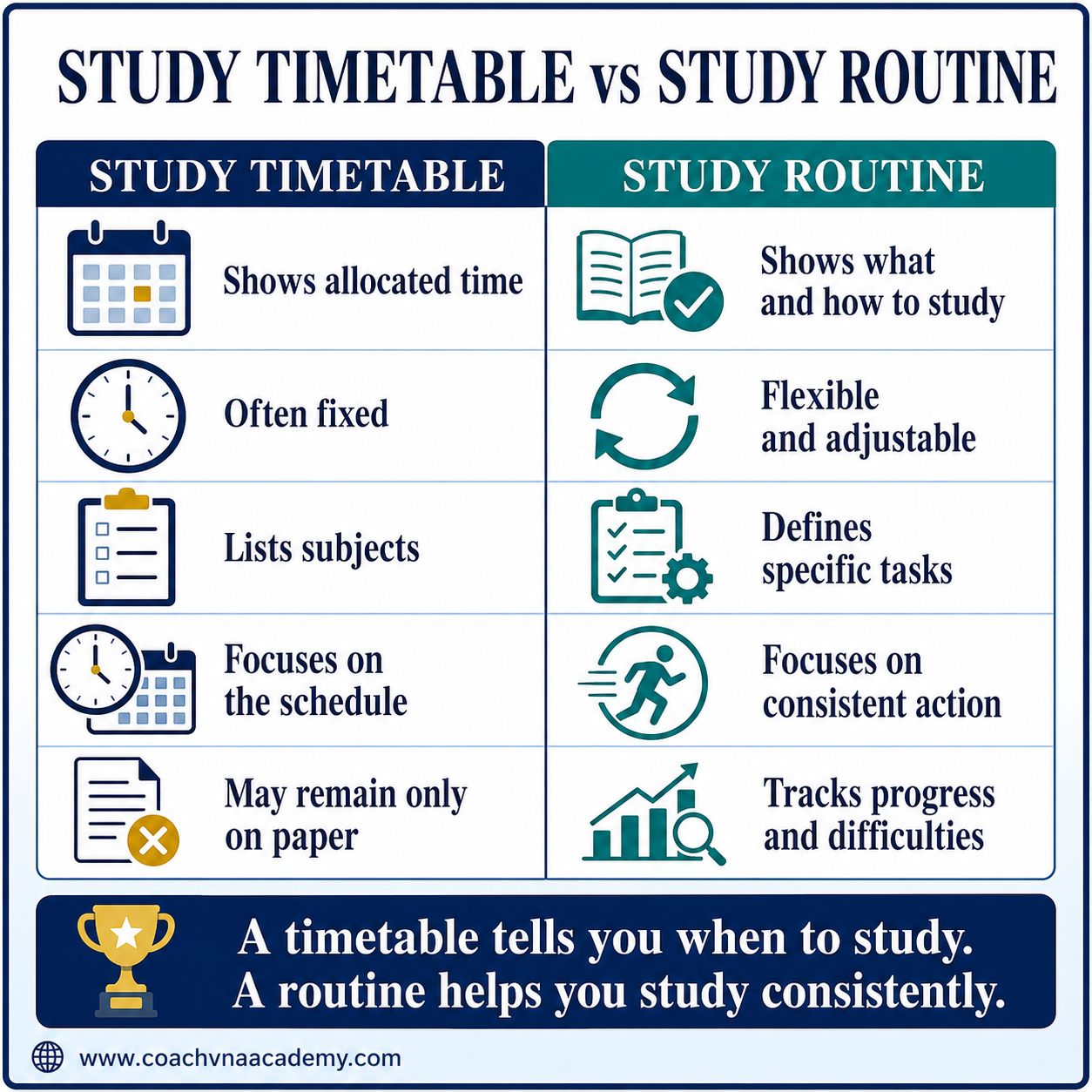
Students often use the terms timetable and study routine as if they mean exactly the same thing. However, there is a practical difference.
A timetable usually tells you what activity should happen at a particular time. A study routine includes the timetable, but it also considers your priorities, energy level, learning progress, revision needs, breaks, and weekly adjustments.
| TIMETABLE EXAMPLE Study chemistry from 6:00 p.m. to 7:00 p.m. |
A study routine asks additional questions:
- Which chemistry topic should I study?
- Is it a new topic, a revision session, or question practice?
- What should I complete during this hour?
- How will I check whether I understood it?
- When will I revise it again?
- What should I do if I miss the session?
Therefore, an effective study routine is more flexible and purposeful than a fixed timetable.
Why Do Many Students Fail to Follow a Study Routine?
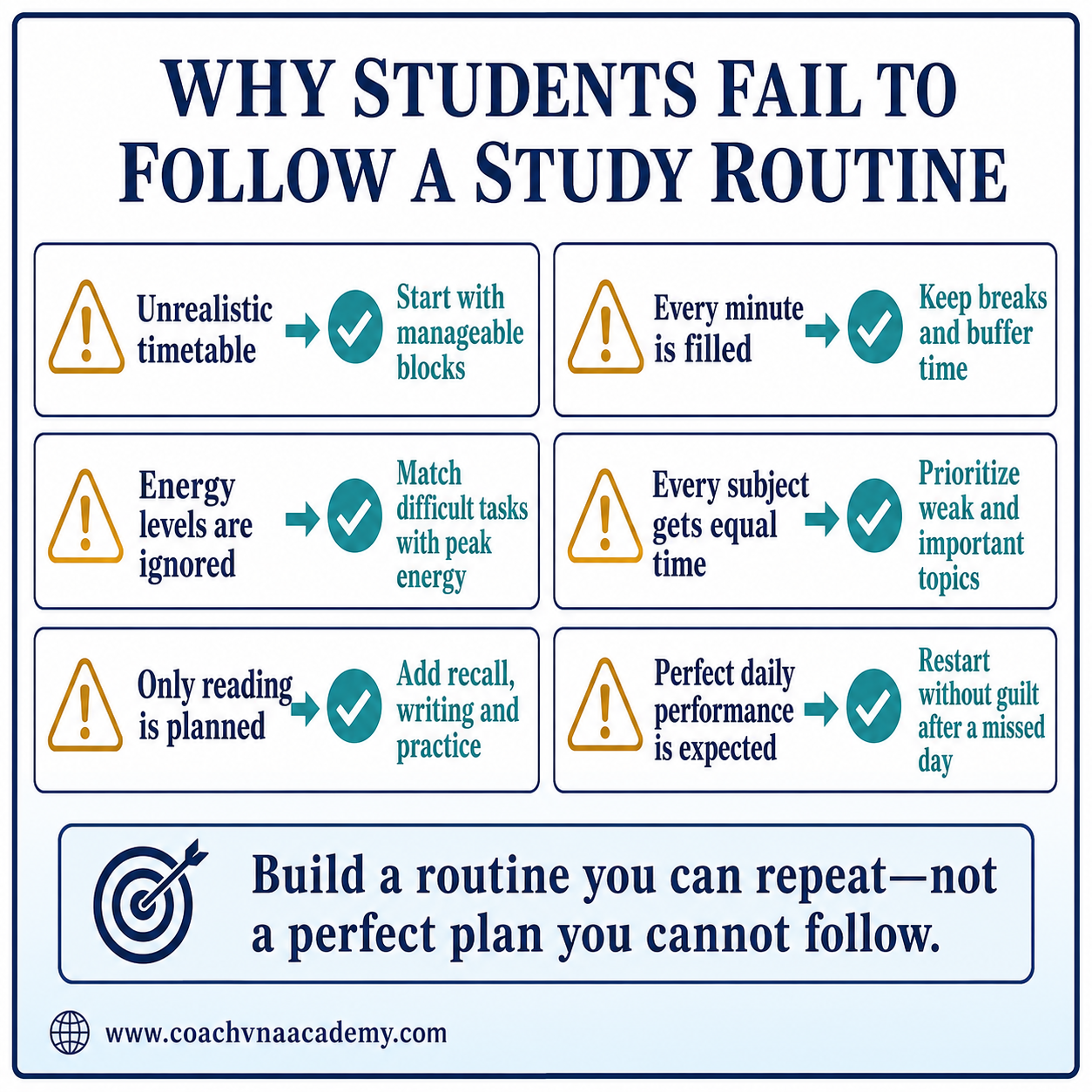
Students do not always abandon a routine because they are careless. Often, the routine itself contains practical weaknesses.
Creating an Unrealistic Timetable
A student who currently studies for one hour a day may suddenly plan to study for six hours daily. Such a major change becomes difficult to maintain. Start with a routine that is slightly better than your present pattern. Once it becomes manageable, increase the duration gradually.
Filling Every Available Minute
Some students schedule classes, study sessions, exercise, meals, and other activities without leaving any flexible time. One unexpected delay then affects the entire plan. Your routine should include buffer time for unfinished tasks and unexpected responsibilities.
Ignoring Personal Energy Levels
Not every student concentrates best at the same time. Some students work effectively in the morning, while others understand difficult material better in the evening. Place demanding subjects during your high-energy periods whenever possible.
Giving Equal Time to Every Subject
All subjects do not require the same amount of time. A difficult subject, an approaching test, or a weak topic may need greater attention. Your routine should reflect academic priorities rather than distribute time mechanically.
Planning Only Reading Sessions
Reading is only one part of learning. Students also need time for recall, written practice, problem-solving, diagrams, revision, and self-testing. An effective routine includes different learning activities.
Expecting Perfect Daily Performance
No student follows a routine perfectly every day. Illness, family responsibilities, college activities, or tiredness may interfere occasionally. The objective is consistency, not perfection.
The Coach VNA ROUTINE Framework™
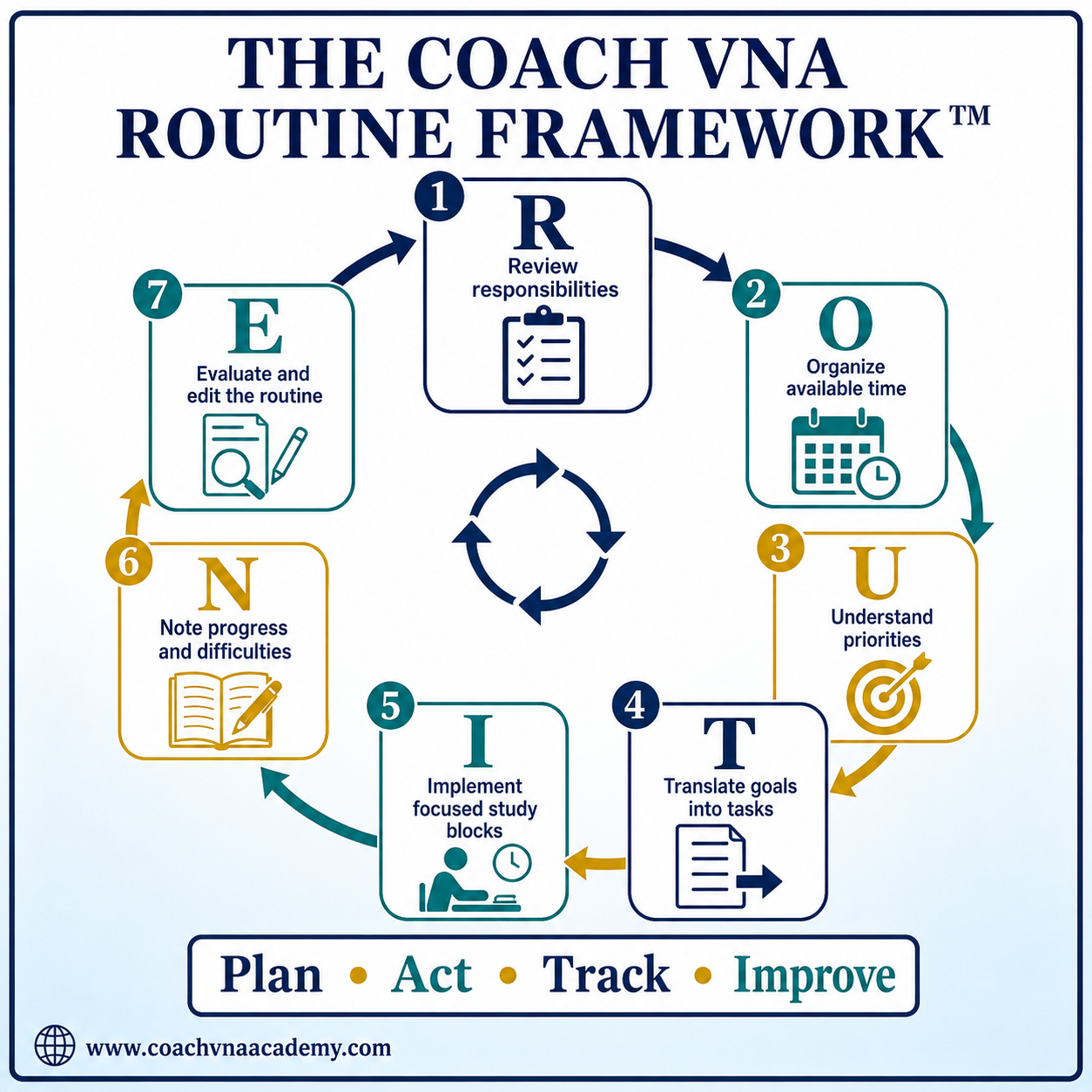
The ROUTINE Framework™ helps students develop a study routine that is realistic, flexible, and connected with academic priorities.
R — Review Your Present Schedule
Before creating a new routine, examine how you currently use your time. For two or three days, record class or college hours, travel time, meals, personal activities, mobile-phone and entertainment time, household responsibilities, present study time, sleep, and rest. Adequate sleep helps students stay focused, improve concentration, and support academic performance, as explained in this CDC guidance on student sleep. This time audit reveals where your hours actually go and prevents you from planning around imagined free time.
O — Organize Subjects by Priority
List all subjects and classify them as high priority (weak subjects, difficult topics, approaching tests, incomplete work), medium priority (regular practice or revision), or maintenance priority (familiar topics needing brief periodic review). Priorities may change every week.
U — Use Realistic Study Blocks
Divide available time into manageable blocks: 25–30 minutes for beginners or easily distracted students, 40–50 minutes for ordinary focused study, or 60–90 minutes for deeper work with a suitable break. Give each block a clear target. Instead of “Study chemistry,” write “Revise the mechanism of nitration and answer five related questions.”
T — Track Daily Completion
At the end of the day, mark each task as completed, partially completed, postponed, or no longer necessary. Tracking reveals patterns and helps improve the routine; it should never become a tool for self-criticism.
I — Include Revision and Rest
Include brief review of the previous class, weekly revision, practice questions, active recall, and periodic self-testing. Adequate sleep, short breaks, meals, and physical movement also support attention and learning.
N — Notice What Is Not Working
Ask which blocks you regularly miss, which subjects receive too little time, when concentration is strongest, which tasks take longer than expected, what distracts you, and whether you are completing work or merely spending time at the desk.
E — Edit the Routine Every Week
Review completed and unfinished work, identify the reason for incomplete tasks, update priorities, adjust block duration, and schedule revision. Do not abandon the entire routine because one part failed; edit the weak part and continue.
| STUDENT SUCCESS CHECK™ How much time can I genuinely devote to focused study on an ordinary weekday? A realistic two-hour routine is more valuable than an unrealistic six-hour plan. |
How to Create Your Weekly Study Routine
When preparing an effective study routine for students, fixed commitments and genuine free time should be identified first.
Step 1: Enter Your Fixed Commitments
Record school or college hours, coaching classes, travel time, meals, family duties, and sleep.
Step 2: Identify Your Available Study Periods
Look for periods in which focused study is genuinely possible. Do not count every free minute as study time.
Step 3: List Your Weekly Academic Tasks
Include topics taught in class, assignments, practical records, difficult concepts, upcoming tests, pending work, revision, and practice questions.
Step 4: Decide the Weekly Priorities
Mark the most urgent or important tasks. Give additional time to subjects that need greater effort.
Step 5: Assign Specific Tasks to Study Blocks
Avoid vague entries such as “Study biology.” Use clear targets such as “Revise photosynthesis and draw the related diagram twice.”
Step 6: Add Revision and Buffer Periods
Keep at least one weekly block for revision and another for incomplete work. Buffer periods prevent a missed session from disturbing the whole week.
Step 7: Review the Plan at the End of the Week
Check what worked, what failed, and what needs to change.
Sample Study Routine for a College Student
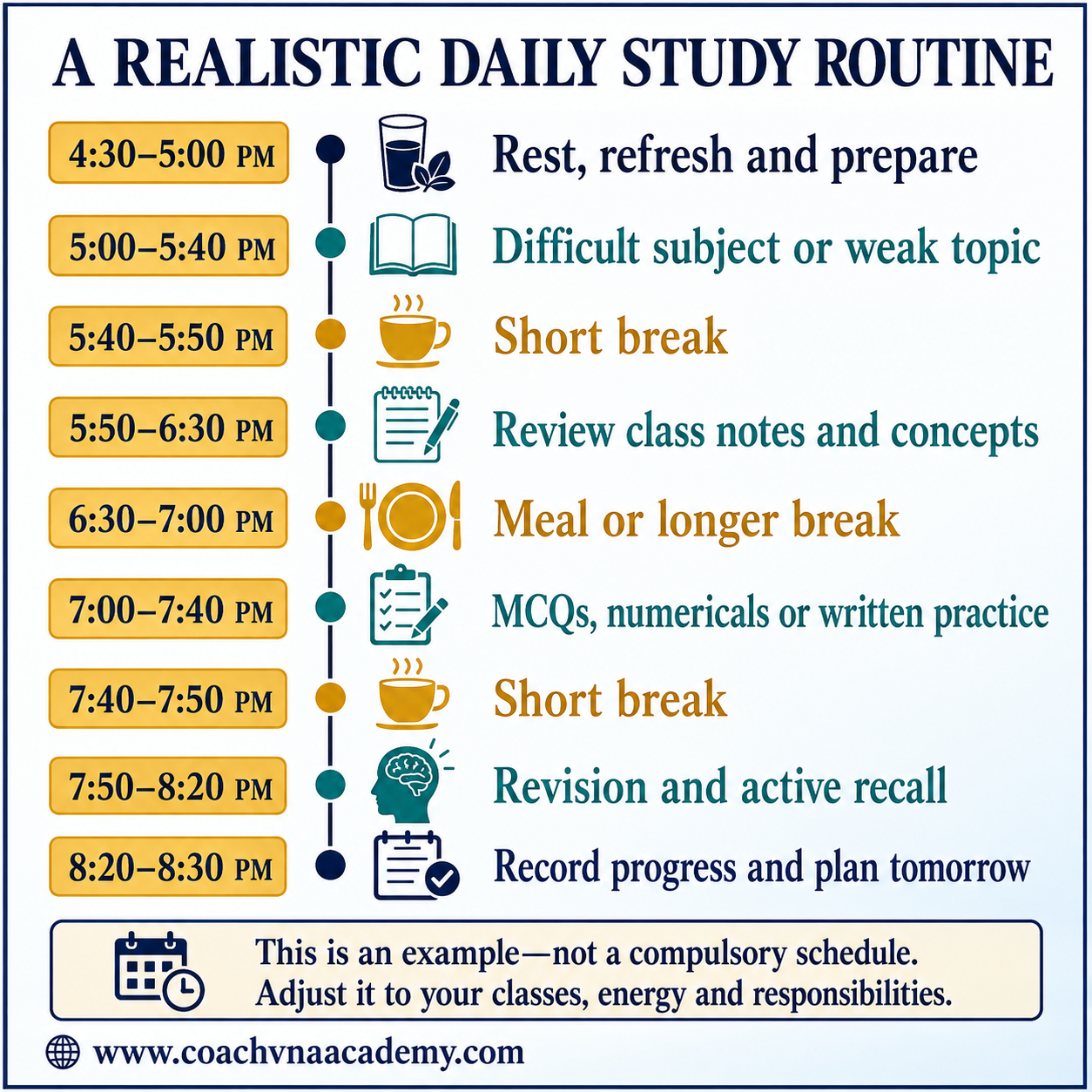
The following example is only a model. Modify it according to your classes, travel, responsibilities, and energy levels.
| Time | Suggested activity |
| 6:30–7:00 a.m. | Review formulas, definitions, reactions, or key points |
| College hours | Attend classes actively and note unclear concepts |
| 5:00–5:30 p.m. | Rest and refreshments |
| 5:30–6:15 p.m. | Review topics taught that day |
| 6:15–6:30 p.m. | Short break |
| 6:30–7:15 p.m. | Work on a difficult or high-priority subject |
| 7:15–8:00 p.m. | Dinner, family time, or relaxation |
| 8:00–8:45 p.m. | Assignment, written practice, or problem-solving |
| 8:45–9:00 p.m. | Recall key points and plan the next day |
| Before sleep | Keep the phone away and prepare for sufficient sleep |
A student with a long commute or household responsibilities may need a shorter weekday routine and longer weekend sessions. That adjustment is completely acceptable.
How Can You Follow the Routine Consistently?
Following an effective study routine for students becomes easier when each session has a clear and manageable target.
Begin with a Small Commitment
Do not wait until you feel completely motivated. Start with one focused block. Beginning often reduces resistance.
Prepare the Study Environment
Arrange your books, notebook, water, and required materials before the session. Keep unrelated devices and distractions away.
Use a Visible Daily Target
Write the most important task where you can see it. A clear target reduces unnecessary switching.
Connect Study with an Existing Activity
For example: “After evening tea, I will begin my first 40-minute study block.” This connection makes the starting time easier to remember.
Measure Completed Work, Not Only Study Hours
Track completed topics, solved questions, recalled concepts, and corrected mistakes—not simply time spent at the desk.
Reward Consistency Appropriately
After a demanding task, take a short walk, speak with family, listen to music, or enjoy another healthy break. Avoid rewards that turn a short break into an hour of distraction.
What Should You Do If You Miss a Study Session?
Missing one session does not mean that the routine has failed. Use this recovery process:
- Identify why you missed the session.
- Decide whether the task is still important.
- Move it to a buffer period or another suitable block.
- Reduce the task if it was too large.
- Resume the routine at the next scheduled session.
Do not try to complete every missed task late at night. Protect your sleep and reorganize the work intelligently.
| COMMON STUDENT MISTAKE “I have already wasted today, so I will start again tomorrow.” Instead, ask: “What is the smallest useful action I can still complete today?” Even ten minutes of revision can restore momentum. |
A Realistic Student Example
Suppose Aarav attends college from 9:00 a.m. to 4:00 p.m. and reaches home at 5:00 p.m. He initially prepares a plan requiring five hours of daily study. After three days, tiredness and unfinished assignments make the routine impossible.
Using the ROUTINE Framework™, Aarav reviews his actual schedule and finds that he can manage two focused weekday blocks. He places his most difficult subject in the first block and uses the second for assignments or revision. He also keeps Saturday afternoon for incomplete work and Sunday evening for weekly revision. His new routine appears less ambitious, but he follows it more consistently. As a result, he completes more meaningful work and experiences less examination pressure.
| REMEMBER The best routine is not the one with the greatest number of study hours. It is the one that produces regular, focused learning. |
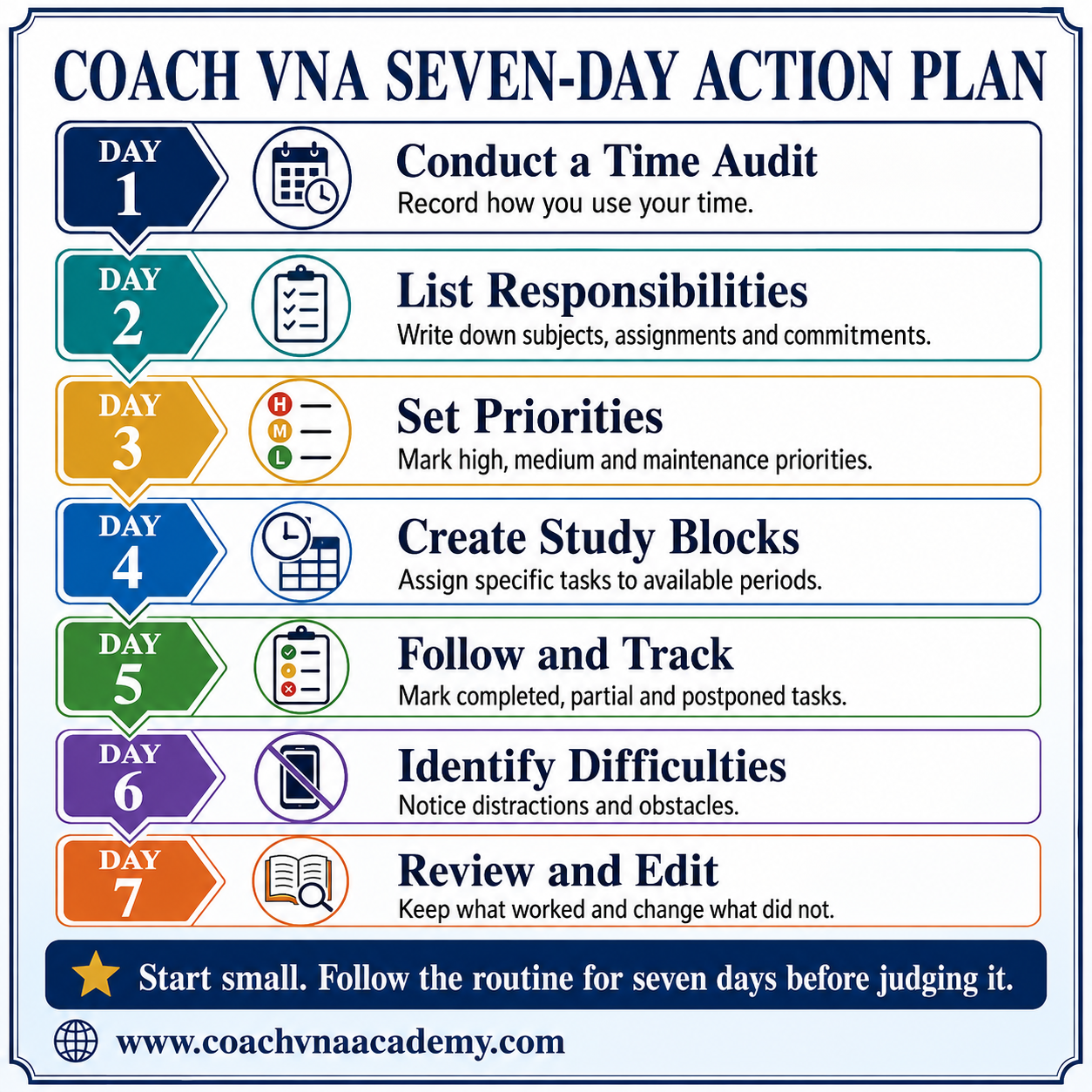
Coach VNA Seven-Day Action Plan
Day 1: Conduct a Time Audit
Record how you use your time throughout the day.
Day 2: List Subjects and Responsibilities
Write down classes, assignments, weak topics, tests, and other commitments.
Day 3: Set Priorities
Mark high-, medium-, and maintenance-priority subjects.
Day 4: Create Realistic Study Blocks
Assign specific academic tasks to the available periods.
Day 5: Follow and Track the Routine
Mark completed, partial, and postponed tasks.
Day 6: Identify Distractions and Difficulties
Notice what prevents you from following the plan.
Day 7: Review and Edit
Keep what worked and modify what did not.
Student Reflection Corner
- At what time of day do I concentrate most effectively?
- Which subject or task do I postpone most frequently?
- How much focused study time can I manage consistently?
- Does my routine include revision, practice, sleep, and rest?
- What is one change that would make my present routine more realistic?
Key Takeaways
Ultimately, an effective study routine for students develops through regular practice, weekly review, and realistic adjustment.
- An effective study routine must match your real life, priorities, and energy levels.
- Specific study targets work better than vague instructions.
- Difficult and urgent subjects may require more time than familiar subjects.
- Revision, active recall, written practice, rest, and sleep belong in the routine.
- Tracking helps you improve your system without criticizing yourself.
- Missing one session does not destroy your progress.
- Consistency produces better results than an impressive but unrealistic timetable.
Frequently Asked Questions
How Many Hours Should a Student Study Every Day?
There is no single number suitable for every student. The required time depends on class hours, academic level, subjects, learning needs, and examination schedule. Begin with a realistic duration and focus on the quality of learning.
Is Studying Early in the Morning Always Better?
Morning study works well for some students, but it is not compulsory. Identify the period when you remain alert and can study without major interruption. Protect adequate sleep regardless of the time you choose.
Should I Study Every Subject Daily?
Not necessarily. Some subjects require daily practice, while others can be studied on selected days. However, avoid ignoring any subject for a long period.
What Is the Best Duration for One Study Session?
Many students can begin with 25–50 minutes of focused study followed by a short break. More experienced learners may use longer blocks for demanding tasks. Adjust the duration according to your concentration and the activity.
What Should I Do If My Routine Stops Working?
Review the routine rather than blaming yourself. Identify changing priorities, unrealistic blocks, distractions, or insufficient rest. Modify the plan and begin again with manageable targets.
From the Teacher’s Desk™
| FROM THE TEACHER’S DESK™ Students sometimes believe that successful learners feel motivated every day. In reality, motivation naturally changes. A practical routine helps you continue working even when enthusiasm is low. Do not aim for a perfect timetable. Aim for a routine that helps you begin, learn, revise, and improve regularly. |
Your Next Step
Take a blank sheet of paper and prepare your first seven-day study routine using the ROUTINE Framework™:
- Review your present schedule.
- Organize subjects by priority.
- Use realistic study blocks.
- Track daily completion.
- Include revision and rest.
- Notice what is not working.
- Edit the routine every week.
Follow it for seven days before judging the result. At the end of the week, improve the routine instead of abandoning it.
Student success does not result from one perfect day. It grows through small, purposeful actions repeated consistently.
| RECOMMENDED NEXT ARTICLE How to Manage Time Effectively in Student Life: Practical Strategies That Work |