
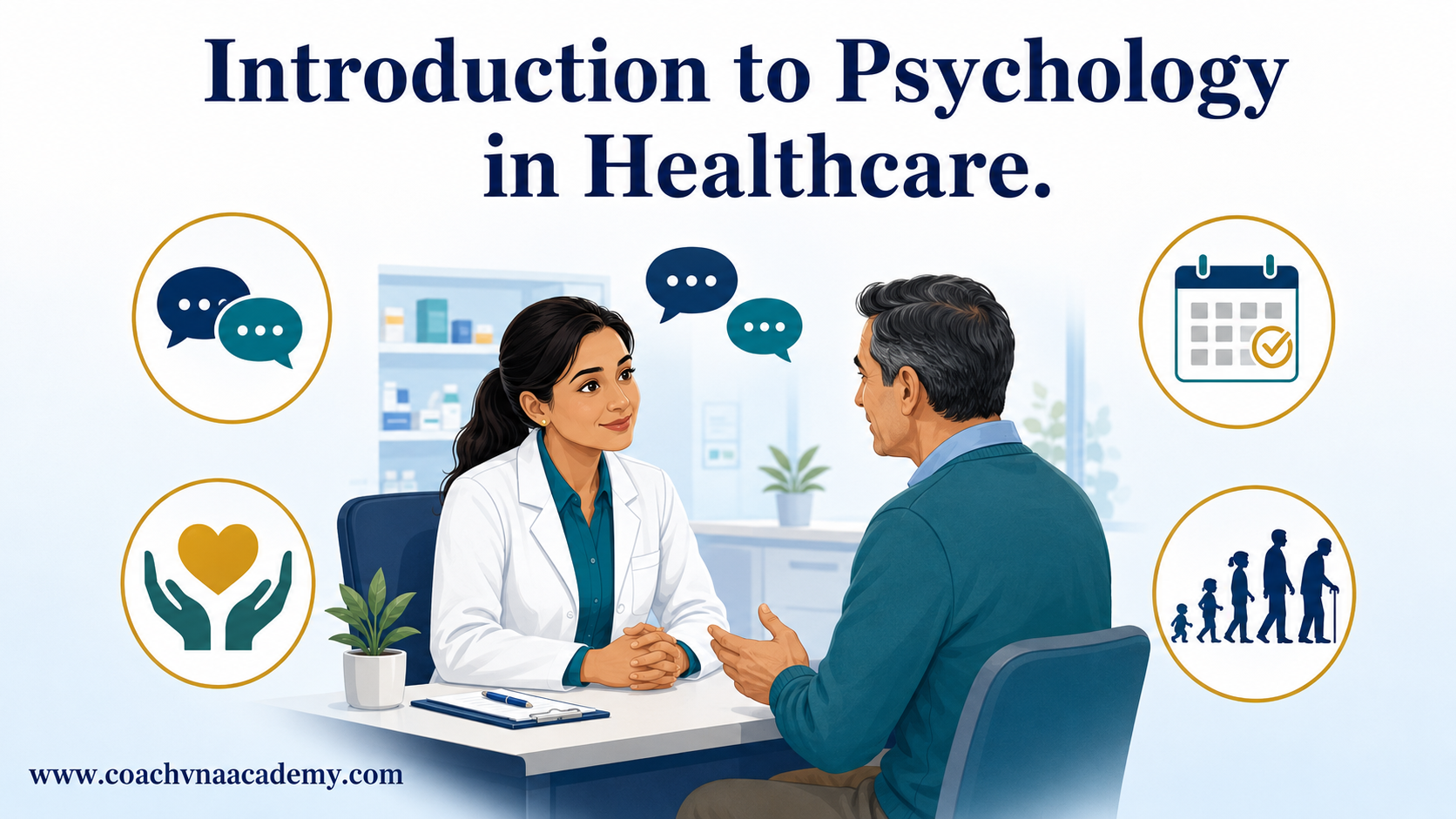
Psychology in healthcare helps us understand how people think, feel, and behave in situations involving health, illness, and treatment. Patients bring their own beliefs, emotions, habits, and experiences to every healthcare interaction. Therefore, understanding these factors helps pharmacists communicate clearly, recognize patients’ concerns, and provide respectful, patient-centered support. This article introduces the meaning and scope of psychology, explains its relevance to pharmacy practice, and explores four key branches: clinical, health, behavioral, and developmental psychology.
Psychology in Healthcare: Meaning, Scope and Branches
A patient may understand a treatment plan yet find it difficult to follow. Another may remain silent even when confused. These situations show why healthcare professionals need to understand people as well as diseases and medicines. Psychology in healthcare helps us examine behavior, thoughts and feelings so that communication responds to the person’s actual needs.
For a pharmacy student, this knowledge forms a foundation for respectful counseling, clearer explanations and appropriate teamwork. It also reminds us to ask about practical difficulties. A problem with medicine use may involve cost or availability as well as beliefs, emotions or habits.
Learning focus
After studying this article, you should be able to define psychology, distinguish behavior from mental processes, explain its scope and healthcare relevance, compare four branches, and apply a psychological perspective to a simple pharmacy situation.
What Is Psychology?
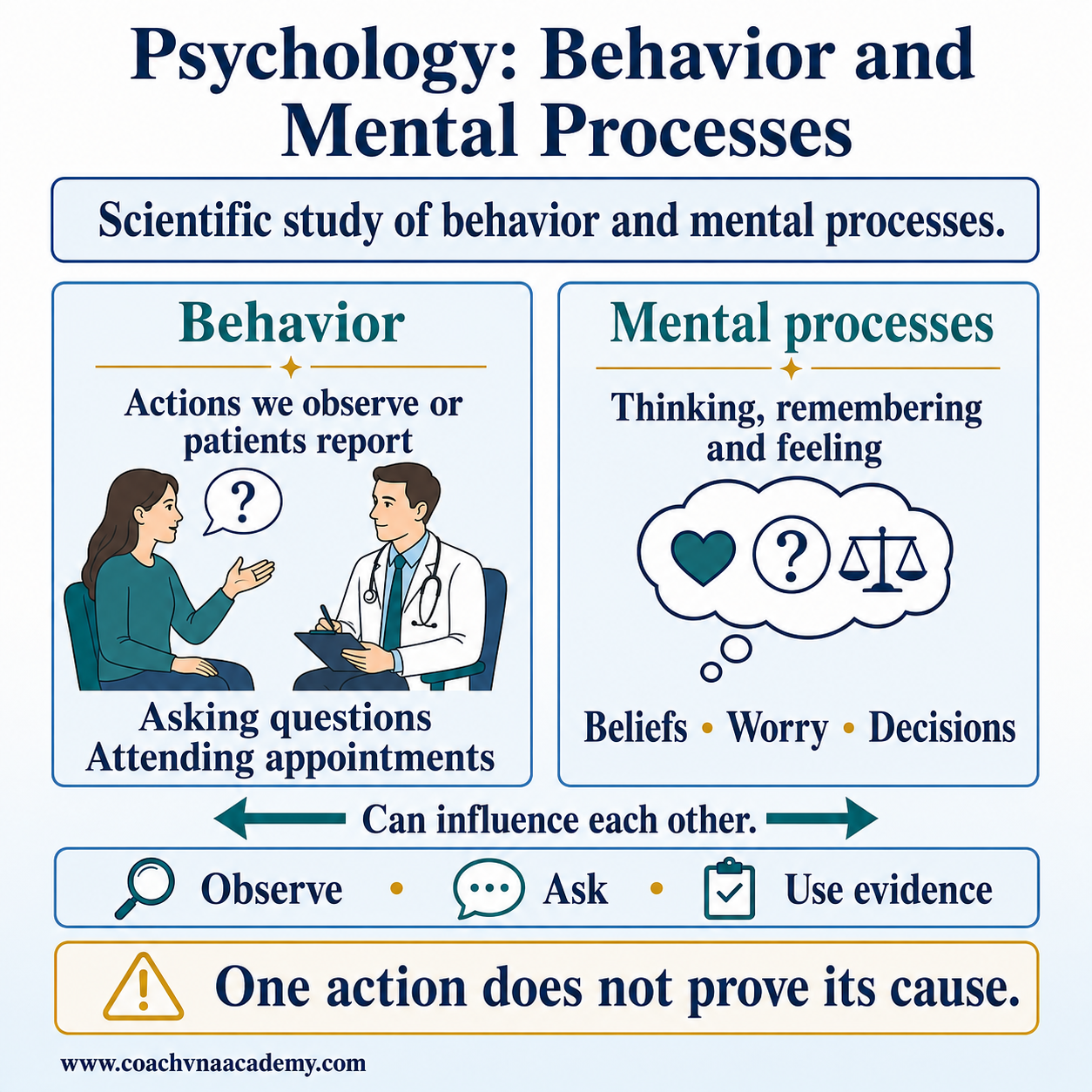
Psychology is the scientific study of behavior and mental processes.
Behavior refers to actions or responses that we can see or hear. It may involve asking a question, attending an appointment or taking a medicine. For example: A patient says, “I did not refill my medicine”.
Mental processes is a thought or feeling inside the patient’s mind. It include thinking, remembering, perceiving, deciding and feeling. For example: The patient may think, “I feel better, so I no longer need this medicine.” Psychologists study these processes through evidence rather than guesswork.
The word scientific matters. An explanation should depend on systematic observation, suitable questions and research, rather than a stereotype or a single impression. We cannot know the patient’s thoughts only by observing their behaviour. For example, a patient’s silence may reflect confusion, uncertainty, language difficulty, privacy concerns or a wish to listen. Silence alone does not tell us which explanation is correct. Therefore, the pharmacist should ask politely before reaching a conclusion.
Behavior, mental processes and scientific understanding
| Basis | Behavior | Mental processes |
| Meaning | Actions or responses that can be observed or reported. | Internal activities and experiences such as thought, memory and emotion. |
| Healthcare example | A patient reports missing a refill. | The patient may believe the medicine is unnecessary. |
| How we investigate | Observation, patient reports or appropriate records. | Respectful questions, self-report and suitable psychological methods. |
| Caution | An action does not prove its cause. | Do not infer a private experience from appearance alone. |
Behavior and mental processes influence each other, but the relationship is not always simple. Worry may lead someone to avoid a conversation; avoidance may then leave the worry unresolved. Nevertheless, we must ask what the person experiences before deciding why an action occurred.
What Makes Psychology Scientific?
Psychology uses methods such as observation, interviews, surveys and experiments to investigate questions. Each method has strengths and limitations. A patient’s account provides valuable information, while a single encounter rarely supports a broad conclusion about personality or mental health.
Four useful introductory goals are to describe behavior, explain possible influences, predict likely patterns and support beneficial change.
- Describe Behavior: What is happening accurately? Example: A pharmacist observes that a patient repeatedly forgets the evening medicine.
- Explain possible influences. Example: Identify possible causes, such as a busy routine, unclear instructions or fear of side effects.
- Predict likely patterns, not certainty. Example: The pharmacist expects that the patient may continue missing doses without reminders or simpler instructions.
- Support beneficial change. Provide a medication chart, sets reminder cues and explains the treatment clearly to improve adherence
Prediction concerns probabilities rather than certainty. In healthcare, efforts to change behavior must respect consent, autonomy and the patient’s priorities.
For example, a professional first describes a missed appointment accurately. Next, they explore transport, timing and concerns. They then agree on suitable support and review whether it helps. They should not assume a cause, guarantee an outcome or use psychological knowledge to manipulate the patient.
Scope of Psychology in Healthcare
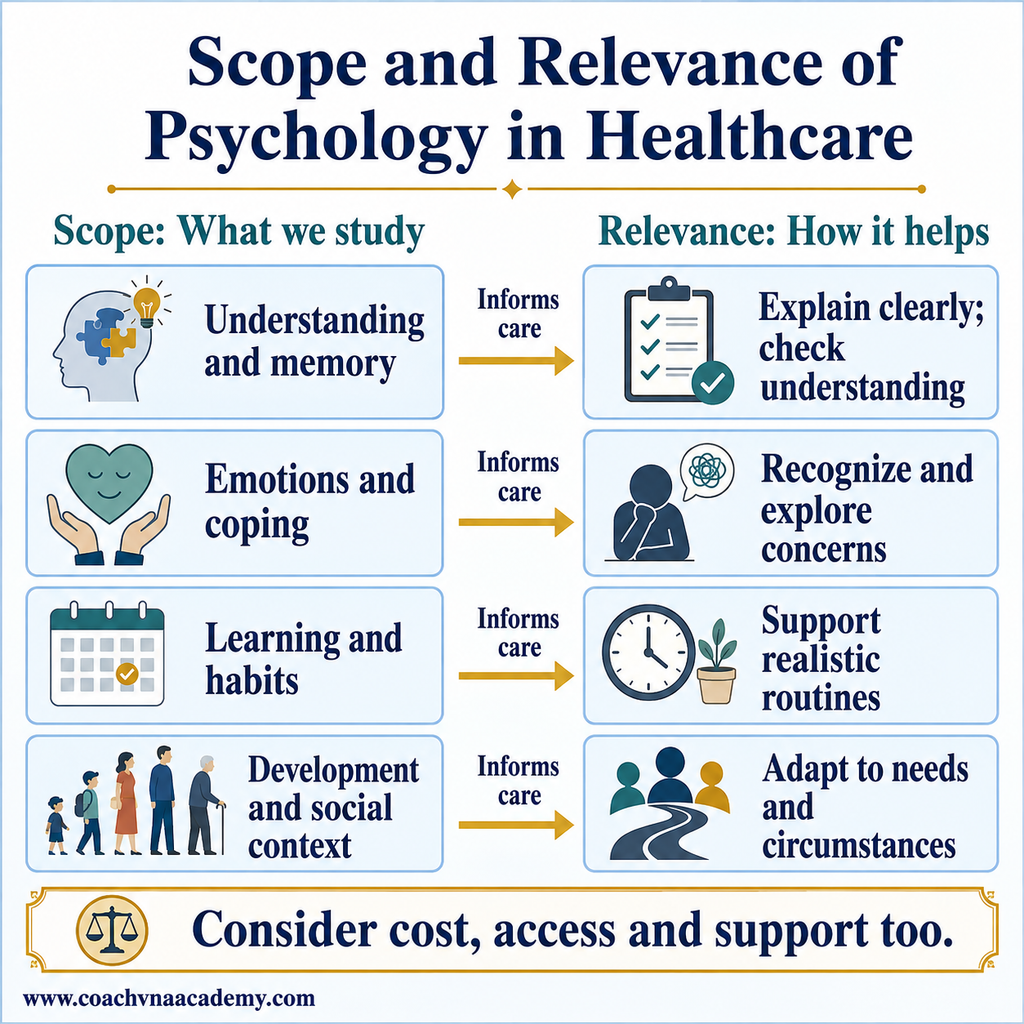
The scope of psychology describes the areas it studies. In healthcare, these areas connect the person’s experience with illness, treatment, relationships and the care environment. Psychology does not replace biological explanations or medical assessment; it adds information about how people understand and respond to their circumstances.
Thinking, understanding and remembering
People notice, interpret and remember information differently. A long explanation may overwhelm a patient, especially when the setting feels unfamiliar. Understanding these processes encourages short, clear messages and a check of what the person understood.
Emotions and coping
Fear, frustration, hope and uncertainty can shape a healthcare encounter. A patient who worries about a procedure may need time to ask questions. Recognizing emotion supports a respectful response; it does not mean that a normal emotional reaction is a mental disorder.
Learning, habits and health-related actions
Psychology examines how people acquire skills and routines, and why they continue or discontinue an action. A person may need a demonstration, repeated practice or a practical cue. However, a reminder cannot solve a lack of money or medicine supply. Support should match the barrier rather than rely on one standard solution.
Development, relationships and context
Abilities, needs and responsibilities change across life. Family involvement, language, social support, past experiences and the healthcare environment may also affect communication. Age and culture offer context, but they do not justify assumptions about an individual. Ask about needs and preferences directly.
Why Psychology Matters in Pharmacy Practice
Understanding concerns before giving advice
A patient’s question often contains more than a request for facts. “Will I need this for a long time?” may reflect uncertainty about illness, cost or treatment burden. An open question helps reveal what the person wants to understand. Consequently, the professional can give a more relevant explanation instead of repeating information the patient already knows.
Supporting understanding and treatment participation
Clear language, manageable amounts of information and opportunities for questions can support participation. To check clarity, a professional may invite the patient to explain the agreed plan in their own words. This teach-back approach checks the explanation rather than tests the patient. If the explanation was unclear, the professional explains it differently and checks again. [2]
Treatment adherence means the extent to which a person’s actions correspond with recommendations agreed with a healthcare professional. A missed dose may arise from several interacting barriers. Explore concerns, everyday demands and access difficulties without blame; do not interpret adherence as obedience or moral worth.
Responding respectfully to distress and differences
A calm tone and an acknowledgment of concern can make a conversation easier. Professionals should also adapt explanations to the patient’s language, understanding and preferences. For example, ask an older adult which format is most useful rather than assuming poor memory. A child may benefit from simple concrete language, with appropriate caregiver involvement.
Working within professional boundaries
Psychological knowledge supports observation, communication and appropriate referral. It does not authorize a student to diagnose a disorder, provide independent psychotherapy or alter medicines. When concerns exceed the learner’s role, involve the supervising professional and follow local procedures. Persistent or severe distress deserves qualified assessment, not a classroom label.
Four Branches of Psychology Relevant to Healthcare
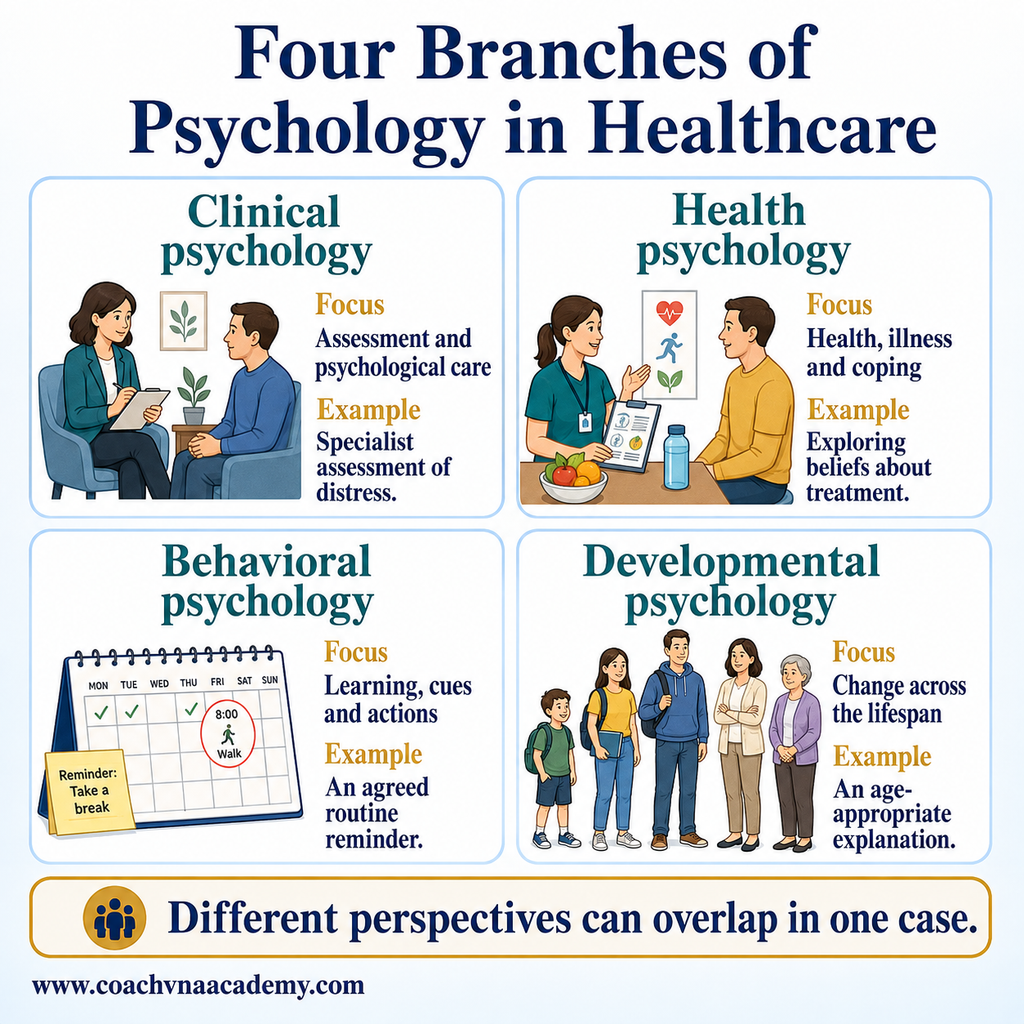
Clinical psychology
Clinical psychology concerns the understanding, assessment and psychological care of mental, emotional and behavioral difficulties. It helps identify and manage problems like distress (extreme pain) and difficulties. Example: Helping a patient cope with anxiety during long-term treatment.
Qualified clinical psychologists work with people who experience distress or impaired functioning. In healthcare, their work may include assessment, psychological interventions and collaboration with other professionals. A pharmacy student’s role is to communicate respectfully and recognize when supervision or referral is needed.
Health psychology
Health psychology studies how psychological, behavioral and social factors relate to health and illness. In short it explain how thoughts, emotions and habits affect physical health. It addresses health promotion, illness prevention, coping with health conditions and participation in care. Example: Encouraging a patient to follow medication, diet and exercise advice during long-term treatment.
Behavioral psychology
Behavioral psychology focuses on behavior, learning, habits, rewards and the influence of the environment. It asks how experiences, cues and consequences shape actions. Example: A pharmacist uses a daily reminder and medicine-tracking chart to help a patient take medicines regularly. The effect depends on the person and setting; support must remain respectful and voluntary.
Developmental psychology
Developmental psychology studies how behaviour and healthcare needs change with age throughout life. Its scope includes childhood, adolescence, adulthood and older age. It helps healthcare professionals consider changing abilities and needs without assuming that every person of the same age is alike. For example, a pharmacist explains medicine differently to a child, an adult and an older patient.
Comparing the Branches: Application Guide
| Branch | Main focus | Illustrative healthcare application |
| Clinical | Assessment and psychological care of distress and difficulties. | A qualified specialist assesses distress affecting daily functioning. |
| Health | Psychological and social influences on health and illness. | A team explores beliefs and coping during long-term treatment. |
| Behavioral | Learning, cues, consequences and actions. | A patient tests an agreed reminder tied to a daily routine. |
| Developmental | Change and continuity across the lifespan. | An explanation matches a child’s level of understanding. |
Clinical versus health psychology: Clinical psychology emphasizes assessment and psychological care of difficulties; health psychology emphasizes psychological influences on health, illness and healthcare. Their work overlaps, particularly when a person with a physical illness experiences distress. Neither branch is limited to a single type of patient.
Behavioral versus developmental psychology: Behavioral psychology asks how behavior develops through learning and environmental conditions. Developmental psychology examines psychological change and continuity across the lifespan. A child learning a healthcare routine can illustrate both perspectives.
Psychology and Psychiatry: a brief clarification
Psychology is a broad scientific discipline, and only some psychologists work in clinical practice. It studies thoughts, emotions and behaviour. Psychologists mainly use counselling and behavioural techniques. Only some psychologists work in clinical practice. Training and roles vary. Example: A psychologist helps a patient overcome fear of taking medicines through counselling.
Psychiatry is a medical specialty concerned with mental health. It diagnoses and treats mental disorders. Psychiatrists can prescribe medicines. Professionals have different training and roles and may work together. Example: A psychiatrist diagnoses depression and prescribes an antidepressant, which the pharmacist dispenses with proper counselling.
This introductory lesson does not provide a qualification to practice either specialty.
A Pharmacy Case: From Assumption to Understanding
Fictional case: Mr. Verma says, “I know the treatment matters, but I sometimes miss it.” When asked about difficulties, he explains that he worries about possible harm and sometimes struggles to pay for a refill. The professional now has more useful information than the original label “noncompliant patient.”
Separate observation from interpretation
The known information is that Mr. Verma reports missed treatment, worry and a financial barrier. It is not known whether he has a mental disorder or lacks motivation. His concerns deserve exploration; the affordability problem also needs practical attention. A psychological explanation must not hide social or material barriers.
Apply the branches without forcing a label
Health psychology helps frame beliefs and coping. Behavioral psychology may help explore a routine if forgetting also contributes. Developmental psychology becomes relevant when age-related needs actually affect the situation. Clinical psychology may contribute if assessment of significant distress is needed. Not every case requires all four branches or a referral to every specialist.
Choose a respectful response
Begin: “What makes the plan difficult for you?” Acknowledge what the patient says, give an appropriate plain-language explanation within your role, and ask the supervising professional about relevant support. Check the patient’s understanding of the agreed next step. Do not promise that counseling alone will fix the problem or advise changes to a medicine in this teaching example.
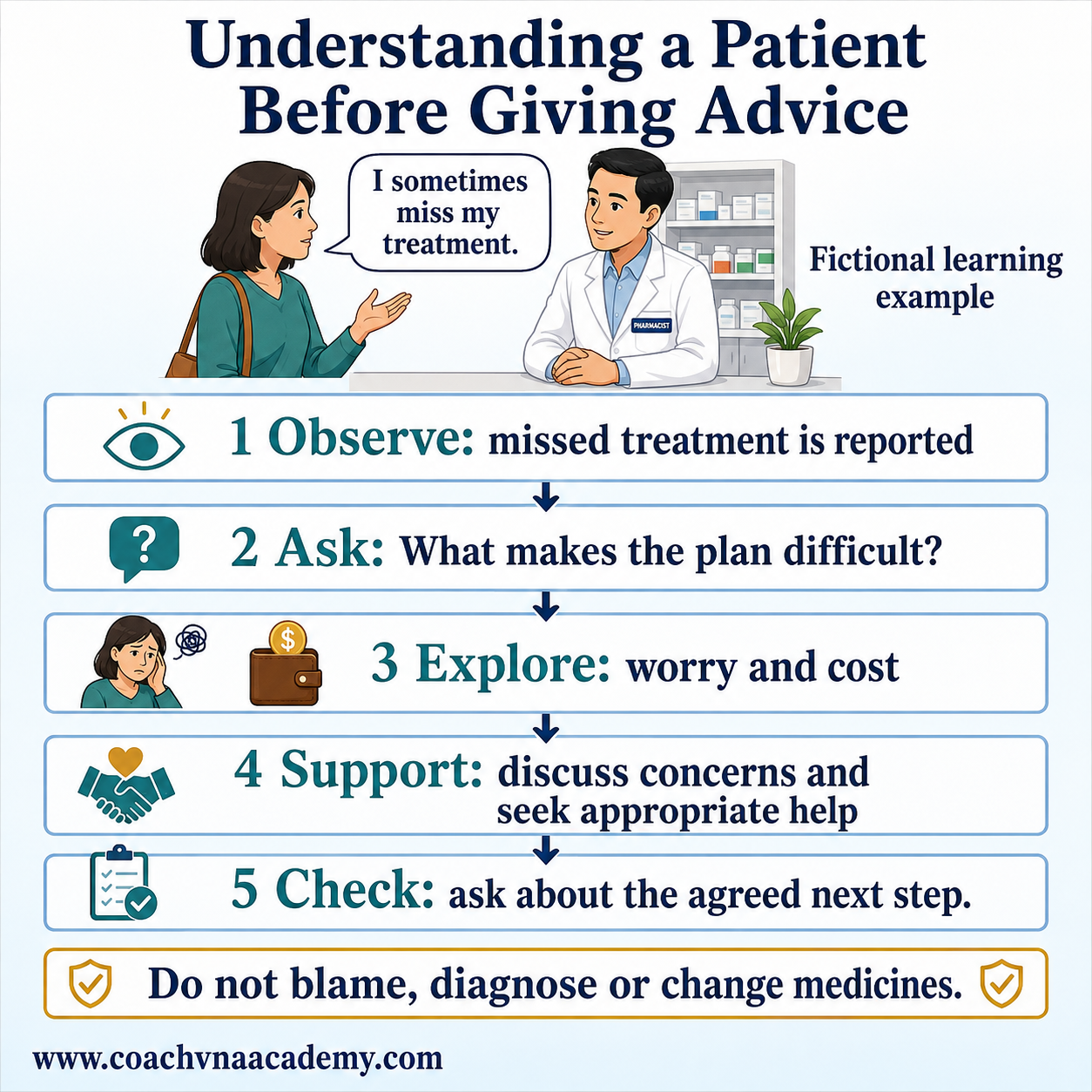
Reflect: Why might repeating instructions fail here? Because the patient already understands the general importance of treatment, while worry and affordability remain unresolved. An effective response needs to address the specific barriers with the appropriate professional team.
References and further reading
[1] American Psychological Association. Psychology subfields. https://www.apa.org/education-career/guide/subfields
[2] Agency for Healthcare Research and Quality. Use the Teach-Back Method: Tool 5. https://www.ahrq.gov/health-literacy/improve/precautions/tool5.html