Introduction
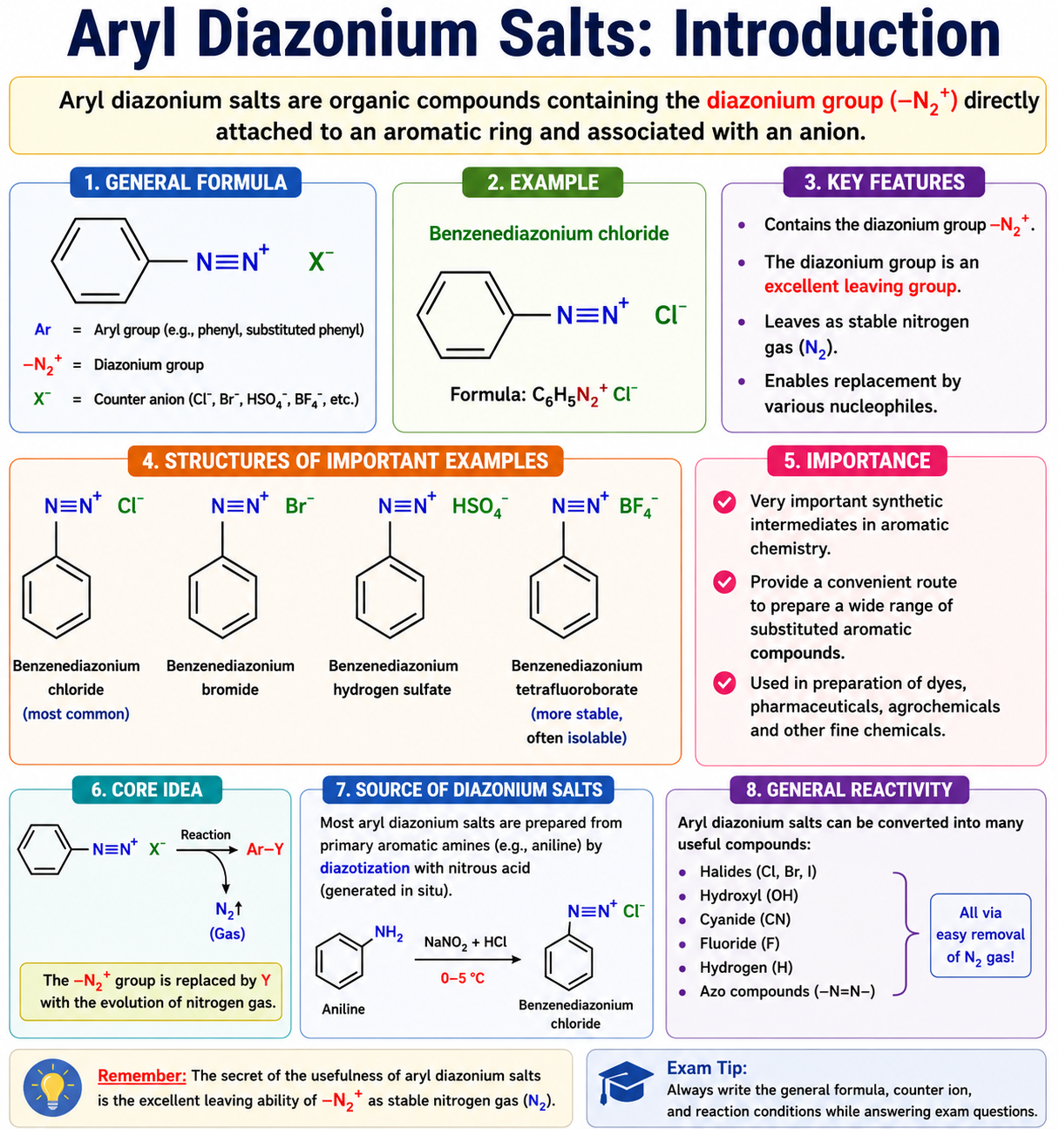
Aryl diazonium salts are important aromatic intermediates because the diazonium group can be replaced by several functional groups. Therefore, they provide useful routes to aromatic compounds that may be difficult to obtain by direct substitution.
Ar-N2+ X–
Here, Ar represents an aryl group, -N₂⁺ is the diazonium group, and X⁻ is the counter-ion.
Benzenediazonium chloride is the most common example. C6H5-N≡N+ Cl–
| Core Idea The diazonium group is an excellent leaving group because it departs as stable nitrogen gas, N₂. This feature explains the high synthetic usefulness of aryl diazonium salts. |
Definition
Aryl diazonium salts are aromatic compounds in which the diazonium group, -N₂⁺, is directly attached to an aromatic ring and is associated with a suitable counter-ion.
| Examination Point Write Ar-N₂⁺ for the aryl diazonium ion and Ar-N₂⁺X⁻ for an aryl diazonium salt. Do not omit the positive charge on the diazonium group. |
Preparation of Benzenediazonium Chloride: Diazotization
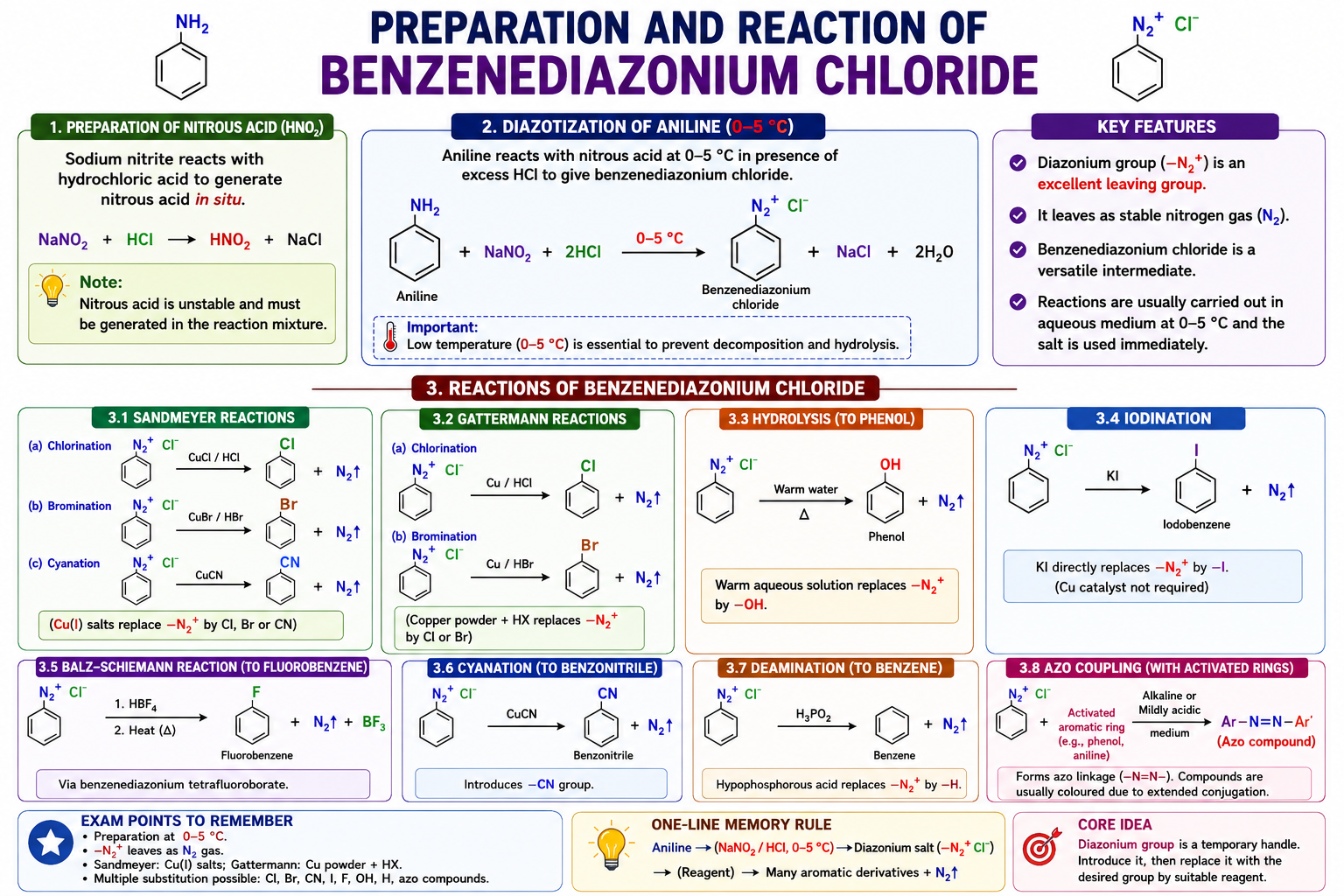
Benzenediazonium chloride is prepared from aniline by diazotization. In this process, sodium nitrite and hydrochloric acid generate nitrous acid in situ, and nitrous acid converts the primary aromatic amine into the corresponding diazonium salt at 0-5 °C.
Step 1: Formation of Nitrous Acid
NaNO2 + HCl → HNO2 + NaCl
Step 2: Diazotization of Aniline
C6H5NH2 + NaNO2 + 2HCl → C6H5N2+Cl– + NaCl + 2H2O
| Essential Condition Maintain the reaction mixture at 0-5 °C throughout diazotization. |
Why Is Low Temperature Essential?
Benzenediazonium chloride remains reasonably stable only in a cold aqueous solution. At higher temperature, hydrolysis or decomposition can occur with the evolution of nitrogen gas. Therefore, low temperature minimizes premature hydrolysis and decomposition of the diazonium salt. It allows the freshly prepared diazonium salt to be used reliably in the next reaction.
Stability of Aryl Diazonium Salts
Aryl diazonium salts are more stable than corresponding alkyl diazonium salts because the aromatic system provides some stabilization. Even so, ordinary aryl diazonium salts are generally handled in cold solution and used soon after preparation. Heating usually promotes loss of nitrogen and further reaction. Most diazonium chlorides are prepared in situ and used immediately. Some aryl diazonium tetrafluoroborates can be isolated more readily.
Synthetic Importance
Aryl diazonium salts act as a synthetic junction. Starting from aniline, chemists can introduce Cl, Br, I, F, CN, OH, or H by choosing a suitable reagent. They also form azo compounds, which have practical importance as dyes, indicators, and analytical reagents.
-NH2 → -N2+ → -Cl / -Br / -I / -F / -CN / -OH / -H
Classification of Reactions
- Replacement reactions: the diazonium group leaves as N₂ and another group takes its place.
- Azo coupling reactions: the diazonium group remains in the product as part of an -N=N- linkage.
Sandmeyer Reactions
In the Sandmeyer reaction, copper(I) salts replace the diazonium group by chlorine, bromine, or cyanide. CuCl, CuBr and CuCN are the classic Sandmeyer reagents.
Formation of Chlorobenzene
C6H5N2+Cl– [CuCl/HCl] → C6H5Cl + N2↑
Formation of Bromobenzene
C6H5N2+Cl– [CuBr/HBr] → C6H5Br + N2↑
Formation of Benzonitrile
C6H5N2+Cl– [CuCN] → C6H5CN + N2↑
Gattermann Reaction
The Gattermann method also introduces chlorine or bromine, but it uses copper powder together with hydrochloric acid or hydrobromic acid rather than a copper(I) salt.
| Feature | Sandmeyer | Gattermann |
| Copper reagent | Cu(I) salt | Copper powder |
| Chlorination | CuCl | Cu + HCl |
| Bromination | CuBr | Cu + HBr |
| Nitrogen evolution | Yes | Yes |
Hydrolysis to Phenol
When an aqueous solution of benzenediazonium chloride is warmed, the diazonium group is replaced by hydroxyl and phenol is formed. Evolution of stable nitrogen gas helps drive the reaction forward.
C6H5N2+Cl– + H2O [warm] → C6H5OH + N2↑ + HCl
Replacement by Iodine
Potassium iodide replaces the diazonium group by iodine. A copper catalyst is generally not required.
C6H5N2+Cl– + KI → C6H5I + KCl + N2↑
Replacement by Fluorine: Balz-Schiemann Reaction
Fluorobenzene is prepared through an aryl diazonium tetrafluoroborate. The diazonium tetrafluoroborate forms first and decomposes on heating to give the aryl fluoride.
C6H5N2+Cl– + HBF4 → C6H5N2+BF4–
C6H5N2+BF4– [Δ] → C6H5F + BF3 + N2↑
Replacement by Hydrogen: Deamination
Hypophosphorous acid replaces the diazonium group by hydrogen. This conversion is valuable when -NH₂ has served as a temporary synthetic handle and must later be removed.
C6H5N2+Cl– [H3PO2] → C6H6 + N2↑
| Synthetic Sequence Ar-NH₂ → Ar-N₂⁺ → Ar-H represents deamination through diazotization. |
Azo Coupling Reaction
Azo coupling differs from replacement reactions because the diazonium group remains in the product as an azo linkage, -N=N-. The diazonium ion behaves as an electrophile and couples with activated aromatic compounds such as phenol, aniline, or β-naphthol.
Coupling with Phenol
Benzenediazonium chloride couples with phenol in alkaline medium, usually at the para position when that position is free, to form a p-hydroxyazobenzene-type product.
C6H5-N=N-C6H4-OH
Coupling with Aniline
Under suitable mildly acidic conditions, aniline undergoes coupling mainly at the para position to form an aminoazobenzene-type product.
C6H5-N=N-C6H4-NH2
| Why Azo Compounds Are Coloured ? The azo linkage forms part of an extended conjugated system. Therefore, many azo compounds absorb visible light and appear intensely coloured. |
Why Does Azo Coupling Often Occur at the Para Position?
Groups such as -OH and -NH₂ activate the ring and direct electrophilic substitution toward ortho and para positions. When the para position is available, it is frequently preferred because steric crowding is lower than at an ortho position.
Why Is Nitrogen Gas an Excellent Leaving Group?
Molecular nitrogen contains a very strong N≡N bond. Formation of stable gaseous N₂ provides a strong driving force for many diazonium reactions. Moreover, its escape from the reaction mixture helps move the reaction toward products.
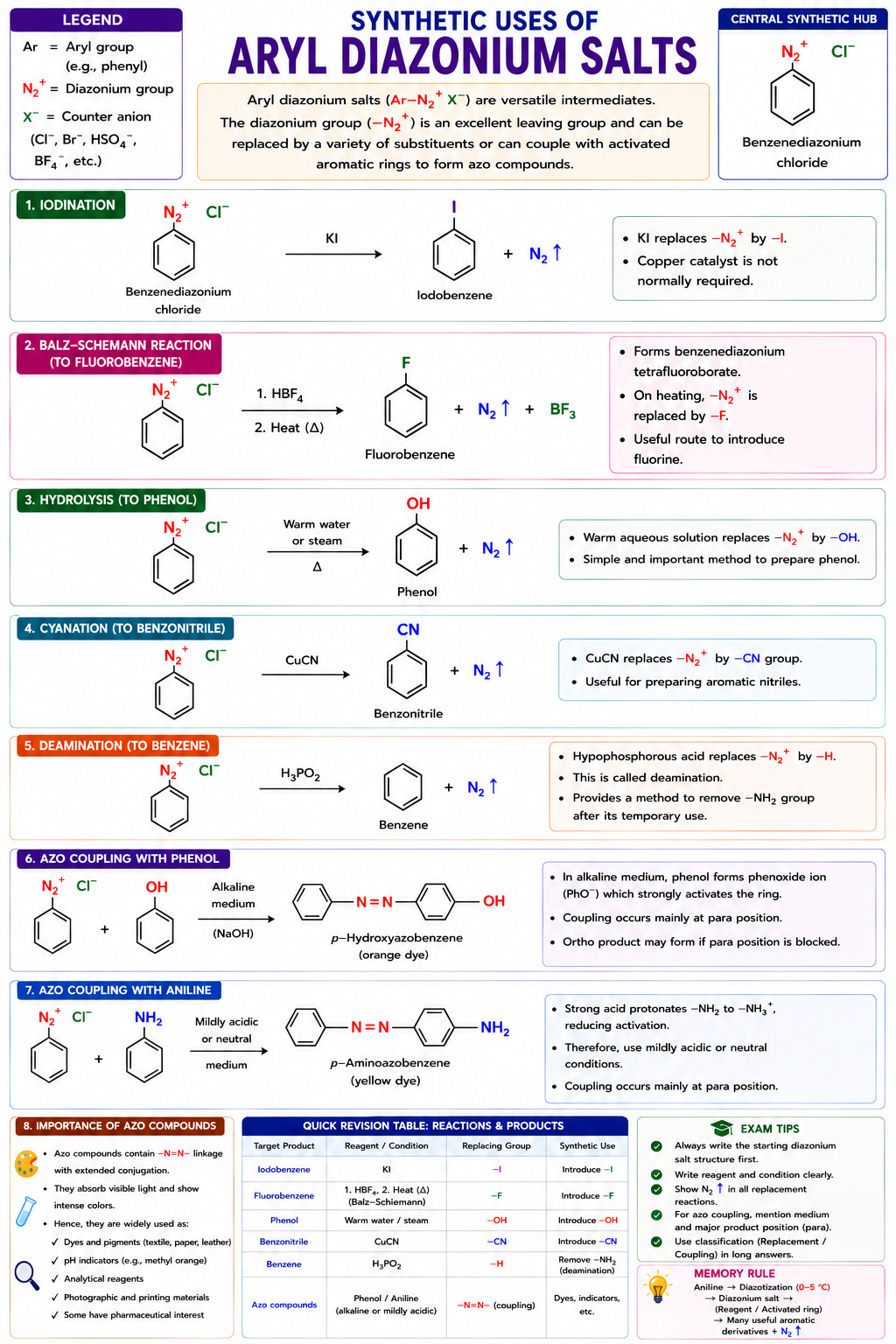
Synthetic Uses of Aryl Diazonium Salts
Aryl diazonium salts serve as versatile synthetic intermediates because the diazonium group can be replaced by several functional groups. Therefore, aniline can act as a starting material for the preparation of haloarenes, phenol, benzonitrile, benzene, and azo compounds.
Diazonium Salt as a Synthetic Hub
Direct substitution does not provide a convenient route to every aromatic derivative. However, diazotization converts the amino group of aniline into a diazonium group, which can then undergo selective replacement. Consequently, one starting material can lead to several useful aromatic products.
Synthetic sequence:
C₆H₅NH₂ → C₆H₅N₂⁺Cl⁻ → C₆H₅Cl / C₆H₅Br / C₆H₅I / C₆H₅F / C₆H₅CN / C₆H₅OH / C₆H₆
Preparation of Iodobenzene
Potassium iodide replaces the diazonium group directly and gives iodobenzene. A copper catalyst is generally not required.
C₆H₅N₂⁺Cl⁻ + KI → C₆H₅I + KCl + N₂↑
Preparation of Fluorobenzene: Balz–Schiemann Reaction
The Balz–Schiemann reaction provides a useful route to fluorobenzene. First, the diazonium salt reacts with fluoroboric acid to form the corresponding diazonium tetrafluoroborate. Then, heating the dry salt releases nitrogen and boron trifluoride and gives fluorobenzene.
C₆H₅N₂⁺Cl⁻ + HBF₄ → C₆H₅N₂⁺BF₄⁻
C₆H₅N₂⁺BF₄⁻ —Δ→ C₆H₅F + BF₃ + N₂↑
Preparation of Phenol, Benzonitrile and Benzene
Three important synthetic conversions are easy to remember: warm water gives phenol, CuCN gives benzonitrile, and hypophosphorous acid gives benzene.
Warm water: C₆H₅N₂⁺Cl⁻ + H₂O —Δ→ C₆H₅OH + N₂↑ + HCl
CuCN: C₆H₅N₂⁺Cl⁻ → C₆H₅CN + N₂↑
H₃PO₂: C₆H₅N₂⁺Cl⁻ → C₆H₆ + N₂↑
Azo Coupling as a Synthetic Use
Azo coupling joins an aryl diazonium ion with an activated aromatic compound and forms an azo linkage, –N=N–. The diazonium ion acts as an electrophile, whereas activated aromatic rings such as phenol and aniline act as coupling partners.
Coupling with phenol:
In alkaline medium, phenol forms phenoxide, which strongly activates the aromatic ring. Coupling occurs mainly at the para position when that position is free; if the para position is blocked, ortho coupling can occur. The principal product is a p-hydroxyazobenzene-type compound.
C₆H₅–N=N–C₆H₄–OH
Coupling with aniline:
Aniline couples under mildly acidic or neutral conditions. Strongly acidic conditions protonate aniline to anilinium ion and reduce ring activation. Therefore, when the amino group remains sufficiently unprotonated, coupling occurs mainly at the para position to form an aminoazobenzene-type compound.
C₆H₅–N=N–C₆H₄–NH₂