
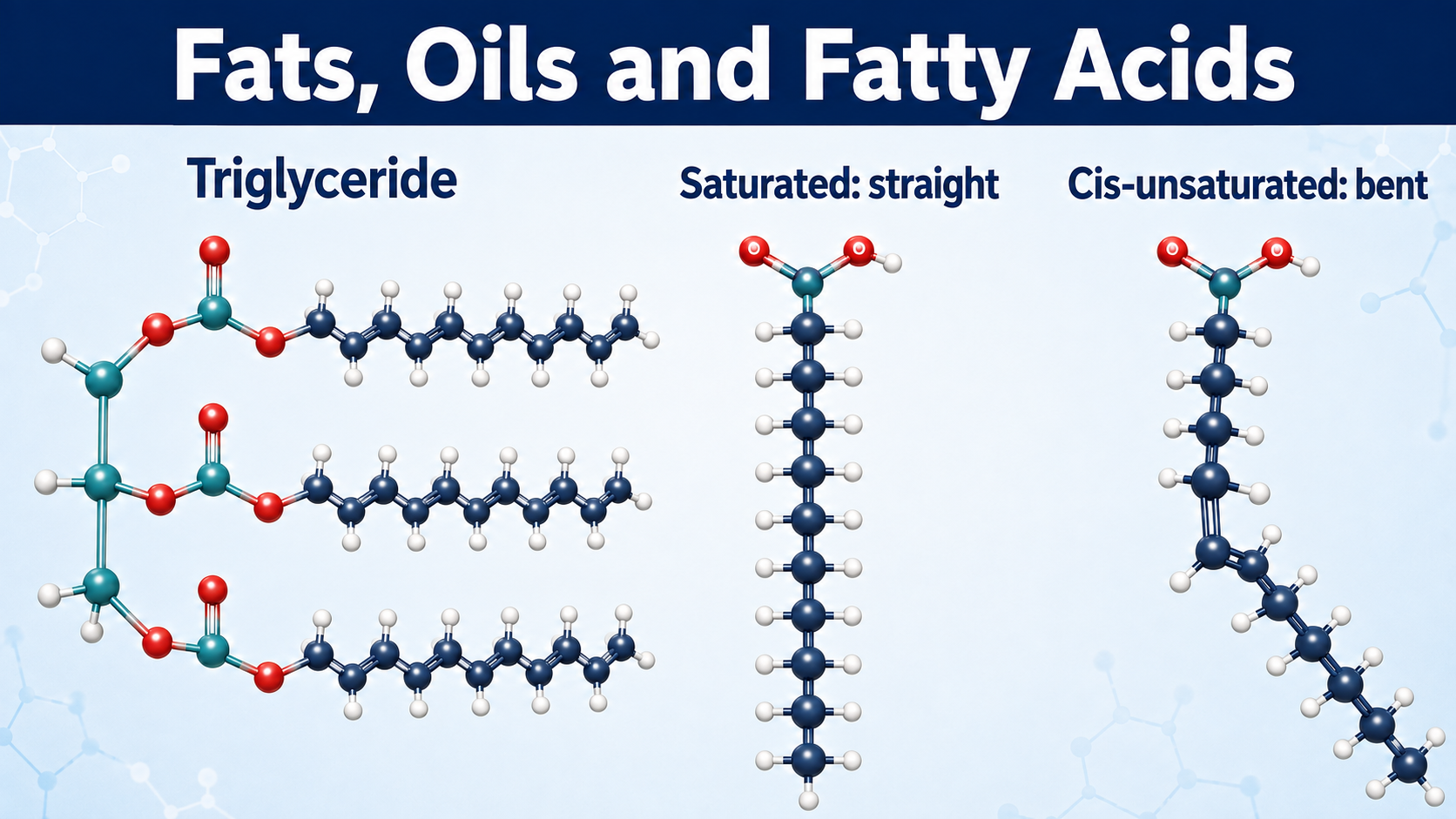
Introduction to Fats and Oils
Fats and oils are important natural lipids that supply energy, store metabolic fuel and carry fat-soluble substances. Chemically, most fats and oils consist mainly of triacylglycerols, also called triglycerides. A triacylglycerol forms when all three hydroxyl groups of glycerol combine with fatty acids to produce ester bonds.
The terms fat and oil describe physical state rather than a different chemical functional group. A fat usually remains solid or semisolid at room temperature, while an oil usually remains liquid. The proportion and geometry of the component fatty acids largely control this behavior.
Chemical Composition: The Triglyceride Framework
Glycerol and fatty acids
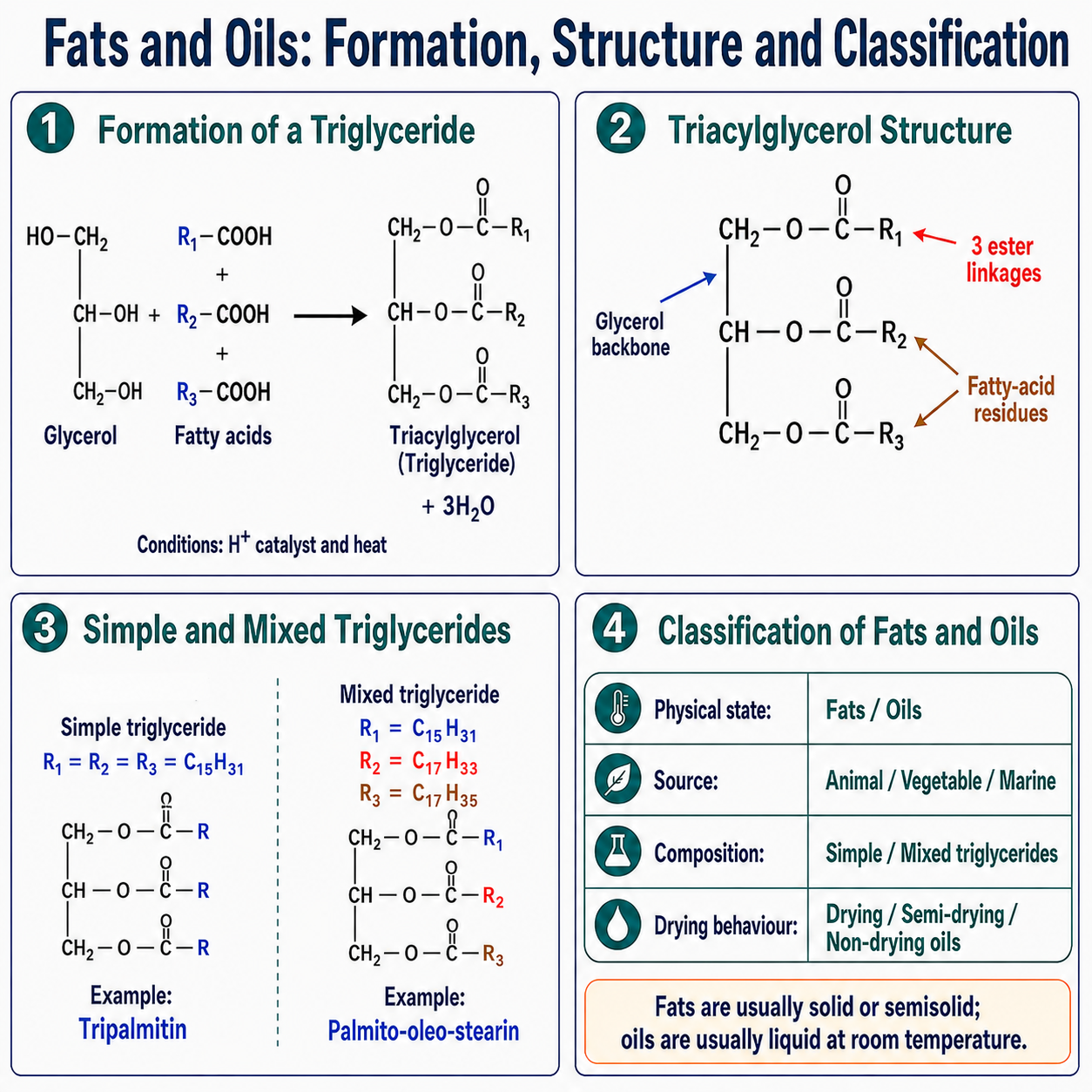
Glycerol is propane-1,2,3-triol. It contains three hydroxyl groups, so it can form three ester linkages. A fatty acid contains a carboxyl group and a hydrocarbon chain and is commonly represented by R-COOH.
| HOCH₂-CH(OH)-CH₂OH + 3 R-COOH ⇌ Triacylglycerol + 3 H₂O |
| Reaction conditions: Acid catalyst and heating; temperature depends on the esterification method. |
In a triacylglycerol, the glycerol portion forms the backbone, while R₁, R₂ and R₃ represent fatty-acid hydrocarbon chains. The three -COO- groups are ester linkages. Because the molecule contains three acyl residues, the systematic term triacylglycerol is chemically precise.
| Exam point: Always mention that a triglyceride is a triester of glycerol with three fatty acids but not just as “fat.” |
Simple and mixed triglycerides
A simple triglyceride contains three identical fatty-acid residues. Tripalmitin contains three palmitate residues, while tristearin contains three stearate residues. A mixed triglyceride contains two or three different fatty-acid residues. Most naturally occurring fats and oils contain mixtures of mixed triglycerides rather than one pure compound.
| Type | Structural feature | Examples |
| Simple triglyceride | R₁ = R₂ = R₃ | Tripalmitin, tristearin, triolein |
| Mixed triglyceride | Two or three R groups differ | Palmito-oleo-stearin and many natural glycerides |
Classification of Fats and Oils
According to physical state
Fats remain solid or semisolid at ordinary room temperature because their component chains often contain more saturated fatty acids and pack efficiently. Oils remain liquid because they commonly contain a larger proportion of cis-unsaturated fatty acids. Room temperature should be understood as an approximate practical range, not a universal sharp boundary.
According to source
| Source class | Examples | General note |
| Animal fats and oils | Butter fat, lard, fish oil | Composition varies with species and diet. |
| Vegetable oils | Groundnut, sunflower, sesame, olive and linseed oils | Usually obtained from seeds or fruits. |
| Marine oils | Cod-liver and other fish oils | May contain long-chain ω-3 fatty acids. |
| Microbial oils | Oils produced by selected algae, yeasts or fungi | Used as specialized nutrient sources. |
According to drying behavior
Drying behavior depends mainly on unsaturation and oxidative polymerization. Drying oils form a hard film on exposure to air, semi-drying oils form a softer or slower film, and non-drying oils do not form a useful solid film under ordinary conditions. This classification will be developed fully in Lecture 28.
| Class | Typical behavior | Examples |
| Drying oils | Form a relatively hard film | Linseed and tung oils |
| Semi-drying oils | Dry slowly or form a softer film | Sesame, cottonseed and soybean oils |
| Non-drying oils | Remain oily and do not form a hard film | Olive and groundnut oils |
Fats and Oils: Important Differences
| Feature | Fats | Oils |
| Physical state | Usually solid or semisolid at room temperature | Usually liquid at room temperature |
| Fatty-acid pattern | Often richer in saturated fatty acids | Often richer in cis-unsaturated fatty acids |
| Packing | Relatively efficient | Less efficient because cis double bonds introduce bends |
| Melting behavior | Generally higher melting range | Generally lower melting range |
| Examples | Ghee, butter and lard | Sunflower, sesame and olive oils |
| Important qualification: The distinction has exceptions. Coconut oil is a vegetable oil rich in saturated fatty acids, and its physical state changes with ambient temperature. Therefore, never equate “vegetable” automatically with “highly unsaturated.” |
Fatty Acids: Definition and General Structure
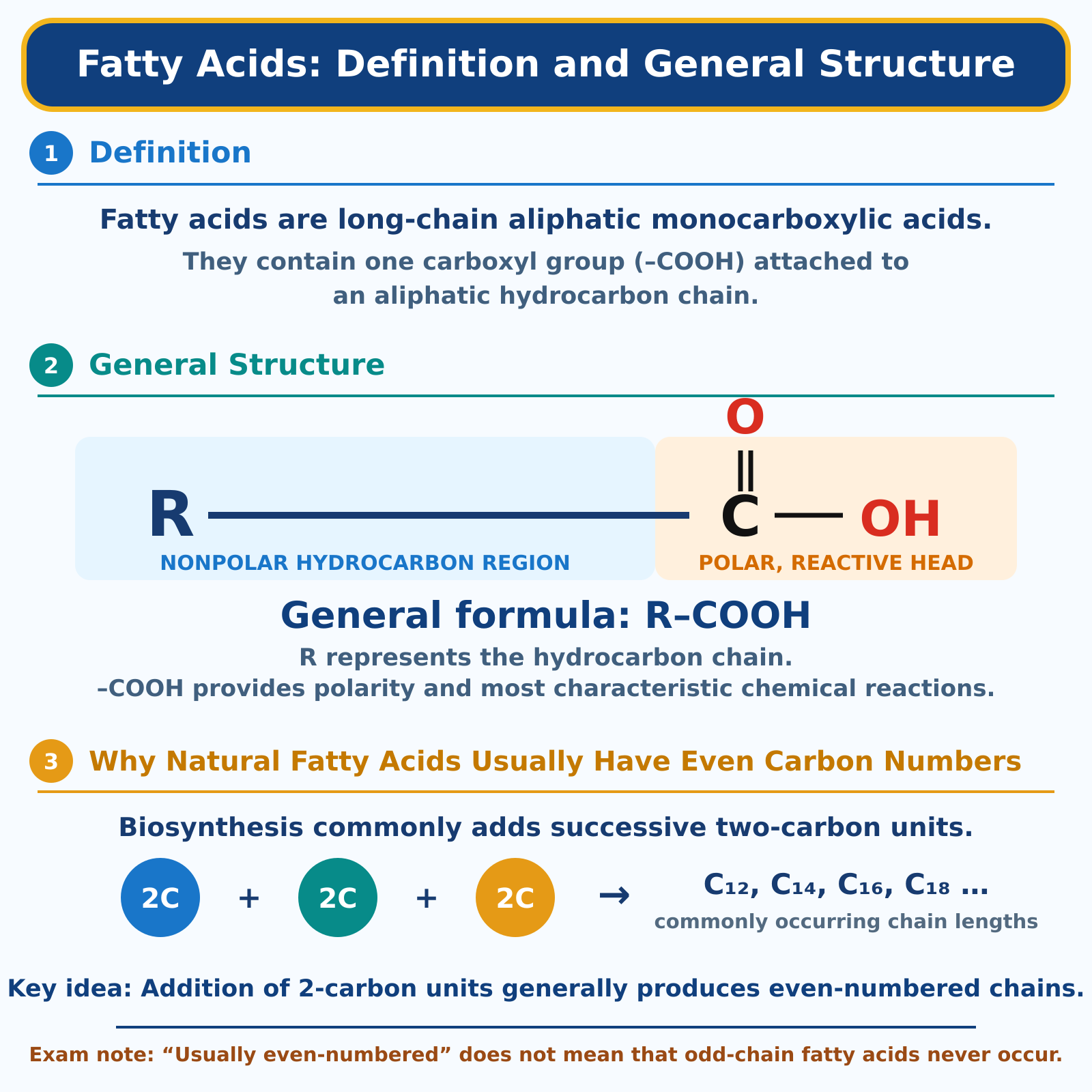
Fatty acids are long-chain aliphatic monocarboxylic acids. Their general formula is R-COOH, in which R represents a hydrocarbon chain. The carboxyl group forms the polar, reactive head, whereas the hydrocarbon chain forms the nonpolar region. Natural fatty acids usually have an even number of carbon atoms because their biosynthesis commonly proceeds through successive addition of two-carbon units.
Classification of Fatty Acids
According to saturation
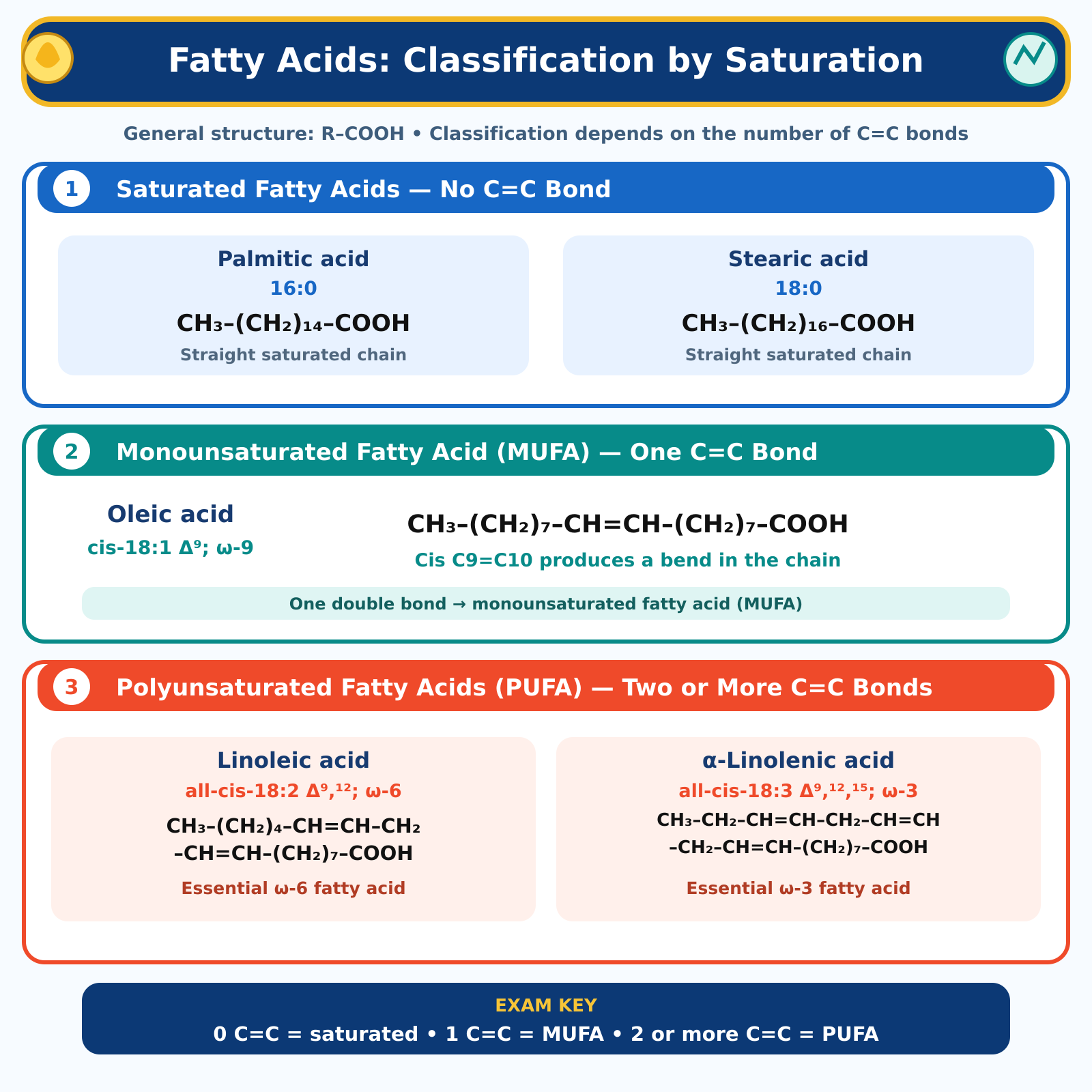
Saturated fatty acids contain no carbon-carbon double bond. Monounsaturated fatty acids contain one C=C bond. Polyunsaturated fatty acids contain two or more C=C bonds. In many natural unsaturated fatty acids, the double bonds have cis geometry and are separated by a methylene group.
| Class | Double bonds | Examples |
| Saturated fatty acids | None | Butyric, lauric, palmitic and stearic acids |
| Monounsaturated fatty acids | One | Palmitoleic and oleic acids |
| Polyunsaturated fatty acids | Two or more | Linoleic, α-linolenic and arachidonic acids |
According to chain length
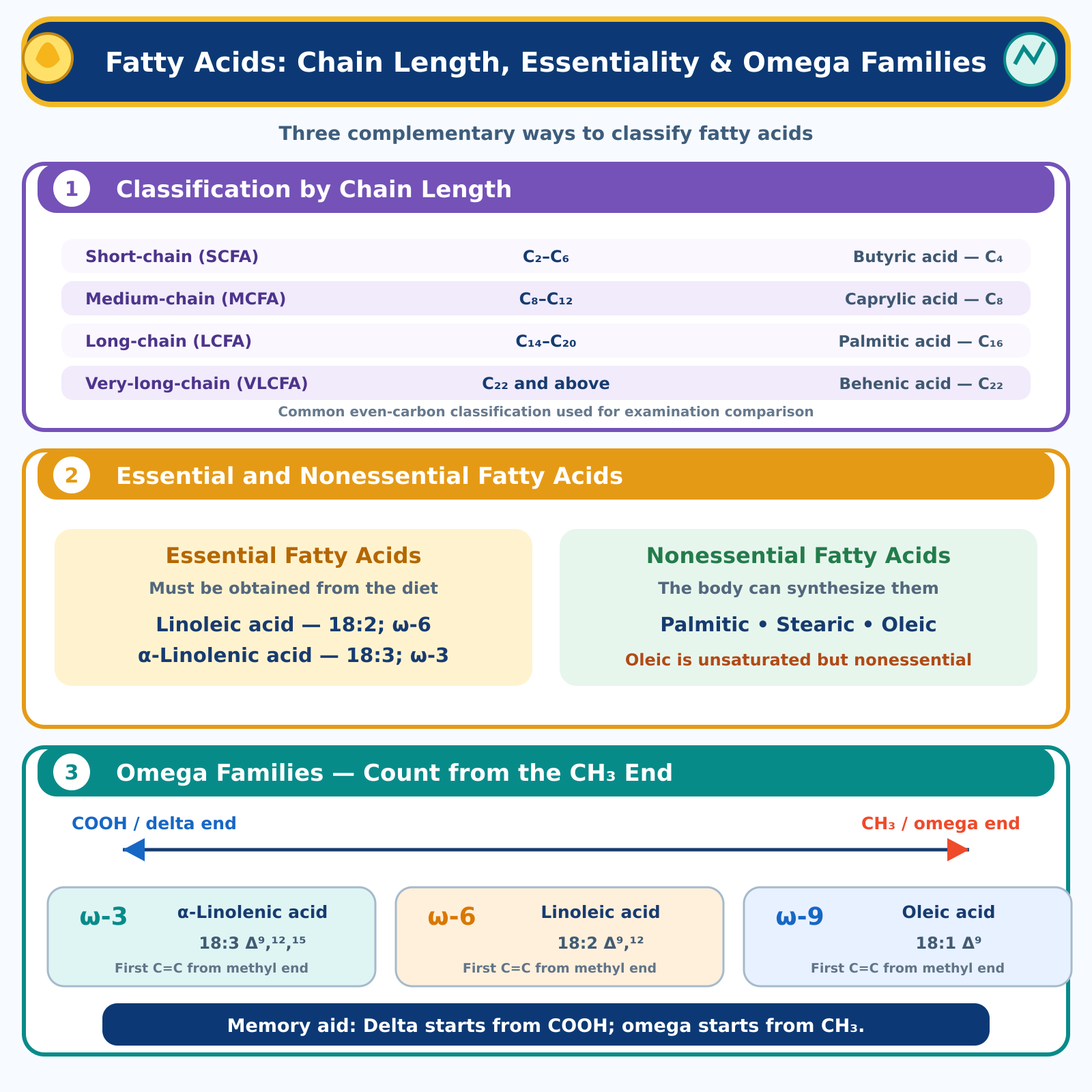
| Class | Common carbon range | Examples |
| Short-chain fatty acids | C₂-C₆ | Acetic and butyric acids |
| Medium-chain fatty acids | C₈-C₁₂ | Caprylic, capric and lauric acids |
| Long-chain fatty acids | C₁₄-C₂₀ | Myristic, palmitic, stearic and oleic acids |
| Very-long-chain fatty acids | C₂₂ and above | Behenic and lignoceric acids |
According to nutritional requirement
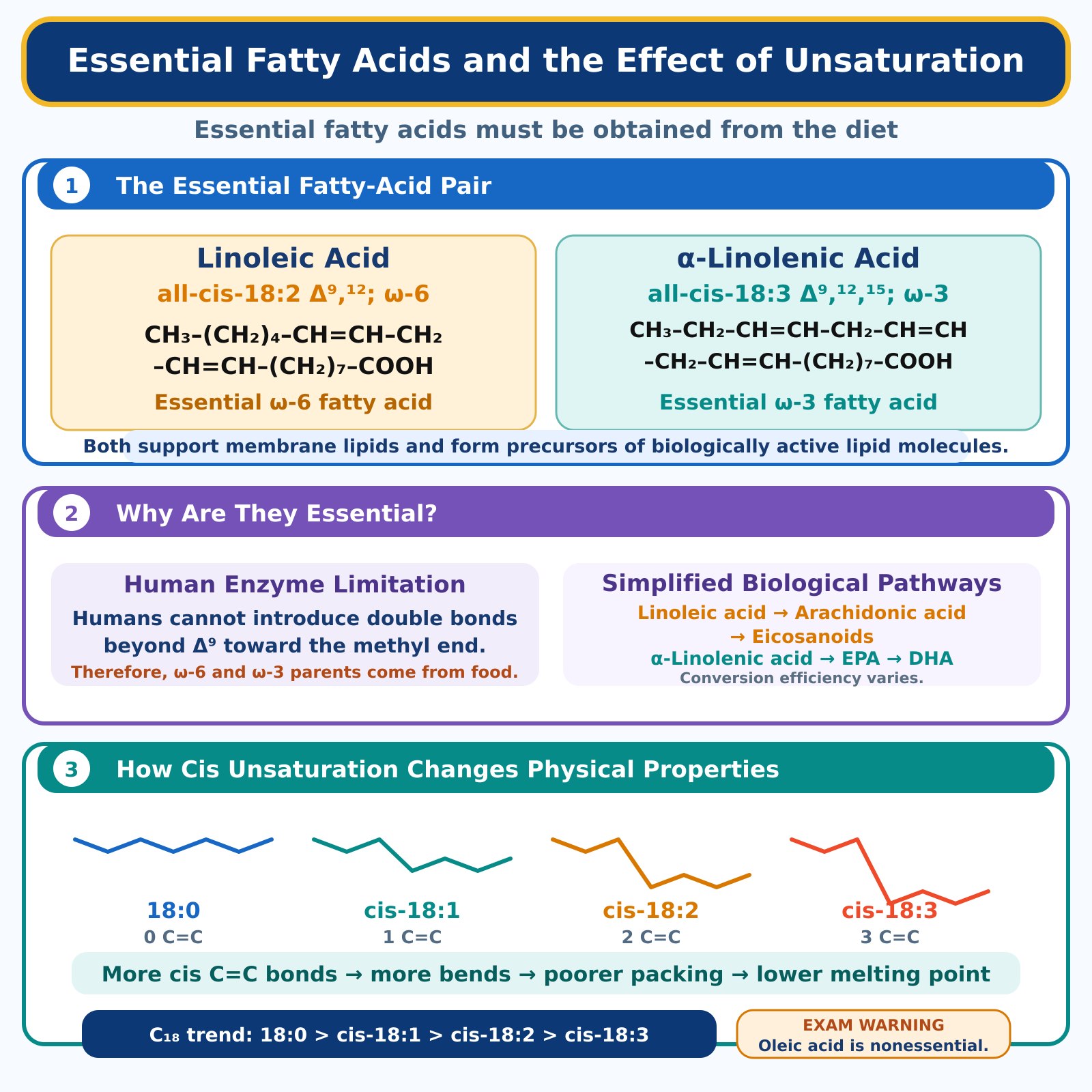
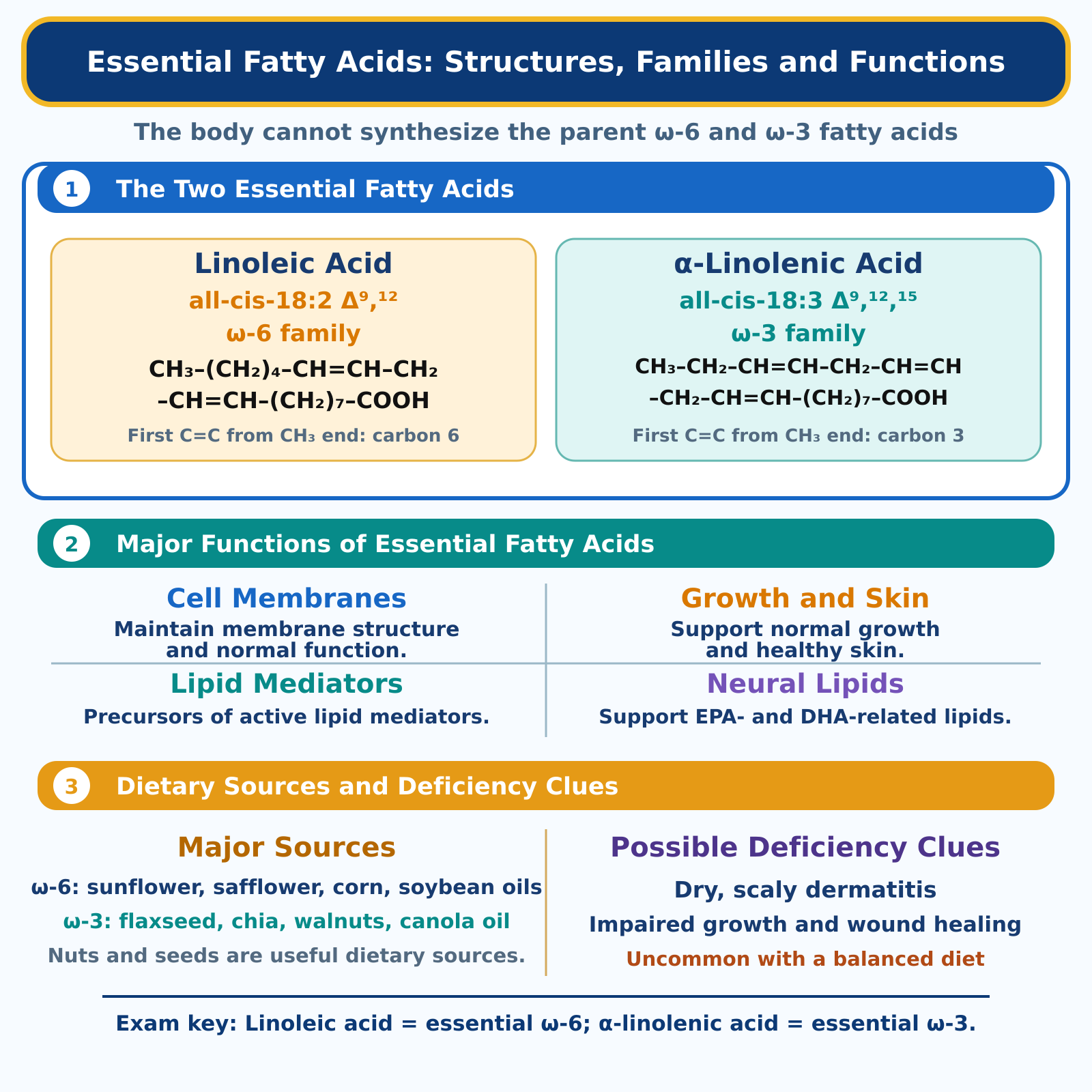
Essential fatty acids cannot be synthesized by the human body in adequate quantity and must therefore come from the diet. Linoleic acid, an ω-6 fatty acid, and α-linolenic acid, an ω-3 fatty acid, are the principal essential fatty acids. Nonessential fatty acids can be synthesized by the body, although they may also come from food.
Nomenclature and Notation of Fatty Acids
Common and IUPAC names
| Common name | IUPAC description | Shorthand |
| Butyric acid | Butanoic acid | 4:0 |
| Lauric acid | Dodecanoic acid | 12:0 |
| Myristic acid | Tetradecanoic acid | 14:0 |
| Palmitic acid | Hexadecanoic acid | 16:0 |
| Stearic acid | Octadecanoic acid | 18:0 |
| Oleic acid | cis-9-octadecenoic acid | 18:1 Δ9; ω-9 |
| Linoleic acid | cis,cis-9,12-octadecadienoic acid | 18:2 Δ9,12; ω-6 |
| α-Linolenic acid | all-cis-9,12,15-octadecatrienoic acid | 18:3 Δ9,12,15; ω-3 |
| Arachidonic acid | all-cis-5,8,11,14-eicosatetraenoic acid | 20:4 Δ5,8,11,14; ω-6 |
Carbon:number-of-double-bonds notation
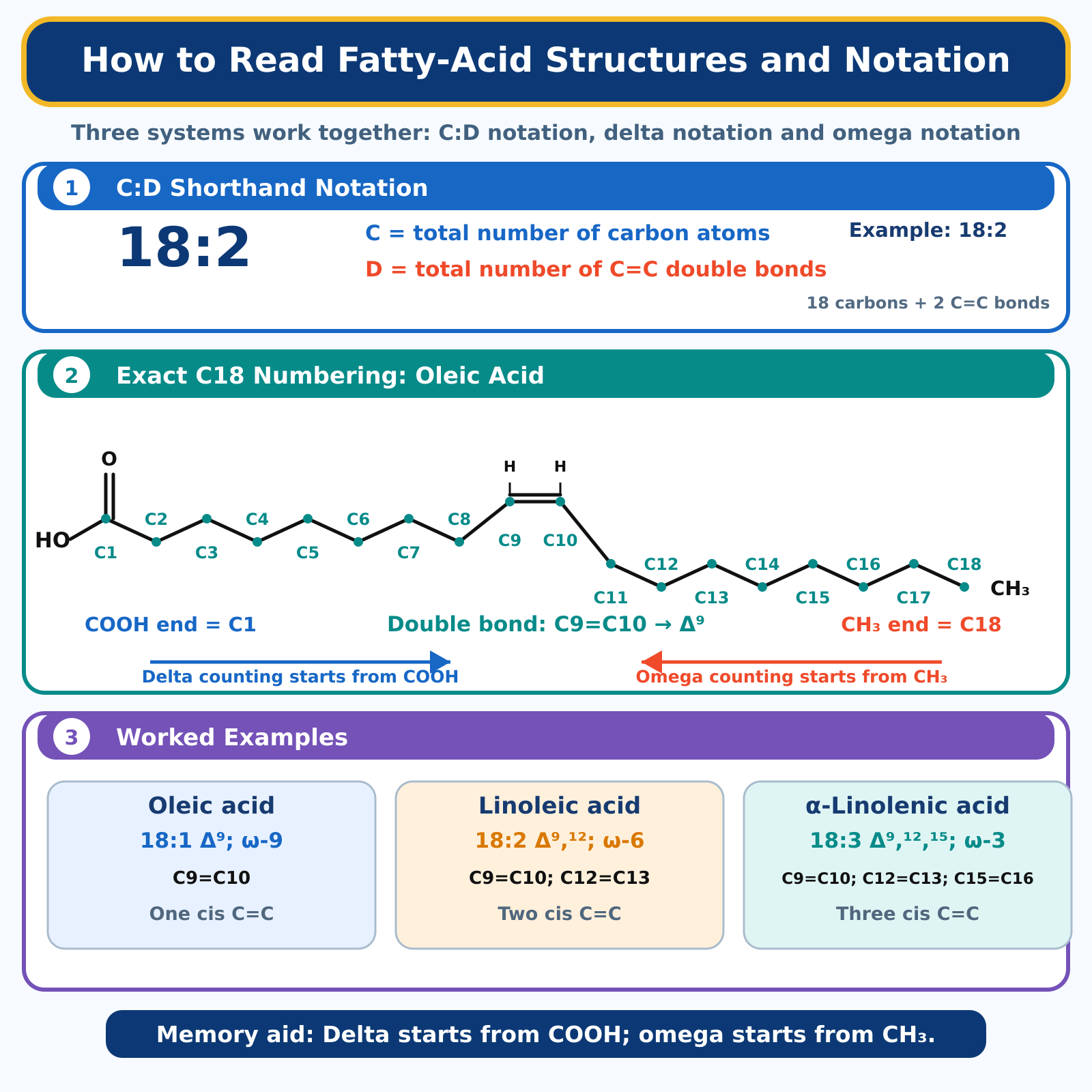
The shorthand C:D gives the total number of carbon atoms followed by the number of double bonds. Thus, 18:0 means 18 carbon atoms and no double bond; 18:1 means 18 carbon atoms and one double bond; and 18:2 means 18 carbon atoms and two double bonds.
Delta notation
Delta notation counts carbon atoms from the carboxyl carbon, which is carbon 1. The superscript numbers show the positions at which double bonds begin. Therefore, 18:2 Δ9,12 contains double bonds between C9-C10 and C12-C13 when counted from the carboxyl end.
Omega notation
Omega notation counts from the terminal methyl carbon. It identifies the first double bond from that end. Linoleic acid is ω-6 because its first double bond begins at the sixth carbon from the methyl end. α-Linolenic acid is ω-3, while oleic acid is ω-9.
Omega (ω) numbering classifies unsaturated fatty acids according to the position of the first carbon–carbon double bond from the terminal methyl (CH₃) end.
- A fatty acid contains two different ends:
- COOH end: carboxyl or delta end
- CH₃ end: methyl or omega end
- In conventional carbon numbering, the carboxyl carbon is C1. The next three carbons are called:
- α-carbon = C2
- β-carbon = C3
- γ-carbon = C4
- The terminal methyl carbon is called the omega carbon because omega is the last letter of the Greek alphabet. Therefore, α identifies the beginning of the hydrocarbon chain near COOH, whereas ω identifies its terminal end.
- Omega notation does not continue the α, β and γ sequence throughout the chain. Instead, it provides a convenient way to count inward from the fixed CH₃ end of long fatty-acid chains.
- The omega number indicates the position of the first double bond from the CH₃ end.
Downloadable Learning Resource

Examples of Omega notation
- Oleic acid: (18:1, ω-9): It contains 18 carbon atoms and one double bond. The first double bond lies between the ninth and tenth carbons from the CH₃ end. Therefore, oleic acid belongs to the omega-9 family.
- Linoleic acid: (18:2, ω-6): It contains 18 carbon atoms and two double bonds. The first double bond lies between the sixth and seventh carbons from the CH₃ end. Therefore, linoleic acid belongs to the omega-6 family.
- α-Linolenic acid: (18:3, ω-3): It contains 18 carbon atoms and three double bonds. The first double bond lies between the third and fourth carbons from the CH₃ end. Therefore, α-linolenic acid belongs to the omega-3 family.
Scientific Basis of Omega Numbering
- Fatty-acid elongation normally adds new carbon atoms at the COOH end. Therefore, the omega family usually remains unchanged during elongation.
- For example: Linoleic acid, 18:2 ω-6 → Arachidonic acid, 20:4 ω-6
The chain length and delta positions change, but both fatty acids remain members of the omega-6 family.
- Thus, omega notation helps group fatty acids that are metabolically and nutritionally related.
- Humans cannot synthesize the parent omega-6 and omega-3 fatty acids because they cannot introduce the required double bonds beyond Δ⁹ toward the methyl end. Therefore, linoleic acid and α-linolenic acid must be obtained from the diet.
Delta and Omega Notation: Key Difference
- Delta notation: Counting begins from the COOH end and identifies the positions of all double bonds.
- Omega notation: Counting begins from the CH₃ end and identifies the position of the first double bond from that end.
For example:
Linoleic acid = 18:2 Δ⁹, ¹²; ω-6
Here, Δ⁹, ¹² gives both double-bond positions from the COOH end, whereas ω-6 identifies the fatty-acid family from the CH₃ end.
| Memory aid: Delta starts from the acid (COOH) end; omega starts from the opposite methyl (CH₃) end. |
Important Fatty Acids
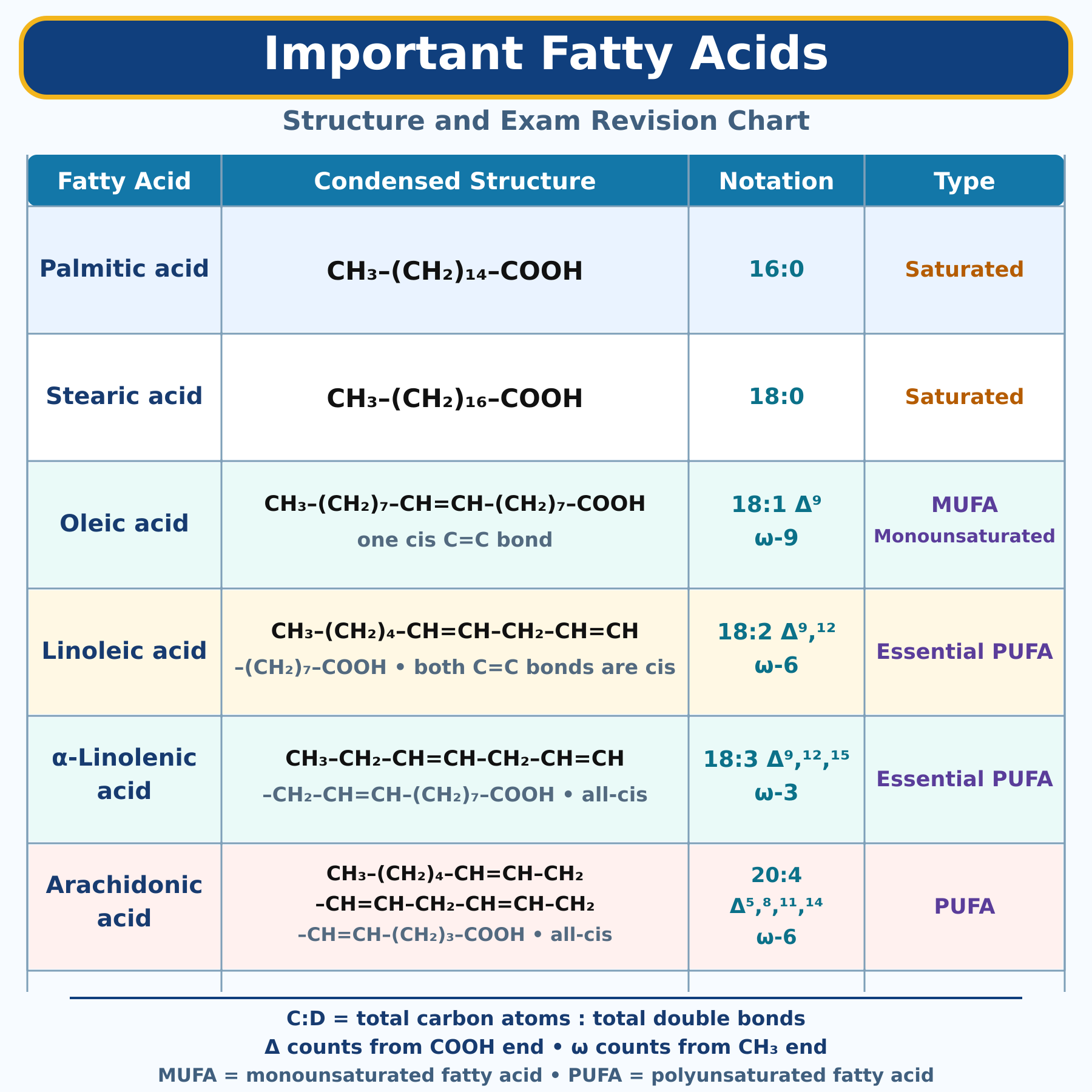
| Fatty acid | Formula / shorthand | Key examination point |
| Palmitic acid | C₁₅H₃₁COOH; 16:0 | Common saturated fatty acid. |
| Stearic acid | C₁₇H₃₅COOH; 18:0 | Saturated C₁₈ acid with efficient packing. |
| Oleic acid | C₁₇H₃₃COOH; 18:1 | cis monounsaturated ω-9 acid. |
| Linoleic acid | C₁₇H₃₁COOH; 18:2 | Essential polyunsaturated ω-6 acid. |
| α-Linolenic acid | C₁₇H₂₉COOH; 18:3 | Essential polyunsaturated ω-3 acid. |
| Arachidonic acid | C₁₉H₃₁COOH; 20:4 | Polyunsaturated ω-6 precursor of eicosanoids. |
Essential Fatty Acids and Their Significance
Humans cannot introduce double bonds at the ω-3 and ω-6 positions because the necessary desaturase enzymes are absent. Therefore, linoleic acid and α-linolenic acid must be obtained through diet. They contribute to membrane lipid structure and act as precursors for longer-chain polyunsaturated fatty acids and physiologically active lipid mediators.
Omega‑3 fatty acids
Important omega‑3 fatty acids include:
- α-Linolenic acid (ALA), (18:3): flaxseed, chia seeds, walnuts and soybean oil
- Eicosapentaenoic acid (EPA), (20:5): fatty fish and fish oil
- Docosahexaenoic acid (DHA), (22:6): fatty fish, fish oil and algal oil
Major functions and importance:
- DHA supports the normal development and functioning of the brain, retina and nervous system.
- EPA and DHA help maintain cardiovascular health and can reduce elevated triglyceride levels.
- They form precursors of signalling molecules involved in regulating inflammation, blood-vessel tone and platelet activity.
- Omega‑3 fatty acids are especially important during pregnancy, infancy and childhood for brain and visual development.
- They contribute to the normal structure and fluidity of cell membranes.
Omega‑6 fatty acids
Important omega‑6 fatty acids include:
- Linoleic acid (LA), (18:2): sunflower, safflower, soybean and corn oils
- Arachidonic acid (AA), (20:4): meat, eggs and other animal foods
Major functions and importance:
- Linoleic acid is required for normal growth and development.
- Omega‑6 fatty acids help maintain the skin barrier, reducing excessive water loss.
- They support normal immune and inflammatory responses.
- Arachidonic acid is an important structural component of cell membranes, particularly in the brain and muscles.
- They serve as precursors for eicosanoids involved in inflammation, blood clotting and smooth-muscle activity.
- Replacing saturated fats with unsaturated fats containing linoleic acid can support healthy blood-cholesterol levels.
In an examination answer, define essential fatty acids first, give the two principal examples with notation, explain the biochemical limitation, and then state their physiological importance.
Structure and Physical Properties
Effect of chain length
As chain length increases, molecular surface area and London dispersion forces increase. Therefore, within a comparable homologous series, melting point generally rises with chain length.
Effect of unsaturation
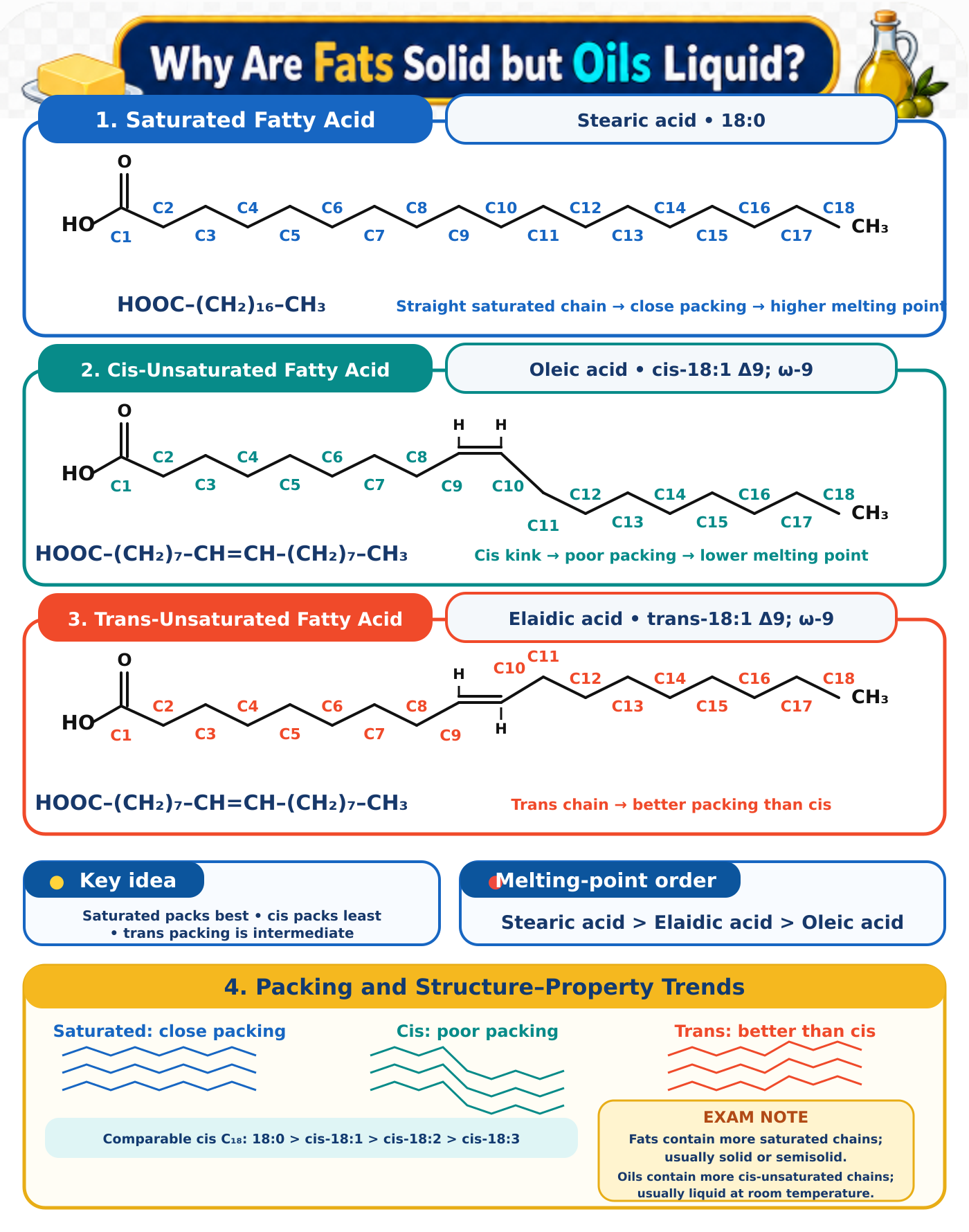
A cis double bond restricts rotation and creates a bend in the chain. Bent chains cannot pack as closely as straight saturated chains. Their intermolecular attractions act less efficiently, so the melting point decreases. Additional cis double bonds usually produce further disruption and a still lower melting point.
Cis versus trans geometry
A trans double bond leaves the hydrocarbon chain relatively linear. Consequently, a trans-unsaturated fatty acid packs more effectively and generally melts at a higher temperature than its cis isomer. However, the corresponding saturated fatty acid often packs most efficiently.
| Comparison | Expected melting-point trend | Reason |
| C₁₈ series | 18:0 > trans-18:1 > cis-18:1 | Packing decreases in the same order. |
| Cis C₁₈ series | 18:0 > 18:1 > 18:2 > 18:3 | Increasing cis unsaturation progressively disrupts packing. |
Pharmaceutical and Practical Importance
- Fats and oils serve as vehicles and excipients in selected pharmaceutical and cosmetic preparations.
- Fatty acids and their derivatives help manufacture soaps, surfactants, emulsifiers and ointment bases.
- Oil composition influences stability, susceptibility to rancidity and suitable storage conditions.
- Degree of unsaturation influences iodine value and drying behavior.
- Fatty-acid chain length influences saponification value because it changes the average molecular mass of triglycerides.
- Essential fatty acids and long-chain ω-3 fatty acids have nutritional and physiological importance.