
Introduction
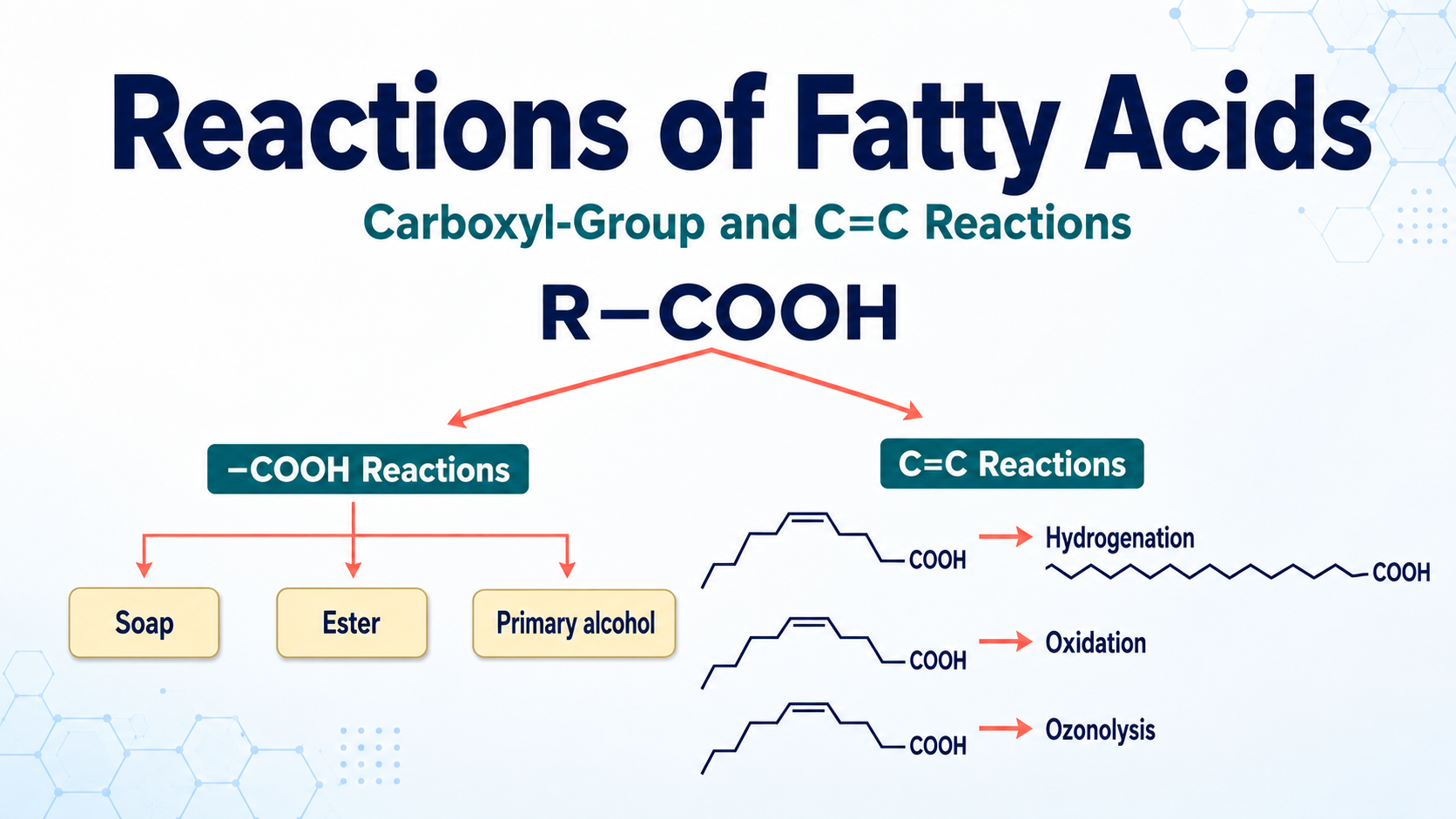
Fatty acids undergo several important reactions because their molecules contain a reactive carboxyl group. Moreover, unsaturated fatty acids contain one or more carbon–carbon double bonds that participate in addition and oxidation reactions. Therefore, fatty-acid reactions can be classified into reactions of the carboxyl group and reactions of the C=C bond.
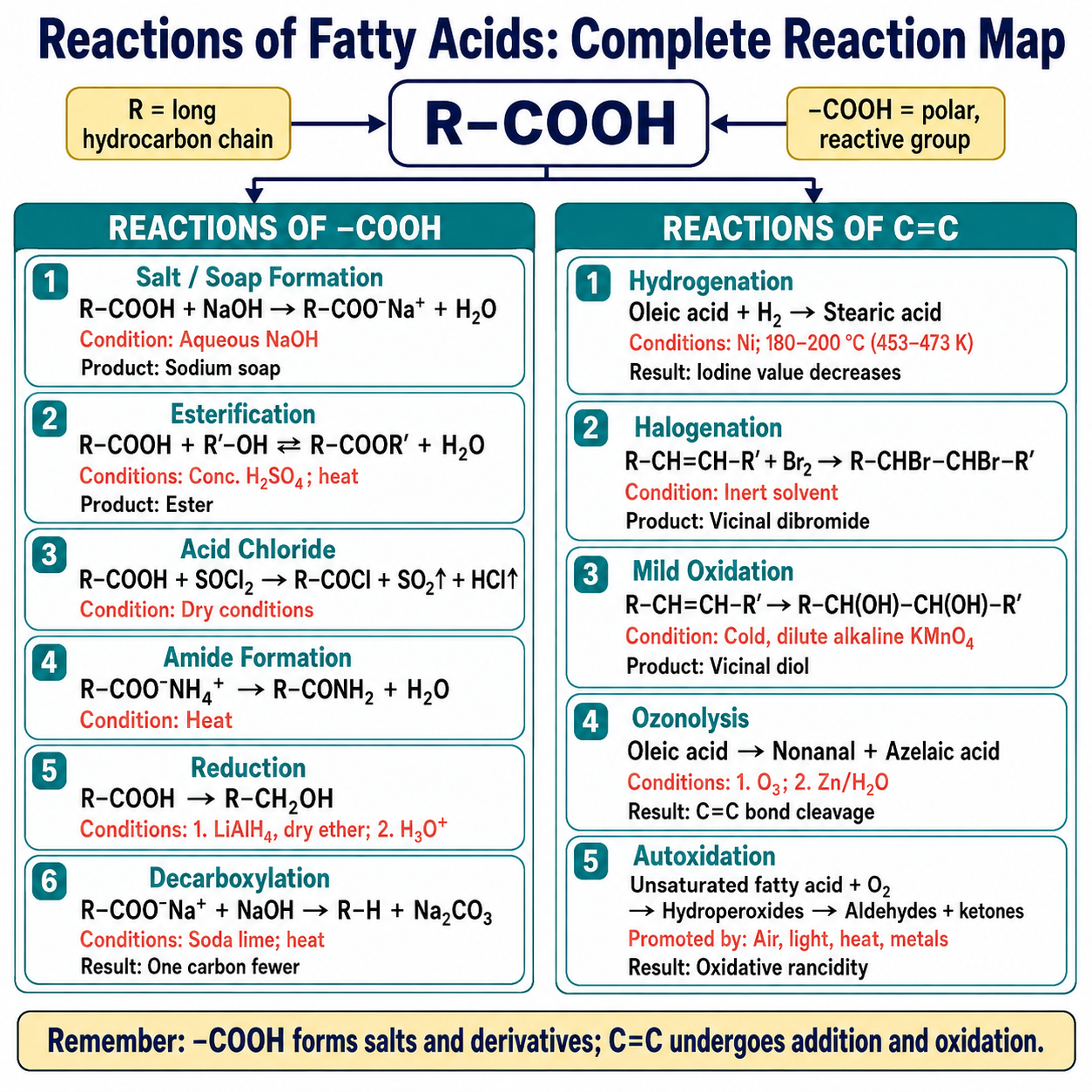
The carboxyl group takes part in salt formation, esterification, acid chloride formation, amide formation, reduction and decarboxylation. Meanwhile, the double bonds of unsaturated fatty acids undergo hydrogenation, halogenation, mild oxidation, ozonolysis and autoxidation. These reactions explain the formation of soaps and fatty-acid derivatives, the hardening of oils, changes in iodine value and the development of oxidative rancidity.
This exam-oriented guide explains each reaction with its equation, reagent, condition, product and practical significance. It also uses clear revision infographics to help students understand and remember the complete topic.
Reaction Map at a Glance
| Reaction center | Reaction | Main product |
| –COOH | Neutralization | Carboxylate salt (soap for long chains) |
| –COOH | Esterification | Fatty-acid ester |
| –COOH | Acid chloride formation | Fatty acyl chloride |
| –COOH | Amide formation | Fatty-acid amide |
| –COOH | Reduction | Long-chain primary alcohol |
| –COOH | Decarboxylation | Hydrocarbon with one fewer carbon atom |
| C=C | Hydrogenation | More saturated fatty acid |
| C=C | Halogenation | Vicinal dihalide |
| C=C | Mild oxidation | Vicinal diol |
| C=C | Ozonolysis/strong oxidation | Smaller aldehydes, ketones, or acids |
| C=C/allylic sites | Autoxidation | Hydroperoxides and secondary rancid products |
Reactions of the Carboxyl Group
Salt formation and soap formation
The carboxyl group donates a proton to a base. Consequently, a fatty acid reacts with sodium hydroxide or potassium hydroxide to form a carboxylate salt and water. Sodium salts of higher fatty acids are generally hard soaps, whereas potassium salts are softer or more soluble soaps.
| R–COOH + NaOH → R–COO⁻Na⁺ + H₂O (Conditions: Aqueous NaOH) C₁₇H₃₅COOH + NaOH → C₁₇H₃₅COO⁻Na⁺ + H₂O (Conditions: Aqueous NaOH; Stearic acid forms sodium stearate) |
Important distinction: Neutralization starts with a free fatty acid. Saponification starts with a triglyceride or another ester and cleaves ester bonds with alkali.
Esterification
In Fischer esterification, a fatty acid reacts with an alcohol. Concentrated sulfuric acid acts as an acid catalyst, and heating increases the reaction rate. Because the reaction is reversible, removing water or using excess alcohol favors ester formation.
| R–COOH + R′–OH ⇌ R–COOR′ + H₂O (Conditions: Concentrated H₂SO₄; heat) C₁₇H₃₅COOH + C₂H₅OH ⇌ C₁₇H₃₅COOC₂H₅ + H₂O (Conditions: Concentrated H₂SO₄ & heat; Stearic acid gives ethyl stearate) |
Exam point: The oxygen atom of the alcohol becomes part of the ester –COOR′ group. State both the catalyst and heat.
Formation of acid chlorides
Fatty acids react with thionyl chloride to form fatty acyl chlorides. The gaseous by-products, sulfur dioxide and hydrogen chloride, escape and help drive the reaction forward. Acid chlorides are highly reactive intermediates used to prepare esters and amides.
| R–COOH + SOCl₂ → R–COCl + SO₂↑ + HCl↑ (Conditions: Dry conditions) |
Formation of amides
A fatty acid first reacts with ammonia to form an ammonium carboxylate. On heating, this salt loses water and produces an amide. Long-chain fatty amides have applications as surfactant intermediates, lubricants, and slip agents.
| R–COOH + NH₃ → R–COO⁻NH₄⁺ (Conditions: Room temperature) R–COO⁻NH₄⁺ → R–CONH₂ + H₂O (Conditions: Heat) |
Reduction to primary alcohols
A strong reducing agent such as lithium aluminium hydride reduces the carboxyl group to a primary alcohol. The carbon atom of –COOH remains in the product and becomes the carbon of –CH₂OH.
| R–COOH → R–CH₂OH (Conditions: 1. LiAlH₄, dry ether; 2. H₃O⁺) C₁₅H₃₁COOH → C₁₆H₃₃OH (Conditions: 1. LiAlH₄, dry ether; 2. H₃O⁺ ) Palmitic acid gives cetyl alcohol (hexadecan-1-ol). |
Decarboxylation
When the sodium salt of a fatty acid is heated with soda lime, the carboxyl carbon is removed. Therefore, the hydrocarbon product contains one carbon atom fewer than the original acid.
| R–COO⁻Na⁺ + NaOH → R–H + Na₂CO₃ (Conditions: Soda lime (NaOH/CaO); heat) C₁₅H₃₁COO⁻Na⁺ + NaOH → C₁₅H₃₂ + Na₂CO₃ (Conditions: Soda lime; heat ) Sodium palmitate gives pentadecane. |
Memory rule: Decarboxylation means “minus one carbon” in the hydrocarbon product.
Reactions of Carbon–Carbon Double Bonds
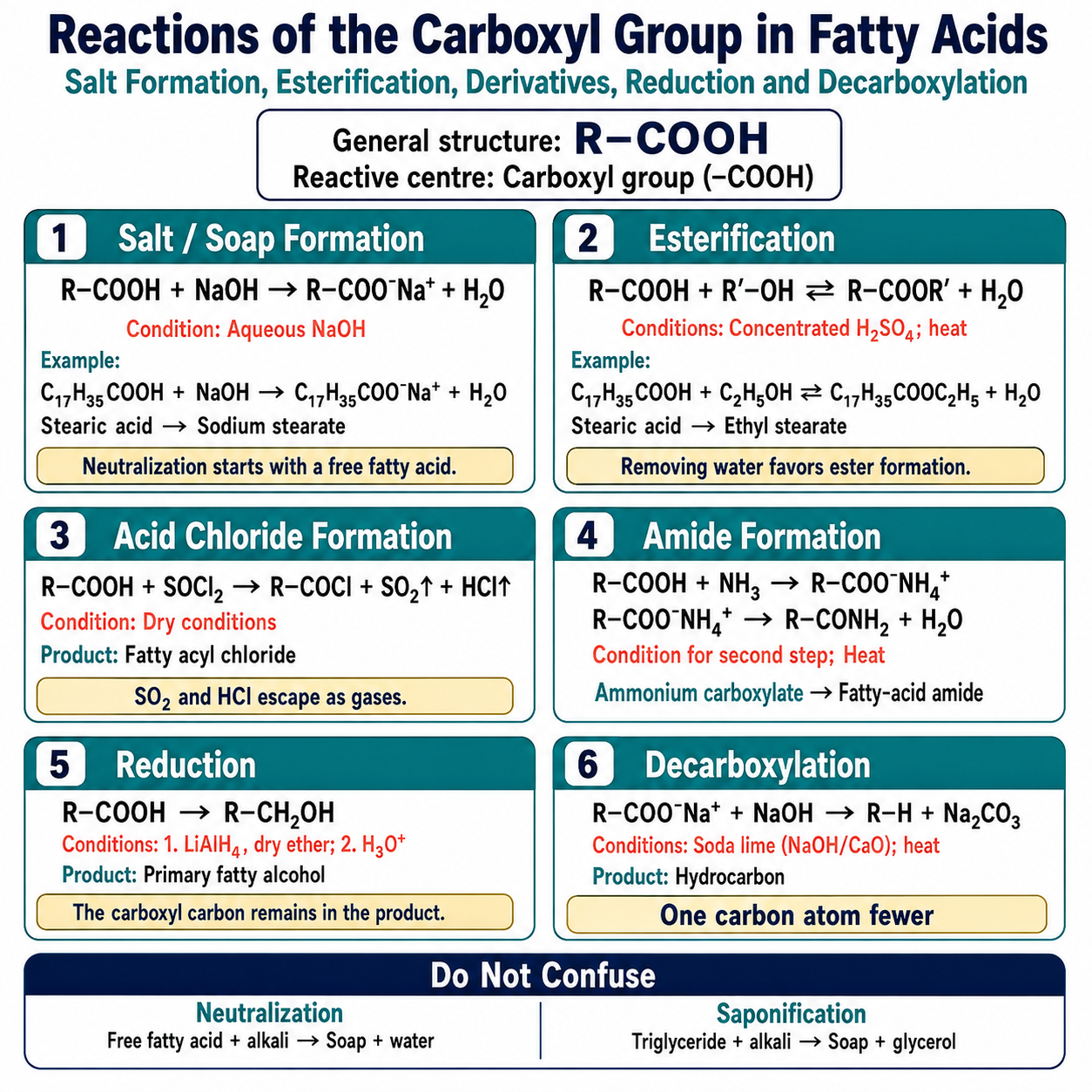
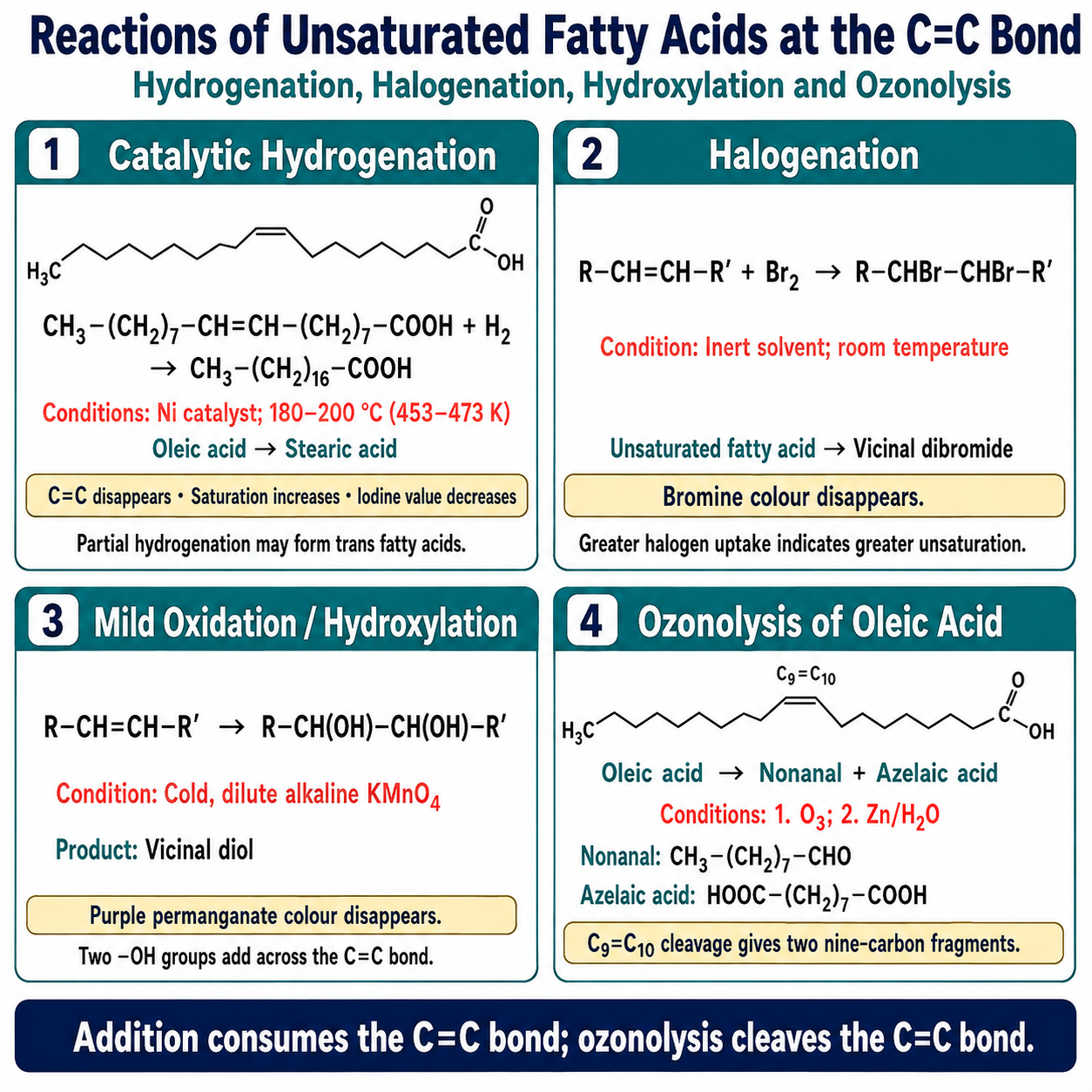
Unsaturated fatty acids undergo addition and oxidation at their C=C bonds. The number of double bonds strongly affects hydrogen uptake, halogen uptake, oxidative stability, melting behavior, and drying properties.
Catalytic hydrogenation
Hydrogenation adds hydrogen across a carbon–carbon double bond in the presence of a metal catalyst. Oleic acid contains one double bond and accepts one mole of hydrogen to form stearic acid. Similarly, linoleic and linolenic acids can undergo stepwise hydrogenation.
| CH₃–(CH₂)₇–CH=CH–(CH₂)₇–COOH + H₂ → CH₃–(CH₂)₁₆–COOH Conditions: Ni catalyst; about 180–200 °C (453–473 K) Oleic acid → stearic acid |
Effects of hydrogenation:
- The degree of unsaturation decreases.
- Iodine value decreases because fewer C=C bonds remain.
- Melting point and solidity generally increase because straighter saturated chains pack more efficiently.
- Oxidative stability generally improves.
- During partial hydrogenation, some cis double bonds may isomerize to trans double bonds.
Health connection: Partial hydrogenation can generate trans fatty acids. Complete hydrogenation removes double bonds but may produce a very hard fat.
Halogenation
Chlorine, bromine, or iodine can add across C=C bonds. Bromine solution therefore loses its color when it reacts with an unsaturated fatty acid. Each double bond can consume one mole of halogen under ideal addition conditions.
| R–CH=CH–R′ + Br₂ → R–CHBr–CHBr–R′ (Conditions: Inert solvent such as CCl₄; room temperature) |
Analytical connection: Iodine value expresses the grams of iodine absorbed by 100 g of fat or oil. A higher iodine value generally indicates greater unsaturation.
Mild oxidation or hydroxylation
Cold, dilute alkaline potassium permanganate oxidizes the double bond without complete chain cleavage under controlled conditions. Two hydroxyl groups appear on the adjacent carbon atoms and form a vicinal diol.
| R–CH=CH–R′ → R–CH(OH)–CH(OH)–R′ (Conditions: Cold, dilute alkaline KMnO₄) |
The purple permanganate color disappears and manganese dioxide may form. This reaction provides evidence for unsaturation, although the exact visual result depends on conditions.
Ozonolysis and oxidative cleavage
Ozone attacks the C=C bond and forms an ozonide. Work-up then cleaves the original double bond. The products reveal the position of the double bond. With reductive work-up, oleic acid gives nonanal and azelaic acid.
| Oleic acid → Nonanal + HOOC–(CH₂)₇–COOH (Conditions: 1. O₃; 2. Zn/H₂O) The dicarboxylic product is azelaic acid (nonanedioic acid). |
Why these products form: Oleic acid is cis-9-octadecenoic acid. Cleavage between C9 and C10 divides its 18-carbon chain into two nine-carbon fragments. The methyl-end fragment gives nonanal, while the carboxyl-end fragment gives azelaic acid.
Under stronger oxidative work-up, aldehyde fragments can undergo further oxidation to carboxylic acids. Therefore, always state the work-up when predicting ozonolysis products.
Autoxidation and oxidative rancidity
Autoxidation is the spontaneous free-radical oxidation of lipids by atmospheric oxygen. Unsaturated fatty acids are especially susceptible because allylic and bis-allylic hydrogen atoms can be removed relatively easily. Light, heat, metal ions, and pre-existing radicals accelerate the process.
Simplified free-radical sequence
| LH → L• Conditions: Heat, light, metal ions, or an initiator Initiation: a lipid radical forms |
| L• + O₂ → LOO• Conditions: Atmospheric oxygen Propagation: a lipid peroxy radical forms |
| LOO• + LH → LOOH + L• Conditions: Chain propagation A lipid hydroperoxide and a new lipid radical form. |
| LOOH → Aldehydes + ketones + short-chain acids + other products Conditions: Heat, light, or metal-catalyzed decomposition Secondary products create unpleasant odor and taste |
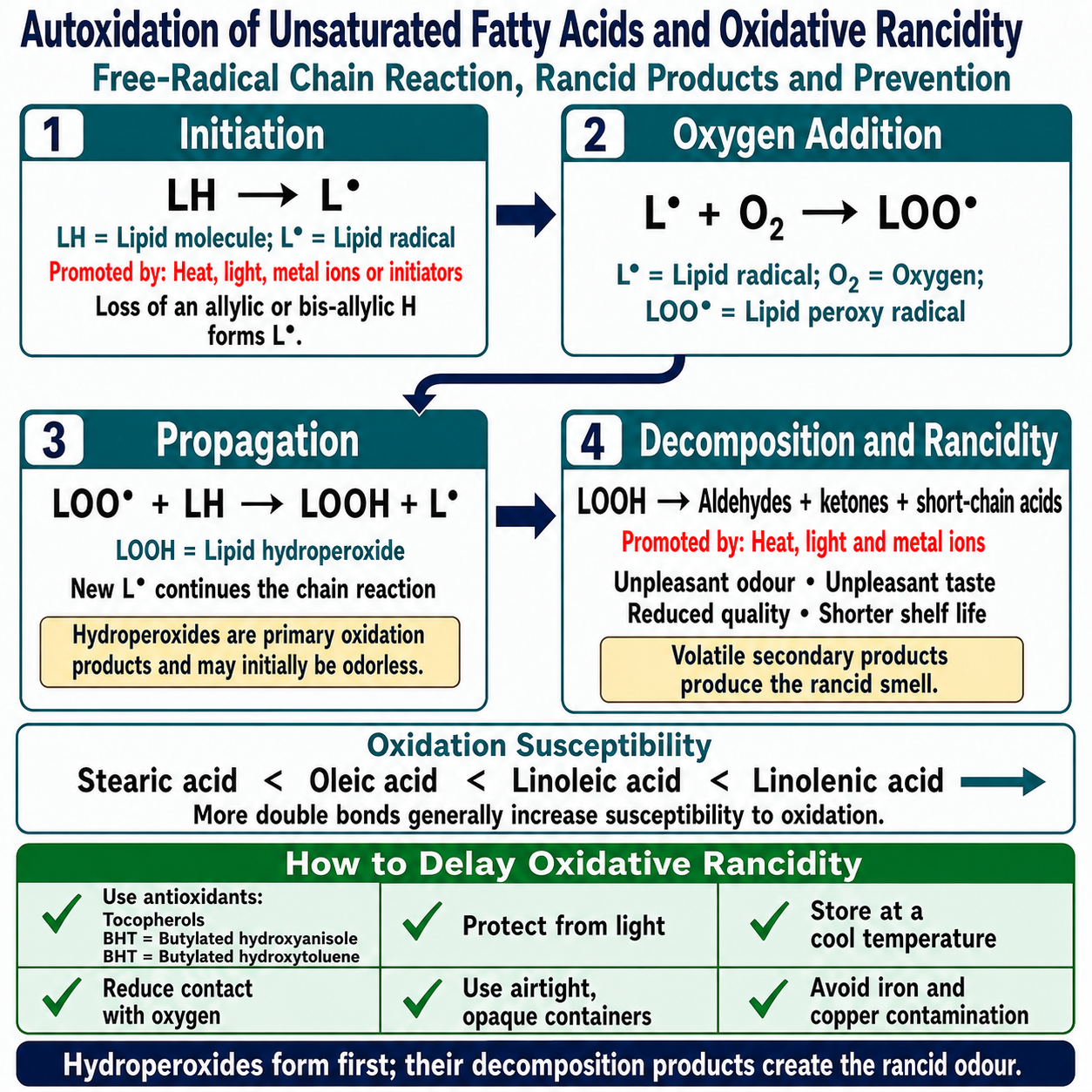
Hydroperoxides are often odorless primary oxidation products. The characteristic rancid odor mainly appears after they decompose into volatile secondary products.
Factors that increase and decrease oxidation
| Promote oxidation | Reduce oxidation |
| More double bonds; oxygen exposure | Antioxidants such as tocopherols, BHA, or BHT |
| Light and high temperature | Opaque, airtight packaging and cool storage |
| Iron or copper ions | Chelating agents and avoidance of reactive metals |
| Large exposed surface area | Reduced headspace and suitable packaging |
Distinctions
Neutralization versus saponification
| Feature | Neutralization of fatty acid | Saponification of triglyceride |
| Starting material | Free fatty acid, R–COOH | Triacylglycerol (ester) |
| Reagent | NaOH or KOH | NaOH or KOH with heat |
| Main products | Soap + water | Soap + glycerol |
| Bond change | Loss of acidic proton | Cleavage of ester bonds |
Hydrogenation versus oxidation
| Feature | Hydrogenation | Oxidation |
| Main reagent | H₂ with metal catalyst | KMnO₄, O₃, or atmospheric O₂ |
| Change at C=C | Adds hydrogen; saturation rises | Adds oxygen or cleaves/oxidizes the chain |
| Iodine value | Decreases | May decrease as C=C bonds react |
| Important result | Hardening and improved stability | Diols, cleavage products, or rancidity |
Comparative Summary
| Reaction | Reagent/condition | Structural change | Exam significance |
| Neutralization | NaOH or KOH | –COOH → –COO⁻M⁺ | Soap formation |
| Esterification | Alcohol, conc. H₂SO₄, heat | –COOH → –COOR′ | Forms fatty-acid esters |
| Reduction | LiAlH₄; then H₃O⁺ | –COOH → –CH₂OH | Primary fatty alcohol |
| Decarboxylation | Soda lime, heat | Loss of carboxyl carbon | One fewer carbon |
| Hydrogenation | H₂/Ni, 180–200 °C | C=C → C–C | Lower iodine value |
| Halogenation | Br₂ in inert solvent | C=C → dibromide | Test/measure of unsaturation |
| Mild oxidation | Cold dilute alkaline KMnO₄ | C=C → vicinal diol | Evidence of unsaturation |
| Ozonolysis | O₃; Zn/H₂O | Cleavage of C=C | Locates double bond |
| Autoxidation | O₂; promoted by light/heat/metals | Hydroperoxides, then fragments | Oxidative rancidity |
Pharmaceutical and Industrial Importance
- Soap salts and fatty-acid derivatives act as surfactants, emulsifying agents, and formulation excipients.
- Fatty-acid esters appear in fragrances, emollients, solvents, lubricants, and prodrug or formulation strategies.
- Hydrogenation adjusts consistency, melting behavior, and oxidative stability of lipid materials.
- Ozonolysis and oxidative cleavage help identify double-bond position and prepare useful dicarboxylic acids such as azelaic acid.
- Understanding autoxidation guides the selection of antioxidants, containers, storage temperature, and shelf-life controls for lipid-containing preparations.