

Emotion and motivation in healthcare help explain why the same information may lead to different feelings and actions. A patient may understand an instruction yet feel worried, doubt their ability to follow it, or face a practical barrier. Pharmacists therefore need to consider feelings, personal goals and everyday circumstances alongside accurate information. This article explains the main theories of emotion and motivation and connects them with respectful pharmacy communication.
| LEARNING FOCUS: Understand emotion, compare major explanatory theories, distinguish sources of motivation, and apply these ideas without blaming or diagnosing patients. |
Emotion: Meaning and Components
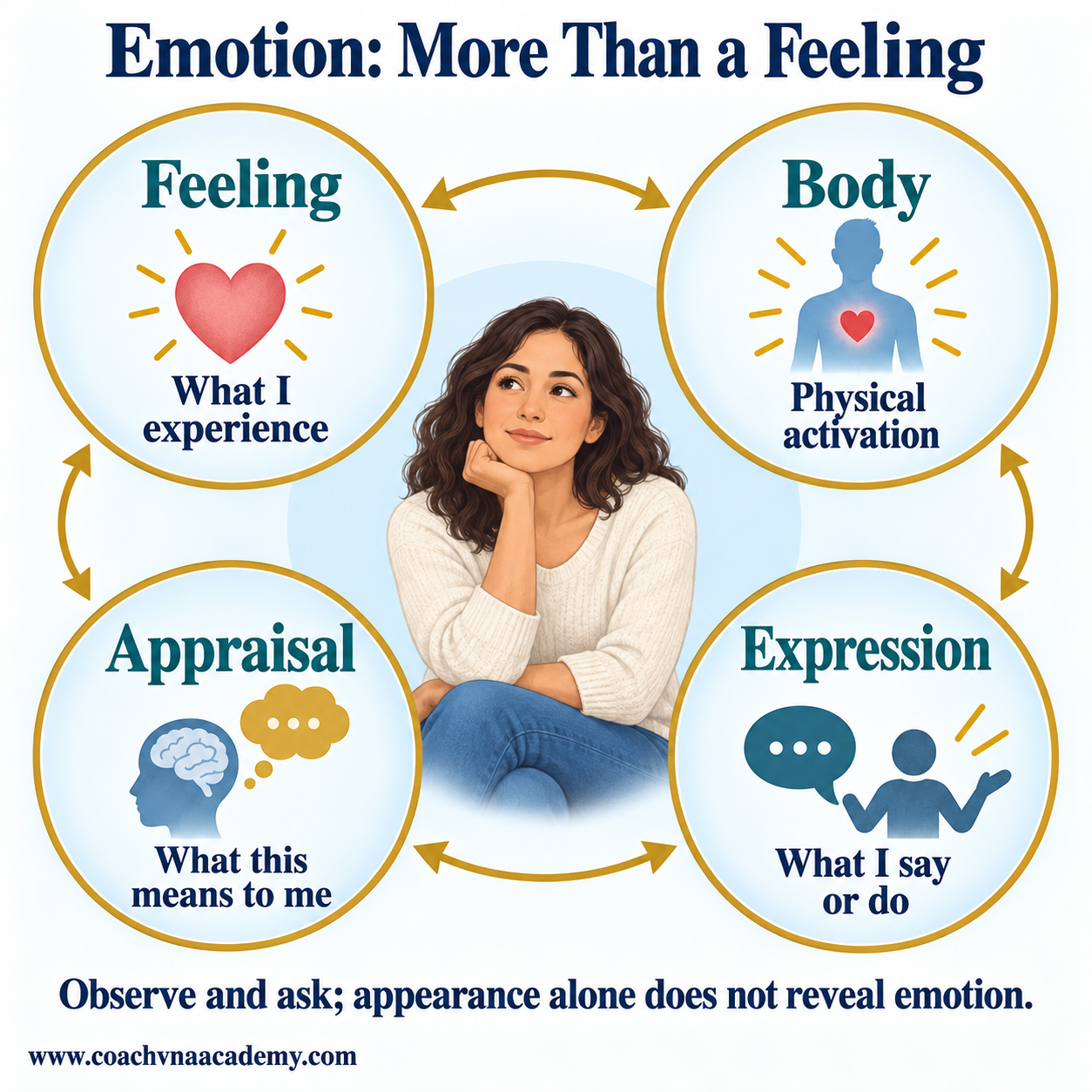
An emotion is a response to something personally meaningful. It can involve a felt experience, bodily changes, interpretation of the situation and a tendency to express or act on the feeling. The trigger may be an external event, such as a consultation, or an internal event, such as remembering a difficult experience. Fear, anger, sadness, joy and relief are familiar examples. People can experience more than one emotion at the same time.
Emotions have useful functions: fear can draw attention to a possible threat, sadness can signal loss, and joy can encourage connection. However, an intense emotion may also compete with attention or make an immediate decision difficult. Calling emotions simply good or bad misses their meaning and context. A feeling does not automatically justify every action that follows it.
Four interacting components
| Component | Simple meaning | Fictional example |
| Subjective feeling | The person’s own experience | “I feel worried about the consultation.” |
| Physiological response | Changes in bodily activity | The person notices a faster heartbeat. |
| Cognitive appraisal | The meaning assigned to the situation | “This may involve something difficult.” |
| Expression and action tendency | How emotion appears or urges action | The person asks repeatedly or wants to leave. |
These components influence one another; they need not occur in one fixed order. A faster heartbeat is not proof of fear, dishonesty or a psychological disorder. Physical symptoms may have medical, environmental or emotional explanations. Similarly, silence, smiling and eye contact have different meanings across people and contexts. Observe what happened, then ask respectfully rather than claiming to know the feeling.
Emotion, mood and affect
Emotion often has a relatively clear focus, such as relief after a reassuring explanation. A mood is usually more sustained and diffuse, with a less obvious immediate trigger. Affect is a broader term for feeling-related experience; in clinical descriptions it often refers to the emotional expression observed during an interaction. These distinctions are useful tendencies, not precise time cutoffs. A student should describe an observation without making a diagnosis from appearance.
Major Theories of Emotion
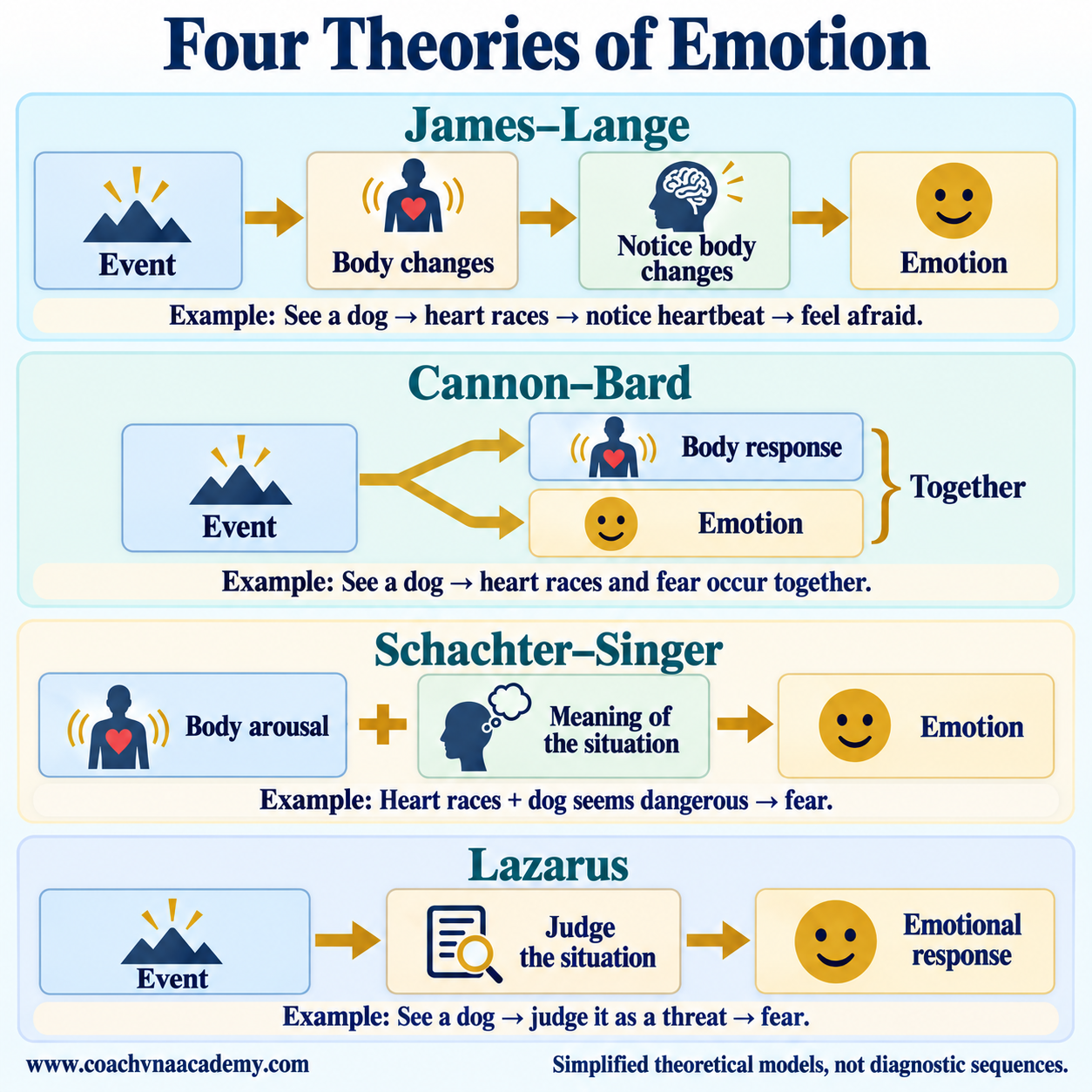
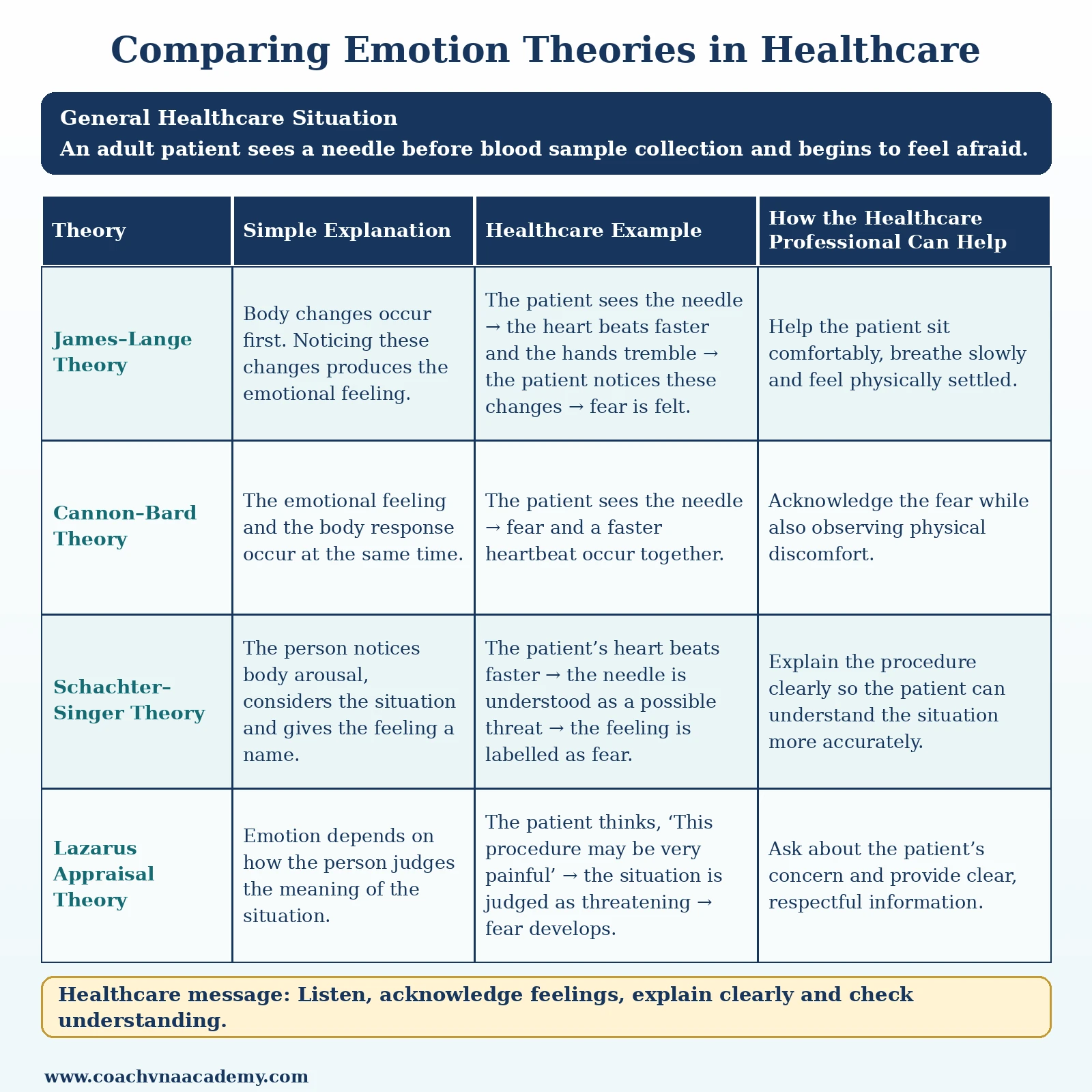
Theories provide different explanations of how bodily activity, interpretation and feeling relate. The following models are introductory frameworks, not literal timelines that can be read from a patient’s face. Each highlights part of emotional experience, and no single model completely explains every emotion. The same fictional consultation example helps make their differences clear.
James–Lange theory: Perceiving bodily change
William James and Carl Lange emphasized bodily feedback. In this account, an event produces physiological changes, and perceiving those changes contributes to the emotional experience. The key point is that the bodily response precedes the experienced emotion in the theory’s explanation.
| MODEL: Event → Bodily response → Perception of bodily changes → Emotional experience. Illustration: Entering a feared consultation setting produces bodily activation; perceiving that activation contributes to feeling afraid. |
This theory draws attention to the body’s contribution to emotion. Its limitation is that bodily patterns can overlap across emotions and do not always explain the full variety of feelings. Therefore, a bodily sign alone cannot identify a particular emotion. The example illustrates a theoretical account, not a clinical conclusion about every consultation.
Cannon–Bard theory: Parallel responses
Walter Cannon and Philip Bard proposed that a meaningful event can produce the emotional experience and bodily response in parallel. The person does not first need to perceive bodily changes before the emotion begins. In the classroom model, the event leads to both feeling afraid and bodily activation at approximately the same time.
| MODEL: Event → Emotional experience AND physiological response in parallel. Illustration: The consultation situation is followed by fear and bodily activation together. Neither response is drawn as causing the other. |
Its central contribution is the distinction between co-occurrence and a simple body-first chain. Nevertheless, it is a simplified historical account; real emotional processing involves interacting systems rather than two completely isolated processes.
Schachter–Singer two-factor theory: Arousal and context
- Arousal is your body and mind’s state of being awake, alert, and energized.
- Context is the situation, place, or environment where something happens.
Stanley Schachter and Jerome Singer, in 1962 emphasized two factors: physiological arousal and a cognitive interpretation of that arousal in context. They proved that physical sensations are often general, and our minds use context to label the emotion. Arousal means activation, such as feeling physically alert or keyed up. The situation helps a person interpret what that activation means. This interpretation contributes to the experienced emotion.
They studied how external cues affect eating. Healthy weight people eat based on internal hunger, while individuals with obesity are very sensitive to external cues like sight, taste, or time and may eat without physical hunger.
| MODEL: Physiological arousal + Contextual interpretation → Emotional experience. Illustration: A rapid heartbeat of a patient is a physical surge of energy that brain interprets as fear when waiting for scary test results, but as joy when taking first steps after injury. |
The comparison does not imply that people freely choose any emotion or that a positive statement removes distress. Context and interpretation matter, but bodily states, previous learning and the situation also constrain experience. Research does not support treating this model as a universal formula.
Lazarus’s cognitive appraisal perspective
Richard Lazarus emphasized appraisal: evaluating what an event means for one’s well-being and what resources are available to respond. An unfamiliar procedure may be appraised as a threat, while a clear explanation and trusted support may change the meaning of the encounter. Appraisal can be rapid and outside deliberate awareness; it does not always involve a spoken thought.
| MODEL: Event → Appraisal of significance → Emotional response. Illustration: Two patients receive the same appointment notice. One sees access to help; another anticipates a difficult experience. Their emotional responses may differ. |
Primary appraisal concerns the significance of the event, such as harm, threat or challenge. Secondary appraisal concerns available coping resources and options. The terms name aspects of appraisal, not necessarily two slow, separate steps. In healthcare, exploring a concern can reveal its meaning without dismissing it as merely negative thinking. Detailed coping and stress management are developed in Unit II.
Comparing the theories
Why Emotions Matter in Pharmacy
Emotion can influence what a patient notices, remembers and feels able to discuss. Worry may draw attention toward possible harm, while embarrassment may make it harder to ask a question. Anger may reflect frustration, unmet expectations or another concern; it is not enough evidence to label someone uncooperative. These are possible influences that need exploration rather than assumptions about an individual.
The pharmacist’s own emotion also matters. Feeling rushed or irritated may change tone, interrupt listening or encourage a premature conclusion. A short pause, an accurate summary and a respectful question can help keep the interaction focused. Empathy means trying to understand the person’s experience; it does not require agreeing with inaccurate information or accepting unsafe behavior.
| PROFESSIONAL BOUNDARY: Acknowledge feelings without diagnosing them. New or concerning physical symptoms need appropriate clinical assessment, not automatic attribution to anxiety. Severe distress or immediate safety concerns require prompt help through the supervising professional and local procedures. |
Motivation: Meaning and Sources
Motivation refers to processes that initiate, direct and sustain goal-related behavior. Initiation concerns starting an action; direction concerns what goal the action serves; persistence concerns continuing when effort is needed. Motivation can vary between tasks and across time. A quiet student may be motivated but hesitant, and a patient who wants to follow a plan may still lack money, transport, understanding or opportunity.
Needs, drives, incentives and goals
A need is a requirement or perceived lack. A drive is an internal state that can energize action, such as thirst encouraging drinking. An incentive is an anticipated external outcome that can attract or discourage action. A goal is an outcome toward which action is directed. These ideas overlap but are not interchangeable: thirst is an internal drive, an offered prize is an incentive, and completing a practice task is a goal.
Intrinsic and extrinsic motivation
Intrinsic motivation involves doing an activity because the activity itself is interesting or enjoyable. A student may practice explaining a concept because they enjoy understanding and teaching it. Extrinsic motivation involves doing an activity for a separable outcome, such as a grade, approval or a valued future benefit. A learner can have both kinds of reason at once.
Extrinsic motivation is not always imposed or undesirable. A patient may carry out a difficult routine because they personally value remaining independent, even if they do not enjoy the routine. Self-determination theory distinguishes such personally endorsed reasons from pressure-driven reasons. Therefore, “internal” does not automatically mean “intrinsic,” and a meaningful health goal is not necessarily enjoyment of the activity itself.
| Reason for action | Interpretation | Example |
| Interest in the activity | Intrinsic motivation | “I enjoy practicing this skill.” |
| Approval or reward | Externally regulated extrinsic motivation | “I practice to receive praise.” |
| A personally valued outcome | Can be autonomous extrinsic motivation | “I practice because safe care matters to me.” |

Major Perspectives (viewpoints) on Motivation
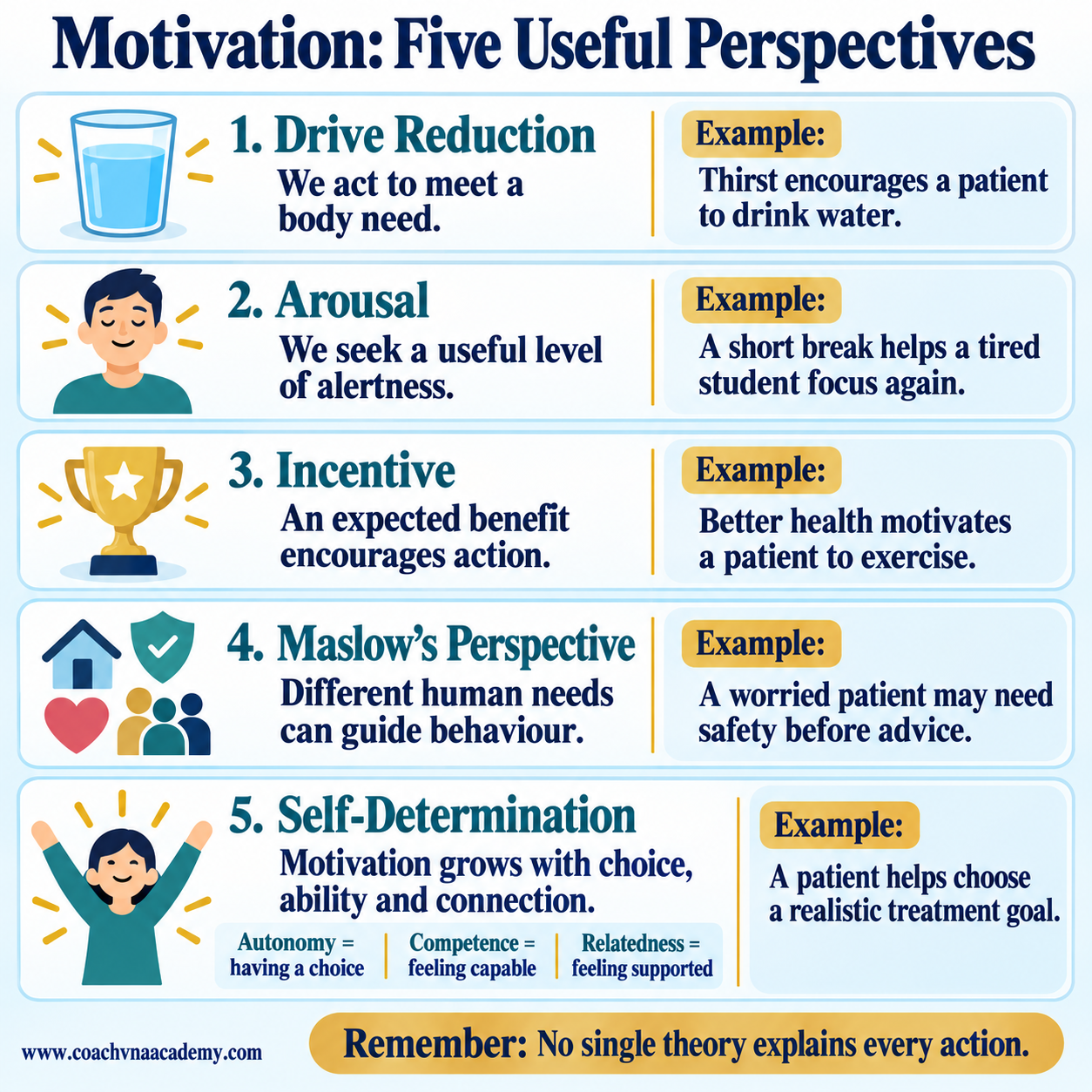
Drive-reduction theory
Drive-reduction theory explains some actions as efforts to reduce internal tension associated with physiological needs. Homeostasis means regulation that keeps internal conditions within workable ranges. For example, thirst can encourage drinking, which helps reduce the drive. This account is useful for some bodily needs, but it does not fully explain curiosity, exploration or activities that deliberately increase stimulation. A patient’s complex treatment choices cannot be reduced to one biological drive.
Arousal theory
Arousal theory proposes that people may act to obtain or maintain a workable level of activation. Someone may seek stimulation when bored or reduce distractions when overwhelmed. The level that supports performance differs with the person, task and setting. A demanding unfamiliar task may be especially disrupted by excessive activation. The often-taught Yerkes–Dodson relationship is a qualified teaching model, not a universal numerical target or a reason to create stress in students.
Incentive theory
Incentive accounts emphasize anticipated outcomes: what a person expects to gain or avoid can influence action. Recognition may encourage a learner to begin practice, while an expected inconvenience may discourage attendance. An incentive is expected before action; reinforcement is defined by a consequence actually increasing later behavior. An attractive incentive does not guarantee a lasting change, and essential care must never depend on earning a reward.
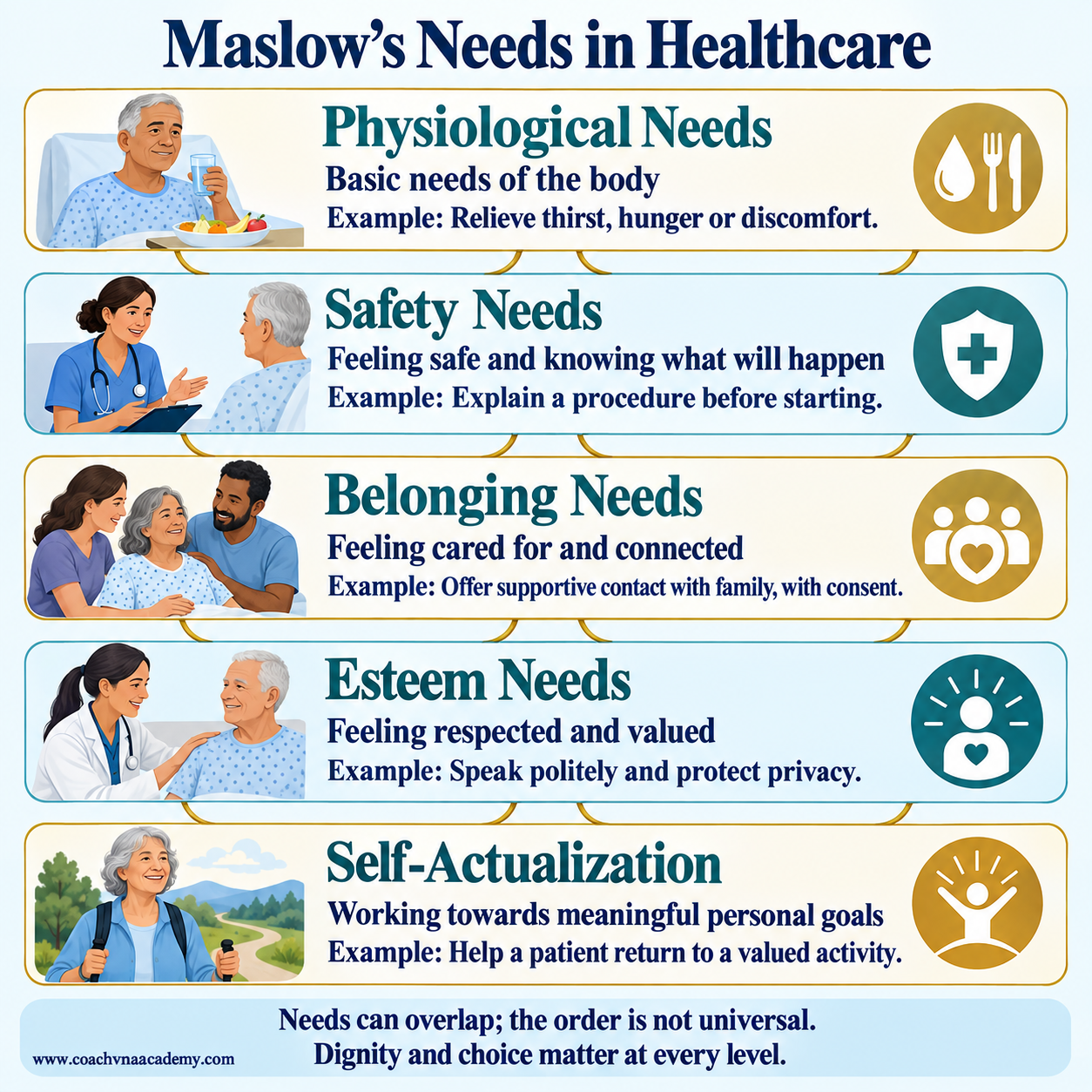
Maslow’s needs perspective
Abraham Maslow proposed a hierarchy commonly presented as physiological needs, safety, love and belonging, esteem, and self-actualization. The model helps broaden attention beyond a single symptom or instruction. Section 6 applies these needs to healthcare. It should not be used as a rigid rule that every person follows or as a justification for delaying dignity and choice.
Self-determination theory
Self-determination theory, associated with Edward Deci and Richard Ryan, emphasizes the quality of motivation and the social conditions supporting it. Its basic psychological needs are autonomy, competence and relatedness. Autonomy concerns a sense of willing choice, competence concerns feeling capable, and relatedness concerns connection and being cared for. Autonomy does not require acting alone.
A pharmacy application is to explain the reason for a plan, invite the person’s perspective, offer appropriate choices within professional limits, and support achievable practice. Clear feedback can help capability; respectful listening can support connection. These conditions may support engagement, but they do not replace access to treatment or guarantee adherence.
Self-efficacy: Confidence about a specific task
Albert Bandura’s concept of self-efficacy means belief in one’s ability to carry out a particular action. A patient may value a goal but doubt their ability to perform a skill. Breaking practice into manageable steps, observing a suitable model and receiving accurate feedback can support task-specific confidence. Self-efficacy differs from self-esteem, which concerns broader self-worth. Confidence must also be checked against actual performance; feeling able is not proof of competence.
| Perspective (angles or viewpoints) | Main focus | Practical teaching implication |
| Drive reduction | Internal needs and tension | Consider bodily comfort and basic needs. |
| Arousal | Level of activation | Reduce overload; adapt the task and setting. |
| Incentive | Anticipated outcomes | Explore what outcomes matter to the person. |
| Maslow | Several categories of human need | Consider safety, support and dignity together. |
| Self-determination | Choice, capability and connection | Support willing participation and achievable learning. |
| Self-efficacy | Belief about ability in a specific task | Use supported practice and check performance. |
Maslow’s Needs in Healthcare
| Need category | Healthcare relevance | Example of appropriate support |
| Physiological | Basic bodily requirements | Notice discomfort; arrange appropriate help within the care plan. |
| Safety | Security, predictability and protection | Explain what will happen and protect privacy. |
| Love and belonging | Connection and supportive relationships | Ask whether the person wants a trusted supporter involved. |
| Esteem | Dignity, recognition and self-respect | Address the person respectfully and acknowledge effort. |
| Self-actualization | Developing potential and meaningful goals | Connect an agreed action to a personally meaningful goal. |
Needs commonly coexist. Someone facing financial hardship can still seek learning, purpose and connection. Likewise, a person who feels physically safe may still need reassurance about an unfamiliar process. Culture and individual circumstances influence priorities. The model is a broad organizing aid rather than a validated checklist for assigning a patient to a level. Involvement of family or caregivers should follow the person’s wishes and appropriate consent.
Emotion, Motivation and Health Behavior
Emotion and motivation influence one another. Concern about illness may create a reason to seek help, yet intense fear can also encourage avoidance. Hope may support effort, but reassurance without accurate information may be misleading. Increasing fear is therefore not a reliable or respectful way to produce cooperation. A useful conversation considers the meaning of the situation, the person’s goals, their confidence and the practical conditions for action.
Ambivalence and practical barriers
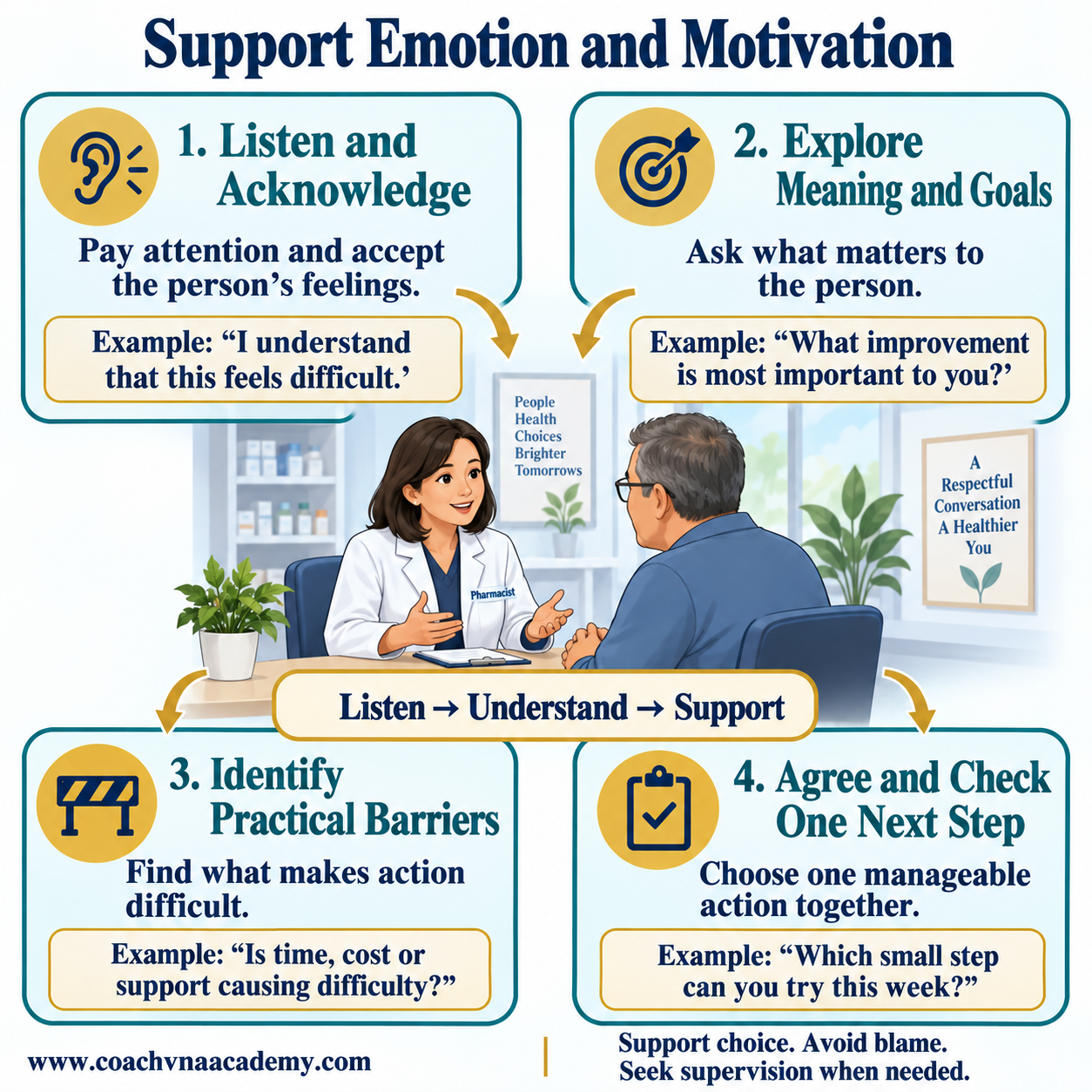
Ambivalence means having mixed reasons or feelings about an action. A person may want the expected benefit of a plan and simultaneously worry about inconvenience or harm. This is different from being careless. Ask what matters to the person and what makes action difficult; avoid arguing that one concern is foolish. Limited opportunity or resources also differ from limited motivation. A reminder or motivational message cannot remove a cost or transport barrier by itself.
Supporting a manageable next step
Support begins with listening and a nonjudgmental summary. Next, clarify unfamiliar information and identify a feasible next step with the person. For a skill, use demonstration and supervised practice. For understanding, invite teach-back: the person explains the agreed step in their own words. Then address practical barriers through suitable professional support. Motivational interviewing, formal behavior-change interventions and psychotherapy require further teaching and appropriate training; this lecture does not qualify students to deliver them independently.
Applying the Concepts in a Pharmacy Conversation
Fictional situation: Ms. Rao says, “I understand why follow-up matters, but I worry about what I may be told. I also lose wages when I attend.” Her statement identifies both worry and an access-related concern. It does not establish a psychological disorder or prove lack of motivation.
A respectful opening is: “You see a reason to attend, and you are concerned about both the visit and time away from work.” The pharmacist can then explore which concern is most pressing, explain the process within their role, and ask the supervising team about available appointment or access support. The aim is to make an informed, feasible next step possible, not to pressure the patient into agreement.
The emotion theories draw attention to bodily responses, meaning and context. Motivation perspectives add goals, capability, relationships and needs. Neither set of theories removes the wage barrier. After discussion, the patient can describe the agreed next step in their own words, while the healthcare professional checks whether further support is needed. No medicine or schedule change is assumed in this example.
Key Points to Retain
Emotion involves more than an outward expression. James–Lange emphasizes bodily feedback, Cannon–Bard parallel responses, Schachter–Singer arousal interpreted in context, and Lazarus appraisal. Motivation initiates, directs and sustains action; reasons for action can be intrinsic, external or personally endorsed. Drive reduction, arousal, incentives, human needs and self-determination offer different perspectives. In healthcare, respect choice, check understanding and address practical barriers alongside feelings and goals.
References and Further Reading
[1] Spielman, R. M., Jenkins, W. J., and Lovett, M. D. Psychology 2e. OpenStax (2020). Sections 10.1, Motivation, and 10.4, Emotion. https://openstax.org/books/psychology-2e/pages/10-1-motivation ; https://openstax.org/books/psychology-2e/pages/10-4-emotion
[2] OpenStax. Introduction to Behavioral Neuroscience (2024), section 13.1, Foundational and Contemporary Theories of Emotion. https://openstax.org/books/introduction-behavioral-neuroscience/pages/13-1-foundational-and-contemporary-theories-of-emotion
[3] Ryan, R. M., and Deci, E. L. (2000). Self-determination theory and the facilitation of intrinsic motivation, social development, and well-being. American Psychologist, 55(1), 68–78. https://doi.org/10.1037/0003-066X.55.1.68
[4] Center for Self-Determination Theory. Theory overview and basic psychological needs. https://selfdeterminationtheory.org/theory/
[5] Agency for Healthcare Research and Quality. Use the Teach-Back Method: Tool 5. https://www.ahrq.gov/health-literacy/improve/precautions/tool5.html