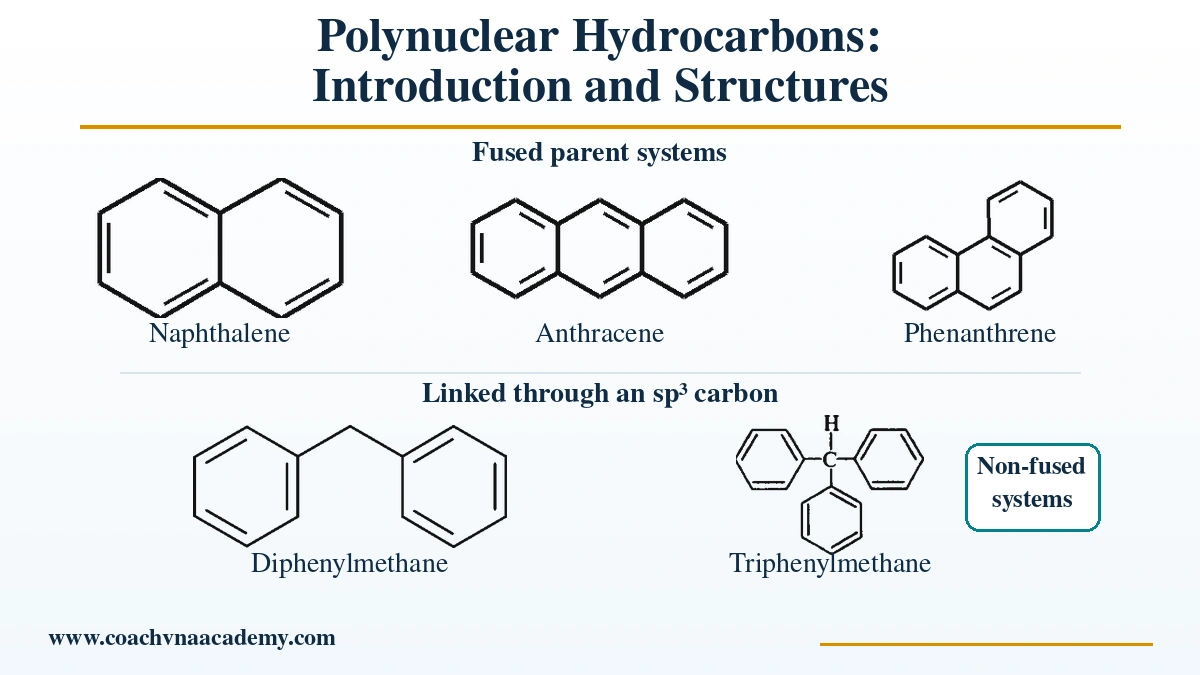
A polynuclear hydrocarbon contains two or more aromatic nuclei in one molecule and consists only of carbon and hydrogen. In this article, we include both fused aromatic hydrocarbons and non-fused methane derivatives under this heading. Here, the word nucleus refers to an aromatic ring framework, not an atomic nucleus.
Occurrence in coal tar
Traditionally, industries separated naphthalene, anthracene and phenanthrene from different coal-tar fractions. Among these three compounds, naphthalene usually occurs in the highest proportion. However, some teaching texts report about 6% naphthalene in coal tar. This figure is an approximate historical value because the coal source and processing conditions change the actual composition.
Classification
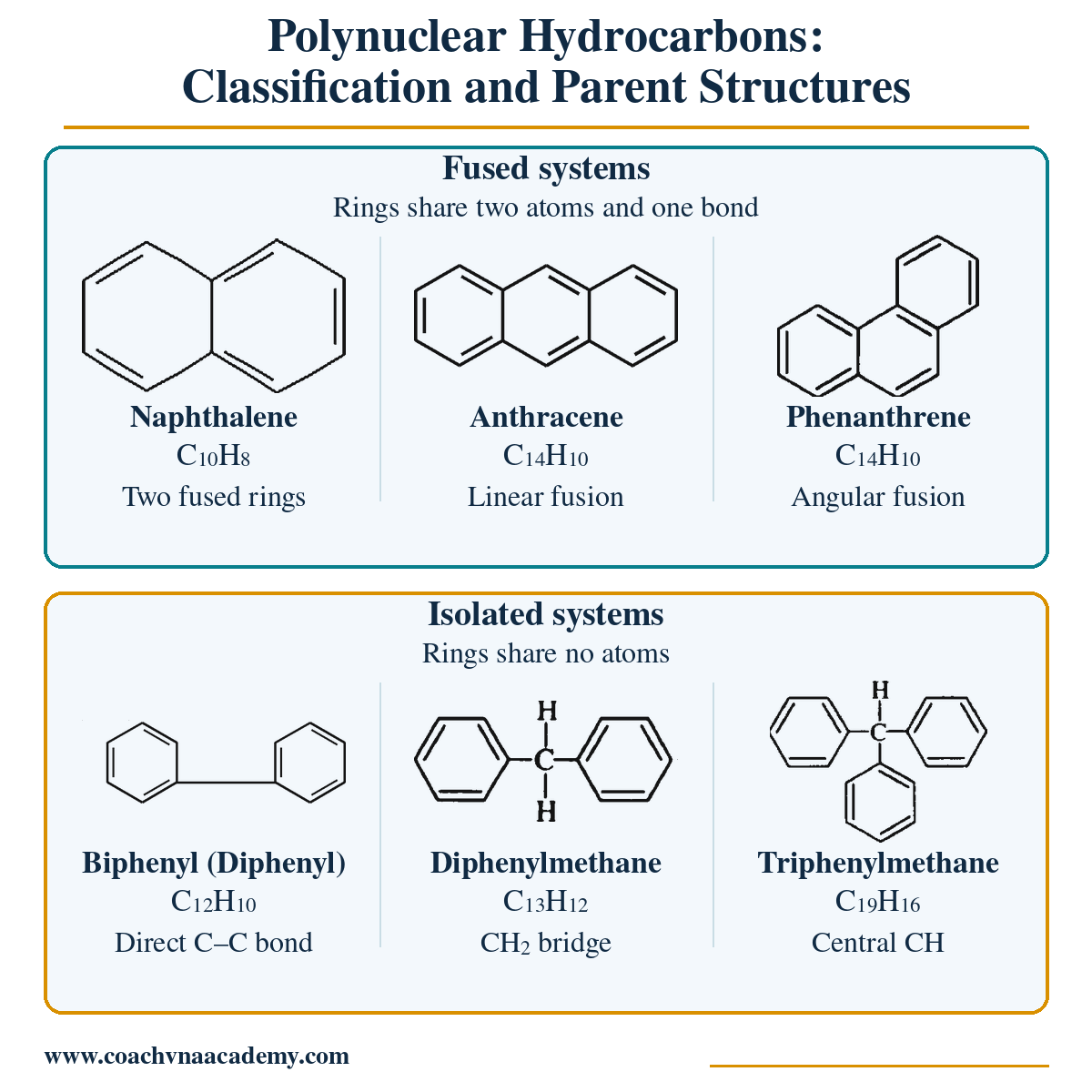
| Class | How the rings connect | Examples |
| Fused or condensed | Neighbouring rings share two adjacent carbon atoms and the bond between them. | Naphthalene, anthracene, phenanthrene |
| Isolated or non-fused | The rings share no atoms. They may join directly or through an sp³ carbon bridge. | Biphenyl, diphenylmethane, triphenylmethane |
Biphenyl: an additional isolated-system example
Biphenyl (or diphenyl), has the formula C₁₂H₁₀. It contains two phenyl rings joined directly by one carbon–carbon single bond. The rings share no carbon atoms, and no CH₂ group lies between them. One carbon from the first ring connects directly to one carbon from the second ring. That specific connecting line—the “bridge” between the two rings—is the C–C single bond. This feature clearly distinguishes biphenyl from diphenylmethane.
| AROMATICITY NOTE The fused systems contain continuous conjugated frameworks. In isolated systems, each phenyl ring remains aromatic, but a direct single bond or an sp³ carbon bridge does not convert the separate rings into one fused ring system. Do not apply a simple whole-molecule 4n + 2 count mechanically to every polynuclear structure. |
Naphthalene: structure and nomenclature
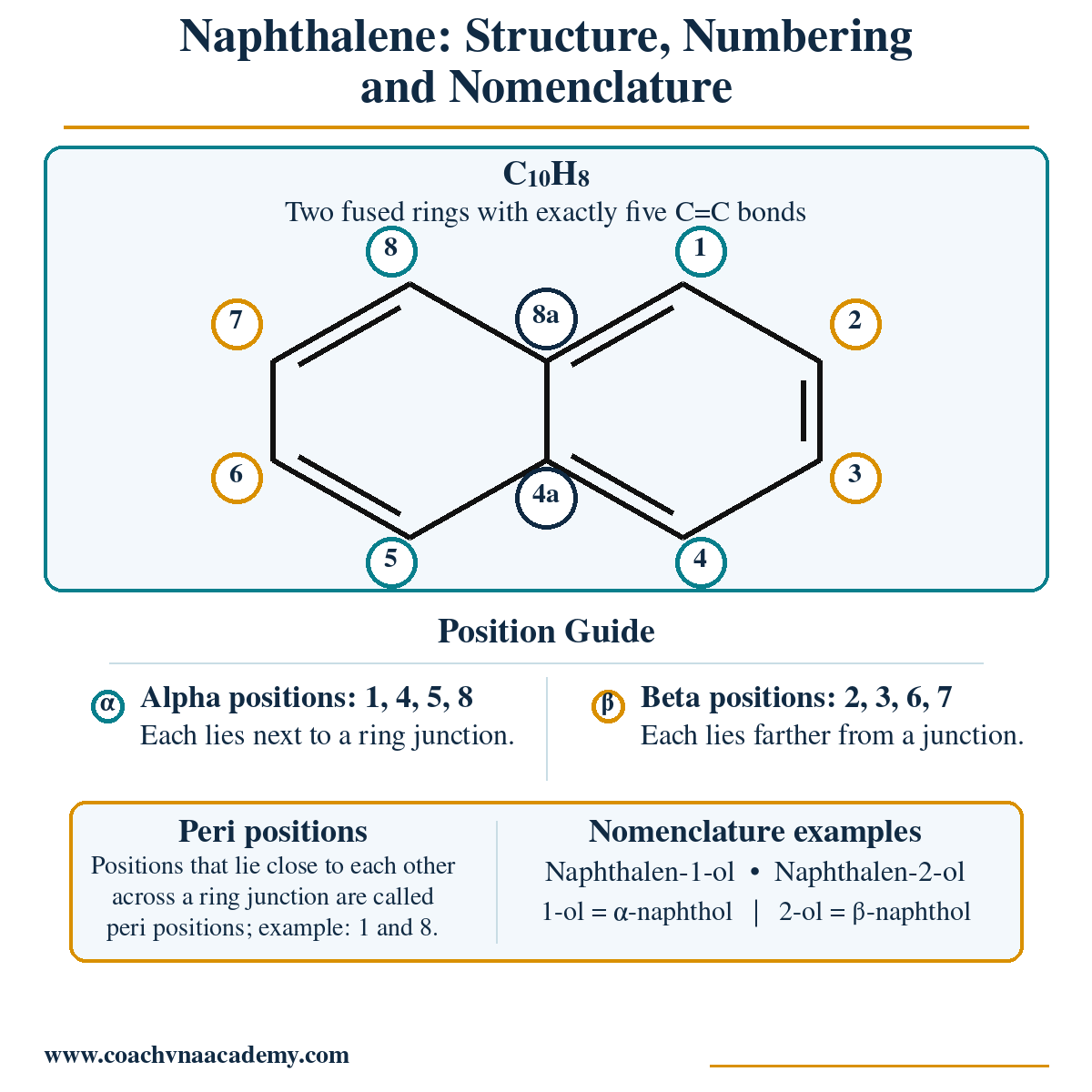
Naphthalene has the molecular formula C₁₀H₈. It contains two six-membered rings that share two adjacent carbon atoms and one bond. Count the shared atoms only once: 6 + 6 − 2 = 10 carbons. All ten carbons are sp²-hybridized and form one planar, conjugated framework with ten π electrons. A correct Kekulé contributor contains five C=C bonds, not six.
Retained parent name and numbering
Naphthalene is an accepted retained parent name. Number the eight hydrogen-bearing peripheral positions 1 to 8. The fusion atoms are 4a and 8a; they do not carry hydrogen in the parent hydrocarbon.
| Position class | Locants | Meaning |
| α (alpha) | 1, 4, 5, 8 | Each position is directly next to a fusion carbon. |
| β (beta) | 2, 3, 6, 7 | The remaining hydrogen-bearing peripheral positions. |
| Fusion junctions | 4a, 8a | Shared carbons; no hydrogen in naphthalene. |
| Peri relationship | 1,8 (also 4,5) | Two close positions across a ring junction. |
Naming naphthalene derivatives
First, choose naphthalene as the parent hydrocarbon. Next, place the locant before the substituent name. Always select the lowest permitted locant. If the principal functional group forms a suffix, write its locant immediately before that suffix, as in naphthalen-1-ol.
- 1-methylnaphthalene: methyl at an α position.
- 2-methylnaphthalene: methyl at a β position.
- naphthalen-1-ol (1-naphthol or α-naphthol): OH at C1.
- naphthalen-2-ol (2-naphthol or β-naphthol): OH at C2.
- naphthalen-1-yl and naphthalen-2-yl: substituent groups formed by removal of H from C1 or C2.
| MEMORY AID Alpha is adjacent to a junction. Do not confuse the suffix “a” in 4a and 8a with the Greek symbol α. |
Anthracene: structure and nomenclature
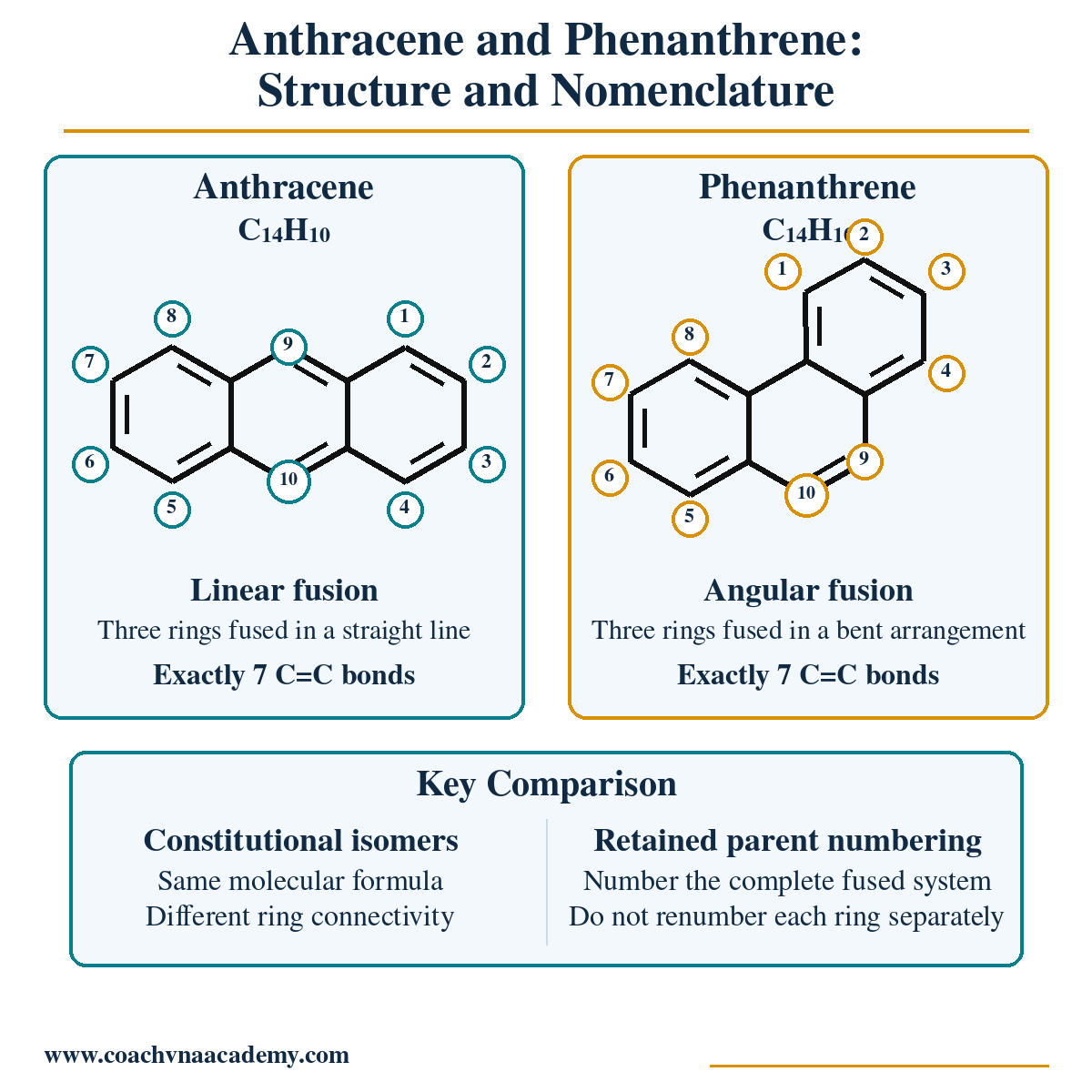
Anthracene, C₁₄H₁₀, contains three six-membered rings fused in a straight or linear arrangement. The central ring shares one edge with each terminal ring. All fourteen carbons belong to the conjugated fused framework. A Kekulé contributor contains seven C=C bonds.
Numbering and important position classes
Anthracene is an accepted retained parent name and keeps its traditional numbering. The outer hydrogen-bearing positions are 1–8. The two hydrogen-bearing carbons in the central ring are 9 and 10; they are called meso positions and are especially important in addition, oxidation and reduction reactions.
| Position group | Locants | Exam use |
| α positions | 1, 4, 5, 8 | Positions next to ring junctions on the terminal rings. |
| β positions | 2, 3, 6, 7 | Other outer hydrogen-bearing positions. |
| Meso positions | 9, 10 | Central-ring positions; characteristic anthracene reactivity. |
Naming anthracene derivatives
- 9-methylanthracene: methyl at a meso carbon.
- anthracen-9-ol (9-anthrol): OH at C9.
- anthracene-9,10-dione: systematic suffix form for anthraquinone.
- anthracen-9-yl: substituent group formed by loss of H at C9.
| EXAM POINT Do not number anthracene as three separate benzene rings. Use one continuous retained numbering system for the complete fused framework. |
Phenanthrene: structure and nomenclature
Phenanthrene, C₁₄H₁₀, also contains three fused six-membered rings. However, its third ring joins the other rings at an angle. Therefore, phenanthrene and anthracene have the same molecular formula but different carbon connectivity. Chemists classify them as constitutional isomers.
Numbering and key locants
Phenanthrene is an accepted retained parent name and follows its traditional numbering system. First, trace positions 1–8 along the outer perimeter. Next, mark positions 9 and 10 on the important carbon pair in the middle-ring region. Complete structural numbering assigns letter suffixes to the ring-junction locants. Therefore, beginners should learn the standard numbered parent diagram instead of numbering each benzene ring separately.
Naming phenanthrene derivatives
- 9-methylphenanthrene: methyl at C9.
- phenanthren-9-ol (9-phenanthrol): OH at C9.
- phenanthrene-9,10-dione: the 9,10-dione derivative.
- phenanthren-9-yl: substituent group formed by removal of H from C9.
Difference between anthracene and phenanthrene:
| Feature | Anthracene | Phenanthrene |
| Ring arrangement | Linear | Angular |
| Formula | C₁₄H₁₀ | C₁₄H₁₀ |
| Relationship | Constitutional isomer of phenanthrene | Constitutional isomer of anthracene |
| Key central locants | 9 and 10 | 9 and 10 |
| Parent nomenclature | Retained name and traditional numbering | Retained name and traditional numbering |
Diphenylmethane: structure and nomenclature
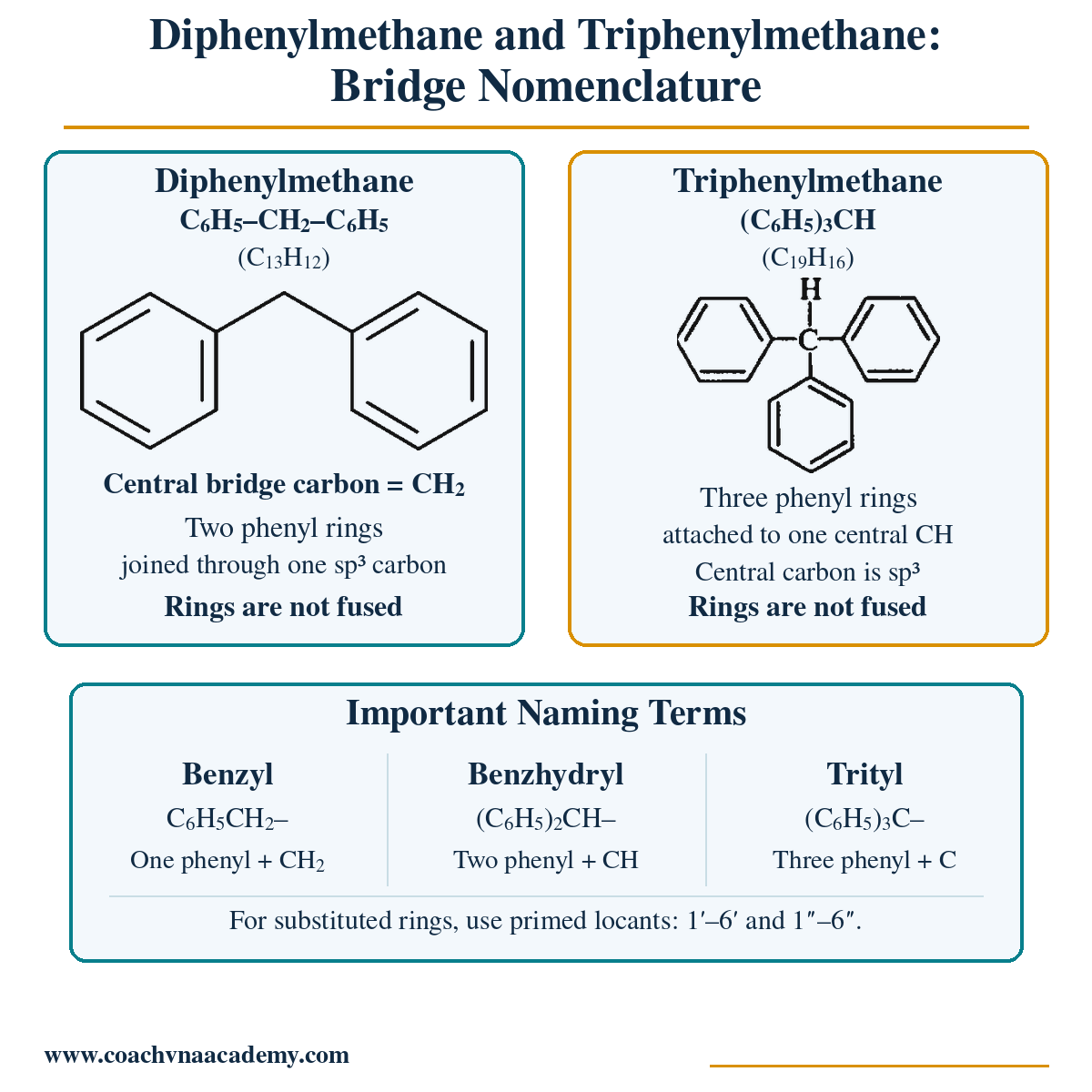
Diphenylmethane, C₁₃H₁₂, consists of two phenyl groups attached to one methylene group: C₆H₅–CH₂–C₆H₅. The rings do not share atoms. The central CH₂ carbon has sp³ hybridization. Therefore, the two aromatic rings do not form one continuous π-conjugated system.
Parent names and ring locants
Chemists widely use diphenylmethane as the retained parent name. They also use benzylbenzene as a systematic-style name for the same skeleton. For a substituted derivative, first choose a benzene ring as the parent if this choice produces a simple name. Otherwise, use the diphenylmethane framework. When both rings require identification, number the first ring from 1–6 and the second ring from 1′–6′.
- 2-methyldiphenylmethane: methyl next to the bridge attachment on one ring.
- 4,4′-dihydroxydiphenylmethane: OH groups para to the CH₂ bridge on both rings.
- Benzyl group: C₆H₅–CH₂–.
- Diphenylmethyl (benzhydryl) group: (C₆H₅)₂CH–; it is not the same as benzyl.
Triphenylmethane: structure and nomenclature
Triphenylmethane, C₁₉H₁₆, contains three phenyl groups attached to one central methane carbon: (C₆H₅)₃CH. The central carbon is sp³-hybridized and carries one hydrogen. The phenyl rings are non-fused and do not share carbon atoms.
Parent names and ring locants
Triphenylmethane is the accepted parent name commonly used for this framework. When substituents occur on more than one ring, use unprimed, primed and double-primed locants to distinguish the three rings where necessary. Positions para to the central carbon are commonly written as 4, 4′ and 4′′.
- 4,4′,4′′-trihydroxytriphenylmethane: one para-OH group on each ring.
- Triphenylmethyl group: (C₆H₅)₃C–.
- Trityl is the common short name for the triphenylmethyl group; define it when first used.
- Triphenylmethane dyes are derivatives; the therapeutic or dye use must not be assigned to the parent hydrocarbon automatically.
Consolidated comparison of the five parent systems
| Parent | Formula | Ring relationship | Recognition and nomenclature cue |
| Biphenyl* | C₁₂H₁₀ | Two rings joined directly | 1 and 1′ form the inter-ring bond; *additional classification example |
| Naphthalene | C₁₀H₈ | Two fused rings | α: 1,4,5,8; β: 2,3,6,7; junctions 4a,8a |
| Anthracene | C₁₄H₁₀ | Three linear fused rings | Traditional numbering; 9,10 are meso positions |
| Phenanthrene | C₁₄H₁₀ | Three angular fused rings | Traditional numbering; important 9,10 region |
| Diphenylmethane | C₁₃H₁₂ | Two rings linked by CH₂ | Second ring may use primed locants |
| Triphenylmethane | C₁₉H₁₆ | Three rings linked to central CH | Three rings may use unprimed, primed and double-primed locants |
| PARENT VERSUS DERIVATIVE A parent hydrocarbon provides the carbon framework. In a derivative functional groups determine its complete name, properties and uses. Never transfer a derivative’s medicinal use directly to naphthalene, anthracene, phenanthrene, diphenylmethane or triphenylmethane. |
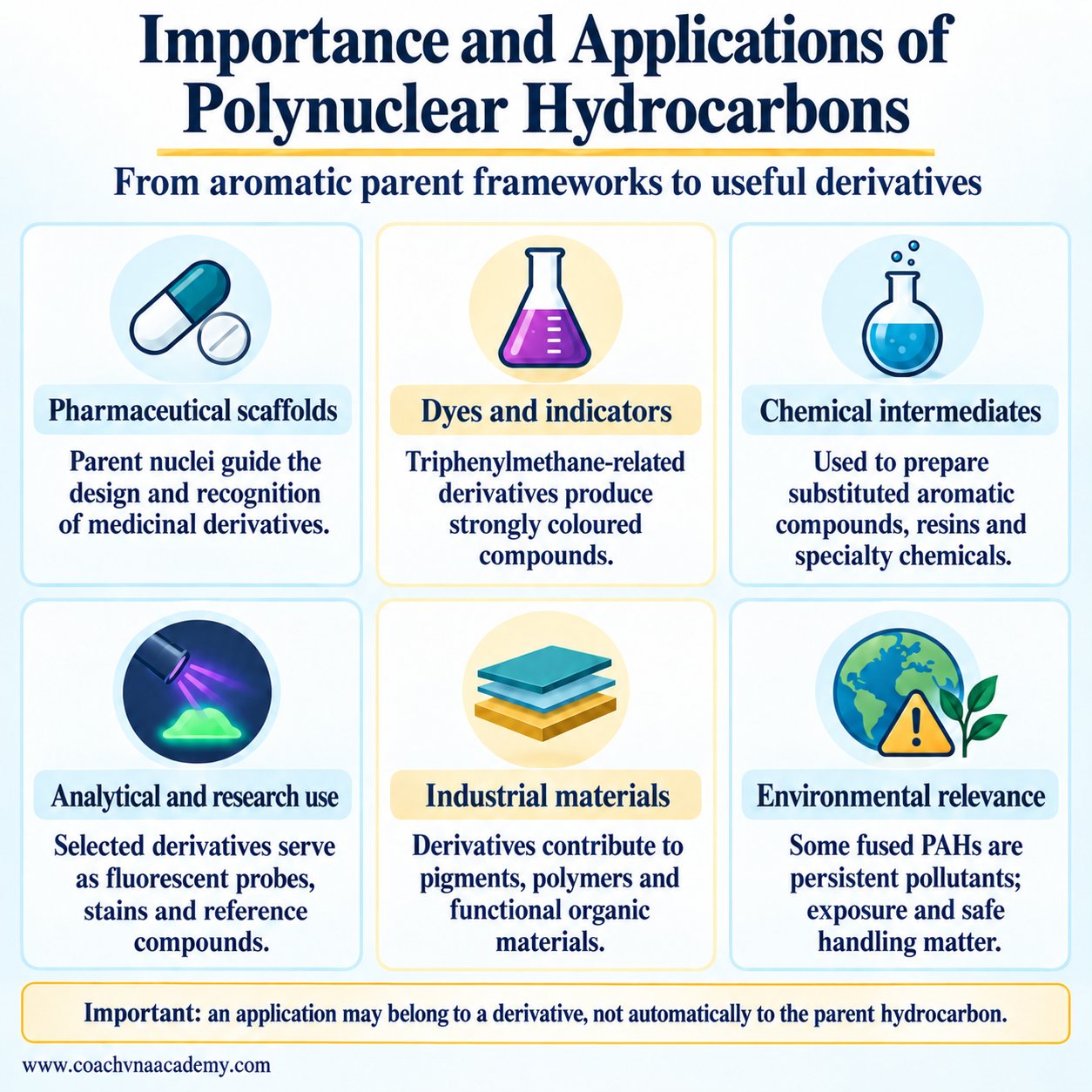
Importance and applications of polynuclear hydrocarbons
Polynuclear hydrocarbons are important because their rigid aromatic frameworks provide recognizable starting nuclei for many useful derivatives. Therefore, these compounds have structural, industrial, pharmaceutical and environmental importance. However, a parent hydrocarbon and its derivatives are not the same substances. Adding functional groups such as –OH, –NH₂, –SO₃H, carbonyl groups or halogens can greatly change the compound’s colour, solubility, reactivity, biological activity and toxicity.
Why these ring systems are important
Core structures for further chemistry: Their stable aromatic nuclei provide defined positions for substitution, oxidation, reduction and side-chain reactions. This makes them valuable parent frameworks for preparing and identifying derivatives.
Pharmaceutical relevance: Several medicinal and antiseptic compounds contain naphthalene-, anthracene-, phenanthrene-, diphenylmethane- or triphenylmethane-related frameworks. In pharmacy, students must recognize the parent nucleus inside the complete drug or medicinal derivative rather than assign the derivative’s action to the bare hydrocarbon.
Colour and light absorption: Extended conjugation in many substituted polynuclear systems allows absorption of visible or ultraviolet light. Consequently, selected derivatives are useful as dyes, indicators, stains, fluorescent probes and analytical reagents.
Industrial usefulness: These frameworks serve as intermediates in the manufacture of substituted aromatic chemicals, pigments, resins, polymers and other functional organic materials.
Environmental and toxicological importance: Incomplete combustion of coal, petroleum, tobacco and organic matter can form fused polycyclic aromatic hydrocarbons. Some PAHs persist in air, soil or water and may be harmful; therefore exposure control, correct waste disposal and safe laboratory handling are important.
Compound-wise importance and representative applications
| Parent framework | Why it matters | Representative applications of the framework or derivatives |
| Naphthalene | Two fused rings; readily undergoes electrophilic substitution and oxidation. | Starting material for phthalic anhydride and substituted aromatic intermediates; naphthol and naphthalene-sulfonic-acid derivatives are important in dyes and chemical manufacture. Medicinal use belongs to specific derivatives, not automatically to naphthalene. |
| Anthracene | Three linearly fused rings with a reactive 9,10-region. | Source framework for anthraquinone chemistry; derivatives are used in dyes, pigments, analytical fluorescence work and selected medicines. |
| Phenanthrene | Three angularly fused rings; the nucleus occurs within several complex natural and medicinal structures. | Useful reference framework in structural chemistry; phenanthrene-related nuclei occur in important natural-product and pharmaceutical families. |
| Diphenylmethane | Two phenyl rings separated by a methylene bridge, allowing ring and benzylic-carbon modification. | Its derivatives occur in pharmaceutical, polymer, resin and specialty-chemical chemistry; the complete substituted molecule determines the actual use. |
| Triphenylmethane | Three phenyl rings around a central carbon; substituted derivatives can develop highly delocalized coloured forms. | Triphenylmethane-related derivatives are widely associated with dyes, indicators, biological stains and selected antiseptic or analytical uses. |
EXAM CAUTION: Write “the parent framework or its derivatives are used in …” unless the application is specifically established for the parent compound. This avoids the common error of transferring a medicinal, dye or indicator use from a substituted derivative to the unsubstituted hydrocarbon.
Practical safety perspective
Polynuclear compounds vary greatly in hazard. Volatile naphthalene should not be inhaled or handled casually, and unknown PAH mixtures should be treated as potentially harmful. In the laboratory, use appropriate personal protective equipment, avoid skin contact and dust or vapour exposure, work with adequate ventilation, and dispose of residues through the approved chemical-waste route. Do not infer safety merely from the fact that a compound is aromatic or has an industrial application.