
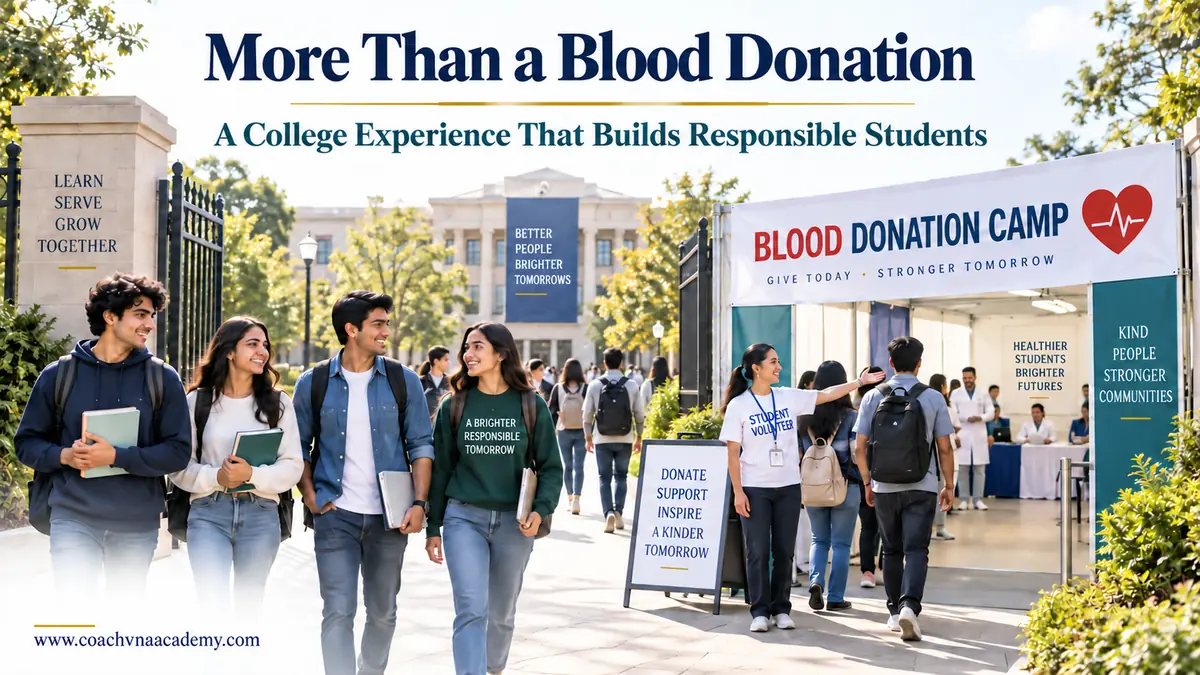
A College Experience That Builds Responsible Students
Introduction
Blood donation in college should not be viewed only as a one-day camp or a target for collecting a certain number of blood units. It can become a meaningful educational experience that helps students understand social responsibility, empathy, teamwork and voluntary service.
Every student may not be medically eligible or emotionally ready to donate blood. Still, each student can contribute by spreading correct information, helping with registration, guiding donors, supporting first-time participants or assisting the organising team. Therefore, the real purpose of a college blood donation initiative is not to pressure students, but to create informed, willing and responsible participation.
When organised with proper medical supervision, informed consent and respect for individual choice, a blood donation camp can teach lessons that go far beyond the classroom. It can help students become more confident, compassionate and socially responsible individuals.
A Different Kind of Learning Day on Campus
As students entered the college campus in the morning, a large banner near the main gate announced a Blood Donation Camp. Some noticed it immediately and discussed it while walking towards their departments. Others gave it only a quick glance because their first lecture was about to begin.
The college day continued normally. Lectures, laboratory sessions and other academic activities followed the scheduled timetable. The camp did not replace academics; it took place alongside the regular working day.
Meanwhile, preparations were already underway in the designated hall. Registration tables, medical screening desks and resting chairs had been arranged inside the venue. Members of the medical team were checking the required equipment, and the students assigned as volunteers were already helping participants understand the registration process.
During a break, some students checked a message shared through their official college WhatsApp groups by the college administration. It informed them that eligible and willing students could visit the designated venue, obtain complete information and participate voluntarily.
After completing an ongoing lecture or practical, interested students gradually began moving towards the hall. Some approached registration confidently. Others observed from a distance, interested but hesitant.
One student wanted to participate but worried about weakness and the needle. A faculty mentor did not compare him with his friends. The mentor encouraged him to ask the qualified medical team, share his health information honestly and decide without pressure.
On another side of the hall, a student was disappointed after being advised not to donate on that occasion. A volunteer invited her to help guide participants towards the registration and refreshment areas. She had not donated blood, but she had still contributed.
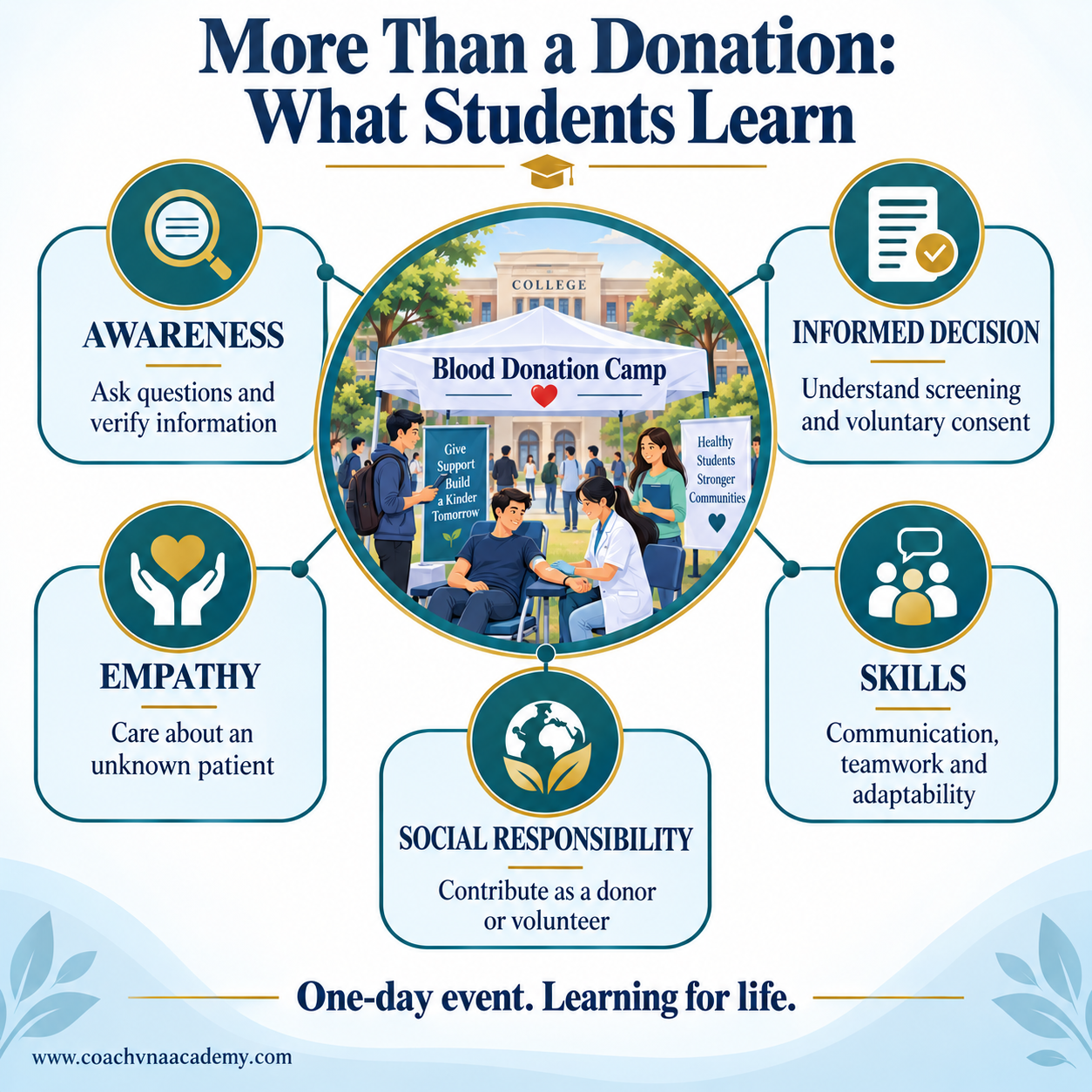
From a faculty observer’s perspective, the camp had become more than a medical activity. Donors were learning informed decision-making and responsibility. Volunteers were practising communication, teamwork, patience and public interaction.
Yeh sirf blood donation ka camp nahi tha. Yeh students ke liye fear ko samajhne, questions poochhne, responsible decision lene aur society mein apna role pehchanne ka practical learning experience tha.
Understanding Blood Donation
Blood donation is the voluntary act of giving blood so that an authorized blood centre can test, process and make it available for patients who require transfusion. The decision must remain informed and voluntary.
Voluntary donation ka matlab hai ki student apni marzi se, proper information lene ke baad aur bina pressure ya payment ke blood donate kare.
Awareness does not mean encouraging everyone to donate. It means helping every student understand the purpose, answer screening questions honestly and respect the medical decision.
Why Donated Blood Is Needed
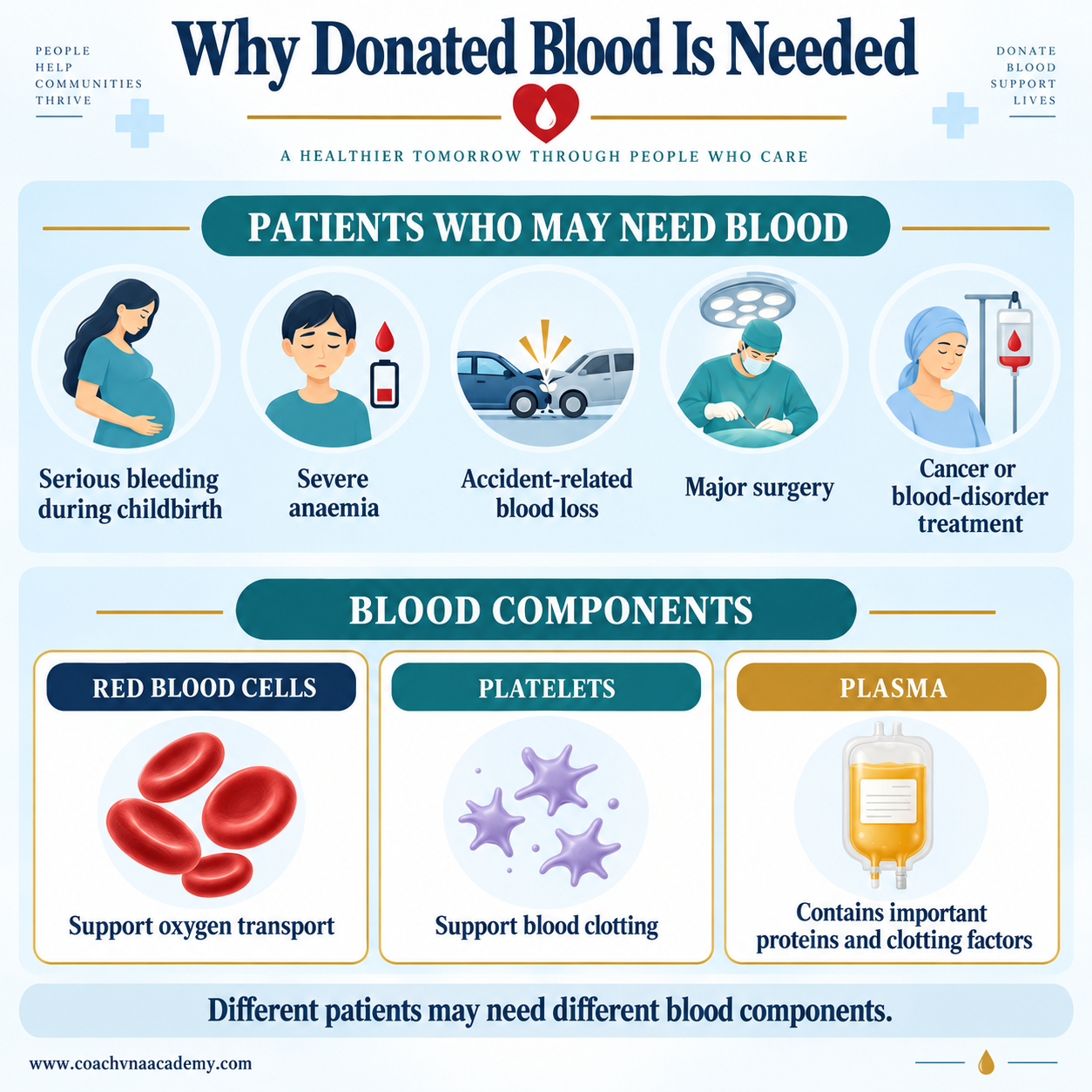
Safe blood may support women with serious bleeding during childbirth, children with severe anaemia, accident victims, surgical patients and people receiving treatment for cancer or blood disorders. Blood also has limited storage periods, so healthcare services require a regular voluntary supply.
| Component | Simple role | Examples of need |
| Red blood cells | Carry oxygen | Severe anaemia or major blood loss |
| Platelets | Support clot formation | Very low platelet count, some cancers, blood disorders, trauma or dengue |
| Plasma | Contains important proteins and clotting factors | Certain bleeding or clotting-factor conditions |
Different patients may need different components. The treating team decides what a patient requires; one student should not make clinical claims about a particular donation.
Who Can Donate Blood
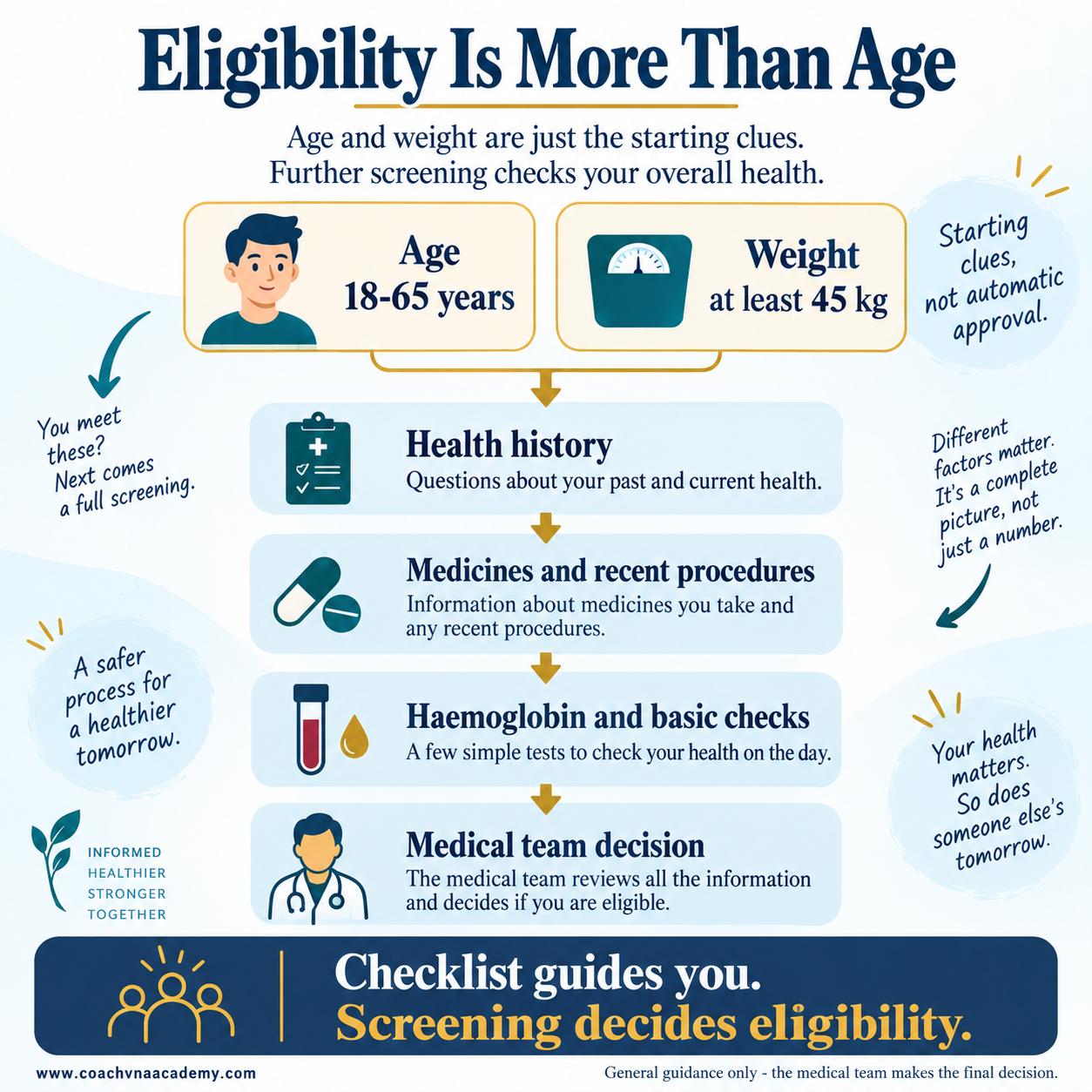
In India, e-RaktKosh presents 18-65 years and at least 45 kg as general starting criteria for whole-blood donation. These are not a self-approval test. Current health, haemoglobin, medicines, recent illness or procedures and other factors may change suitability.
-
-
- Register and read the form carefully.
-
- Disclose current health, medicines and relevant recent procedures honestly.
-
- Complete pulse, blood pressure, temperature, weight and haemoglobin checks as required.
-
- Ask questions before signing informed consent.
-
- Accept temporary or permanent deferral without shame.
Age aur weight match karna sirf starting point hai. Final fit-to-donate decision medical screening ke baad hota hai.
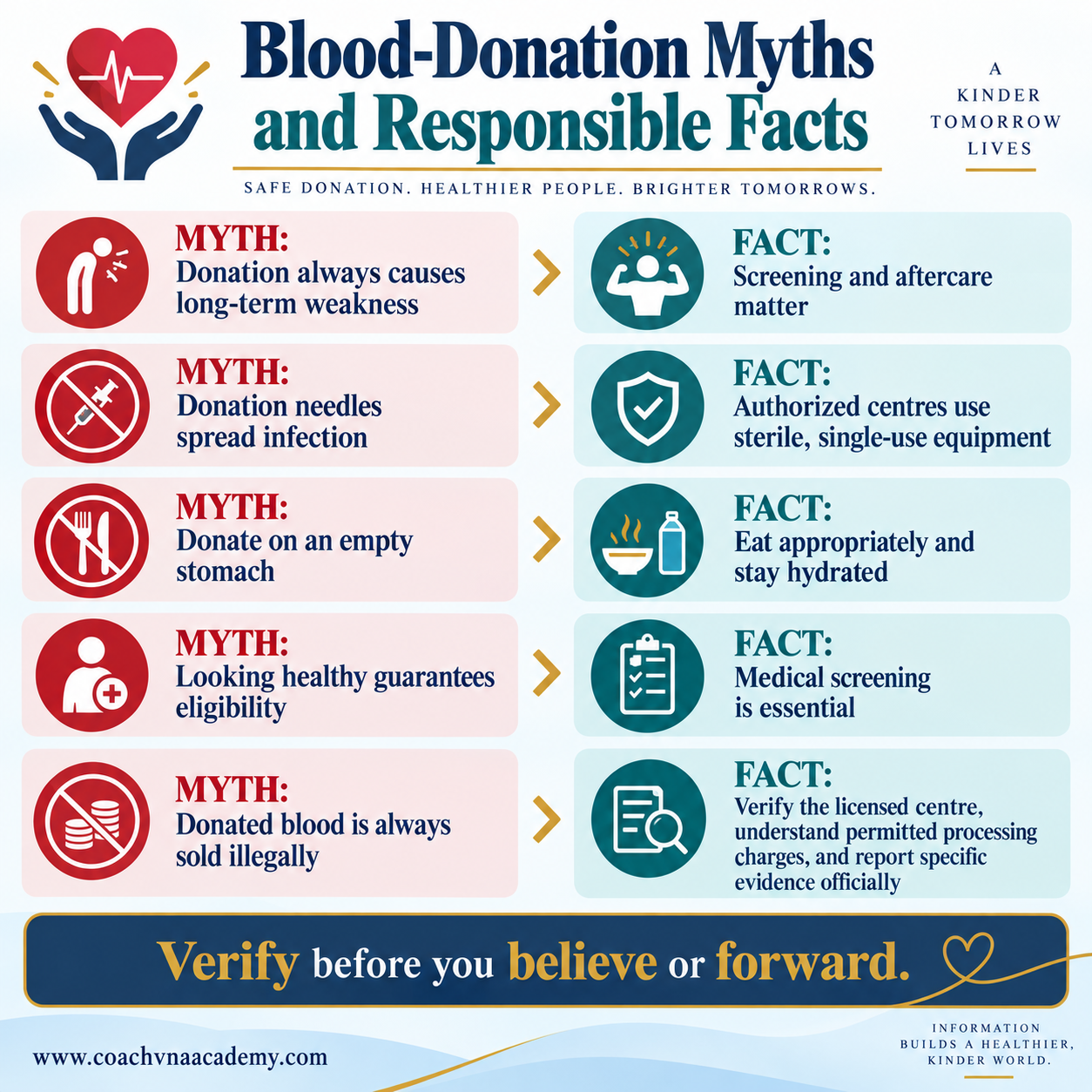
Common Myths and Responsible Facts
| Myth | Responsible fact |
| Donation always causes long-term weakness | Suitable donors are screened. Follow rest, food, fluid and aftercare guidance. |
| Donation needles spread infection | Authorized centres use sterile, single-use equipment. |
| Donate on an empty stomach | Eat an appropriate light meal, hydrate and follow centre instructions. |
| Looking healthy guarantees eligibility | Individual screening remains essential. |
| Only rare blood groups matter | Different patients require different compatible groups and components. |
| Women cannot donate | Gender alone does not decide eligibility; individual health factors matter. |
| Deferral means failure | Deferral can be temporary and protects donor and recipient. |
| Donated blood is always sold illegally | Verify the licensed centre. Distinguish permitted processing charges from illegal activity and report specific evidence officially. |
The presence of a bill does not by itself prove illegal sale. India bans professional blood donation; licensed blood centres may have permitted costs for collection, testing, processing, storage and issue. Do not forward an unverified mafia allegation. Preserve specific evidence and report a genuine concern through the hospital, blood centre, State Drug Controller or State Blood Transfusion Council.
Student Motivation Without Pressure
A donor may never meet the patient who benefits. That is what makes the contribution meaningful: another person matters even without recognition. Yet emotional meaning must never become guilt or competition.
-
-
-
- Do not call a nervous student weak or selfish.
-
-
-
-
-
- Do not make donation a certificate or photograph competition.
-
-
-
-
-
- Encourage questions and honest screening.
-
-
-
-
-
- Respect a decision not to donate.
-
-
-
-
-
- Offer an appropriate volunteer role when available.
-
-
Real courage ka matlab fear ka absence nahi hai. Real courage ka matlab fear ko samajhkar safe aur informed action lena hai.
If you feel nervous before screening, a gentle slow-breathing break may help you pause and communicate your concerns clearly.
What Donors and Volunteers Learn
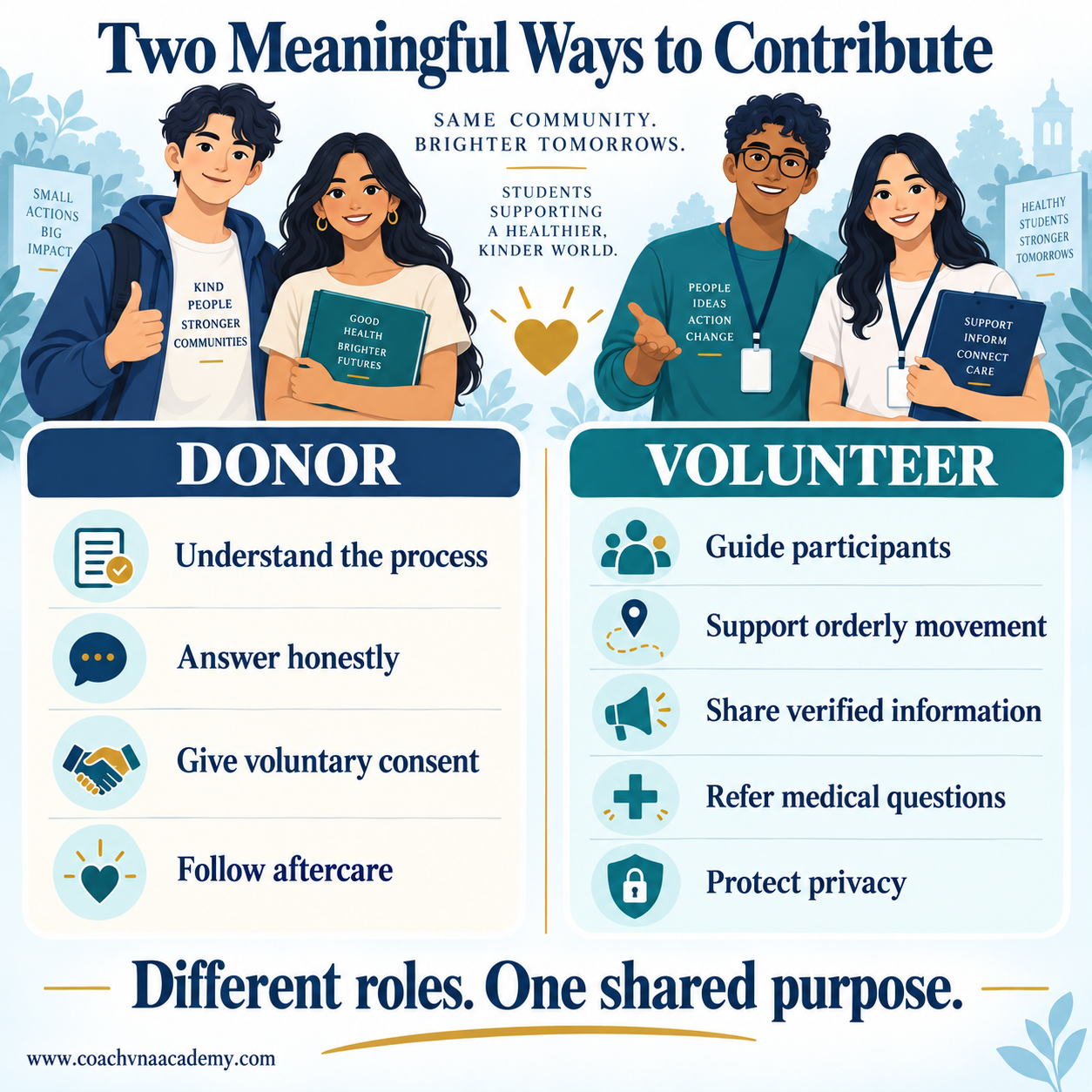
| Learning area | Donor example | Volunteer example |
| Communication | Asks questions and reports discomfort | Gives clear directions and listens patiently |
| Responsibility | Discloses health information honestly | Stays within assigned role |
| Adaptability | Accepts screening outcome | Adjusts to changing flow |
| Empathy | Thinks about an unknown patient | Supports a nervous participant without pressure |
| Teamwork | Cooperates with staff | Coordinates duties with other volunteers |
| Privacy | Uses the confidential process | Does not reveal screening information |
A student should claim only a skill supported by a real action. Participating once does not automatically prove leadership or event management.
From Camp Participation to Career Readiness
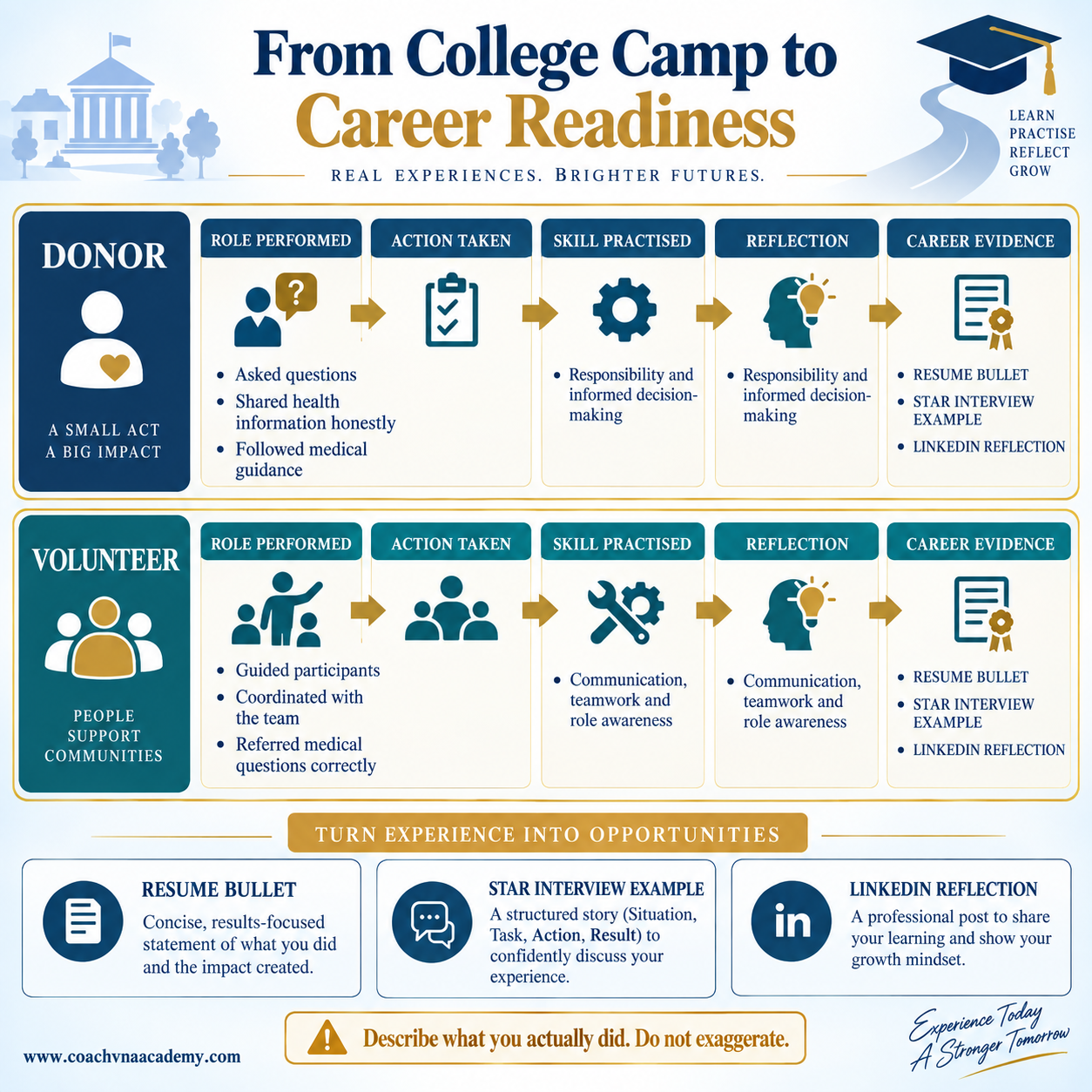
A volunteer may include the event under Volunteer Experience, College Activities or Community Engagement. A donor may mention it briefly when relevant, but personal medical details do not belong in a resume.
Resume Examples
Volunteer: Guided participants through designated registration, screening and recovery areas while referring health-related questions to qualified professionals.
Donor: Participated voluntarily in an authorized college blood-donation initiative after completing required screening and informed consent.
Interview Example
During a college blood-donation camp, several students arrived after an official WhatsApp notification. I coordinated with other volunteers so that registration guidance, queue movement and waiting-area directions remained clear. We referred medical questions to the qualified team. The experience taught me that teamwork requires clear roles and professional boundaries.
LinkedIn Example
Today I supported a college blood-donation camp as a student volunteer. While regular classes continued, our team guided participants and referred medical questions to qualified professionals. The experience showed me how calm communication, teamwork and respect for voluntary choice strengthen community service. #StudentVolunteer #CommunityEngagement #LifelongLearning
Before posting, obtain photograph permission, hide forms and health details, verify numbers and describe the role honestly.
From a One-Day Event to Lifelong Learning
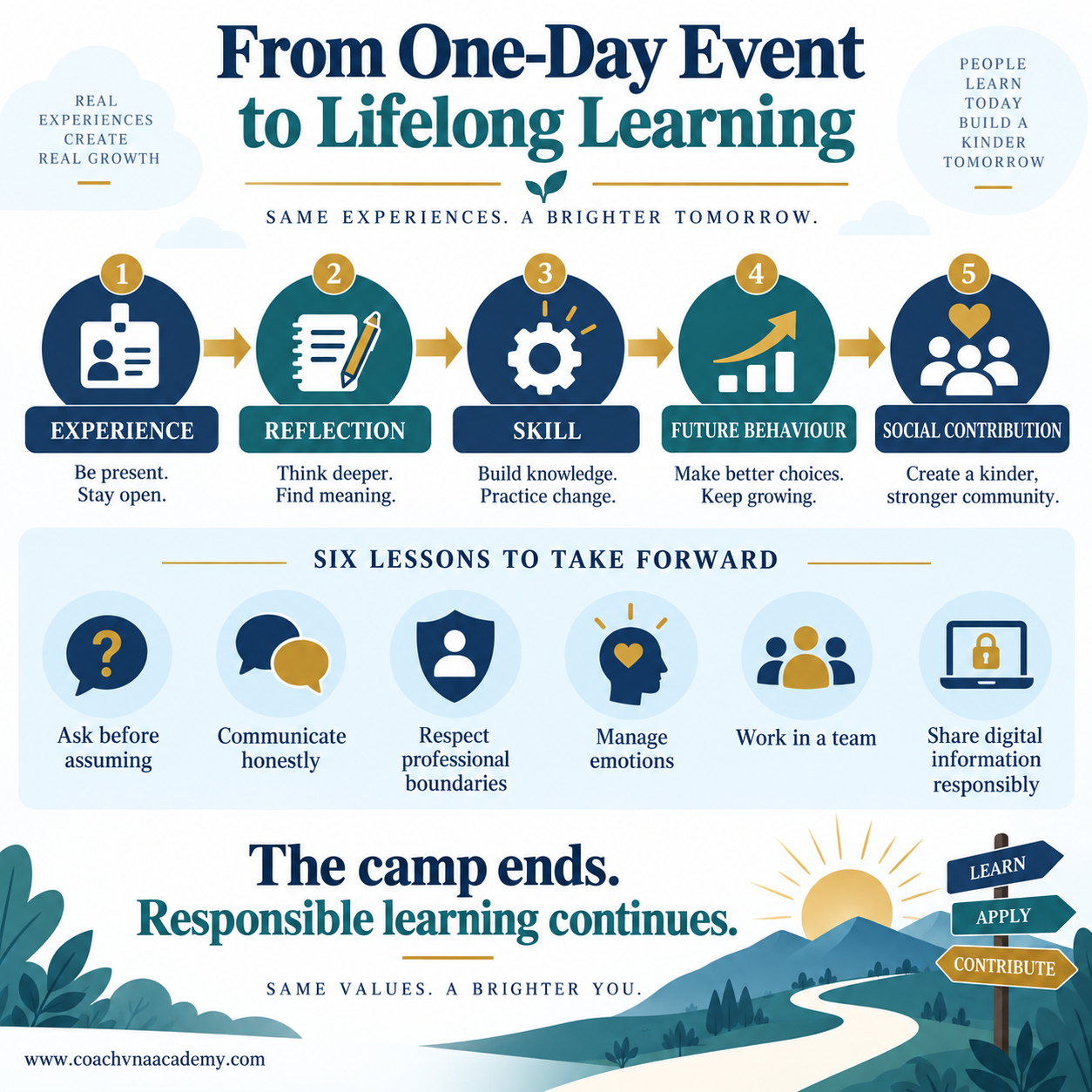
Experience becomes lifelong learning when students reflect, identify a skill, apply it later and contribute more responsibly. A useful pathway is: Experience -> Reflection -> Skill -> Future Behaviour -> Social Contribution.
-
-
-
- Ask before you assume.
-
-
-
-
-
- Give honest information even when it feels uncomfortable.
-
-
-
-
-
- Respect professional boundaries and refer medical questions.
-
-
-
-
-
- Manage emotion without hiding it.
-
-
-
-
-
- Balance social participation with academic responsibility.
-
-
-
-
-
- Verify digital information before forwarding.
-
-
Kisi event mein participate karna ek experience hai. Us experience par reflect karke future behaviour improve karna lifelong learning hai.
Before, During and After Blood Donation
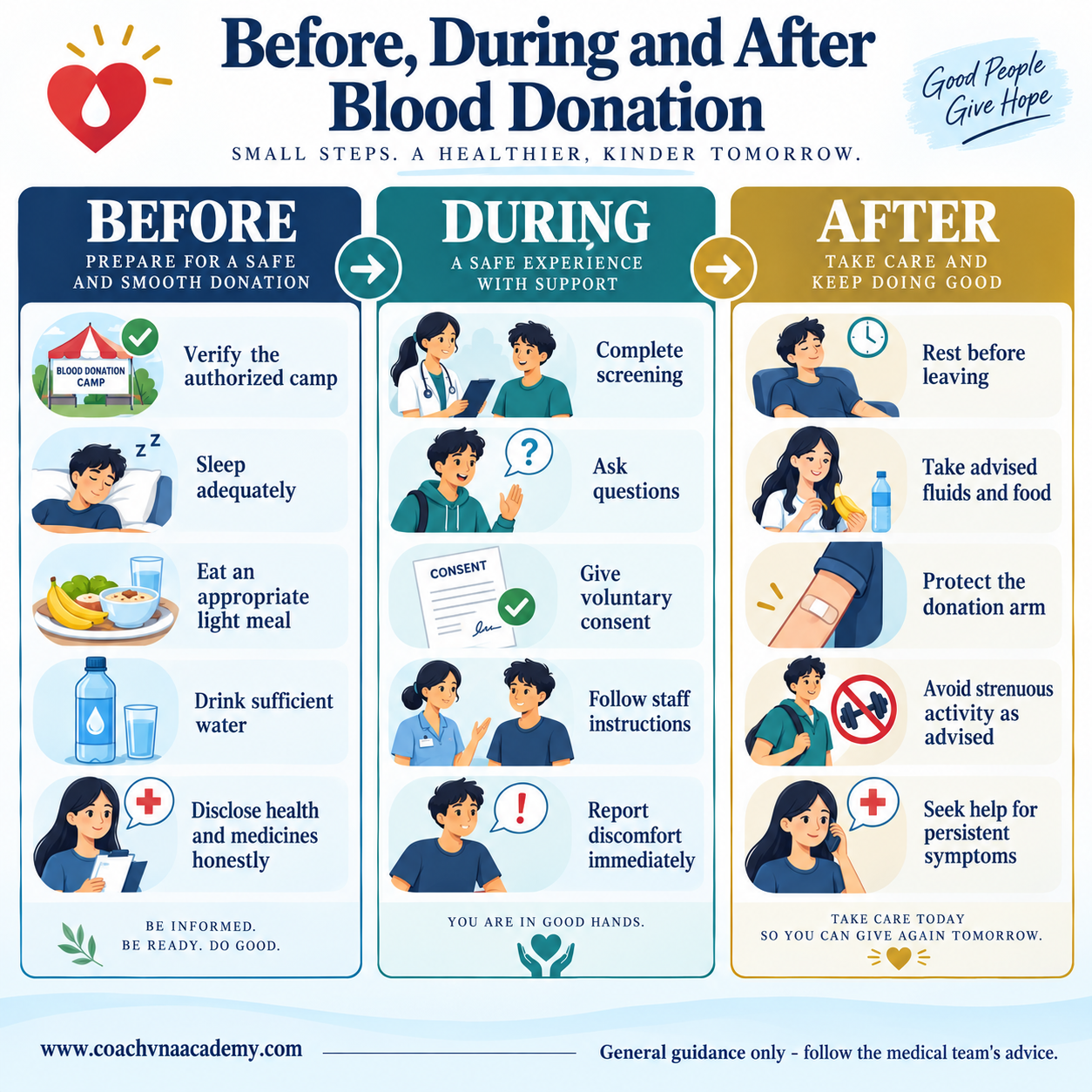
1. Verify the official camp, organizer, location and timing.
2. Complete scheduled academic work and allow time for screening and recovery.
3. Sleep adequately, eat an appropriate light meal and drink sufficient water. Proper preparation is also connected with everyday habits. Explore the guides on Healthy Eating Habits for College Students and Healthy Sleep Routine for College Students for practical guidance.
4. Disclose illness, medicines, recent procedures and relevant health concerns honestly.
5. Complete registration, screening and informed consent.
6. During donation, follow instructions and report pain, nausea, sweating, dizziness or anxiety immediately.
7. Rest before standing, accept advised fluids or refreshments and protect the donation arm.
8. Increase fluid intake, eat balanced meals and avoid strenuous activity for the period advised.
9. If light-headed, sit or lie safely and seek help if symptoms persist, worsen or concern you.
10. If deferred, ask for clear guidance and consider a suitable volunteer role.
Five Essential Questions
Can every college student above 18 donate?
No. Age is only one criterion. Every prospective donor needs individual medical screening.
What if I am afraid of the needle?
Tell the medical team, ask questions and decide without peer pressure.
Can I catch infection from the donation needle?
Authorized services use sterile, single-use collection equipment. Verify the licensed blood centre.
Can I contribute if I am deferred or do not donate?
Yes. Under organizer guidance, you may support participant flow, verified awareness or another suitable volunteer task.
Why might a patient pay when donation is voluntary?
The donor is unpaid, while permitted collection, testing, processing, storage and issue charges may apply. A bill alone does not prove illegal sale.
What Students Should Carry Forward
When the banner is removed and the WhatsApp message moves upward in the group, the learning can remain. Learn before deciding. Donate only when eligible, screened and willing. If donation is not suitable, contribute in another responsible role. Verify information, respect consent and carry the experience into future decisions.
At the next authorized camp, do not respond only with excitement or fear. Verify the information, consult the medical team, decide voluntarily and contribute responsibly in the role suitable for you.
Downloadable Student Workbook
Use this printable workbook to record your camp preparation, questions, volunteer responsibilities, learning reflections and career-related skills. It includes practical checklists, a skill-evidence builder, resume guidance, an interview worksheet and a lifelong-learning action plan.
Authoritative references
Medical disclaimer: This article provides general education and does not replace individual medical advice, donor screening or the instructions of the authorized blood centre.