
Introduction
Benzene is an aromatic hydrocarbon with the molecular formula C₆H₆. The formula indicates high unsaturation, but the chemical behavior of benzene differs from that of ordinary alkenes and polyenes. Ordinary unsaturated compounds generally undergo addition reactions easily, whereas benzene mainly undergoes substitution and shows unusual stability. Therefore, analytical, synthetic and chemical evidence was used to derive its structure.
Analytical Evidence
Elemental analysis showed that benzene contains only carbon and hydrogen. Its empirical formula is CH. The empirical formula mass is 13 and the molecular mass is approximately 78. Therefore:
78 ÷ 13 = 6; hence, molecular formula = (CH)₆ = C₆H₆
This result establishes the number of carbon and hydrogen atoms, but it does not show whether they are arranged in an open chain or a ring.
| Important point: A molecular formula gives the number of atoms but not their exact arrangement. |
| Degree of Unsaturation of Benzene: Degree of unsaturation, also called the Index of Hydrogen Deficiency (IHD), indicates the total number of rings and multiple-bond equivalents in a compound. A saturated open-chain hydrocarbon with six carbon atoms is C₆H₁₄, whereas benzene is C₆H₆. The division by 2 is used because each one degree of unsaturation causes a deficiency of two hydrogen atoms compared with the corresponding saturated open-chain hydrocarbon. For example: * Formation of one double bond removes two hydrogen atoms. * Formation of one ring also reduces the hydrogen count by two. Thus, Hydrogen deficiency = 14 – 6 = 8, and degree of unsaturation = 8 ÷ 2 = 4. Hence, the degree of unsaturation of benzene is four. In the classical representation, this corresponds to one ring plus three double bonds. The value four does not prove the exact structure because different combinations of rings, double bonds and triple bonds can give the same total. Memory line: Hydrogen deficiency ÷ 2 = Degree of unsaturation |
Formation of Benzene from Acetylene
Three molecules of acetylene combine under suitable conditions to form one molecule of benzene:
3 HC≡CH → C₆H₆
This reaction is called the trimerization or cyclic polymerization of acetylene. It supports the formation of a six-carbon cyclic framework. It does not independently explain equal carbon-carbon bond lengths, unusual stability, or preference for substitution.
Hydrogenation of Benzene
Benzene reacts with three molecules of hydrogen in the presence of a suitable metal catalyst and under relatively strong conditions to form cyclohexane:
C₆H₆ + 3 H₂ → C₆H₁₂
The product cyclohexane supports a six-membered carbon ring, and consumption of three hydrogen molecules supports three units of pi unsaturation. Benzene does not hydrogenate as easily as an ordinary alkene because it has additional stability.
Evidence from Monosubstituted Derivatives
When one hydrogen atom of benzene is replaced by a substituent X, only one monosubstituted derivative is obtained:
C₆H₆ → C₆H₅X
This observation shows that all six hydrogen atoms in benzene are chemically equivalent.
One monosubstituted derivative = all six hydrogens are equivalent
Evidence from Disubstituted Derivatives
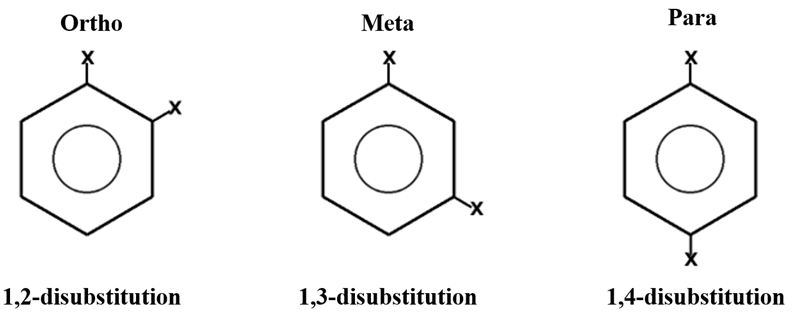
When two identical substituents are present on the benzene ring, only three positional isomers are possible: ortho at 1,2-positions; meta at 1,3-positions; and para at 1,4-positions. The formation of exactly three disubstituted derivatives supports a symmetrical six-membered ring.
| Arrangement | Position numbers | Name |
| Adjacent positions | 1,2 | Ortho |
| One carbon between substituents | 1,3 | Meta |
| Opposite positions | 1,4 | Para |
Preference for Substitution Reaction
Although benzene is unsaturated, it usually undergoes substitution reaction rather than easy addition. In substitution, one hydrogen atom is replaced while the benzene ring is retained:
C₆H₆ + E⁺ → C₆H₅E + H⁺
This behavior suggests unusual stability of the benzene ring.
Observation-Conclusion Summary
| Experimental observation | Structural Conclusion |
| Only carbon and hydrogen are present. | Benzene is a hydrocarbon. |
| Empirical formula CH and molecular mass about 78. | Molecular formula is C₆H₆. |
| Degree of unsaturation is four. | Rings and/or multiple-bond equivalents are present. |
| Three acetylene molecules form benzene. | Supports a six-carbon cyclic framework. |
| Benzene forms cyclohexane with three H₂ molecules. | Supports three pi-unsaturation units in a six-carbon ring. |
| Only one monosubstituted derivative forms. | All six hydrogen atoms are equivalent. |
| Three disubstituted derivatives form. | Ortho, meta and para relative positions are possible. |
| Benzene mainly undergoes substitution. | The ring possesses unusual stability. |
Brief Pharmaceutical Relevance
Benzene and aromatic rings occur in many pharmaceutical substances and organic intermediates. Understanding the structure, stability, and reactions of benzene is therefore a foundation for studying pharmaceutical organic compounds.
Final Conclusion
The molecular formula, formation from acetylene, hydrogenation to cyclohexane, one monosubstituted derivative, and three disubstituted derivatives collectively support a symmetrical six-membered cyclic structure for benzene. However, these observations do not completely explain why all carbon-carbon bonds are equal, why benzene is more stable than an ordinary triene, or why it mainly undergoes substitution. These questions led to Kekule structure and the modern resonance description.
Practice & Exam Preparation
Strengthen your understanding through MCQs, model answers, and university-examination preparation resources.