

A simple guide to understanding what you do well and what you can improve
The Day Nikhil Saw Himself Differently
It was 8:40 p.m., one night before a group presentation. Four students were active in the WhatsApp group, but nobody had combined the slides. One slide had too much text, another had no reference, and two important points were missing.
Nikhil opened the shared file. He arranged the slides in the correct order, checked the data, shortened the long points and sent each friend one clear task. By 10:15 p.m., the presentation was ready.
The next morning, the teacher appreciated the group’s clear flow. A classmate told Nikhil, ‘You saved our presentation. You always organise things well.’ Nikhil was surprised. He had never called organisation a strength because he was not the highest-scoring student in the class.
During the presentation, however, he spoke very fast and forgot to look at the audience. Earlier, he would have said, ‘I am bad at speaking.’ This time he wrote something more useful: ‘My content is clear, but I need to slow down and practise eye contact.’
In one college activity, Nikhil noticed both a strength and a weakness. Neither came from a personality label. Both came from what actually happened.
This article is part of the Student Success hub, which helps students improve through practical, manageable steps.
Why Knowing Yourself Helps in College
College students make decisions every week: who will present, who will prepare the report, how to study for a difficult subject, which internship to choose and what skill to improve. If you know your strengths, you can use them with confidence. If you understand a weakness correctly, you can work on the real problem instead of blaming yourself.
Strengths help you contribute: If you organise information clearly, you can prepare the outline of a group report. If you listen patiently, you may help a team resolve confusion. A strength becomes useful when you know where to apply it.
Weaknesses show where support or practice is needed: A student who speaks too quickly does not need to conclude that communication is impossible. The student needs focused practice in pace, pauses and eye contact.
Self-awareness makes goals realistic: Instead of writing ‘I will improve my personality,’ a student can decide, ‘I will ask one question in class each week’ or ‘I will submit my assignment three days before the deadline.’
Examples make interviews more convincing: When asked about a strength, ‘I am responsible’ sounds general. ‘I submitted my part early in the last two group projects and helped combine the final report’ gives evidence.
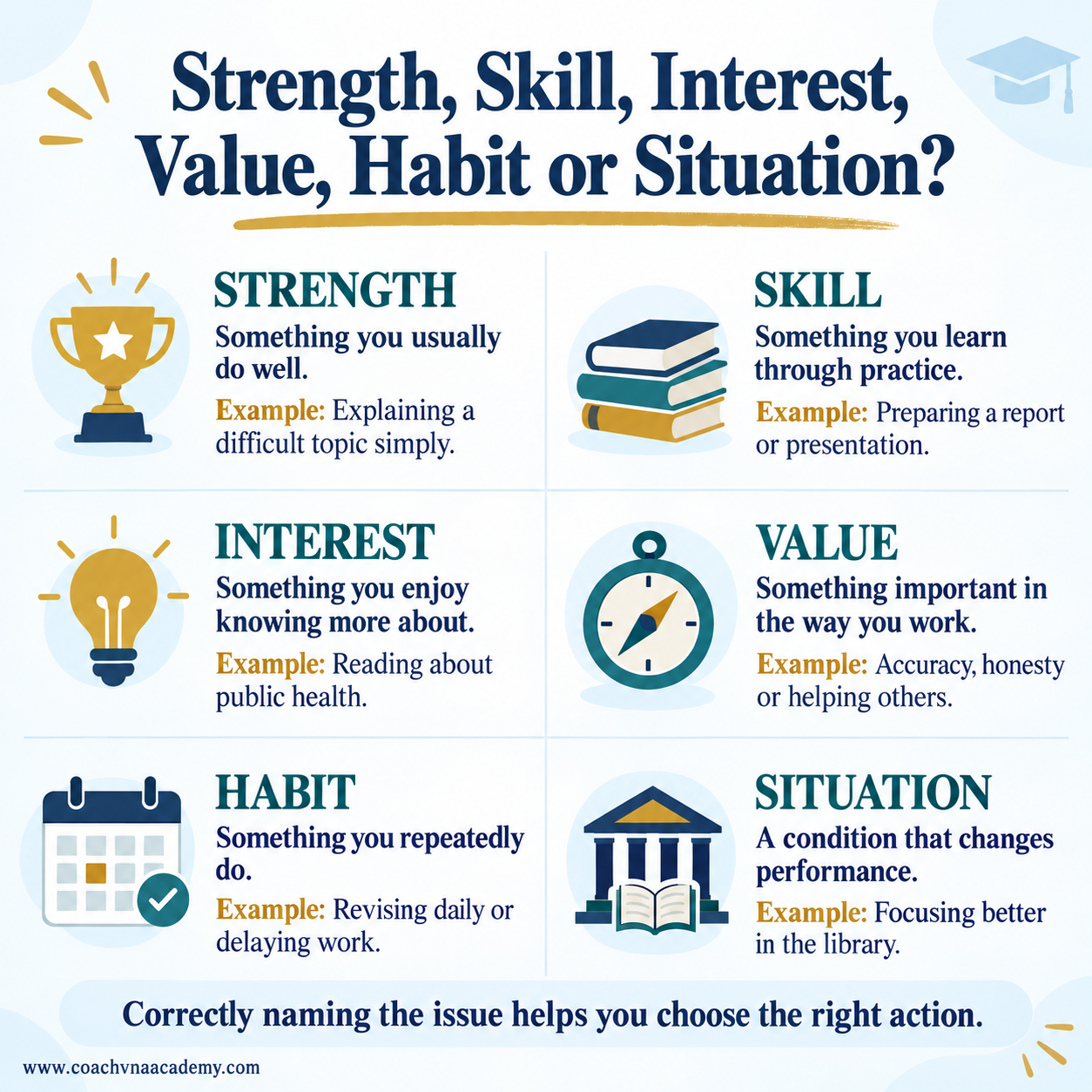
First Know What You Are Measuring
Students often use one word for many different things. For example, ‘I am weak in practicals’ may mean that you do not remember the steps, your hands need more practice, or you become nervous when the teacher watches. The solution depends on what the real difficulty is.
| What it is | Simple meaning | Undergraduate example |
| Strength | Something you usually do well and can repeat. | You explain a difficult topic in simple words to your classmates. |
| Skill | Something you learn and improve through practice. | You learn to prepare a report, use Excel or give a presentation. |
| Interest | Something you enjoy or want to know more about. | You enjoy reading about medicines, marketing, coding or public health. |
| Value | Something that is important to the way you work. | You care about accuracy, honesty, helping others or completing work on time. |
| Habit | Something you repeatedly do. | You revise for 20 minutes daily, or you postpone every assignment until the last night. |
| Situation | A condition that changes your performance. | You concentrate well in the library but get distracted in a noisy hostel room. |
These words are connected, but they are not the same. You may be interested in public speaking but still need practice. You may have good subject knowledge but lose marks because of late revision. That is why one examination result cannot fully describe you.
Look for Clues in Real College Life
A true strength usually appears more than once. Look for three simple clues:
- Result: Did your work help complete the task or improve the outcome?
- Response: Did the activity hold your attention, even when it required effort?
- Reaction of others: Did teachers or classmates depend on you or appreciate a specific action?
Suppose you prepare neat notes once. That is one clue. If classmates repeatedly ask for your summaries, your teacher finds them accurate and you can prepare them without constant help, the evidence is stronger.
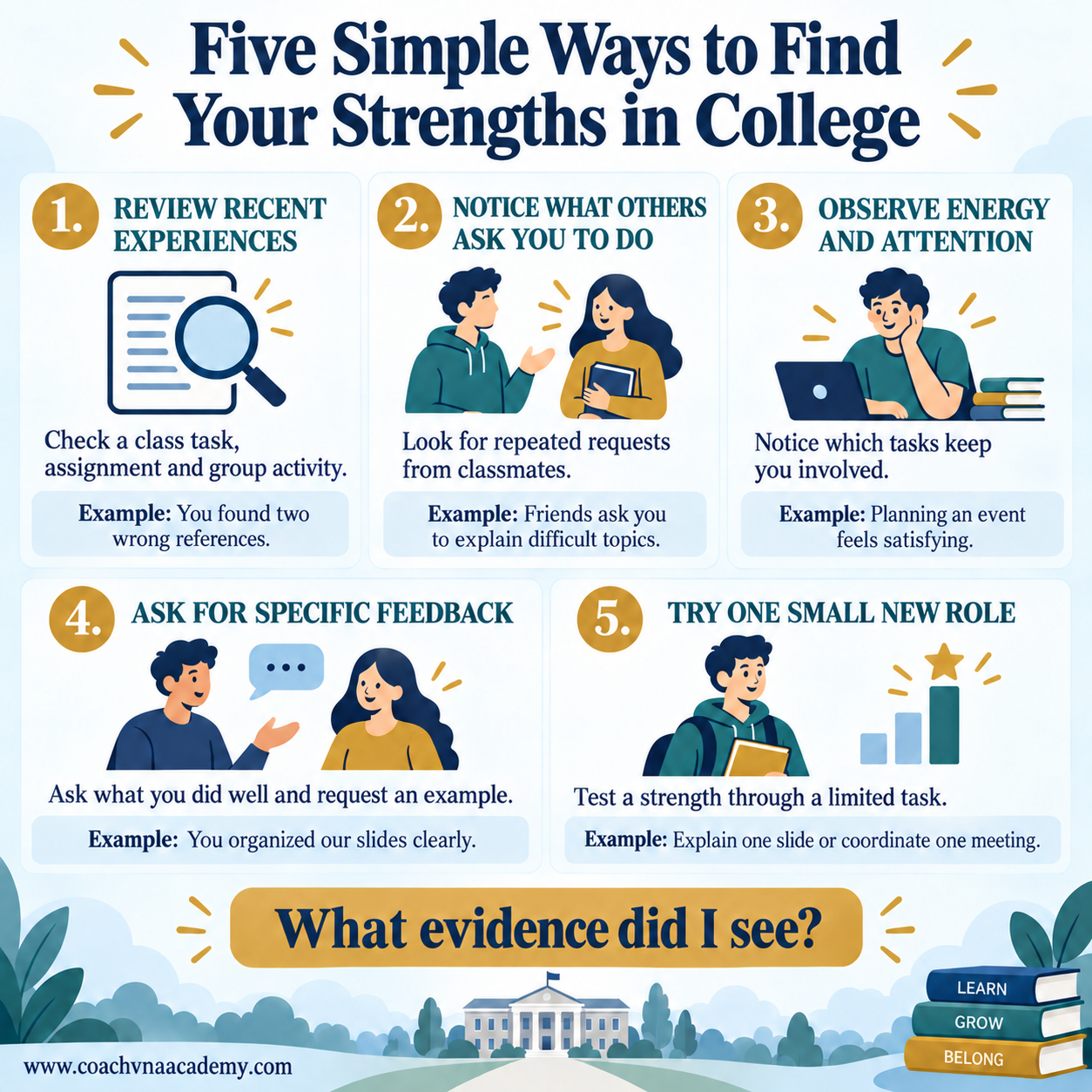
Five Practical Ways to Identify Your Strengths
Review Three Recent College Experiences
Think about one class task, one assignment or practical, and one group activity. Ask what you personally did well. Do not write only the final mark.
Example: Your group received an average mark, but you found two wrong references before submission. Checking accuracy may be one of your strengths.
Notice What Classmates Ask You to Do
People often notice a useful ability before we name it. Do friends ask you to explain topics, check calculations, design slides, talk to the teacher, settle a disagreement or keep the group on schedule?
Example: If different classmates regularly ask you to explain difficult topics, clear explanation may be a strength. Confirm it by asking whether your explanation actually helped them understand.
Observe Your Energy and Attention
A strength does not always feel easy, but some activities keep you involved. For one week, notice which tasks make you focused and satisfied, and which tasks leave you confused or repeatedly stuck.
Example: You may feel tired after organising a college event, yet still feel satisfied because planning and coordination suit you. On the other hand, repeated tiredness alone does not prove a weakness; sleep, health and workload also matter.
Ask for Specific Feedback
Do not ask only, ‘Am I good?’ Ask for an example. Speak to a classmate, teacher, mentor or family member who has seen you work.
Use this sentence: ‘In our recent project, what did I do well? What is one thing I should improve? Please give me an example.’
If a critical comment remains in your mind for too long, read Har Baat Dil Par Kyun Lagti Hai Criticism Ko Handle Karna Seekhein. It explains how to take the useful part of feedback without treating it as a personal attack.
Try a Small New Role
Some strengths remain hidden because you always choose the same safe role. Try a small task rather than waiting for a major opportunity.
Example: Explain one slide, coordinate one meeting, create one chart, welcome a guest or prepare the first draft of a report. Afterwards, note what went well, what was difficult and what feedback you received.
An online assessment may give you ideas, but it cannot decide who you are. The official National Careers Service skills assessment can be used as one reflection tool. Compare its suggestions with your real college experiences.
How to Identify a Weakness Accurately
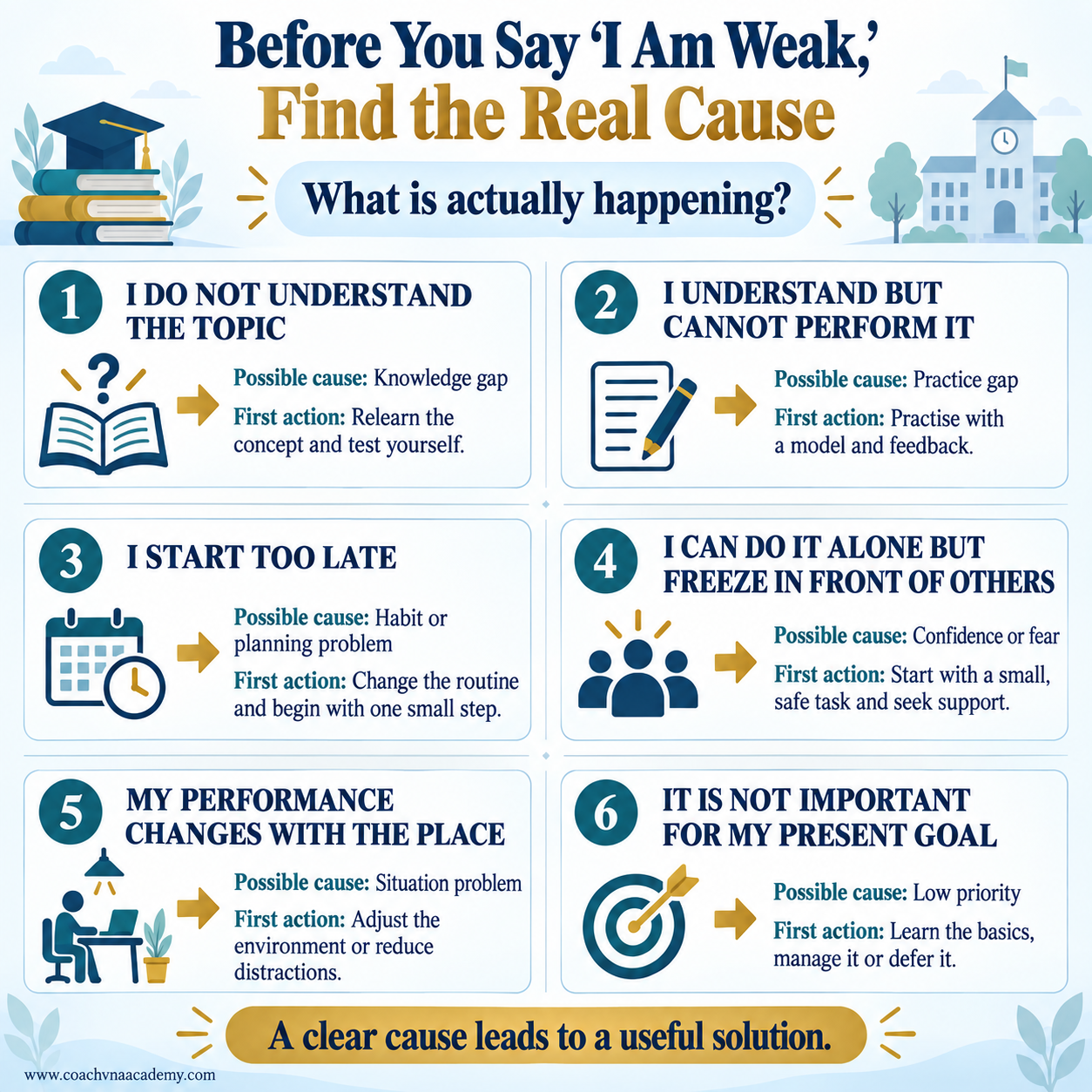
A weakness should describe a specific difficulty, not your whole personality. Before saying ‘I am weak,’ ask what is actually happening.
| Possible reason | Question to ask | Simple example | Useful first step |
| Knowledge gap | Do I understand the topic? | You cannot explain the basic concept behind an experiment. | Relearn the concept and test yourself. |
| Practice gap | Do I understand it but struggle while doing it? | You know the presentation content but speak too quickly. | Practise for three minutes and record yourself. |
| Habit problem | Would better planning improve the result? | You begin every assignment on the final night. | Fix a starting time and complete the first small step. |
| Confidence or fear | Can I do it alone but freeze in front of others? | You answer correctly in your notebook but stay silent in class. | Start with a small, safe speaking task and seek support. |
| Situation problem | Does the difficulty change with the environment? | You study well in the library but not beside a noisy roommate. | Change the place or reduce distractions. |
| Low importance | Is this ability necessary for my present goal? | You are not skilled at decorative poster design, but your role is data checking. | Manage it, learn only the basics or take another role. |
The same visible problem can have different causes. A student who gives a weak presentation may lack subject knowledge, need speaking practice or feel anxious before an audience. Each cause needs a different response.
If late starting is the main difficulty, use How to Build an Effective Study Routine. If planning and priorities are the problem, use Students Time Management Kaise Improve Karein. These guides fit this section because they address habit and planning problems.
Turn Labels into Testable Statements
A label closes the discussion. A testable statement shows what happens and what you can practise.
| Avoid this label | Write this instead | What you can do next |
| I am weak in studies. | I remember definitions but struggle with application questions. | Practise two application questions after each topic. |
| I cannot communicate. | I speak comfortably with friends but rush during class presentations. | Record a three-minute explanation and practise pauses. |
| I am lazy. | I delay work when the first step is unclear and my phone is nearby. | Write the first step and keep the phone away for 20 minutes. |
| I am bad at practicals. | I forget the sequence when I do not review the procedure beforehand. | Read the procedure and write the steps before the practical. |
| I am not a leader. | I hesitate to divide tasks or remind classmates about deadlines. | Coordinate one small group task with clear roles. |
| I am bad at mathematics. | I make errors when I skip calculation steps under time pressure. | Write every step and check units before submitting. |
Build a Personal Strengths Inventory
Use categories so that you do not think only about marks. The examples below show the type of evidence you should write. Replace them with your own experience.
| Category | Possible strength | Evidence from college | How to use or test it |
| Learning and understanding | Explaining concepts simply | Two classmates understood a difficult topic after my explanation. | Explain one topic in the next study-group meeting. |
| Practical or technical work | Following steps carefully | I completed a laboratory procedure without missing a recorded observation. | Volunteer to prepare the procedure checklist. |
| Communication | Listening before responding | During a group disagreement, I heard both students and summarised their concerns. | Take the discussion-summary role in the next meeting. |
| Teamwork and responsibility | Completing an assigned task on time | I submitted my part one day early in the last two projects. | Accept one time-sensitive task and track the deadline. |
| Planning and organisation | Arranging work in a clear order | I combined the group presentation and removed repeated slides. | Create a simple task plan for the next assignment. |
| Problem solving and creativity | Finding a practical solution | I identified repeated content in our group assignment and reorganized it clearly. | Review the next group task for repetition, missing information and possible improvements. |
A single example is a starting clue. When a similar strength appears in another task or is supported by specific feedback, you can trust it more.
Choose Which Weakness to Work On
Do not try to correct every weakness together. Choose one that is important for your present college goal and can improve through regular action.
- Name the exact difficulty. Example: ‘I speak too quickly during presentations.’
- Check its effect. Does it reduce marks, teamwork, confidence, internship readiness or daily functioning?
- Check whether you can influence it through knowledge, practice, planning, support or a better environment.
- Choose one small behaviour to practise for four weeks.
- Review the result. Continue, adjust the method or ask for guidance.
Example: If patient counselling is important for a pharmacy student, avoiding every speaking opportunity is a useful weakness to address. The first goal is not ‘become confident.’ A clearer goal is ‘practise one two-minute medicine explanation twice a week and ask a classmate whether it was clear.’
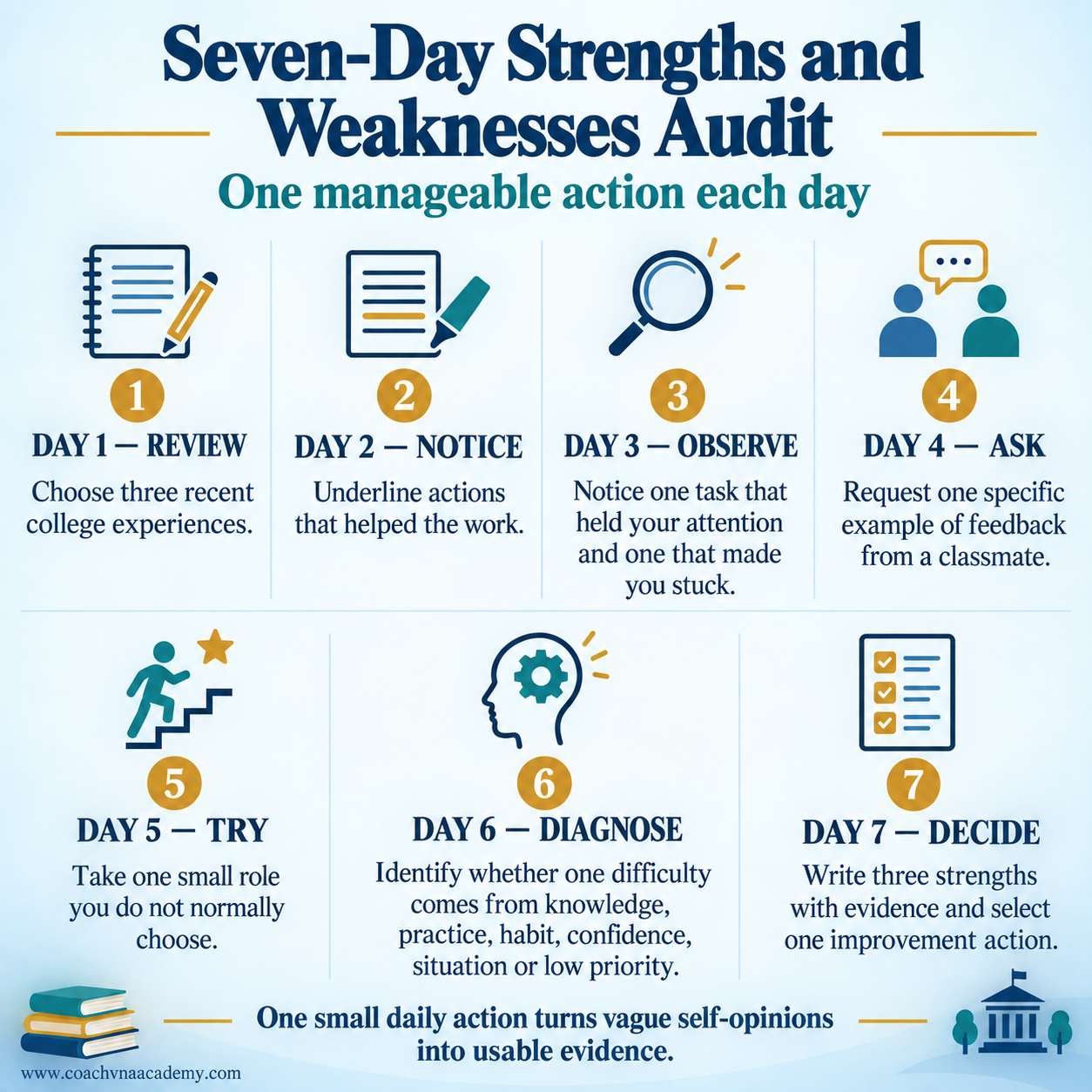
A Seven Day Strengths and Weaknesses Audit
This activity does not require a personality test. Keep one page in your notebook and complete one manageable action each day.
| Day | What to do | What you should have at the end |
| 1 | Choose three recent experiences: a class task, an assignment or practical, and a group activity. Write what you personally did. | Three real situations to review. |
| 2 | Underline actions that helped the work: explained, checked, organised, listened, designed, calculated or completed on time. | A first list of possible strengths. |
| 3 | Notice one task that held your attention and one that repeatedly made you stuck. Write the situation as well. | An energy and attention clue. |
| 4 | Ask one classmate the specific feedback question given earlier. Request an example. | One outside observation. |
| 5 | Try one small role that you do not normally choose. Keep the task limited and safe. | One new piece of evidence. |
| 6 | Choose one difficulty and identify its likely cause: knowledge, practice, habit, confidence, situation or low importance. | A specific weakness statement. |
| 7 | Write three possible strengths with evidence. Select one important weakness and one small four-week action. | A simple personal action plan. |
Use Your Strengths and Improve One Weakness
Self-awareness is useful only when it changes action. Use one strength deliberately and practise one weakness in a small, measurable way.
| Planning question | Student example |
| Which strength will I use? | I organise information clearly. |
| Where will I use it? | I will prepare the outline for our next group report. |
| Which weakness will I improve? | I speak too quickly during presentations. |
| What will I practise? | I will record a three-minute explanation twice a week. |
| Who can give feedback? | A classmate will rate clarity and pace. |
| When will I review progress? | Every Sunday for four weeks. |
Common Mistakes to Avoid
Self-assessment becomes harmful when students use it to judge themselves instead of understanding their behaviour. The following mistakes can produce a false picture of ability.
Do Not Decide Your Ability from One Examination
One result can be affected by preparation, health, sleep, question selection, time management or examination fear. A low score deserves attention, but it does not prove that you lack ability in every part of the subject. Check which questions went wrong and why before reaching a conclusion.
Do Not Compare Your First Attempt with Someone Else’s Practice
A classmate may present confidently because they have already taken part in school debates or college events. If your first presentation feels difficult, compare it with your next attempt after practice—not with another student’s longer experience.
Do Not Treat a Personality Test as a Final Verdict
A test may suggest interests or work preferences, but it cannot observe every classroom, practical, family responsibility or college activity. Use the result as a question to explore. Confirm it through real tasks, repeated behaviour and feedback.
Do Not Turn a Behaviour into a Harsh Personal Label
Words such as ‘lazy,’ ‘weak’ or ‘useless’ do not explain what happened. ‘I delayed the assignment because I did not understand the first step’ identifies a problem that can be solved by asking for clarification and beginning with a small task.
Do Not Try to Improve Everything Together
If you work on speaking, time management, calculations, writing and confidence at the same time, you may not practise any one skill consistently. Choose the weakness that has the greatest effect on your present goal and work on one clear behaviour for four weeks.
Do Not Ignore Strengths That Feel Ordinary
A student may think that listening carefully, checking details or meeting deadlines is ‘nothing special’ because it feels natural. Yet these behaviours can be valuable in group projects, practical work, internships and future employment. Notice what others repeatedly depend on you to do.
Do Not Accept Vague Criticism Without an Example
Comments such as ‘Your communication is poor’ are too broad to guide improvement. Ask, ‘Was my voice unclear, was the content disorganised, or did I avoid eye contact?’ A specific example helps you decide what to practise.
When to Ask for Help
Ask a teacher, mentor, career counsellor or college counsellor when feedback is confusing, a difficulty keeps repeating despite sincere practice, or you need a safe way to build confidence. If self-evaluation produces severe distress, hopelessness or constant harsh self-criticism, stop the exercise and seek appropriate support.
If examination fear makes you think that anxiety is proof of low ability, read Exam Fear Aur Academic Pressure and speak with a qualified support professional when needed.
Start Today
You do not need to complete the entire seven-day audit before taking the first step. Use the following ten-minute activity today.
Choose One Recent Task That Went Well
Select a real activity from the last two or three weeks: an assignment, practical, presentation, class discussion, event duty or family responsibility. Choose a task in which your action made some difference, even if the final result was not perfect.
Example: ‘Our group submitted the project on time.’
Write Exactly What You Did
Avoid a general statement such as ‘I worked hard.’ Name the action that helped the task. This action is the evidence from which a possible strength can be identified.
Example: ‘I checked the references, reminded the group about the deadline and combined the final pages.’ Possible strengths may include accuracy, responsibility and organisation.
Rewrite One Difficulty as a Behaviour
Choose one difficulty from the same task. Remove labels such as weak, lazy or nervous and describe what another person could actually observe.
Example: Replace ‘I am poor at presentations’ with ‘I read directly from the slide and spoke too quickly.’
Choose One Small Action for This Week
Your action should be small enough to repeat and clear enough to check. Do not use a vague goal such as ‘become confident.’
Example: ‘Before the next presentation, I will practise one slide twice without reading every line and ask a classmate whether my pace is clear.’
You do not need to be good at everything. You need enough self-awareness to use what you already do well and improve what matters for your next step. Strengths grow when you use them. Weaknesses become manageable when you describe them clearly and act on the real cause.
Educational Disclaimer
This article is for general educational purposes. It is not a psychological assessment, diagnosis, counselling service or substitute for individual guidance from a qualified professional. Online assessments should be treated as reflection tools, not final judgments.