Phenol: Definition and Structural Distinction
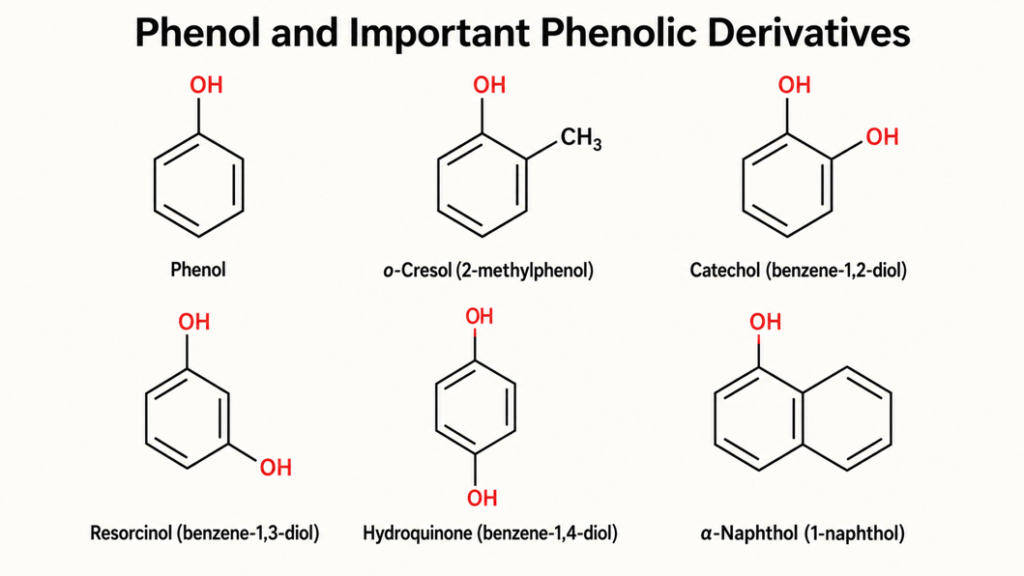
Phenols contain one or more hydroxyl groups directly attached to an aromatic ring. Therefore, phenol has the formula C6H5OH. In contrast, aromatic alcohols carry the hydroxyl group on a side-chain carbon; for example, benzyl alcohol has the formula C6H5CH2OH. This structural difference strongly influences acidity and reaction behaviour.
Classification and Nomenclature of Phenols
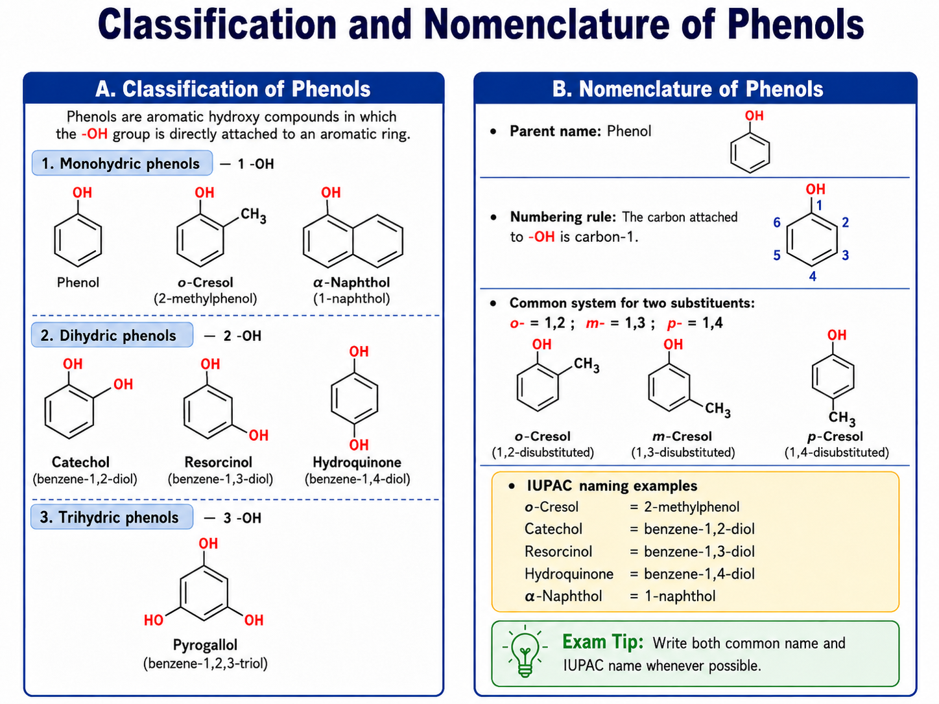
Chemists classify phenols mainly by the number of hydroxyl groups and by the aromatic nucleus. Monohydric phenols contain one -OH group, dihydric phenols contain two, and trihydric phenols contain three. Common names remain important; for example, cresols are methylphenols, resorcinol is benzene-1,3-diol, and naphthols contain -OH on a naphthalene ring.
Preparation of Phenol
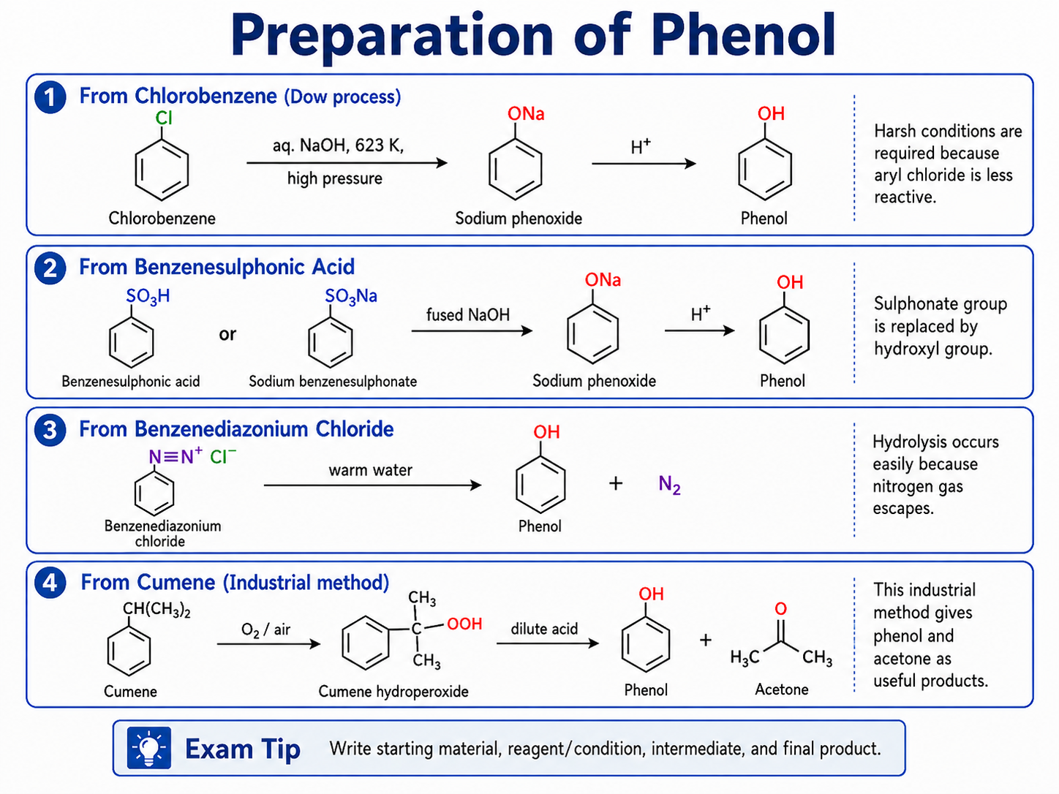
From Chlorobenzene: Dow Process
In the Dow process, chlorobenzene reacts with aqueous sodium hydroxide at about 623 K under high pressure to form sodium phenoxide. Acidification then converts sodium phenoxide into phenol. Chlorobenzene requires harsh conditions because the aryl C-Cl bond resists ordinary nucleophilic substitution.
From Benzenesulphonic Acid
First, sodium benzenesulphonate undergoes alkaline fusion with sodium hydroxide and forms sodium phenoxide. Subsequently, acidification gives phenol. In this route, hydroxyl ultimately replaces the sulphonate group.
From Benzenediazonium Chloride
Warm water hydrolyses benzenediazonium chloride and gives phenol with the evolution of nitrogen gas. Because nitrogen gas leaves the reaction mixture, the conversion proceeds readily. This method also provides a convenient laboratory route from aniline after diazotization.
Cumene Process
Industry commonly prepares phenol through the cumene process. First, air oxidizes cumene to cumene hydroperoxide. Next, acidic cleavage gives phenol and acetone. Thus, the process produces two commercially useful products from one intermediate.
Important Reactions of Phenol
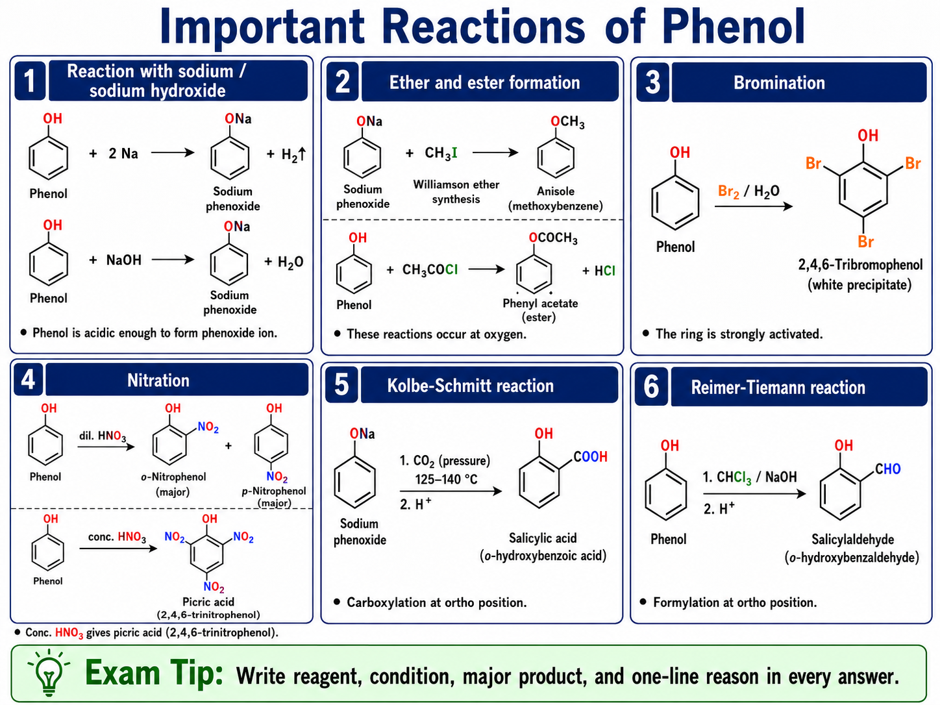
After learning how chemists prepare phenol, the next step is to understand its characteristic reactions. The hydroxyl group influences both the O-H bond and the aromatic ring; consequently, phenol shows distinctive acidity, rapid ortho/para substitution, named reactions, and useful qualitative tests.
Reactions at the Phenolic O-H Bond
Phenol reacts with active metals such as sodium and forms sodium phenoxide with hydrogen gas. It also reacts with sodium hydroxide because the phenoxide ion gains resonance stabilization. However, phenol generally does not react with sodium bicarbonate because phenol is weaker than carbonic acid.
Ether and Ester Formation
Sodium phenoxide reacts with an alkyl halide in Williamson synthesis and forms an aryl-alkyl ether. In addition, acyl chlorides or acid anhydrides convert phenol into phenyl esters. These reactions occur at oxygen rather than on the aromatic ring.
Bromination and Nitration
The -OH group strongly activates the aromatic ring and directs incoming electrophiles mainly to ortho and para positions. Therefore, bromine water reacts rapidly with phenol and produces 2,4,6-tribromophenol as a white precipitate without requiring FeBr3. Dilute nitric acid gives mainly ortho- and para-nitrophenols, whereas concentrated nitric acid produces picric acid.
Sulphonation of Phenol
Temperature changes the product distribution during sulphonation. At lower temperature, phenol mainly forms ortho-phenolsulphonic acid. At higher temperature, the reversible reaction favours the more stable para isomer.
Kolbe-Schmitt Reaction
Sodium phenoxide reacts with carbon dioxide under pressure and heat. After acidification, the reaction gives salicylic acid mainly through ortho carboxylation. This named reaction introduces a -COOH group adjacent to the phenolic -OH group.
Reimer-Tiemann Reaction
Phenol reacts with chloroform and sodium hydroxide to introduce a formyl group mainly at the ortho position. Acidic work-up then gives salicylaldehyde. Therefore, this reaction provides a standard method for ortho formylation of phenol.
Qualitative Tests of Phenol
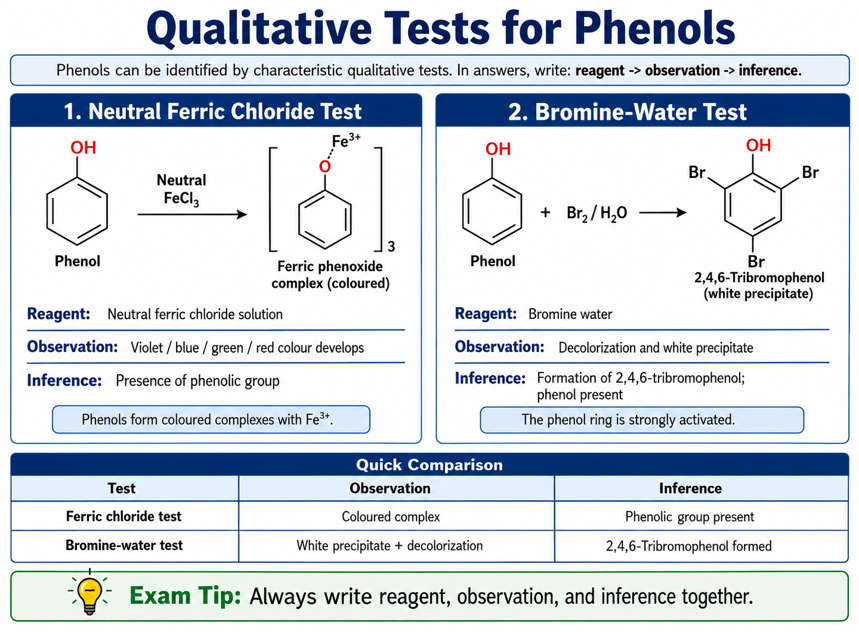
Qualitative tests help identify the phenolic functional group. For this topic, two high-yield tests are the neutral ferric chloride test and the bromine-water test. Each test should include the reagent, the visible observation, and the final inference.
Neutral Ferric Chloride Test
Phenols form coloured complexes with neutral ferric chloride. Depending on the phenol, violet, blue, green, or red colour may develop. Therefore, this test indicates the presence of a phenolic group.
Bromine-Water Test
Phenol rapidly reacts with bromine water because the -OH group strongly activates the aromatic ring. The bromine colour disappears and a white precipitate of 2,4,6-tribromophenol forms.