
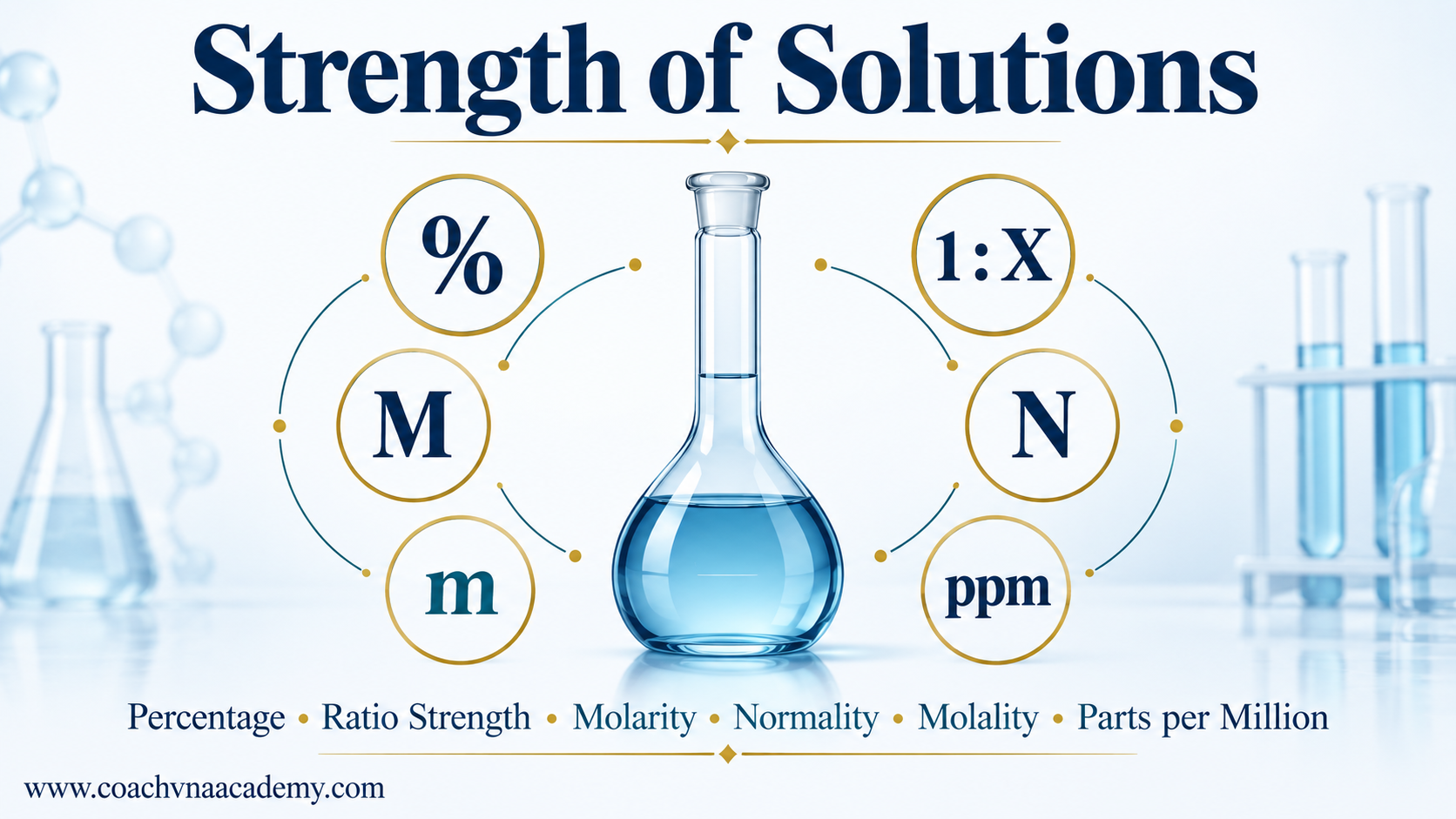
In this lecture first understand the meaning of solution strength. Next study percentage strengths, ratio strength, molarity, normality, molality and parts per million. Finally, use the conversion section to move safely between common concentration expressions. The central idea is simple: every strength expression compares a stated quantity of solute with a stated quantity of solution or solvent. Correctly identifying the numerator, denominator and units is the key to every calculation.
Meaning of Strength of Solutions
The strength or concentration of a solution expresses the quantity of solute present in a specified quantity of solvent or solution. A complete concentration statement must identify both quantities and their units.
Solute is the substance dissolved. Solvent is the medium that dissolves the solute. Solution is the homogeneous mixture formed by the solute and solvent.
Concentration = amount of solute / specified amount of solution or solvent
A concentration value is meaningful only when its basis is clear. For example, 5% may mean 5 g in 100 g, 5 g in 100 mL or 5 mL in 100 mL. The dosage form and the units determine the correct interpretation.
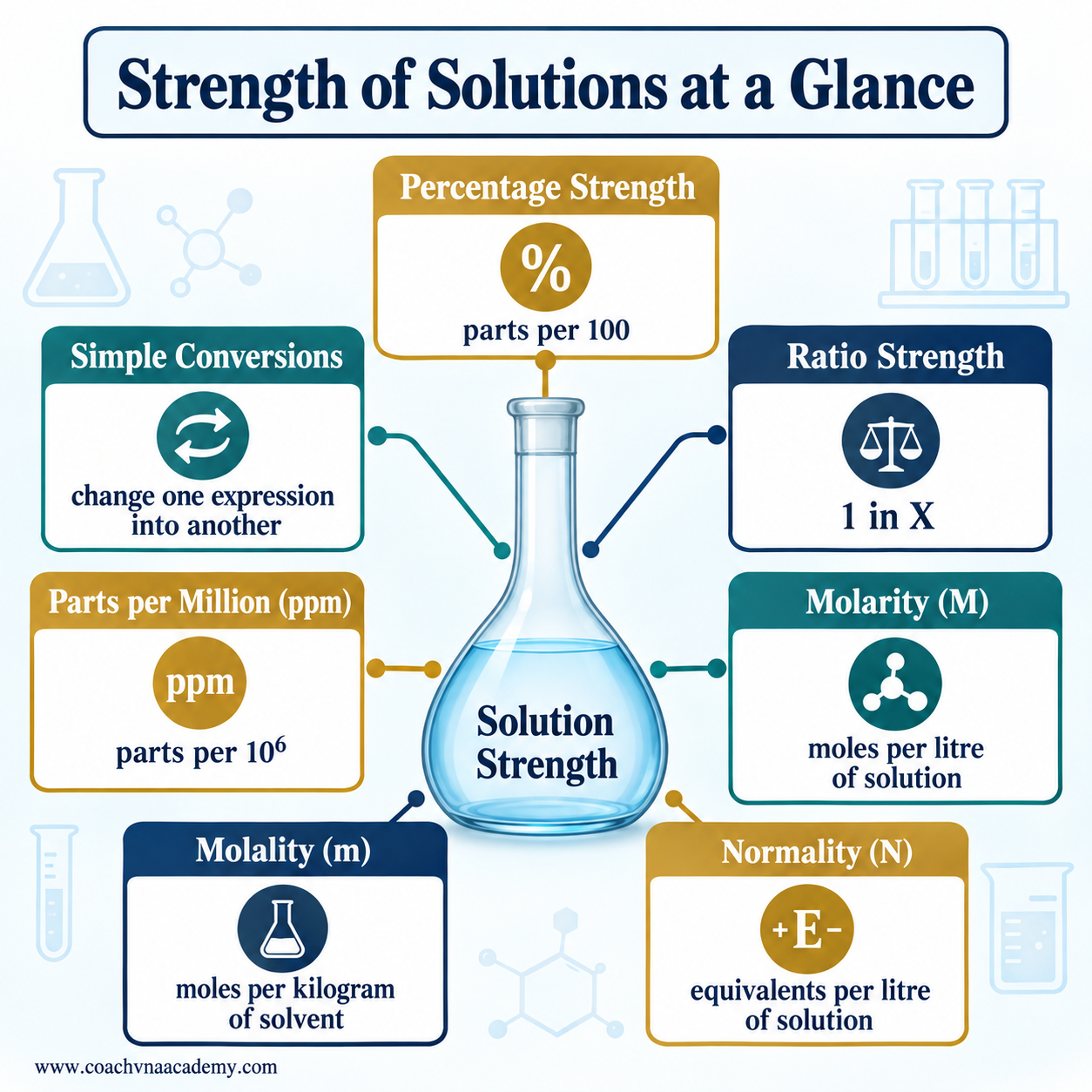
Percentage Strengths
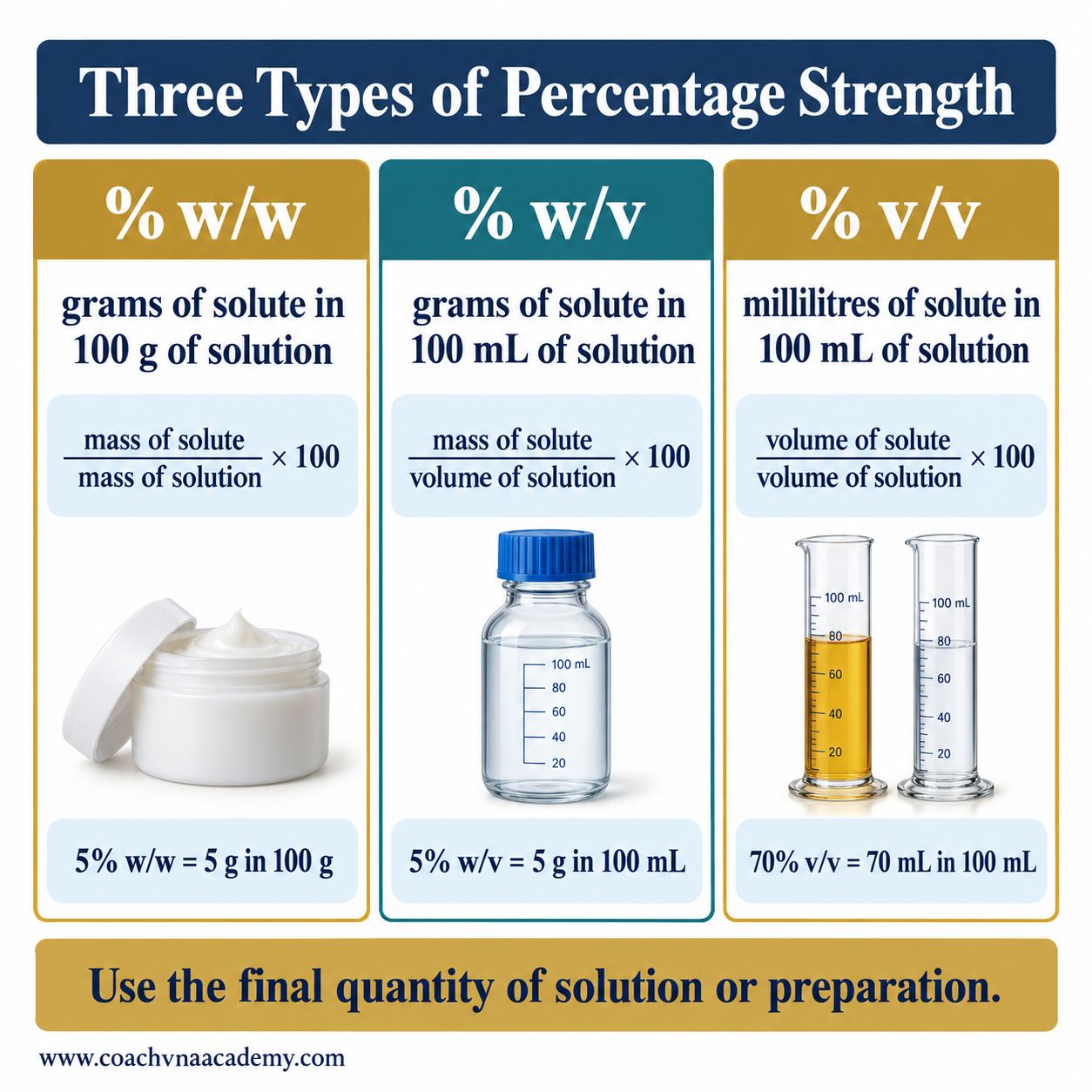
Percentage strength states the amount of solute present in 100 parts of the final solution. The type of percentage depends on whether the solute and solution are measured by mass or volume.
| Type | Meaning | Formula | Typical use |
| % w/w | grams of solute in 100 g of solution | (mass of solute / mass of solution) x 100 | Ointments, creams and solids |
| % w/v | grams of solute in 100 mL of solution | (mass of solute / volume of solution) x 100 | Most pharmaceutical liquids containing solid solute |
| % v/v | millilitres of solute in 100 mL of solution | (volume of solute / volume of solution) x 100 | Liquid solute mixed with liquid vehicle |
Percentage Weight in Weight (% w/w)
% w/w = (mass of solute in g / mass of solution in g) x 100
A 5% w/w preparation contains 5 g of solute in enough vehicle to make 100 g of the final preparation. “Enough to make” is important: 5 g solute plus sufficient vehicle gives a final mass of 100 g. It does not mean 5 g plus 100 g of mass.
Worked Example 1
Given: Prepare 200 g of 2% w/w salicylic acid ointment.
1. Mass of solute = (% strength x mass of preparation) / 100.
2. Mass of salicylic acid = (2 x 200) / 100 = 4 g.
3. Mass of ointment base = 200 – 4 = 196 g.
Answer: Use 4 g salicylic acid and sufficient base to make 200 g.
Percentage Weight in Volume (% w/v)
% w/v = (mass of solute in g / volume of solution in mL) x 100
A 5% w/v solution contains 5 g of solute in enough solvent to produce 100 mL of final solution. It does not mean 5 g plus 100 mL of solvent.
Worked Example 2
Given: How much sodium chloride is required for 500 mL of 0.9% w/v solution?
1. Mass of solute = (% strength x final volume in mL) / 100.
2. Mass = (0.9 x 500) / 100 = 4.5 g.
Answer: Dissolve 4.5 g sodium chloride and make the final volume to 500 mL.
Percentage Volume in Volume (% v/v)
% v/v = (volume of solute in mL / volume of solution in mL) x 100
Worked Example 3
Given: Prepare 250 mL of 70% v/v alcohol.
1. Volume of alcohol = (% strength x final volume) / 100.
2. Volume = (70 x 250) / 100 = 175 mL.
Answer: Measure 175 mL alcohol and add vehicle to make 250 mL.
Common caution: volumes of liquids may not always be exactly additive. Prepare to the required final volume rather than calculating the vehicle only by subtraction when accurate compounding is required.
Ratio Strength (1 in X)
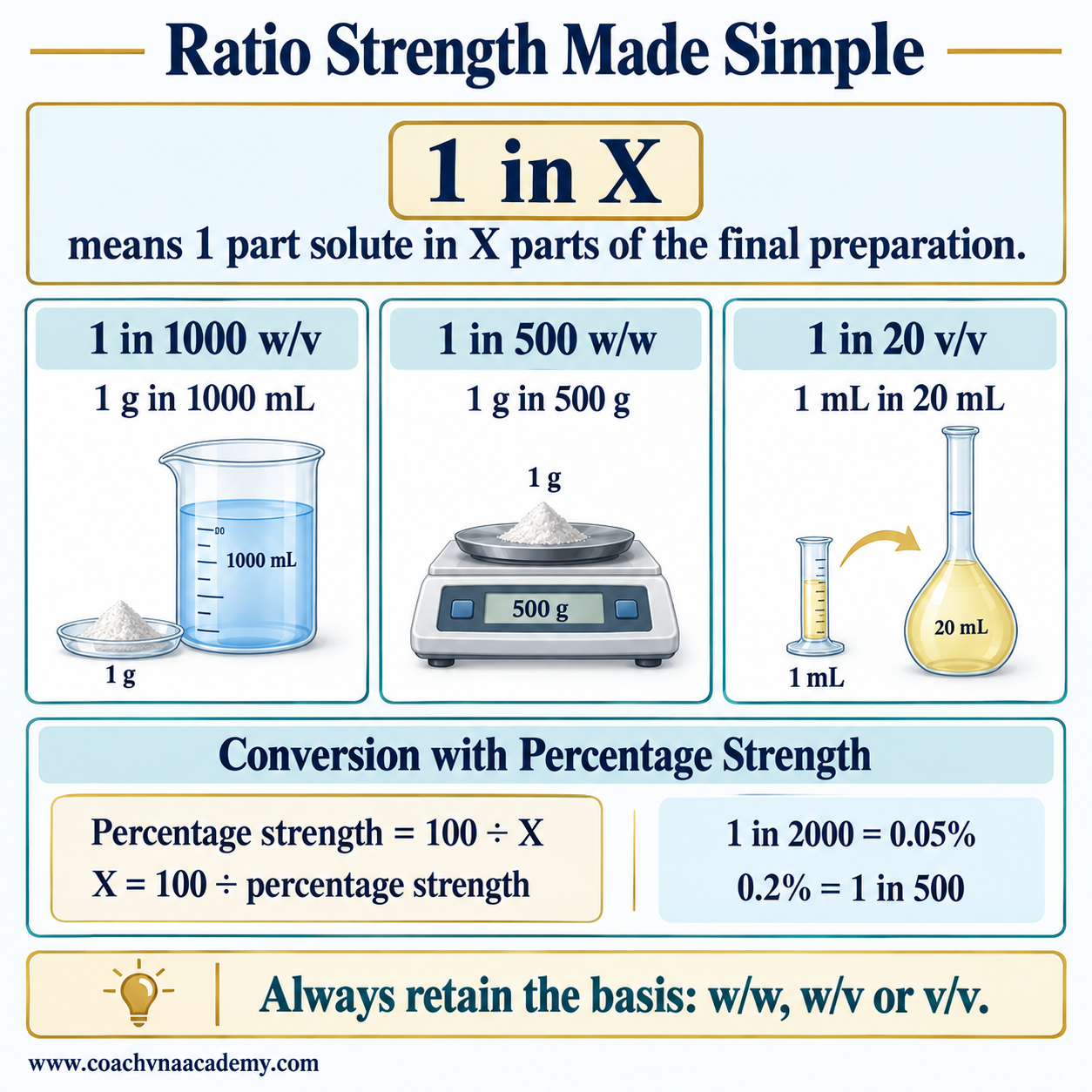
Ratio strength expresses concentration as 1 part of solute in a stated number of parts of the final solution or preparation. It is written as 1 in X or 1:X. The units must still be identified.
| Expression | Interpretation |
| 1 in 1000 w/v | 1 g solute in 1000 mL solution |
| 1 in 500 w/w | 1 g solute in 500 g preparation |
| 1 in 20 v/v | 1 mL liquid solute in 20 mL solution |
Percentage strength = 100 / ratio number
Ratio number = 100 / percentage strength
Worked Example 4
Given: Convert 1 in 2000 w/v to percentage w/v.
1. Percentage = 100 / 2000.
2. Percentage = 0.05.
Answer: 1 in 2000 w/v = 0.05% w/v.
Worked Example 5
Given: Convert 0.2% w/v to ratio strength.
1. Ratio number = 100 / 0.2 = 500.
Answer: 0.2% w/v = 1 in 500 w/v.
Very dilute ratio strengths are sometimes convenient because they avoid long decimal percentages. The ratio refers to the final solution, not the amount of solvent added.
Molarity (M)
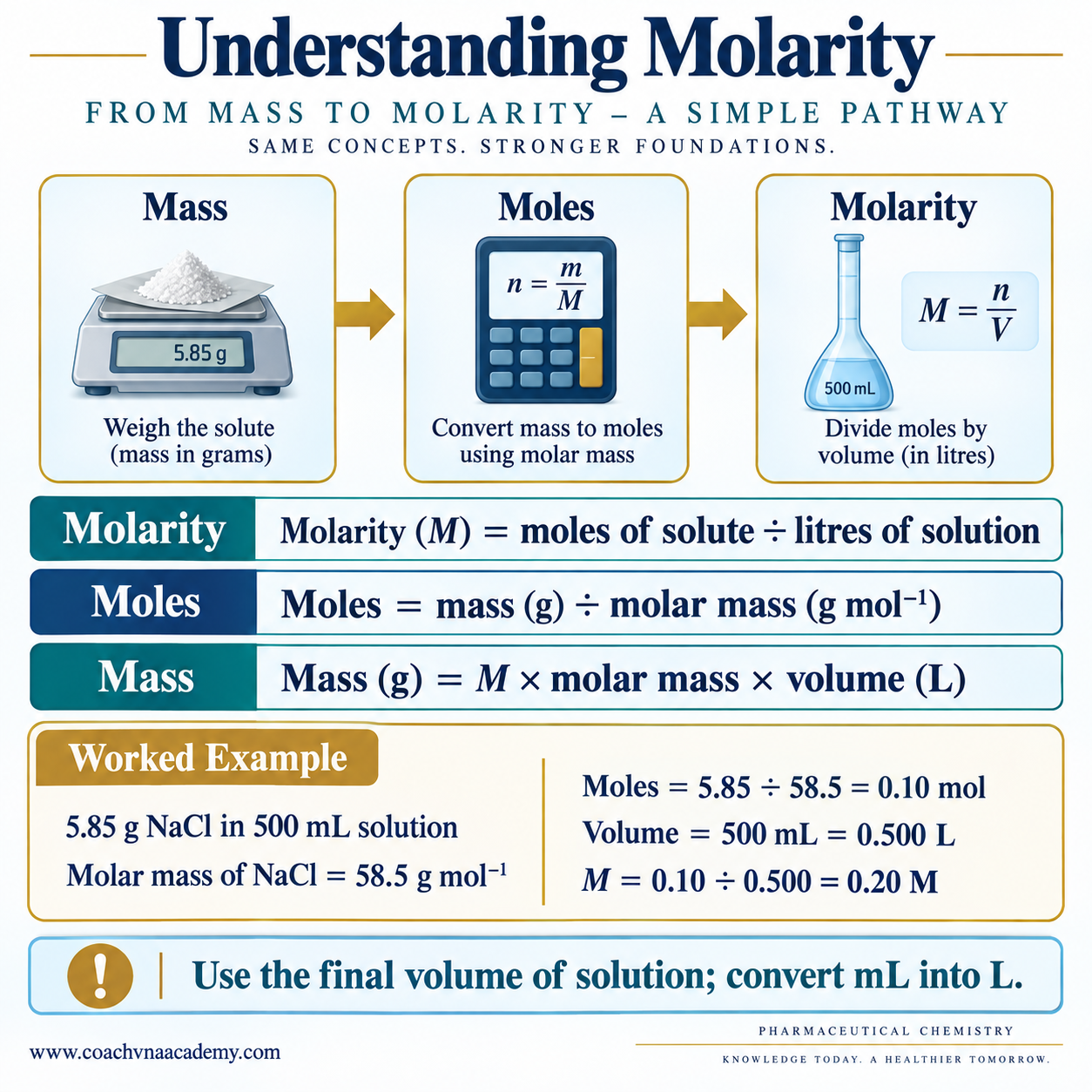
Molarity is the number of moles of solute present in one litre of solution. Its symbol is M and its unit is mol L⁻¹.
Molarity M = moles of solute / volume of solution in litres
Moles = mass in grams / molar mass in g mol⁻¹
M = mass in grams x 1000 / (molar mass x volume in mL)
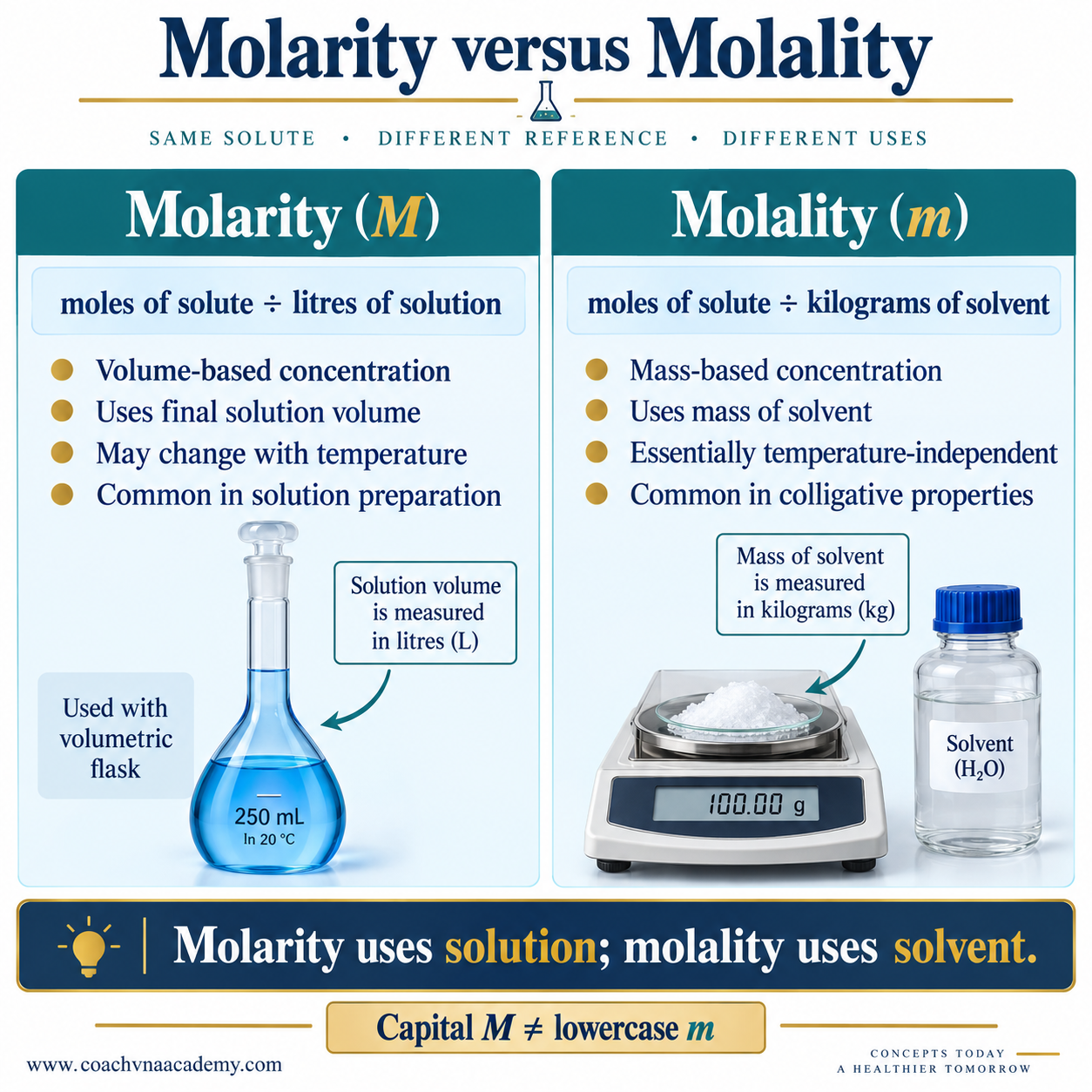
Because molarity is based on the volume of solution, it can change slightly with temperature as liquid volume changes.
Worked Example 6
Given: Calculate the molarity of 5.85 g sodium chloride in 500 mL solution. Molar mass of NaCl = 58.5 g mol⁻¹.
1. Moles of NaCl = 5.85 / 58.5 = 0.10 mol.
2. Volume = 500 mL = 0.500 L.
3. M = 0.10 / 0.500 = 0.20 mol L⁻¹.
Answer: The solution is 0.20 M NaCl.
Worked Example 7
Given: How much NaOH is required to prepare 250 mL of 0.10 M solution? Molar mass = 40 g mol⁻¹.
1. Mass = M x molar mass x volume in litres.
2. Mass = 0.10 x 40 x 0.250 = 1.0 g.
Answer: Use 1.0 g NaOH and make the final volume to 250 mL.
Normality (N)
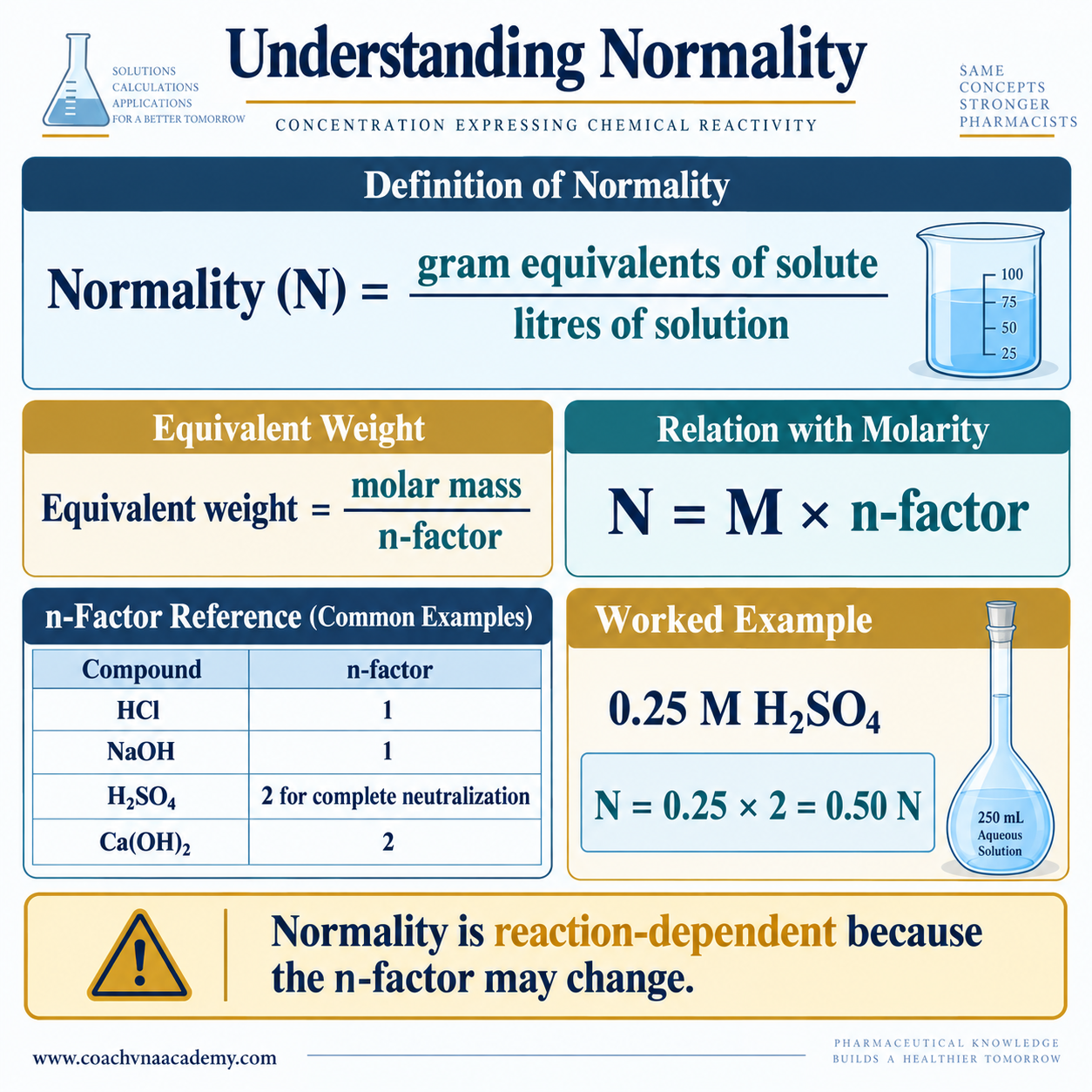
Normality is the number of gram equivalents of solute present in one litre of solution. Its symbol is N and its unit is equivalent L⁻¹. Normality depends on the reaction because the n-factor may change with the chemical process.
Normality N = equivalents of solute / volume of solution in litres
Equivalent weight = molar mass / n-factor
N = mass in grams x 1000 / (equivalent weight x volume in mL)
N = M x n-factor
| Substance or reaction role | Common n-factor idea | Example |
| Acid | number of replaceable H⁺ involved | HCl: 1; H₂SO₄ in complete neutralization: 2 |
| Base | number of OH⁻ furnished or H⁺ accepted | NaOH: 1; Ca(OH)₂: 2 |
| Redox agent | number of electrons transferred per formula unit | Reaction dependent |
| Salt in precipitation | total ionic charge participating | Reaction dependent |
Worked Example 8
Given: Find the normality of 0.25 M sulfuric acid for complete neutralization.
1. For complete neutralization, the n-factor of H₂SO₄ is 2.
2. N = M x n-factor = 0.25 x 2.
Answer: The solution is 0.50 N H₂SO₄.
Worked Example 9
Given: How much NaOH is required for 500 mL of 0.1 N solution? Equivalent weight of NaOH = 40 g eq⁻¹.
1. Mass = N x equivalent weight x volume in litres.
2. Mass = 0.1 x 40 x 0.500 = 2.0 g.
Answer: Use 2.0 g NaOH and make the final volume to 500 mL.
Important: never convert molarity to normality without knowing the reaction and the correct n-factor.
Molality (m)
Molality is the number of moles of solute present in one kilogram of solvent. Its symbol is m and its unit is mol kg⁻¹. Unlike molarity, molality is based on mass and is therefore essentially independent of temperature.
Molality m = moles of solute / mass of solvent in kilograms
m = mass of solute in g x 1000 / (molar mass x mass of solvent in g)
Worked Example 10
Given: Calculate the molality of 18 g glucose dissolved in 200 g water. Molar mass of glucose = 180 g mol⁻¹.
1. Moles of glucose = 18 / 180 = 0.10 mol.
2. Mass of solvent = 200 g = 0.200 kg.
3. m = 0.10 / 0.200 = 0.50 mol kg⁻¹.
Answer: The solution is 0.50 m glucose.
| Feature | Molarity | Molality |
| Basis | litres of solution | kilograms of solvent |
| Symbol | M | m |
| Temperature effect | may change with volume | essentially unchanged |
| Common application | solution preparation and analysis | colligative properties and temperature-sensitive work |
Parts per Million (ppm)
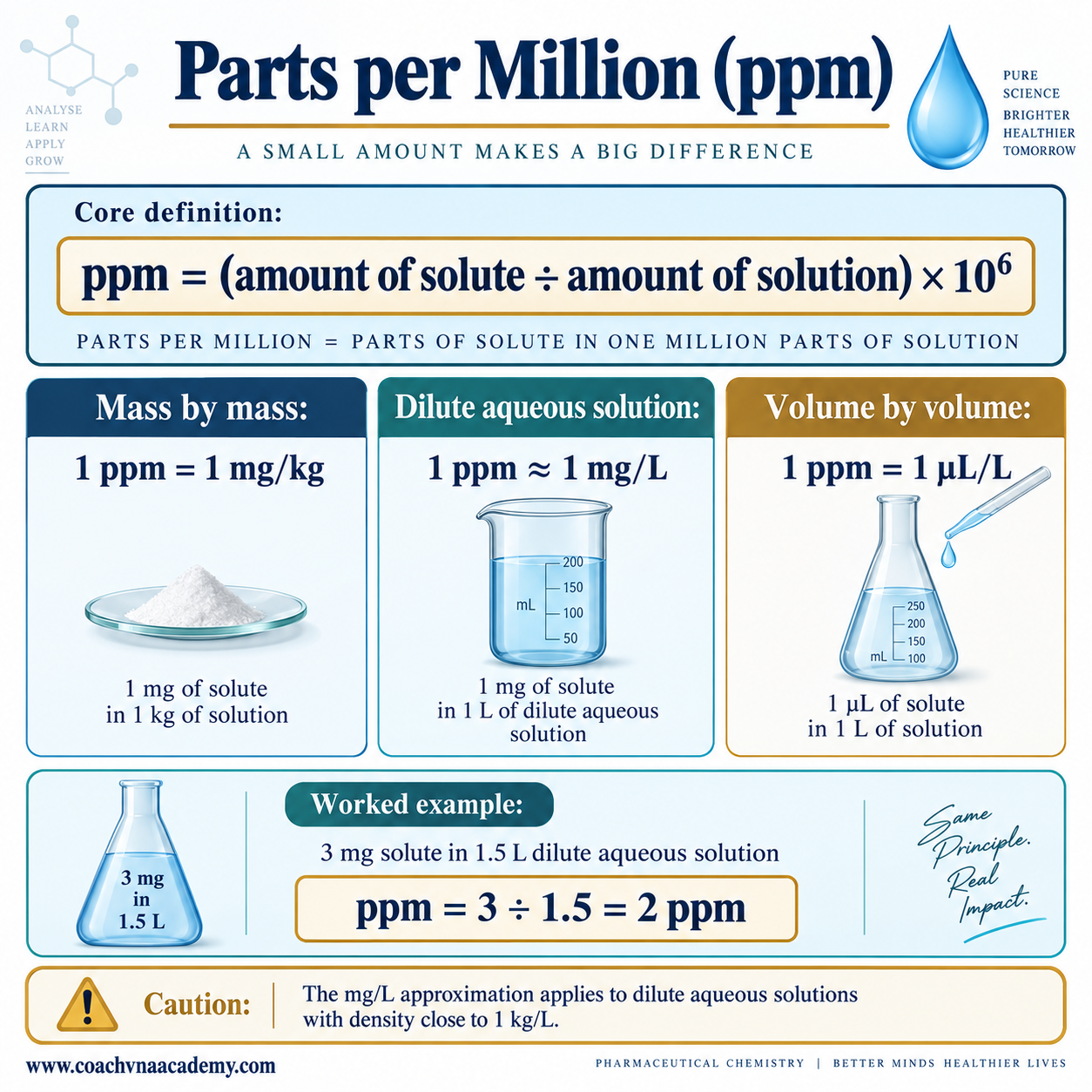
Parts per million is used for very dilute concentrations. One ppm means one part of solute in one million parts of the mixture.
ppm = (amount of solute / amount of solution) x 10⁶
| Basis | Useful equivalent under stated condition |
| Mass by mass | 1 ppm = 1 mg/kg |
| Dilute aqueous solution with density about 1 g/mL | 1 ppm is approximately 1 mg/L |
| Volume by volume | 1 ppm = 1 microlitre/L |
Worked Example 11
Given: A water sample contains 3 mg fluoride in 1.5 L. Estimate the concentration in ppm.
1. For a dilute aqueous solution, mg/L is approximately ppm.
2. Concentration = 3 mg / 1.5 L = 2 mg/L.
Answer: The fluoride concentration is approximately 2 ppm.
The equivalence 1 mg/L = 1 ppm is an approximation valid for dilute aqueous solutions having density close to 1 g/mL. For other liquids or concentrated solutions, density must be considered.
Simple Conversions
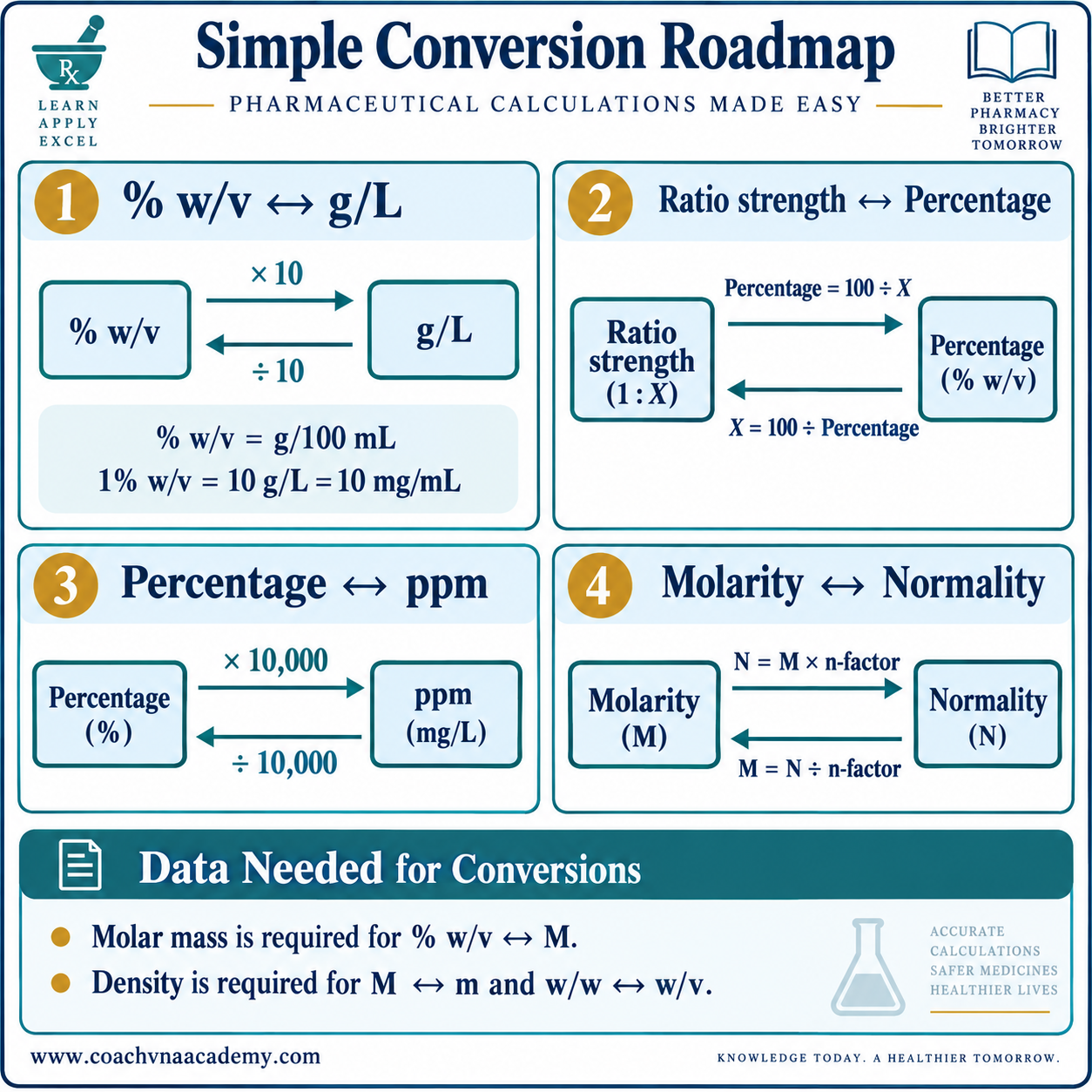
Conversions are safe only when the basis of concentration remains consistent and any required molecular information is known.
| Conversion | Direct relationship | Condition |
| % w/v to g/L | g/L = % w/v x 10 | same solute and final solution |
| % w/v to mg/mL | mg/mL = % w/v x 10 | same solute and final solution |
| Ratio strength to % | % = 100 / X for 1 in X | retain w/w, w/v or v/v basis |
| % to ratio strength | 1 in X, where X = 100 / % | retain the same basis |
| % to ppm | ppm = % x 10,000 | same mass or volume basis |
| ppm to % | % = ppm / 10,000 | same mass or volume basis |
| % w/v to M | M = 10 x % w/v / molar mass | molar mass must be known |
| M to % w/v | % w/v = M x molar mass / 10 | molar mass must be known |
| M to N | N = M x n-factor | reaction and n-factor must be known |
| N to M | M = N / n-factor | reaction and n-factor must be known |
Percentage Strength and Mass per Volume
Worked Example 12
Given: Convert 2.5% w/v glucose to g/L and mg/mL.
1. g/L = 2.5 x 10 = 25 g/L.
2. mg/mL = 2.5 x 10 = 25 mg/mL.
Answer: 2.5% w/v = 25 g/L = 25 mg/mL.
Percentage Strength and Parts per Million
Worked Example 13
Given: Convert 0.02% to ppm on the same basis.
1. ppm = % x 10,000.
2. ppm = 0.02 x 10,000 = 200.
Answer: 0.02% = 200 ppm.
Worked Example 14
Given: Convert 50 ppm to percent on the same basis.
1. % = ppm / 10,000.
2. % = 50 / 10,000 = 0.005.
Answer: 50 ppm = 0.005%.
Percentage Weight in Volume and Molarity
Worked Example 15
Given: Convert 0.9% w/v NaCl to molarity. Molar mass = 58.5 g mol⁻¹.
1. 0.9% w/v = 9 g/L.
2. M = g/L / molar mass = 9 / 58.5 = 0.1538.
Answer: 0.9% w/v NaCl is approximately 0.154 M.
Worked Example 16
Given: Convert 0.20 M NaCl to % w/v. Molar mass = 58.5 g mol⁻¹.
1. g/L = M x molar mass = 0.20 x 58.5 = 11.7 g/L.
2. % w/v = g/L / 10 = 1.17.
Answer: 0.20 M NaCl = 1.17% w/v.
Molarity and Normality
Worked Example 17
Given: Convert 0.1 M H₂SO₄ to normality for complete neutralization.
1. n-factor = 2.
2. N = M x n-factor = 0.1 x 2.
Answer: 0.1 M H₂SO₄ = 0.2 N for complete neutralization.
Molarity and Molality
A direct numerical conversion between molarity and molality requires the density of the solution and the molar mass of the solute. Without density, the mass of solvent cannot be obtained from the volume of solution.
m = 1000 M / (1000 rho – M x molar mass)
In this formula, rho is solution density in g/mL and molar mass is in g/mol. This relationship is included to show why density is necessary; simple syllabus calculations usually provide all required data.
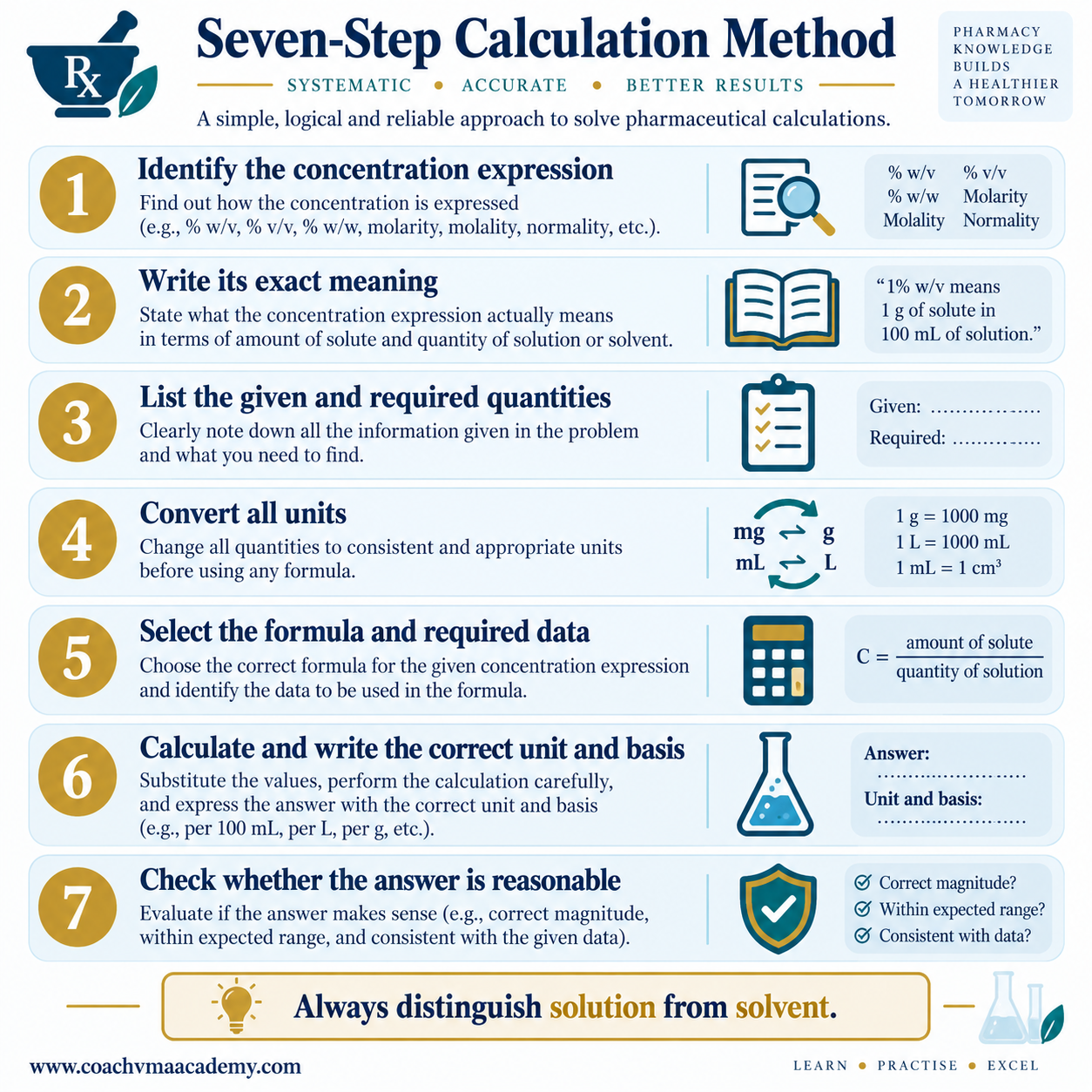
How to Solve Strength Problems
1. Identify the concentration expression and write its exact meaning.
2. List the given quantity, required quantity and units.
3. Convert mL to L or g to kg when the selected formula requires it.
4. Use final solution quantity for percentage, molarity, normality and ppm expressions; use solvent mass for molality.
5. Insert molar mass, equivalent weight, n-factor or density only when required.
6. Calculate and attach the correct unit and concentration basis to the answer.
7. Check whether the answer is reasonable: a dilute solution should not produce an unexpectedly large concentration.
Common Sources of Confusion
| Confusion | Correct understanding |
| 5% w/v means 5 g plus 100 mL solvent | It means 5 g in enough solvent to make 100 mL of final solution. |
| Molarity and molality use the same denominator | Molarity uses litres of solution; molality uses kilograms of solvent. |
| Normality is fixed for every substance | Normality depends on the reaction and n-factor. |
| 1 ppm always equals 1 mg/L | This is approximate for dilute aqueous solutions of density near 1 g/mL. |
| Ratio strength has no units | The w/w, w/v or v/v basis must be stated or understood. |
| All percent strengths are interchangeable | Conversion between w/w and w/v generally requires density. |
Formula Sheet
| Expression | Formula |
| % w/w | mass of solute / mass of solution x 100 |
| % w/v | mass of solute in g / solution volume in mL x 100 |
| % v/v | solute volume / solution volume x 100 |
| Ratio strength | 1 in X; % = 100/X |
| Molarity | moles / litres of solution |
| Normality | equivalents / litres of solution; N = M x n-factor |
| Molality | moles / kilograms of solvent |
| ppm | amount of solute / amount of solution x 10⁶ |
Key Terms
| Term | Student friendly meaning |
| Concentration | Amount of solute related to a stated amount of solution or solvent. |
| Mole | Amount containing one molar mass of a substance in grams. |
| Molar mass | Mass of one mole, expressed in g/mol. |
| Equivalent | Reactive amount determined by the chemical reaction. |
| Equivalent weight | Molar mass divided by n-factor. |
| n-factor | Number that represents reactive H⁺, OH⁻, electrons or ionic charge per formula unit for the specified reaction. |
| Density | Mass per unit volume; needed in some w/w, w/v, M and m conversions. |
| Aliquot | Measured portion of a solution. |