
Kekule Structure of Benzene
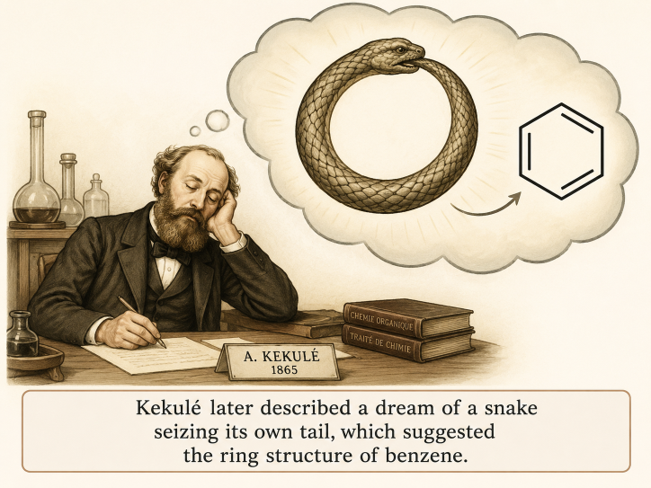
Historical Insight: Kekule’s Snake Dream
Kekule in 1865 recalled a dream-like vision in which he saw a snake seizing its own tail. The circular form suggested that the six carbon atoms of benzene might be joined in a ring rather than arranged in an open chain. This image helped him visualize the cyclic structure of benzene, which he represented as a six-membered ring with alternating single and double bonds.
Benzene has the molecular formula C₆H₆. To satisfy carbon’s tetravalency and account for the high degree of unsaturation, August Kekule proposed a six-membered carbon ring with alternating carbon-carbon single and double bonds. In addition, he attached one hydrogen atom to each carbon atom.
Essential Features of the Proposed Structure
1. Six carbon atoms form a closed hexagonal ring.
2. Three carbon-carbon single bonds and three carbon-carbon double bonds alternate around the ring.
3. Each carbon atom bonds with two neighboring carbon atoms and one hydrogen atom.
4. Every carbon atom maintains its normal valency of four.
5. The structure contains one ring and three double bonds; therefore, it represents four degrees of unsaturation.
Two Equivalent Kekule Forms
Chemists can draw two equivalent Kekule forms by changing the displayed positions of the three double bonds.
Form I places the double bonds between carbon atoms 1-2, 3-4, and 5-6.
In contrast, Form II places them between carbon atoms 2-3, 4-5, and 6-1.
The arrangement of atoms remains unchanged; however, the displayed positions of the pi bonds differ.
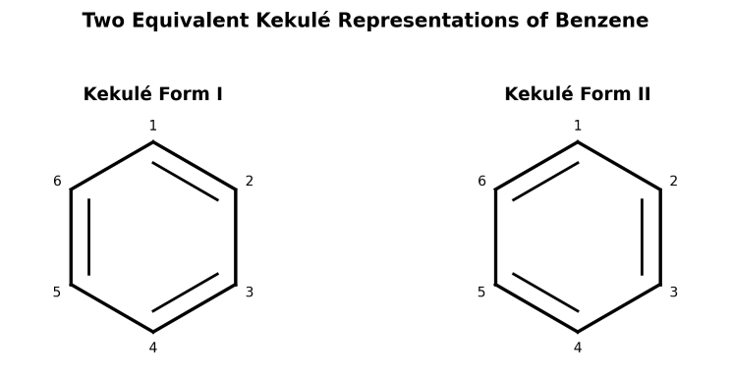
| Important Terminology: The two drawings are equivalent contributing structures, canonical structures, or resonance contributors. They are not two separate benzene molecules and should not be described as ordinary structures rapidly changing into one another. |
Achievements of Kekule’s Structure
Although the Kekule model does not provide the complete modern description of benzene, it marked an important structural advance because it explained several experimental observations.
Molecular Formula
The model contains six carbon atoms and six hydrogen atoms and therefore agrees with the molecular formula C₆H₆.
Tetravalency of Carbon
Each carbon atom bonds with two neighboring carbon atoms and one hydrogen atom, while a double bond supplies the fourth bond. Therefore, every carbon atom satisfies its normal valency.
Cyclic Nature
Six carbon atoms form a ring. Moreover, the formation of benzene from acetylene and its conversion into cyclohexane on complete hydrogenation support this cyclic arrangement.
Degree of Unsaturation
The proposed structure contains one ring and three carbon-carbon double bonds. Therefore, one ring plus three double bonds gives four degrees of unsaturation, which agrees with the molecular formula C₆H₆.
Monosubstituted Derivative
The symmetrical ring arrangement produces only one monosubstituted derivative. Therefore, all six hydrogen atoms occupy equivalent positions.
Disubstituted Derivatives
The six-membered ring permits three relative arrangements for two substituents:
- 1,2- or ortho;
- 1,3- or meta; and
- 1,4- or para.
Thus, the model explains the three types of disubstituted benzene derivatives.
Complete Hydrogenation
The Kekule representation shows three units of pi unsaturation. Consequently, benzene consumes three molecules of hydrogen during complete hydrogenation to cyclohexane.
| Observation explained | How the Kekule model accounts for it |
| Molecular formula C₆H₆ | Contains six carbon atoms and six hydrogen atoms. |
| Valency of carbon | Every carbon atom forms four bonds. |
| Cyclic structure | Six carbon atoms are arranged in a ring. |
| Four degrees of unsaturation | The model shows one ring and three double bonds. |
| One monosubstituted derivative | The model presents a symmetrical carbon framework. |
| Three disubstituted derivatives | The ring permits ortho (1,2), meta (1,3), and para (1,4) positions. |
| Hydrogenation with three H₂ molecules | The model shows three pi-unsaturation units. |
Limitations of Kekule’s Structure
The fixed Kekule structure treats benzene as a molecule with three ordinary localized single bonds and three ordinary localized double bonds. However, several experimental observations show that this model cannot represent the complete real structure.
Equal Carbon-Carbon Bond Lengths
A fixed alternating-bond structure predicts two different carbon-carbon bond lengths. A normal carbon-carbon single bond measures approximately 1.54 Å, whereas a normal carbon-carbon double bond measures approximately 1.34 Å. However, experimental studies reveal that all six carbon-carbon bonds in benzene have the same length, approximately 1.39 Å. Therefore, the benzene bond length lies between a normal single bond and a normal double bond.
Normal C-C bond = 1.54 Å; Normal C=C bond = 1.34 Å; Benzene C-C bond = 1.39 Å
This evidence shows that benzene does not contain permanently fixed ordinary single and double bonds. Every carbon-carbon bond has the same character and possesses partial double-bond character.
| Memory Line: Kekule predicts two bond lengths, but benzene has one equal intermediate bond length. |
Formation of Only One Ortho-Disubstituted Derivative
A fixed Kekule structure shows two apparently different types of adjacent carbon pairs: one joined by a single bond and another joined by a double bond. Therefore, two different 1,2-disubstituted structures might be expected—one with the substituents across a single bond and the other across a double bond.
Experimentally, however, chemists obtain only one ortho-disubstituted derivative, such as one form of 1,2-dichlorobenzene.
This proves that all adjacent carbon–carbon positions in benzene are equivalent. The ring does not contain permanently localized single and double bonds.
| Memory Line: Only one ortho product means that all adjacent positions in benzene are equivalent. |
Unusual Stability of Benzene
If benzene contained three ordinary independent double bonds, it should behave like a normal cyclic triene. It should:
- Undergo addition reactions readily,
- Decolorize bromine like an alkene, and
- Undergo oxidation readily.
However, benzene does not show ordinary triene behavior under normal conditions. Instead, it displays much greater stability and commonly undergoes substitution reactions that retain the ring.
Therefore, the fixed Kekule structure fails to explain the additional stability of benzene.
Heat of Hydrogenation Evidence
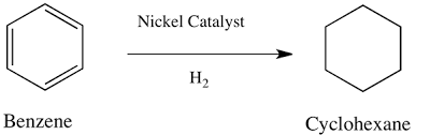
Hydrogenation of one ordinary carbon–carbon double bond releases approximately 120 kJ mol⁻¹ (28.7 kcal mol⁻¹) of heat. If benzene contained three ordinary, independent double bonds, its expected heat of hydrogenation would be:
3 × 120 = 360 kJ mol⁻¹ (approximately 86.0 kcal mol⁻¹)
Experimentally, however, the complete hydrogenation of benzene releases only about 208 kJ mol⁻¹ (approximately 49.7 kcal mol⁻¹) of heat.
Therefore, the difference between the expected and experimental values is:
360 − 208 = 152 kJ mol⁻¹ (approximately 36.3 kcal mol⁻¹)
Consequently, this difference represents the resonance energy or aromatic stabilization energy of benzene.
| Interpretation of the Calculation: Benzene is approximately 152 kJ mol⁻¹ (36.3 kcal mol⁻¹) more stable than a hypothetical cyclic compound containing three ordinary localized double bonds. A more stable reactant starts at a lower energy level and therefore releases less heat on hydrogenation. |
Preference for Substitution over Addition
Ordinary alkenes usually undergo addition because their localized pi bonds are readily attacked. Benzene mainly undergoes electrophilic substitution, represented generally as:
C₆H₆ + E⁺ → C₆H₅E + H⁺
During substitution, one hydrogen atom is replaced and the stable benzene ring is restored in the final product. In an addition reaction, the special delocalized system would be destroyed and aromatic stability would be lost.
Thus, benzene’s preference for substitution rather than easy addition reveals another limitation of the fixed Kekule model.
| Memory Line: Substitution restores and preserves the benzene ring; addition destroys aromatic stability. |
Bromination as Supporting Chemical Evidence
An ordinary alkene generally decolorizes bromine solution by addition across the double bond. Benzene does not readily undergo such direct addition and does not decolourize bromine solution.
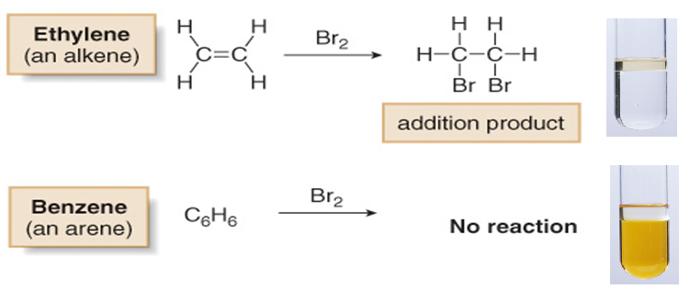
A Lewis-acid catalyst such as FeBr₃ activates bromine and allows benzene to undergo substitution:
C₆H₆ + Br₂ → C₆H₅Br + HBr
Therefore, this reaction demonstrates that benzene behaves differently from a compound containing ordinary isolated double bonds. Students study the detailed bromination mechanism later under electrophilic aromatic substitution, so they need not include it in this answer unless the question specifically asks for it.
The Two Kekule Forms Are Not Separate Molecules
Do not interpret the two Kekule forms as two independent molecules in rapid equilibrium. Instead, the actual benzene molecule exists as one stable structure in which six pi electrons extend over the entire ring. Thus, the two Kekule drawings act as contributing representations of this delocalized system.
Achievements and Limitations at a Glance
| Achievements of the Kekule model | Limitations of the fixed Kekule model |
| Explains the molecular formula C₆H₆. | Cannot explain six equal carbon-carbon bond lengths. |
| Satisfies the tetravalency of carbon. | Predicts ordinary single and double bond lengths instead of the observed 1.39 Å. |
| Represents a six-membered carbon ring. | Does not satisfactorily explain the complete equivalence of adjacent positions. |
| Accounts for one ring and three double bonds. | Cannot explain the additional stability of benzene. |
| Accounts for one monosubstituted derivative. | Cannot explain the lower-than-expected heat of hydrogenation. |
| Accounts for ortho, meta, and para derivatives. | Cannot explain why only one ortho-disubstituted derivative is observed under a fixed-bond interpretation. |
| Is consistent with consumption of three H₂ molecules. | Cannot explain the preference for substitution over easy addition. |
| Provides useful contributing forms. | Does not itself represent the true delocalized pi-electron system. |
Practice & Exam Preparation
Strengthen your understanding through MCQs, model answers, and university-examination preparation resources.