
Introduction
Friedel–Crafts alkylation is an important electrophilic aromatic substitution reaction. Chemists use it to introduce an alkyl group into benzene or another suitable aromatic ring. Usually, anhydrous aluminium chloride activates the alkyl halide and generates a strong electrophilic species. Subsequently, the benzene ring attacks the electrophile, forms a sigma complex, and finally restores aromaticity to produce an alkylbenzene. Before studying this reaction, review the general mechanism of electrophilic aromatic substitution.
Definition
In Friedel–Crafts alkylation, an alkylating agent and a Lewis-acid catalyst replace one aromatic-ring hydrogen with an alkyl group.
General Reaction
We can represent the general reaction as:
Ar–H + R–X —anhydrous AlCl₃ → Ar–R + HX
Here, Ar–H represents the aromatic compound, R–X represents the alkyl halide, AlCl₃ acts as the Lewis-acid catalyst, and Ar–R represents the alkylated aromatic product.
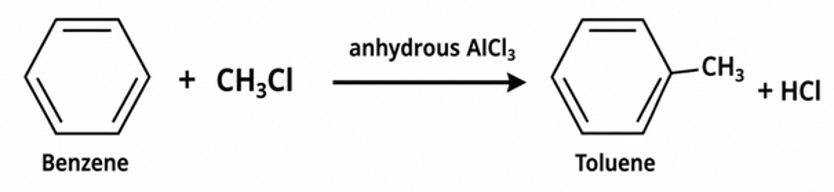
Example: Benzene reacts with methyl chloride in the presence of anhydrous AlCl₃ to form toluene and hydrogen chloride.
Reagents and Reaction Conditions
| Component | Function |
| Aromatic substrate | Provides the electron-rich aromatic ring. |
| Alkyl halide, R–Cl or R–Br | Supplies the alkyl group. |
| Anhydrous AlCl₃ | Acts as a Lewis acid and activates the alkyl halide. |
| Dry reaction conditions | Keep AlCl₃ protected from water. |
Mechanism of Friedel–Crafts Alkylation of Benzene
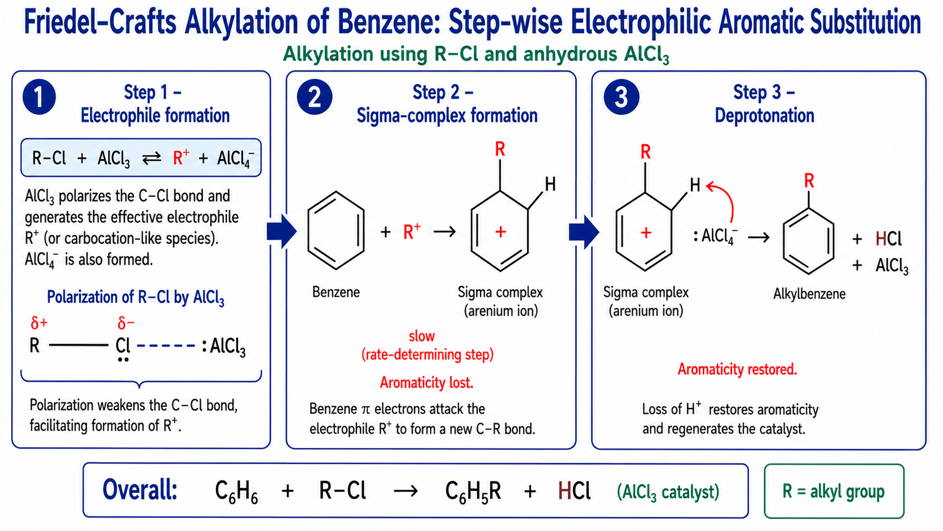
The mechanism of Friedel–Crafts alkylation of benzene proceeds through electrophile generation, sigma-complex formation, and restoration of aromaticity.
Formation of the Electrophile
First, the alkyl halide reacts with anhydrous AlCl₃. It is commonly represented as formation of a carbocation together with AlCl₄⁻:
R–Cl + AlCl₃ → R⁺ + AlCl₄⁻
However, depending on the alkyl halide, the actual reactive species may exist as a carbocation, an ion pair, or a strongly polarized complex.
Formation of the Sigma Complex
Next, the pi electrons of benzene attack the electrophile and form a new carbon–carbon sigma bond. Consequently, one ring carbon becomes sp³-hybridized, and the ring temporarily loses aromaticity. However, resonance stabilizes the resulting positively charged intermediate, which chemists call the sigma complex, arenium ion, or Wheland intermediate.
Deprotonation and Restoration of Aromaticity
Finally, AlCl₄⁻ removes the proton from the carbon bearing the new alkyl group. As a result, the carbon–hydrogen bond electrons restore the aromatic pi system. Consequently, the reaction forms alkylbenzene and HCl while regenerating AlCl₃:
Sigma complex + AlCl₄⁻ → alkylbenzene + HCl + AlCl₃
Examples of Friedel–Crafts Alkylation
| Reaction | Major product |
| Benzene + CH₃Cl / AlCl₃ | Toluene |
| Benzene + C₂H₅Cl / AlCl₃ | Ethylbenzene |
| Benzene + (CH₃)₂CHCl / AlCl₃ | Isopropylbenzene or cumene |
| Benzene + tert-butyl chloride / AlCl₃ | tert-Butylbenzene |
Students may also compare this reaction with the sulphonation and halogenation of benzene.
Reactivity of Alkylbenzene
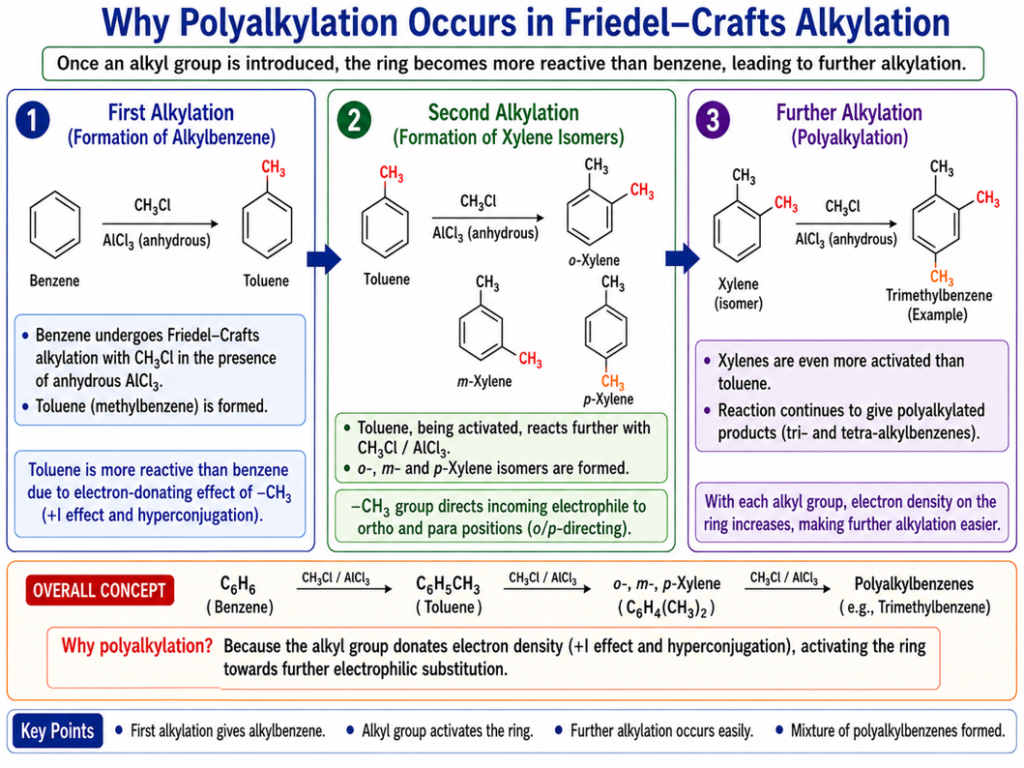
An alkyl group releases electron density toward the benzene ring through its positive inductive effect and hyperconjugation. Consequently, alkylbenzenes such as toluene react faster than benzene toward further electrophilic substitution. In addition, alkyl groups direct an incoming electrophile mainly to the ortho and para positions.
| Key Principle: An alkyl group activates the benzene ring and is an ortho/para-directing group. |
Limitations of Friedel–Crafts Alkylation
Although Friedel–Crafts alkylation of benzene provides an effective method for preparing alkylbenzenes, carbocation rearrangement and polyalkylation may limit the reaction.
Polyalkylation
The first alkyl group activates the aromatic ring. It increases the electron density of the aromatic ring. Consequently, the monoalkylated product reacts faster with another electrophile than the original benzene. As a result, the reaction may produce a mixture of monoalkylated and polyalkylated products. Although chemists may use a large excess of benzene to favour monoalkylation, this approach does not completely remove the limitation.
Carbocation Rearrangement
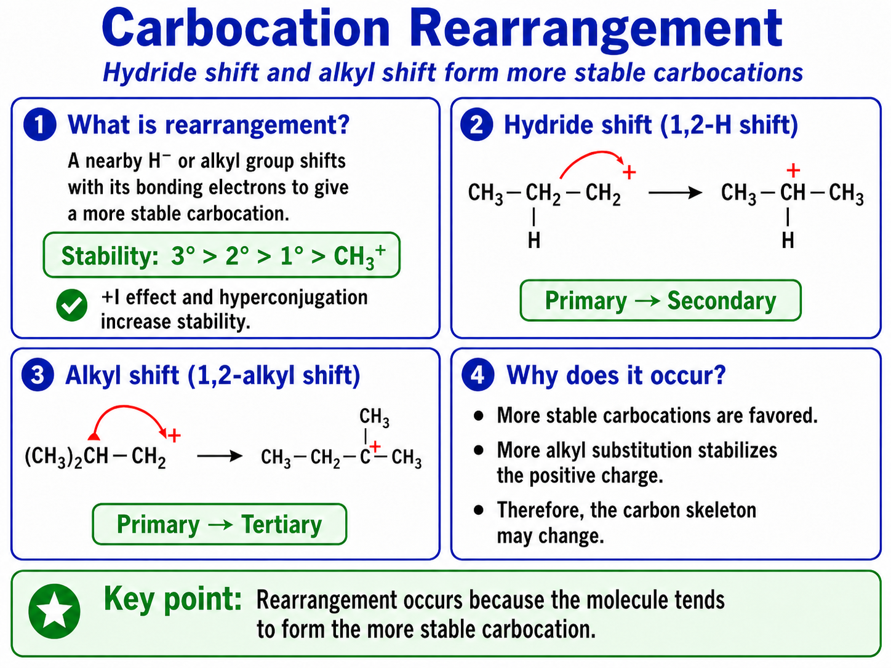
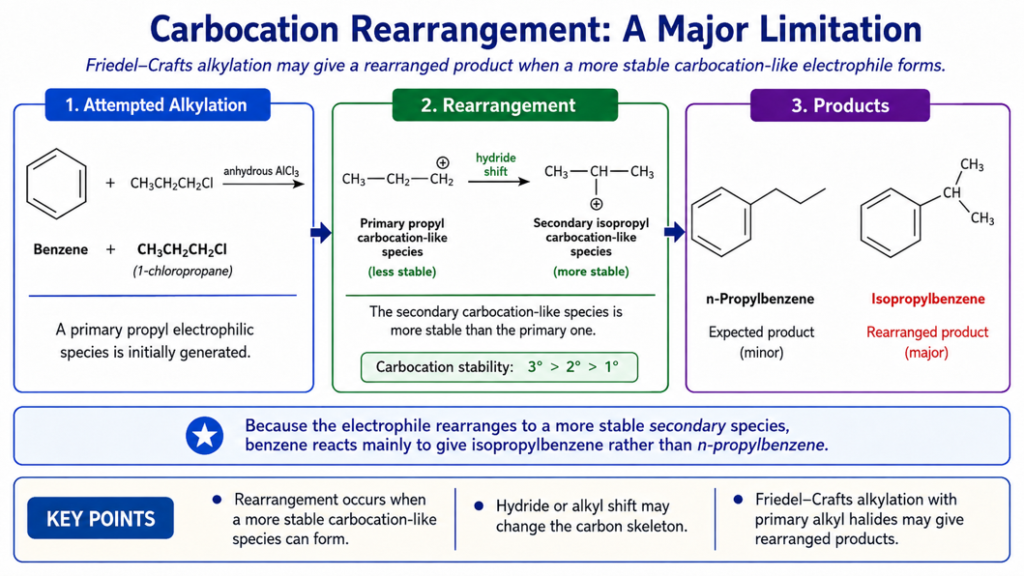
In Friedel–Crafts alkylation, the electrophile has carbocation character and may rearrange to form a more stable species. Therefore, hydride or alkyl shifts can convert a primary carbocation-like intermediate into a secondary or tertiary one.
For example, benzene reacts with 1-chloropropane to give mainly isopropylbenzene instead of n-propylbenzene because the secondary electrophilic species is more stable.
Thus, carbocation rearrangement may change the original carbon skeleton of the alkyl halide.
Carbocation Stability Order:
Tertiary carbocation > Secondary carbocation > Primary carbocation > Methyl carbocation
Failure with Strongly Deactivated Aromatic Rings
Strongly electron-withdrawing groups reduce the electron density and nucleophilicity of an aromatic ring. Therefore, nitrobenzene and rings bearing groups such as –SO₃H, –CN, –CHO, –COR, and –COOH generally fail to undergo Friedel–Crafts alkylation under normal conditions.
Interference by Amino Groups
A free amino group contains a lone pair that coordinates strongly with AlCl₃. As a result, the Lewis acid–base complex lowers the electron density of the ring and consumes the catalyst. Consequently, aniline does not undergo normal Friedel–Crafts alkylation directly.
Unsuitable Alkylating Agents
Aryl halides and vinyl halides do not generate the required carbocation-like electrophiles under ordinary Friedel–Crafts conditions. Therefore, chlorobenzene cannot introduce a phenyl group, and vinyl chloride cannot serve as a normal alkylating agent in this reaction.
Important Limitations at a Glance
| Limitation | Chemical reason | Typical example |
| Polyalkylation | The first alkyl group activates the ring. | Toluene reacts faster than benzene. |
| Carbocation rearrangement | A more stable electrophilic species forms. | 1-Chloropropane may give isopropylbenzene. |
| Deactivated rings fail | The electron-poor ring lacks enough nucleophilicity to attack the electrophile. | Nitrobenzene does not react. |
| Amino-group interference | –NH₂ forms a complex with AlCl₃. | AlCl₃ complexation prevents aniline from reacting directly. |
| Aryl/vinyl halides unsuitable | The reagent cannot generate the required carbocation-like species. | Chlorobenzene and vinyl chloride are unsuitable alkylating agents. |
Comparison of Expected and Actual Outcomes
| Situation | Expected by simple reaction writing | Possible actual outcome |
| Benzene + methyl chloride | Toluene | Toluene; rearrangement is not possible for methyl. |
| Benzene + 1-chloropropane | n-Propylbenzene | Isopropylbenzene due to rearrangement. |
| Benzene + excess alkyl halide | Monoalkylbenzene | Mixture containing polyalkylated products. |
| Nitrobenzene + alkyl halide | Alkylnitrobenzene | No normal Friedel–Crafts alkylation. |
| Aniline + alkyl halide | Alkylaniline | AlCl₃ complexation prevents the expected ring alkylation. |
Pharmaceutical and Synthetic Relevance
Alkyl-substituted aromatic rings occur in many pharmaceutical intermediates and biologically active molecules. Therefore, Friedel–Crafts alkylation provides a fundamental method for forming a carbon–carbon bond on an aromatic ring. However, rearrangement and polyalkylation can reduce product control. Consequently, chemists often choose an alternative method or use Friedel–Crafts acylation followed by reduction when they require a controlled straight-chain alkyl group.
Summary
Friedel–Crafts alkylation introduces an alkyl group into benzene through electrophilic aromatic substitution. First, an alkyl halide and anhydrous AlCl₃ generate a carbocation or carbocation-like electrophile. Next, benzene attacks the electrophile and forms a sigma complex. Finally, loss of a proton restores aromaticity. However, several limitations affect the reaction, including polyalkylation, carbocation rearrangement, failure with strongly deactivated rings, amino-group complexation with AlCl₃, and the inability of aryl or vinyl halides to act as normal alkylating agents.