Introduction
After one substituent enters the benzene ring, it influences the position at which the next electrophile enters. Chemists call this positional influence orientation or the directing effect. Depending on the existing group, the incoming electrophile may enter mainly at the ortho, meta, or para position.
Orientation does not mean that only one product must form. Instead, it identifies the position or positions favored in the product mixture because the corresponding sigma complex has greater relative stability.
Positions in Monosubstituted Benzene
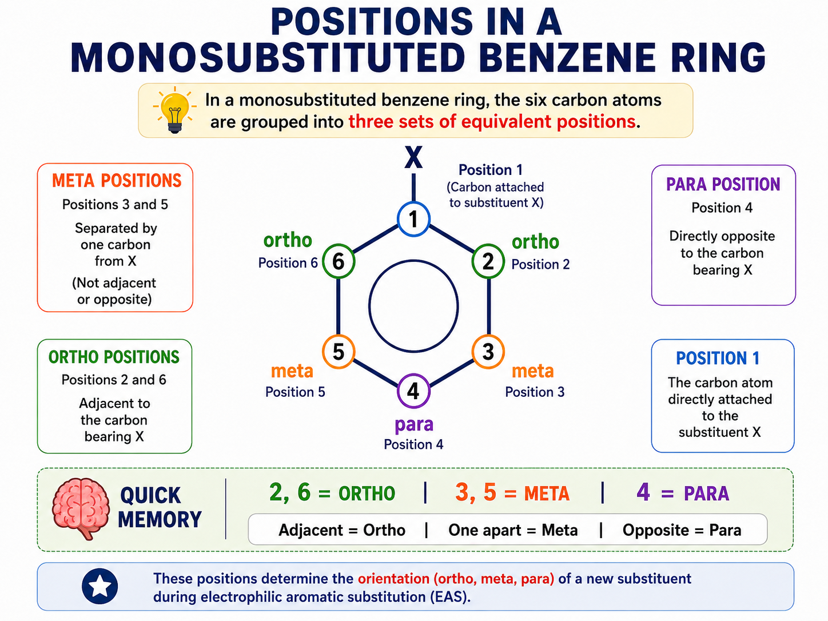
Number the carbon attached to the existing substituent as carbon 1. Then, positions 2 and 6 are ortho, positions 3 and 5 are meta, and position 4 is para. Chemists call carbon 1 the ipso carbon.
Meaning of Orientation
Orientation is the preferential position of further electrophilic substitution in a monosubstituted benzene ring. For example, the methyl group directs nitration mainly to the ortho and para positions, whereas the nitro group directs nitration mainly to the meta position.
| Term | Question answered | Example |
| Reactivity | How fast does the ring react compared with benzene? | Toluene reacts faster than benzene. |
| Orientation | Where does the incoming electrophile enter? | The methyl group directs mainly to ortho and para positions. |
Basic Principle: Stability of the Sigma Complex
Electrophilic aromatic substitution proceeds through a positively charged sigma complex or arenium ion. Attack at the ortho, meta, and para positions produces different sigma complexes. Therefore, the substituent already present may stabilize some intermediates more effectively or may strongly destabilize others. Consequently, the relative stability of these sigma complexes controls the major orientation.
Ortho/Para-Directing Groups
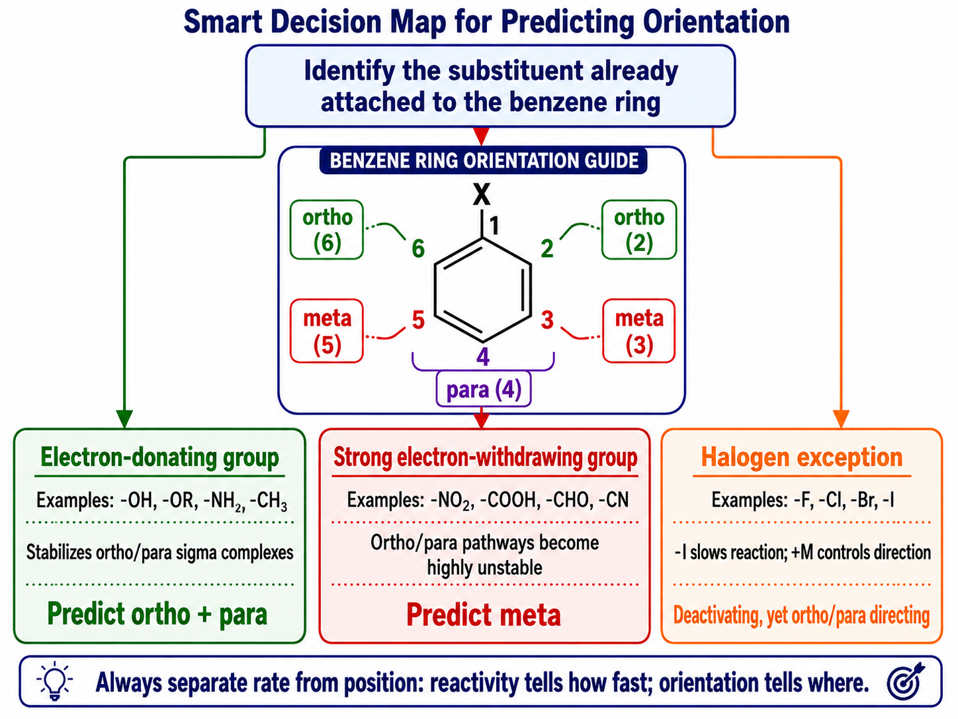
Most electron-donating groups direct the incoming electrophile to the ortho and para positions because they stabilize the corresponding sigma complexes more effectively than the meta sigma complex.
Lone-Pair-Donating Groups
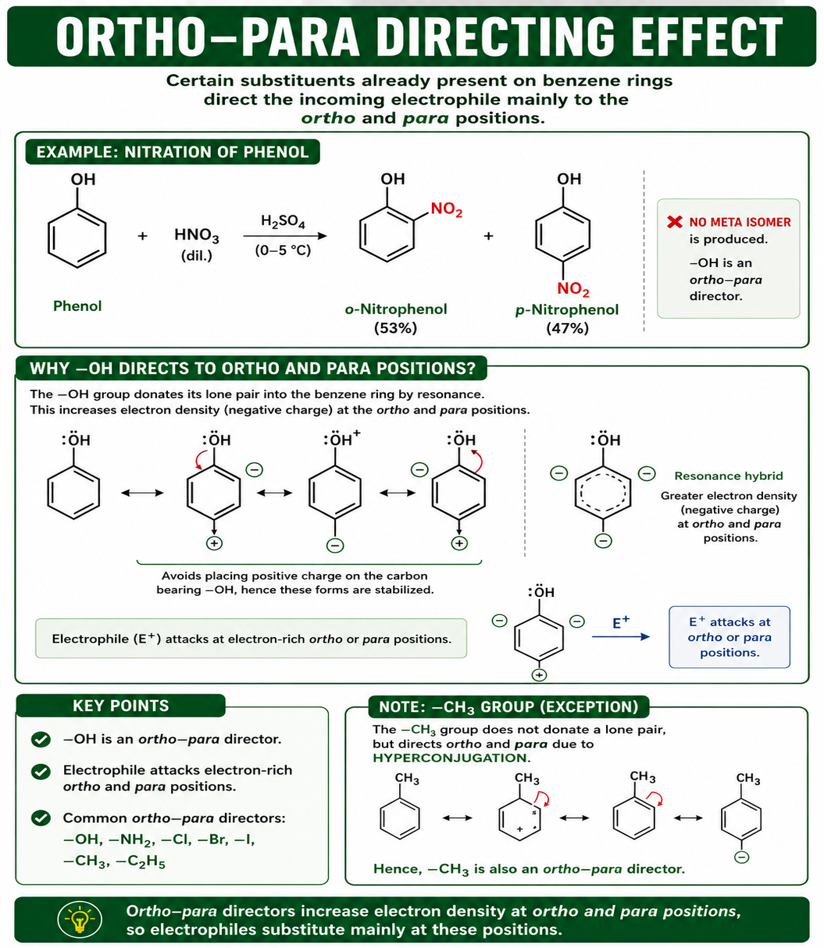
Groups such as -OH, -OR, -NH₂, -NHR, and -NR₂ contain a lone pair that can enter conjugation with the benzene ring. Through the +M effect, these groups donate electron density and provide an additional resonance contributor that stabilizes the ortho and para sigma complexes. However, the meta sigma complex does not receive the same extra stabilization. Therefore, these groups act as activating ortho/para directors.
For example, nitration of phenol gives mainly ortho-nitrophenol and para-nitrophenol.
Alkyl Groups
Alkyl groups such as -CH₃ donate electron density weakly through the +I effect and stabilize the sigma complex through hyperconjugation. In particular, the ortho and para sigma complexes receive greater stabilization than the meta sigma complex. Therefore, alkyl groups act as weakly activating ortho/para directors.
Meta-Directing Groups
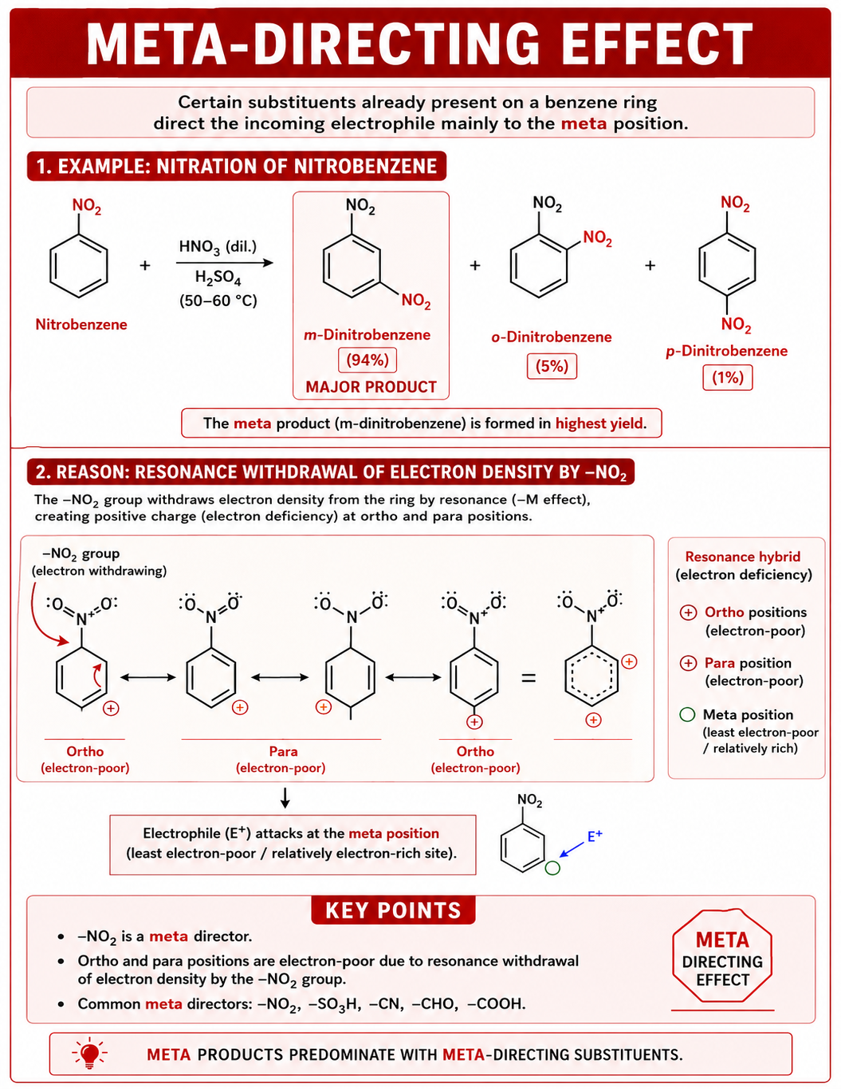
Strong electron-withdrawing groups usually direct the incoming electrophile to the meta position. Common examples include -NO₂, -SO₃H, -CHO, -COR, -COOH, -COOR, and -CN.
During ortho or para attack, one sigma-complex contributor places the positive charge on the carbon bearing the electron-withdrawing group. This arrangement becomes highly unstable because the group withdraws electron density from an already electron-deficient carbon. In contrast, the meta sigma complex avoids this especially unfavorable contributor. Therefore, the meta pathway predominates. For example, nitration of nitrobenzene gives mainly m-dinitrobenzene.
Halogen Exception
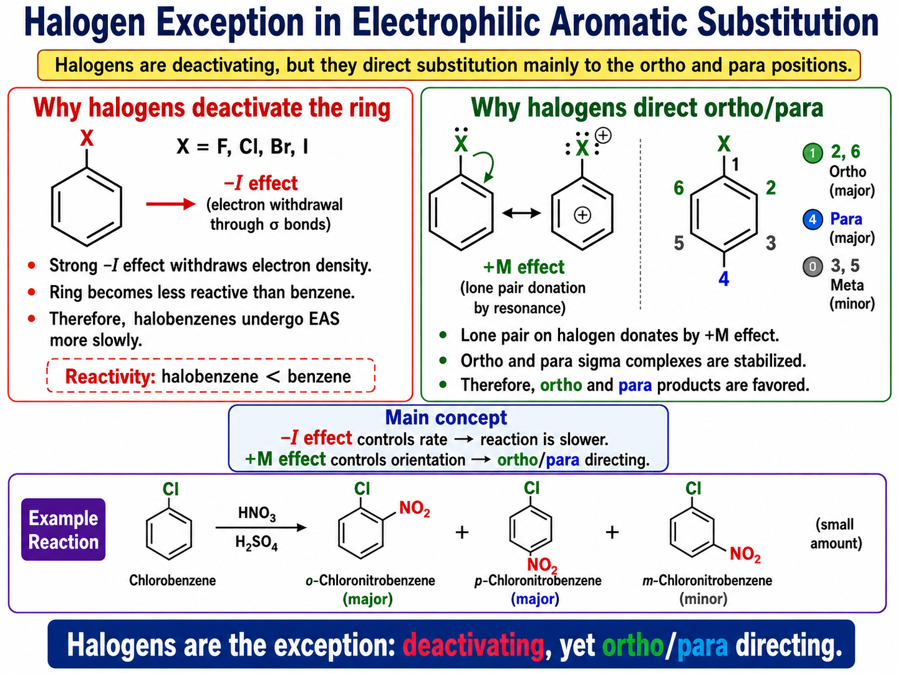
Halogens such as -F, -Cl, -Br, and -I show two opposing electronic effects. First, their strong -I effect withdraws electron density and decreases the reaction rate. Therefore, halobenzenes react more slowly than benzene. However, the halogen lone pair donates electron density through the +M effect and stabilizes the ortho and para sigma complexes. Consequently, halogens are deactivating but ortho/para directing.
Classification of Directing Groups
| Type of substituent | Important examples | Main reason | Orientation |
| Activating ortho/para directors | -OH, -OR, -NH₂, -NHR, -NR₂ | Lone-pair donation through +M effect | Ortho and para |
| Weakly activating ortho/para directors | Alkyl groups such as -CH₃ | +I effect and hyperconjugation | Ortho and para |
| Deactivating meta directors | -NO₂, -SO₃H, -CHO, -COR, -COOH, -COOR, -CN | Electron withdrawal through -M and/or -I effects | Meta |
| Deactivating ortho/para directors | -F, -Cl, -Br, -I | -I decreases rate; +M controls direction | Ortho and para |
Steric Effect and the Ortho/Para Product Ratio
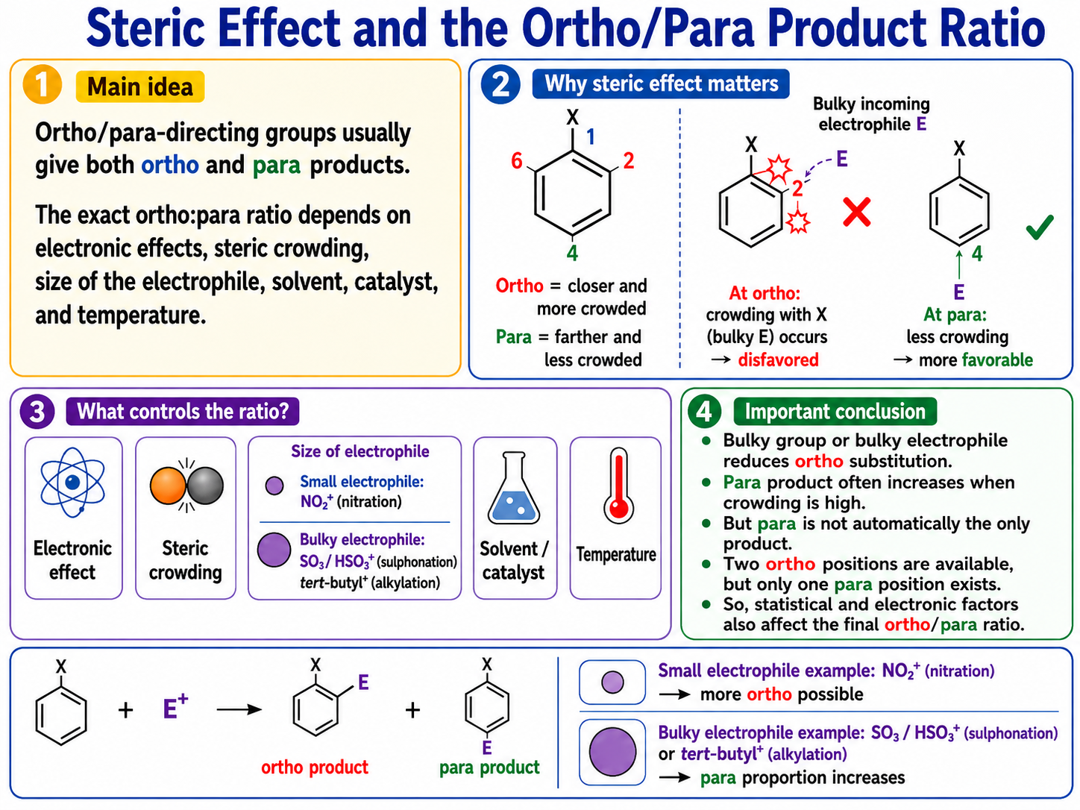
An ortho/para-directing group generally produces both ortho and para products. However, the exact ratio depends on electronic effects, steric crowding, the size of the electrophile, solvent, catalyst, and temperature.
When either the existing substituent or the incoming electrophile is bulky, crowding near the ortho position may reduce ortho substitution and increase the proportion of para product. Nevertheless, the para product is not always the only product or automatically the major product because two ortho positions are available, whereas only one para position exists. Therefore, statistical and electronic factors also influence the final ratio.
Worked Product-Prediction Examples
Nitration of Toluene
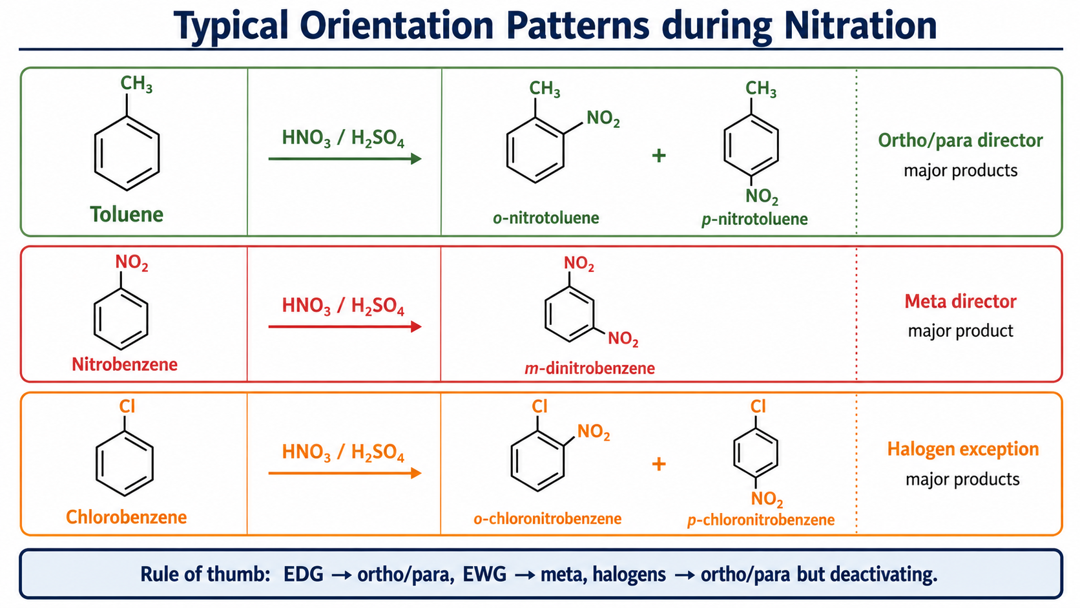
The methyl group donates electron density through the +I effect and hyperconjugation. Therefore, it stabilizes the ortho and para sigma complexes and directs the nitro group mainly to these positions.
| Toluene + HNO₃/H₂SO₄ -> o-nitrotoluene + p-nitrotoluene (major products) |
Nitration of Nitrobenzene
The nitro group strongly withdraws electron density through -M and -I effects. Consequently, ortho and para attack produce an especially unstable sigma-complex contributor. Therefore, nitration occurs mainly at the meta position.
| Nitrobenzene + HNO₃/H₂SO₄ -> m-dinitrobenzene (major product) |
Nitration of Chlorobenzene
Chlorine deactivates the ring through the -I effect, so chlorobenzene reacts more slowly than benzene. Nevertheless, chlorine donates a lone pair by resonance and stabilizes the ortho and para sigma complexes. Therefore, nitration gives mainly ortho- and para-chloronitrobenzene.
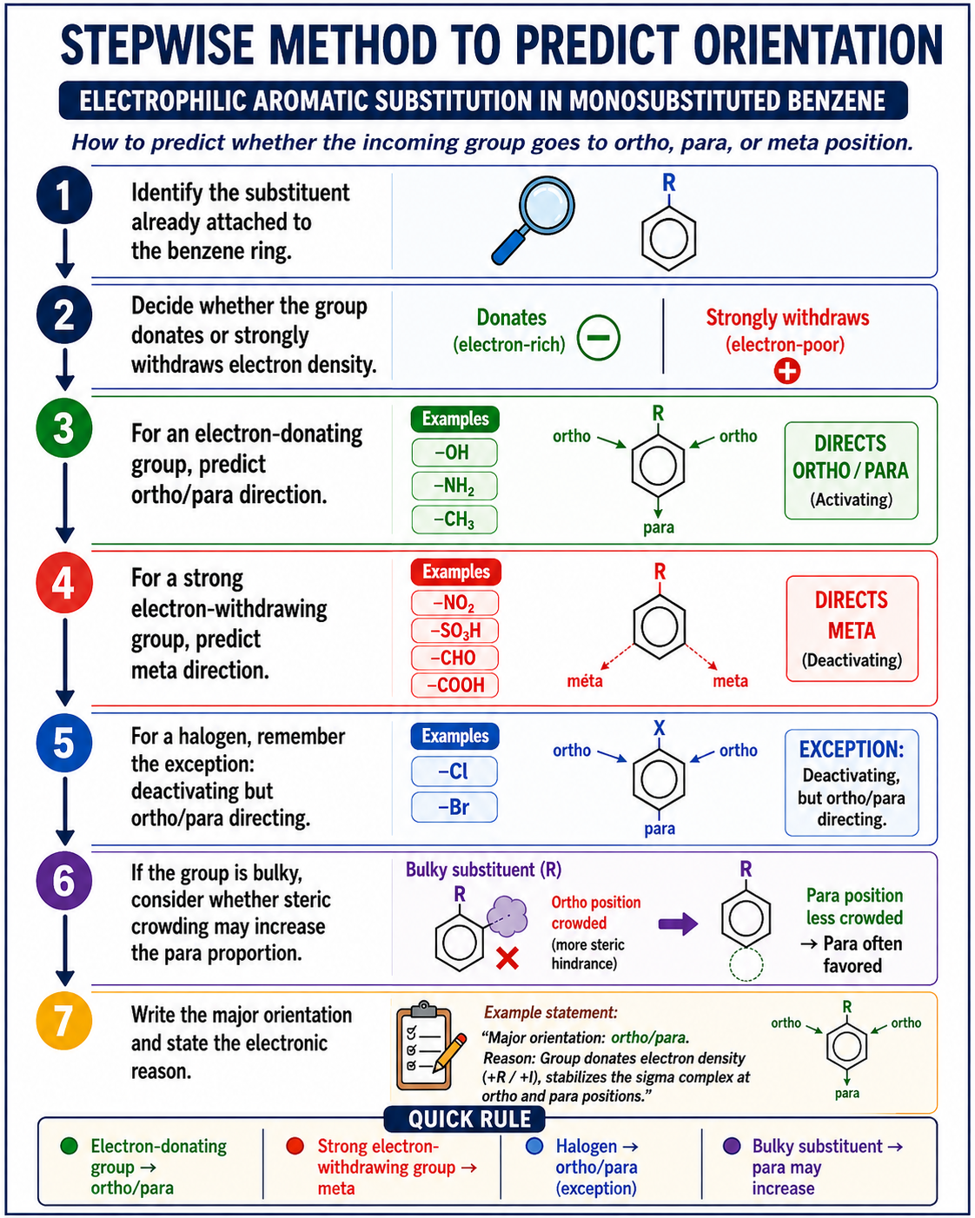
Stepwise Method to Predict Orientation
1. Identify the substituent already attached to the benzene ring.
2. Decide whether the group donates or strongly withdraws electron density.
3. For an electron-donating group, predict ortho/para direction.
4. For a strong electron-withdrawing group, predict meta direction.
5. For a halogen, remember the exception: deactivating but ortho/para directing.
6. If the group is bulky, consider whether steric crowding may increase the para proportion.
7. Write the major orientation and state the electronic reason.