
Introduction to Acidity of Phenols
This lecture explains why phenol is more acidic than alcohols and how substituents strengthen or weaken phenolic acidity. Phenol is a weak acid because its O-H bond can ionize and produce a resonance-stabilized conjugate base. The topic becomes easier when students connect three ideas: proton donation, conjugate-base stability, and electronic effects of substituents.
C6H5OH + H2O ⇌ C6H5O– + H3O+
Three Core Concepts
Concept 1 – Proton-Donation Concept
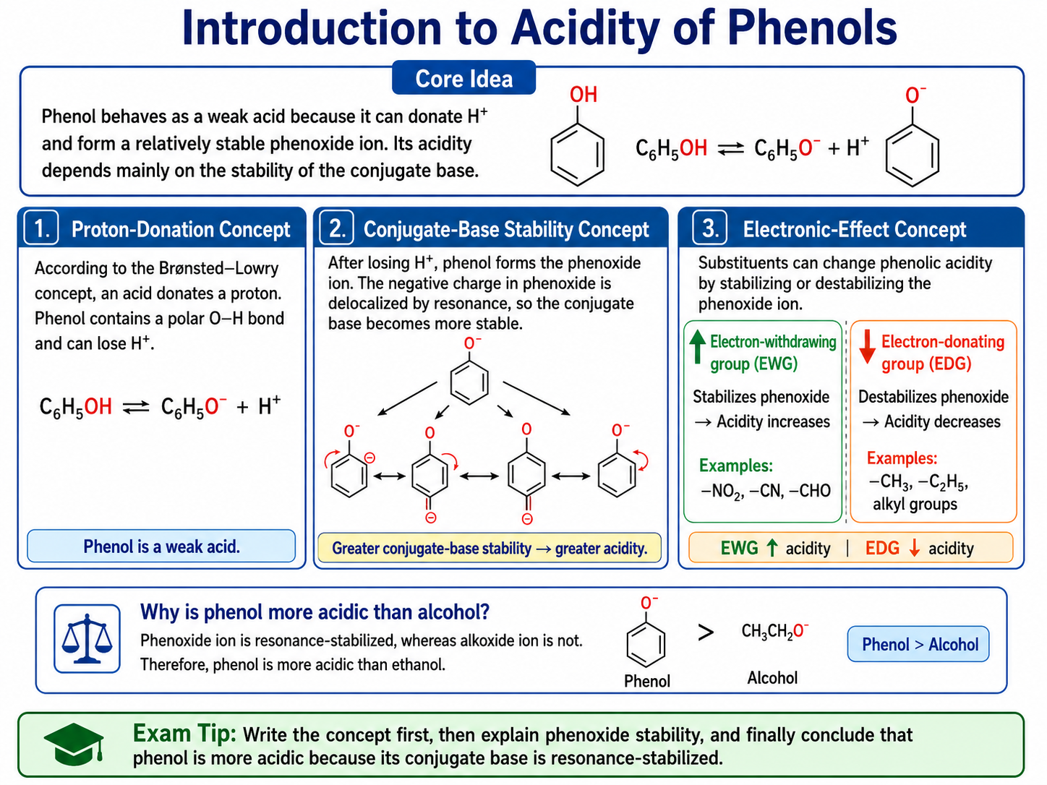
According to the Bronsted-Lowry concept, an acid donates a proton, H+. Phenol contains a polar O-H bond and can therefore lose its hydroxyl proton. After deprotonation, phenol forms the phenoxide ion.
C6H5OH + H2O ⇌ C6H5O– + H3O+
Thus, phenol behaves as a weak acid. However, the most important question is not simply whether phenol can lose H+. The acidity of phenol depends mainly on the relative stability of the phenoxide ion. A more stable phenoxide ion shifts the acid-base equilibrium more readily toward deprotonation.
Concept 2 – Conjugate-Base Stability Concept (Resonance Stabilization)
When phenol loses H+, it forms the phenoxide ion. In phenoxide, the negative charge does not remain localized only on oxygen. Instead, the oxygen lone pair interacts with the aromatic pi-system, and resonance distributes part of the negative charge over the ring. In important resonance contributors, negative charge appears on oxygen and at the two ortho and the para carbon atoms of the ring. This delocalization stabilizes the conjugate base. Therefore, phenoxide gains more stabilization than an ordinary alkoxide ion such as ethoxide.
Phenol → Phenoxide ion + H+
Ethoxide cannot delocalize its negative charge through resonance, so its negative charge remains mainly localized on oxygen. Consequently, phenoxide is more stable than ethoxide, and phenol is more acidic than ethanol.
Concept 3 – Electronic-Effect Concept
A substituent attached to the aromatic ring can withdraw or donate electron density. An electron-withdrawing group stabilizes the negatively charged phenoxide ion and therefore increases acidity. In contrast, an electron-donating group increases electron density in phenoxide, destabilizes the conjugate base, and decreases acidity.
Phenol versus Alcohol
Ethanol forms ethoxide ion, but ethoxide cannot delocalize its negative charge through resonance. Therefore, phenol is more acidic than aliphatic alcohols. Even so, phenol remains weaker than carboxylic acids because carboxylate ions distribute the negative charge efficiently over two electronegative oxygen atoms.
| Feature | Phenol | Alcohol |
| Conjugate base | Phenoxide ion | Alkoxide ion |
| Charge distribution | Resonance delocalized | Mainly localized on oxygen |
| Relative conjugate-base stability | Higher | Lower |
| Relative acidity | More acidic (pKa ≈ 10) | Less acidic (pKa ≈ 16) |
Effect of Substituents on the Acidity of Phenols
Substituents change phenolic acidity mainly by altering the stability of the phenoxide ion. Two electronic effects are especially important: the inductive effect and the resonance (mesomeric) effect.
- Inductive effect: electron withdrawal or donation transmitted through sigma bonds.
- Resonance/mesomeric effect: electron donation or withdrawal through conjugation with the aromatic pi-system.
Electron-Withdrawing Groups Increase Acidity
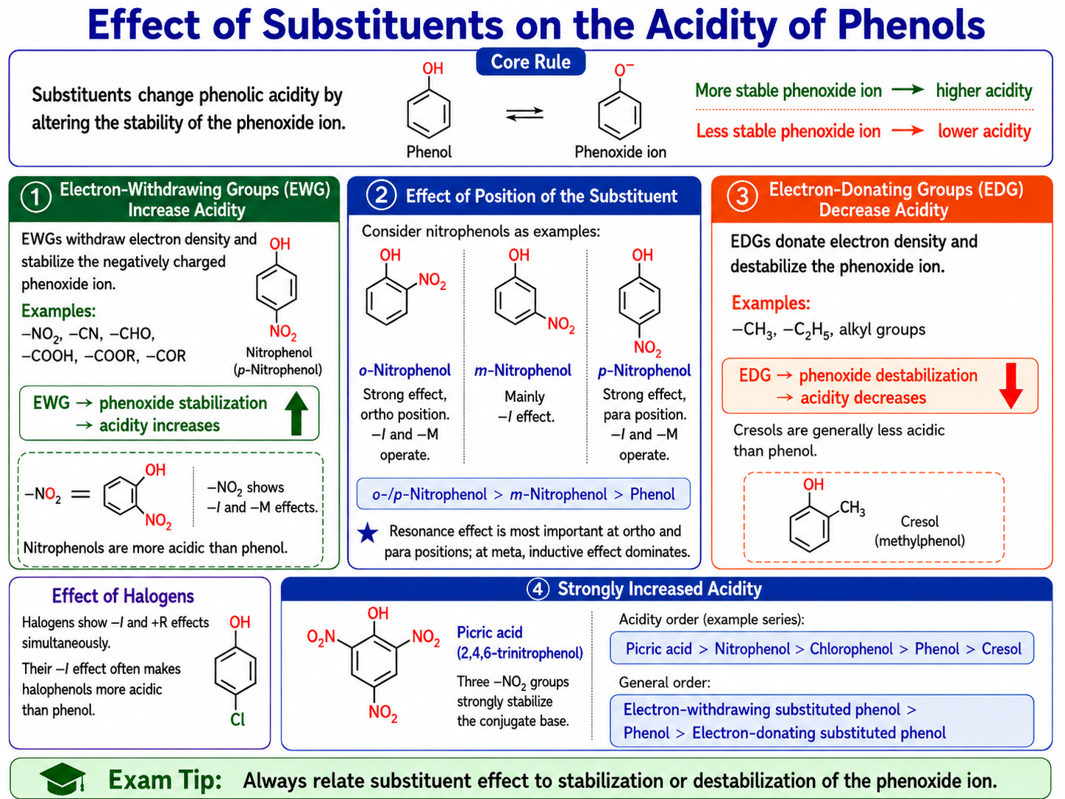
Electron-withdrawing groups such as -NO2, -CN, -CHO, -COOH, -COOR, and -COR generally increase the acidity of phenol. They withdraw electron density from the aromatic system and help stabilize the negatively charged phenoxide ion.
Example: Nitrophenols
The nitro group is a strong electron-withdrawing group because it shows both -I and -M/-R effects. Therefore, nitrophenols are more acidic than phenol.
At the ortho and para positions, -NO2 can stabilize phenoxide through both inductive and resonance effects. At the meta position, the nitro group cannot directly stabilize the relevant phenoxide resonance contributors in the same way; therefore, its effect is mainly inductive and the increase in acidity is smaller.
Multiple Electron-Withdrawing Groups
When more than one strong electron-withdrawing group is present, their effects reinforce one another. In picric acid (2,4,6-trinitrophenol), three nitro groups strongly withdraw electron density and greatly stabilize the conjugate base. Consequently, picric acid is far more acidic than phenol.
Electron-Donating Groups Decrease Acidity
Electron-donating groups such as -CH3, -C2H5, and other alkyl groups increase electron density in the aromatic ring. A methyl group shows a +I effect. Consequently, it increases electron density in the already negatively charged phenoxide ion and destabilizes the conjugate base. Therefore, cresols are generally less acidic than phenol.
The order of acidity is as below:
Nitrophenol > Phenol > Cresol
Effect of Position of the Substituent
The position of a substituent becomes especially important when the substituent can participate in resonance.
Ortho and Para Positions
At the ortho and para positions, a substituent can interact with resonance contributors in which negative charge appears on the ring. Therefore, groups showing resonance effects often influence acidity strongly at these positions.
Meta Position
At the meta position, direct resonance interaction with the relevant negative-charge positions of phenoxide does not operate in the same way. Therefore, the inductive effect becomes relatively more important.
Effect of Halogens
Halogens present an important special case. They show a strong -I effect, which withdraws electron density, and a +R effect, because their lone pairs can donate electron density into the aromatic ring. For phenolic acidity, the electron-withdrawing inductive effect often promotes stabilization of the phenoxide system. Therefore, halogen-substituted phenols can be more acidic than phenol, although both opposing electronic effects should be recognized.
Summary of Substituent Effects
| Substituent Type | Electronic Effect | Effect on Phenoxide Ion | Effect on Acidity |
| -NO2 | -I and -M | Strong stabilization | Strongly increases |
| -CN | -I and -M | Stabilizes | Increases |
| Carbonyl-containing EWG | -I / -M | Stabilizes | Increases |
| Halogen | Strong -I, opposing +R | Net stabilization often dominates | Usually increases |
| -CH3 | +I | Destabilizes | Decreases |
| Alkyl group | +I | Destabilizes | Decreases |