

10 practical habits for better rest, concentration and daily energy
| CORE MESSAGE A healthy sleep routine is not a strict timetable. It is a few simple habits that help you sleep well and fit into real college life. |
At 1:20 a.m., Riya Was Still Scrolling
Riya had planned to sleep by 11:30 p.m. She had an early pharmacology lecture, a record to complete and a quiz the next day. She opened her phone for one short video. Soon, one video became many. When she finally kept the phone aside, she was tired but could not sleep quickly.
At 7:00 a.m., Riya pressed the snooze button twice. She skipped breakfast and hurried to college. In the second lecture, she was yawning and reading the same line again and again. She told herself, ‘I will sleep properly on Sunday.’
Riya was not lazy. Her day simply had no clear time to stop studying, using the phone and worrying. Many students face the same problem, but their reasons may be different.
| KEY MESSAGE Sleep improves when students build a repeatable sequence—not when they wait to feel perfectly sleepy or try to repair an entire week in one night. |
What Is a Healthy Sleep Routine?
A healthy sleep routine is a reasonably consistent pattern of daytime and evening habits that supports enough, good-quality sleep. It includes a regular wake time, sufficient opportunity to sleep, a calming wind-down period and a sleep-friendly environment.
Sleep duration and sleep quality both matter. Most adults aged 18–60 are advised to obtain at least seven hours of sleep regularly. However, individual needs differ, and a student should also notice daytime alertness, mood and functioning rather than treating one number as a competition. Sleep is one part of the broader mental and emotional well-being of students
Why Sleep Matters in College Life
Sleep supports attention, learning, memory, emotional regulation, physical recovery and safe decision-making. A student may spend an extra late-night hour studying yet learn less efficiently the next day because tiredness reduces sustained attention and increases errors.
Occasional late nights happen. The greater concern is a repeated pattern of inadequate or poor-quality sleep that disrupts classes, laboratory work, travel, relationships or health. The purpose of a routine is to reduce that pattern gradually—not to create guilt after one difficult night.
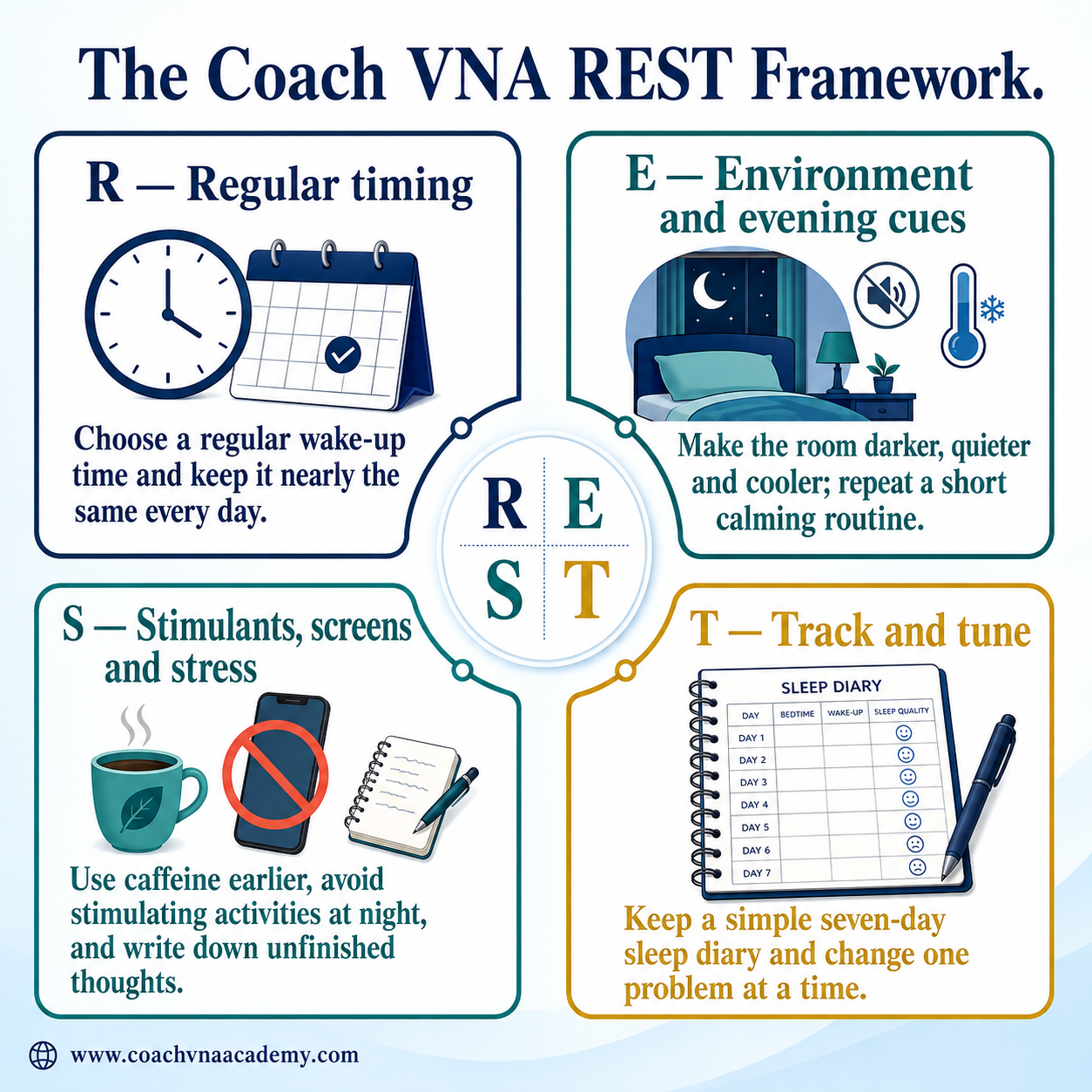
The Coach VNA REST Framework
The infographic gives the framework at a glance. Read the four short explanations below and choose the part that matches your present difficulty.
R — Regular timing
Choose a regular wake-up time and keep it nearly the same every day. A steady morning time helps your body know when the day begins. It is more useful to follow a realistic time than to make a perfect timetable that you cannot follow.
E — Evening environment
Make your room darker, quieter and cooler when possible. Repeat a short calming routine, such as packing your bag, dimming the light and reading quietly. Hostel and PG students can discuss a common quiet time with roommates.
S — Screens, stimulants and stress
Use caffeine earlier in the day and reduce stimulating activities at night. Keep the phone away from the pillow when possible. If unfinished work or family worries keep returning to your mind, write down the next small step on paper.
T — Track and improve
Keep a simple seven-day sleep diary. Note your bedtime, wake-up time, naps, caffeine and morning energy. Change one problem at a time so you can learn what actually helps you.
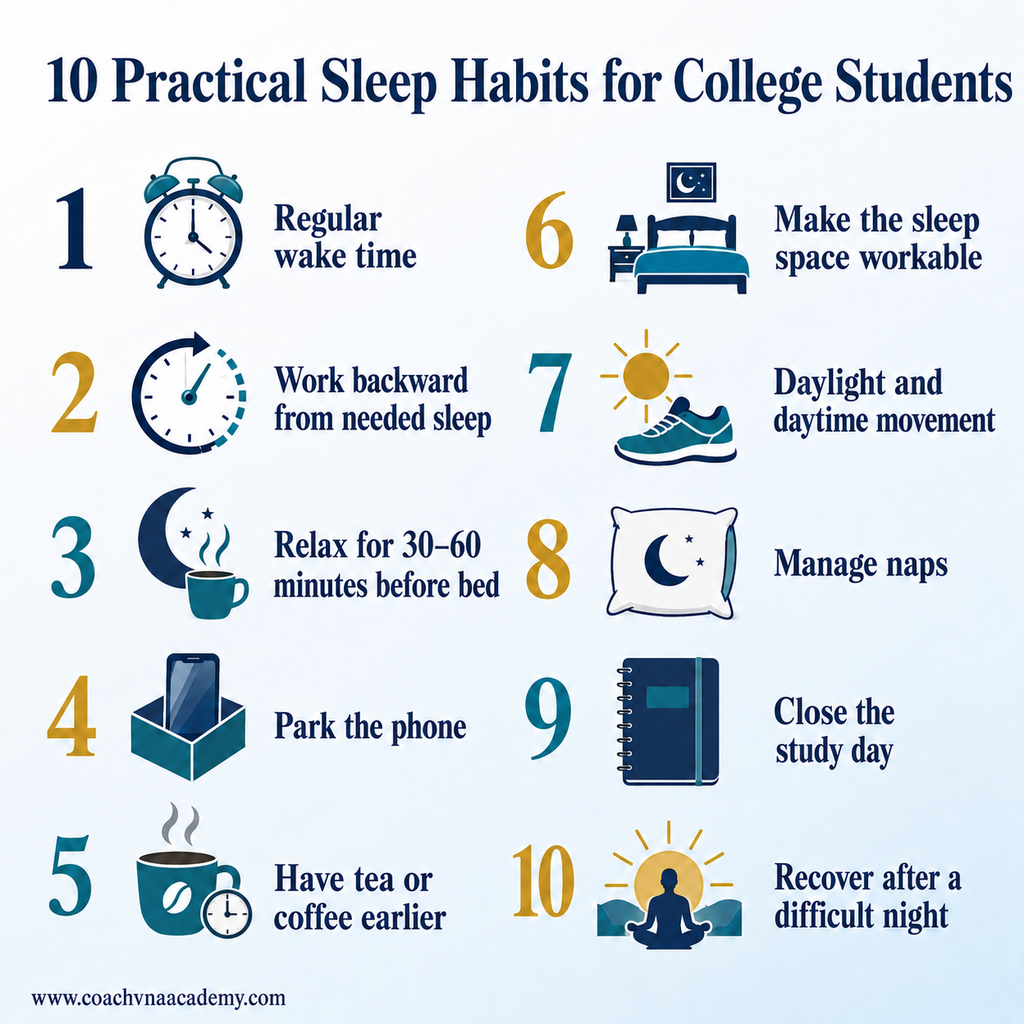
10 Practical Habits for a Healthier Sleep Routine
Anchor the morning with a regular wake time
Wake time is often easier to control than bedtime. Choose a time that fits most class days. On weekends, avoid shifting the schedule so far that Monday feels like a new time zone. If one night is poor, return to the usual rhythm gently rather than abandoning it.
Work backward from the sleep opportunity you need
If you must wake at 6:30 a.m., a midnight bedtime allows only six and a half hours in bed—and actual sleep may be shorter. Count backward, include time to settle, and protect the resulting window as seriously as an early lecture.
Create a 30–60 minute wind-down sequence
Use the same two or three low-stimulation cues to relax for 30–60 minutes before bed: pack the college bag, dim the lights, complete basic hygiene, read something calm or practice slow breathing. The sequence should be simple enough to repeat in a hostel or at home.
Give the phone a parking place
Set a ‘last useful check’ rather than demanding instant digital perfection. Charge the phone away from the pillow, use Do Not Disturb, silence nonessential notifications and keep the alarm audible. If late-night scrolling continues, move the charger farther away.
Time caffeine instead of using it as emergency fuel
Tea, coffee, cola, chocolate and many energy drinks contain caffeine. Its effects can continue for hours. Notice your personal response and avoid caffeine late in the day, particularly during the hours before planned sleep.
Make the sleep space workable
A perfect bedroom is not required. In a shared room, agree on a quiet period, lower screen brightness, use a comfortable eye covering or earplugs when appropriate, keep bedding clean and reduce unnecessary light. Safety and roommate communication come first.
Use daylight and daytime movement
Morning or daytime light helps reinforce the sleep–wake rhythm. Regular daytime physical activity can also support sleep. Very vigorous exercise close to bedtime affects people differently, so observe what helps you settle.
Manage naps strategically
A short, earlier nap may improve alertness, but a long or late nap can make nighttime sleep harder for some students. If falling asleep at night is difficult, shorten the nap, move it earlier or test several days without it.
Close the study day before entering bed
Write tomorrow’s first task, save the document and list any unfinished concern. This ‘mental parking’ reduces the urge to solve everything in bed. Use the bed mainly for sleep rather than studying, eating and scrolling whenever circumstances allow.
Recover from a difficult night without panic
Get up near the usual time, seek daylight, eat regularly and lower the next day’s demands where possible. Do not drive or perform hazardous work when dangerously sleepy. Return to the routine that evening instead of chasing sleep with an extreme schedule.
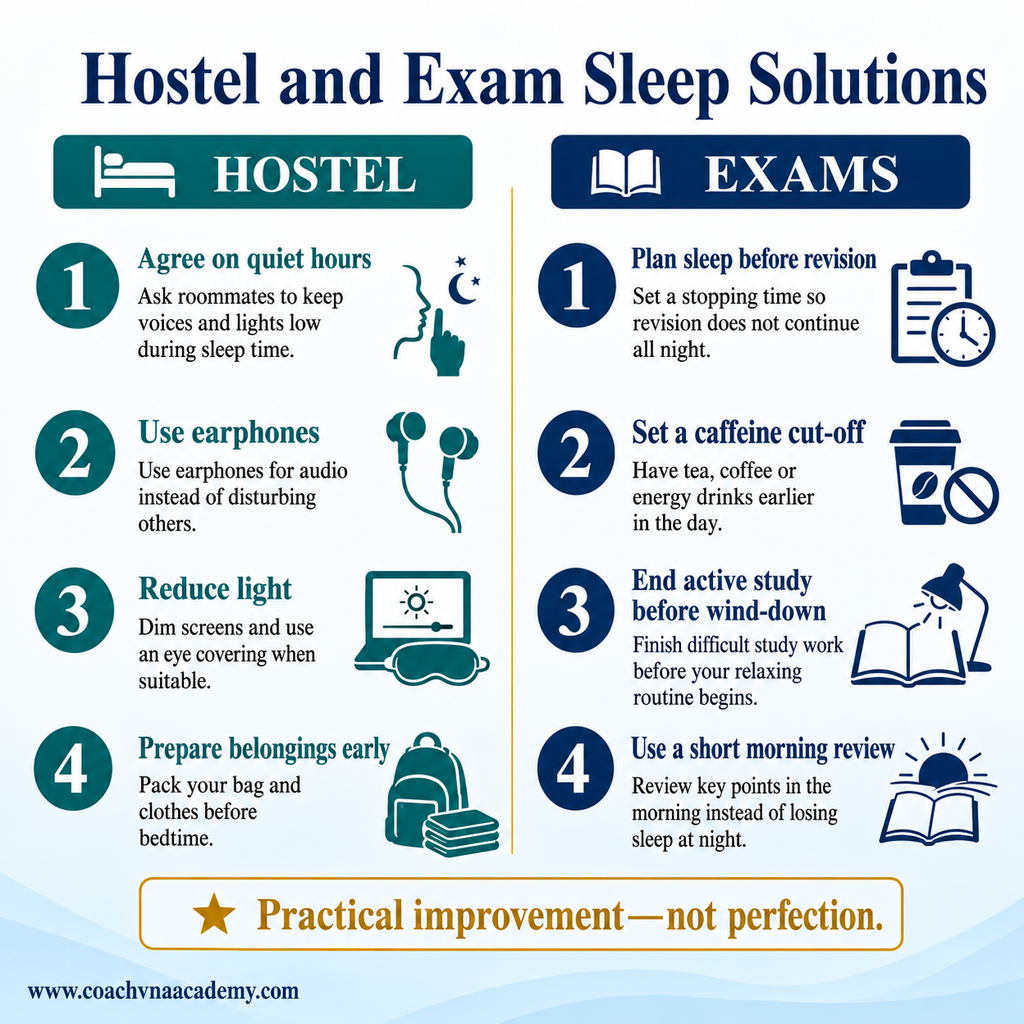
Hostel and Exam Sleep Solutions
Hostel life can make regular sleep difficult because students share rooms, follow different study schedules and manage noise, lights and visitors. A student who wants to sleep at 10:30 p.m. may share a room with someone who studies or watches videos until midnight. A respectful conversation about quiet hours can help. Roommates can agree to lower voices, reduce bright lights and use earphones during the agreed sleep period.
Small preparations also reduce late-night disturbance. Students can pack the college bag, arrange clothes, fill the water bottle and keep books ready before bedtime. If the room cannot become completely quiet, dimming screens, using a suitable eye covering and keeping belongings organised may still make sleep easier. These changes do not require expensive products; they require cooperation and a few repeatable habits.
Examination time creates a different challenge. Many students postpone revision and then study through the night with repeated cups of tea, coffee or energy drinks. Instead, plan sleep before revision begins. Set a stopping time, complete the most important topics first and finish difficult study work before the wind-down period. A short morning review can be used for key points instead of losing several hours of night sleep.
Students may also have family responsibilities, long travel or household work. Therefore, the plan should be realistic rather than perfect. Explain the examination schedule to family members, protect one basic sleep period and return to the usual routine after a difficult night. The aim is practical improvement—not perfection.
Case Study 1: A Hostel Room with Different Habits
| FICTIONAL / COMPOSITE EDUCATIONAL CASE Arjun comes from a middle-income family and lives in a hostel for the first time. His roommate studies until midnight with the main light on. Another roommate watches reels and talks to friends. Arjun has an 8:00 a.m. class, but he stays quiet because he does not want an argument. |
After a week, Arjun feels tired in class and becomes irritated with his friends. He decides to speak politely after dinner: ‘I have an early class. Can we use earphones after 11 p.m. and keep the main light off after 11:30?’ He also packs his bag before the quiet time and keeps his phone on the desk, away from his pillow.
The room may not become completely silent. Still, a shared rule, a small light and earphones can make sleep easier. Students do not need expensive products; they need a respectful conversation and two or three practical changes.
| COACH’S INSIGHT Environmental changes work better when they are specific: ‘Can we use earphones after 11 p.m.?’ is more actionable than ‘You always disturb my sleep.’ |
Case Study 2: A Days-Scholar Managing Family Responsibilities
| FICTIONAL / COMPOSITE EDUCATIONAL CASE Mehak travels 90 minutes each way to college. At home, she helps her mother with dinner and looks after her younger brother. She starts revision late at night because the house becomes quiet only after everyone sleeps. |
Before examinations, Mehak drinks strong tea at midnight and studies until 2:30 a.m. She then wakes at 5:30 a.m. for the bus. Her family believes she is studying well, but she feels sleepy during lectures and forgets material she revised the previous night.
Mehak explains her problem to her family and asks for one protected study hour after dinner. She studies the most important topics first, stops active study at a planned time and keeps a short morning review for the bus journey. She cannot remove every family duty, but she can share the timetable and protect a basic sleep period.
A PG student or a local student may have a different problem: late meals, neighbours, part-time work or family expectations. The useful question is: ‘What is disturbing my sleep, and which small change can I discuss or test this week?’
Myth Versus Fact
| Myth | Fact |
| I can train myself to need very little sleep. | Most adults need at least seven hours regularly; feeling accustomed to short sleep does not prove that performance is unaffected. |
| One long weekend sleep completely repairs the week. | Extra sleep may reduce some tiredness, but it does not make repeated weekday sleep loss a healthy routine. |
| If I cannot sleep, I should stay in bed and force it. | Trying harder can increase frustration. A calm, low-light activity outside bed may help until sleepiness returns. |
| Scrolling relaxes everyone before bed. | Some content feels relaxing, but light, novelty and emotional stimulation can delay sleep for many people. |
| A perfect routine must begin in one night. | Small repeatable changes—especially a stable wake time and a wind-down cue—are more sustainable. |
Different Student Lives, Different Sleep Problems
A good routine must fit the student’s real home. The same advice will not look identical for everyone.
| Student situation | Simple explanation |
|---|---|
| Hostel student | Talk with roommates and decide a quiet time. After that time, use earphones, lower the light and keep books ready before going to bed. |
| PG student | Discuss suitable timings for lights, visitors and kitchen use with the owner or roommates. This can reduce disturbance at night. |
| Days scholar | Tell your family when you need to study and sleep. Finish small household tasks early so that they do not continue until bedtime. |
| Local student living with family | Keep the phone away from the bed and request one quiet period at night for peaceful sleep. |
| Student with a long commute | Use travel time for light revision or planning. Do not depend on late-night study to complete all your work because this may reduce sleep. |
Common College Barriers and Practical Responses
| Barrier | Try this first |
| Back-to-back classes and late assignments | Define a final study block and write the next action before stopping. |
| Noisy hostel or PG room | Agree on quiet hours; use earphones, an eye covering or safe earplugs. |
| Long commute | Use the return journey to plan tomorrow, not to begin an endless evening task list. |
| Late-night messages | Enable Do Not Disturb and allow calls only from selected emergency contacts. |
| Weekend schedule drift | Keep wake time reasonably close to the weekday pattern; adjust gradually after unavoidable late nights. |
| Worry in bed | Write concerns and the next practical step; use slow breathing or another calm routine. |
Riya’s Realistic Evening Plan
| Time | Cue or action | Purpose |
| 9:45 p.m. | Review tomorrow’s priorities; finish active study | Creates a clear stopping point |
| 10:05 p.m. | Pack bag, fill bottle, arrange clothes | Reduces morning stress |
| 10:20 p.m. | Last useful phone check; activate Do Not Disturb | Limits open-ended scrolling |
| 10:30 p.m. | Dim lights; hygiene; calm reading or breathing | Signals transition toward sleep |
| 11:00 p.m. | Phone parked away from pillow; lights out | Protects sleep opportunity |
| 6:45 a.m. | Wake, open curtains and begin the day | Anchors the daily rhythm |
This is an example, not a universal timetable. Students should adapt the times to class schedules, commuting and individual needs while preserving the sequence.
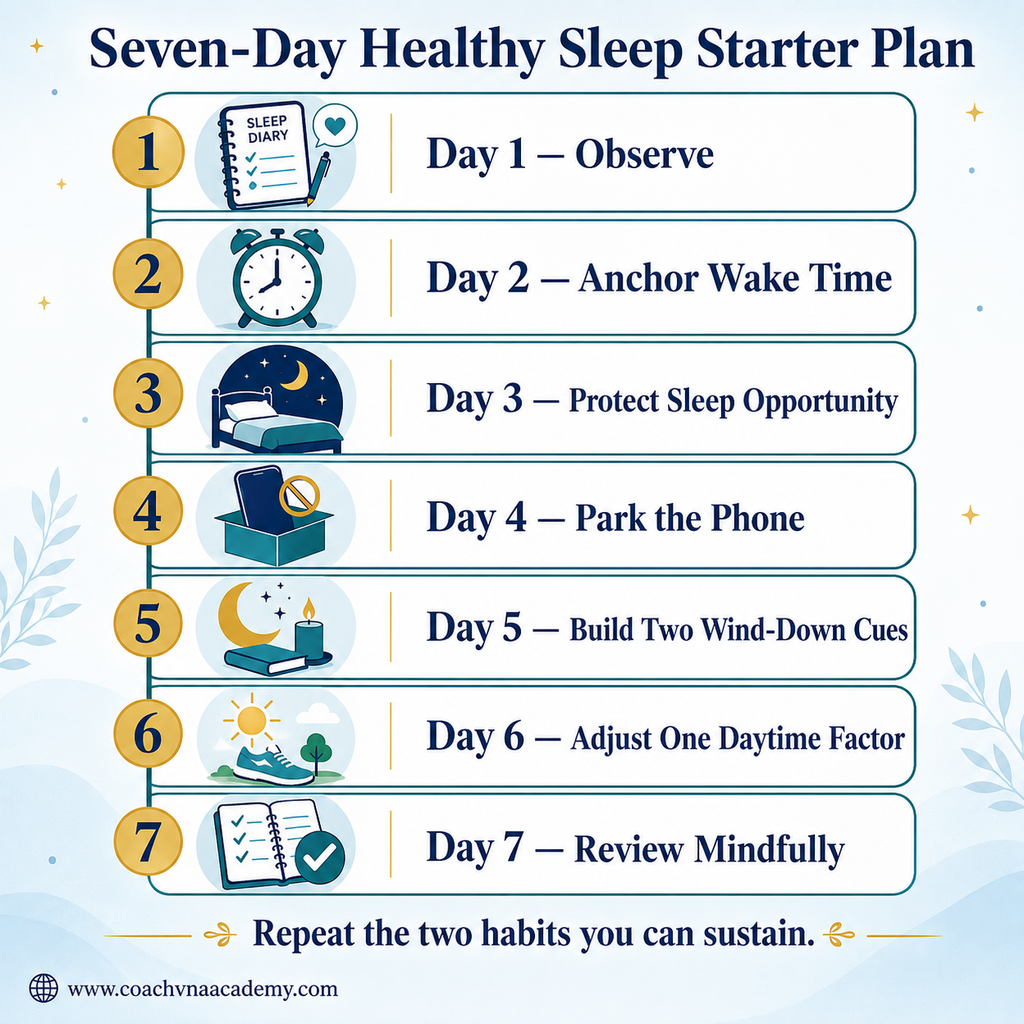
A Seven-Day Healthy Sleep Starter Plan
- Day 1 — Observe: Record bedtime, estimated sleep time, waking time, naps, caffeine and morning energy without judging yourself.
- Day 2 — Anchor: Choose a realistic wake time for most college days and place the alarm away from the pillow.
- Day 3 — Protect: Count backward to create enough opportunity for sleep; block the target wind-down time.
- Day 4 — Park the phone: Select a charging place away from bed and activate Do Not Disturb.
- Day 5 — Build two cues: Repeat two calming actions, such as packing the bag and reading quietly for ten minutes.
- Day 6 — Adjust one daytime factor: Move caffeine earlier, seek daylight, add daytime movement or modify a late nap.
- Day 7 — Review mindfully: Notice what was practical, what interfered and which two habits you can repeat next week.
| MINDFUL PRACTICE Before reaching for the phone at night, pause and ask: ‘What do I need now—information, connection, escape or rest?’ Choose the smallest action that meets the real need. |
What Changed for Riya?
Return to Riya’s opening situation
Riya did not suddenly sleep perfectly. During the first week, she kept one late laboratory night and scrolled longer than planned twice. However, she began parking her phone on the desk, wrote tomorrow’s first task before stopping work and woke at a more consistent time.
By the end of the week, her routine felt less accidental. She still had demanding days, but bedtime was no longer the moment when every unfinished task, message and video competed for attention. Her success was not perfection; it was a pattern she could repeat.
When Should a Student Seek Professional Help?
General sleep habits cannot diagnose or treat a sleep disorder. A student should consider speaking with a qualified healthcare professional when sleep difficulty persists, causes significant daytime impairment or involves concerning symptoms.
- Persistent difficulty falling asleep, staying asleep or waking too early
- Loud snoring, gasping, choking or witnessed pauses in breathing
- Severe daytime sleepiness, unintended sleep episodes or safety concerns
- Restless or uncomfortable sensations in the legs that repeatedly disturb sleep
- Sleep problems occurring with marked anxiety, low mood, substance use or medication concerns
| SAFETY NOTE Do not drive, operate machinery or perform hazardous laboratory work when dangerously sleepy. Seek urgent local help for immediate safety concerns. |
Quick Self-Check
☐ Do I give myself enough time to sleep on most nights?
☐ Is my wake time reasonably consistent?
☐ Do I have a clear end to study and scrolling?
☐ Is caffeine affecting my planned sleep time?
☐ Can I make my room darker, quieter or more comfortable?
☐ Which one habit will I repeat for the next seven days?
Key Takeaways
- Protect adequate sleep opportunity; most adults aged 18–60 are advised to obtain at least seven hours regularly.
- A stable wake time and repeatable wind-down cues are strong starting points.
- Screens, caffeine, naps, stress and the sleep environment should be adjusted one barrier at a time.
- Hostel and examination routines need practical compromises, not guilt or perfection.
- Persistent or dangerous sleepiness deserves professional assessment.
Reflection and Call to Action
| REFLECTION QUESTION Which evening habit most often steals your sleep—and what smaller replacement could you test tonight? |
Choose one action before leaving this page: set tomorrow’s wake time, select a phone-parking place or write a two-step wind-down routine. Repeat it for seven days before deciding whether it works.
Next in the Wellness Education series: Why Students Feel Tired Even After Sleeping.
References
- Centers for Disease Control and Prevention. About Sleep. Updated May 15, 2024. https://www.cdc.gov/sleep/about/index.html
- National Heart, Lung, and Blood Institute. Healthy Sleep Habits. Updated March 24, 2022. https://www.nhlbi.nih.gov/health/sleep-deprivation/healthy-sleep-habits
- National Heart, Lung, and Blood Institute. Insomnia Treatment. Updated March 24, 2022. https://www.nhlbi.nih.gov/health/insomnia/treatment
- Watson NF, Badr MS, Belenky G, et al. Recommended Amount of Sleep for a Healthy Adult: A Joint Consensus Statement of the American Academy of Sleep Medicine and Sleep Research Society. Sleep. 2015;38(6):843–844. doi:10.5665/sleep.4716.
Educational Health Disclaimer
| IMPORTANT This article provides general wellness education and is not medical advice, diagnosis or treatment. Sleep needs and sleep problems vary. Students with persistent symptoms, significant daytime impairment or safety concerns should consult a qualified healthcare professional. |