

Build useful abilities, choose thoughtful learning, and turn your goals into small daily actions.
Aadarsh Knew the Answer but Could Not Say It
It was 9:30 a.m., and Aadarsh was sitting in the third row of his classroom. The teacher asked a question from a topic he had revised the previous class.
He knew the answer. He even formed the first sentence in his mind.
Then the teacher asked, “Who would like to explain it?”
Aadarsh looked down at his notebook. A classmate raised a hand, explained the idea, and answered a follow-up question. Aadarsh listened quietly.
During lunch, he told his friend, “Yaar, answer aata tha. Bol hi nahi paaya.”
That evening, he opened a video about confidence. One video led to another. By 10 p.m., he had saved three useful tips, but he had not practised any of them.
His assignment was complete. His notes were ready. Yet the same thought stayed with him: “I am studying regularly. Why do I still feel unprepared?”
A Small Step Toward Change
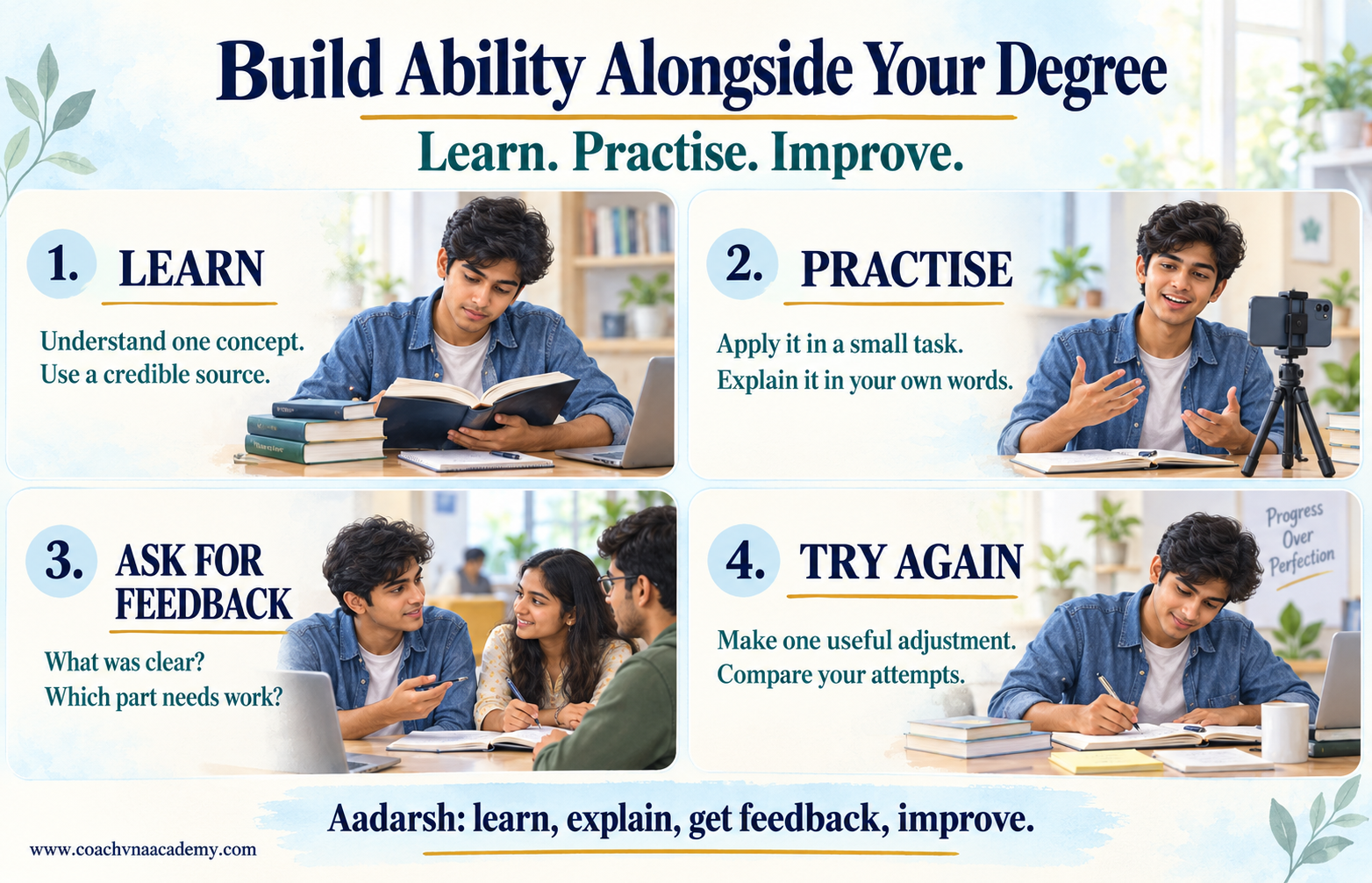
The next morning, he tried something smaller. He explained one topic aloud for two minutes and recorded it. His voice hesitated, he repeated a sentence, and he lost his place. When he listened back, he noticed one clear problem: he was trying to say too much at once.
He shortened the explanation and tried again.
Aadarsh is an illustrative student. His situation shows how self-investment can begin: notice a specific difficulty, learn what might help, and practise a manageable action.
What Does Investing in Yourself Mean
Investing in yourself means using your time, attention, effort, and sometimes money to develop abilities that matter to you.
For a student aged 18–22, this can be ordinary work: preparing a clearer presentation, reading a useful book, tracking expenses, learning a spreadsheet function, asking for feedback, or making room for rest.
You do not need a perfect routine or a complete career plan. You need a starting point that fits your present life.
Ask yourself: “Which ability would help me handle my current responsibilities more capably?”
For Aadarsh, the answer was explaining ideas clearly. Your answer may be organisation, writing, teamwork, digital skills, or understanding a difficult subject.
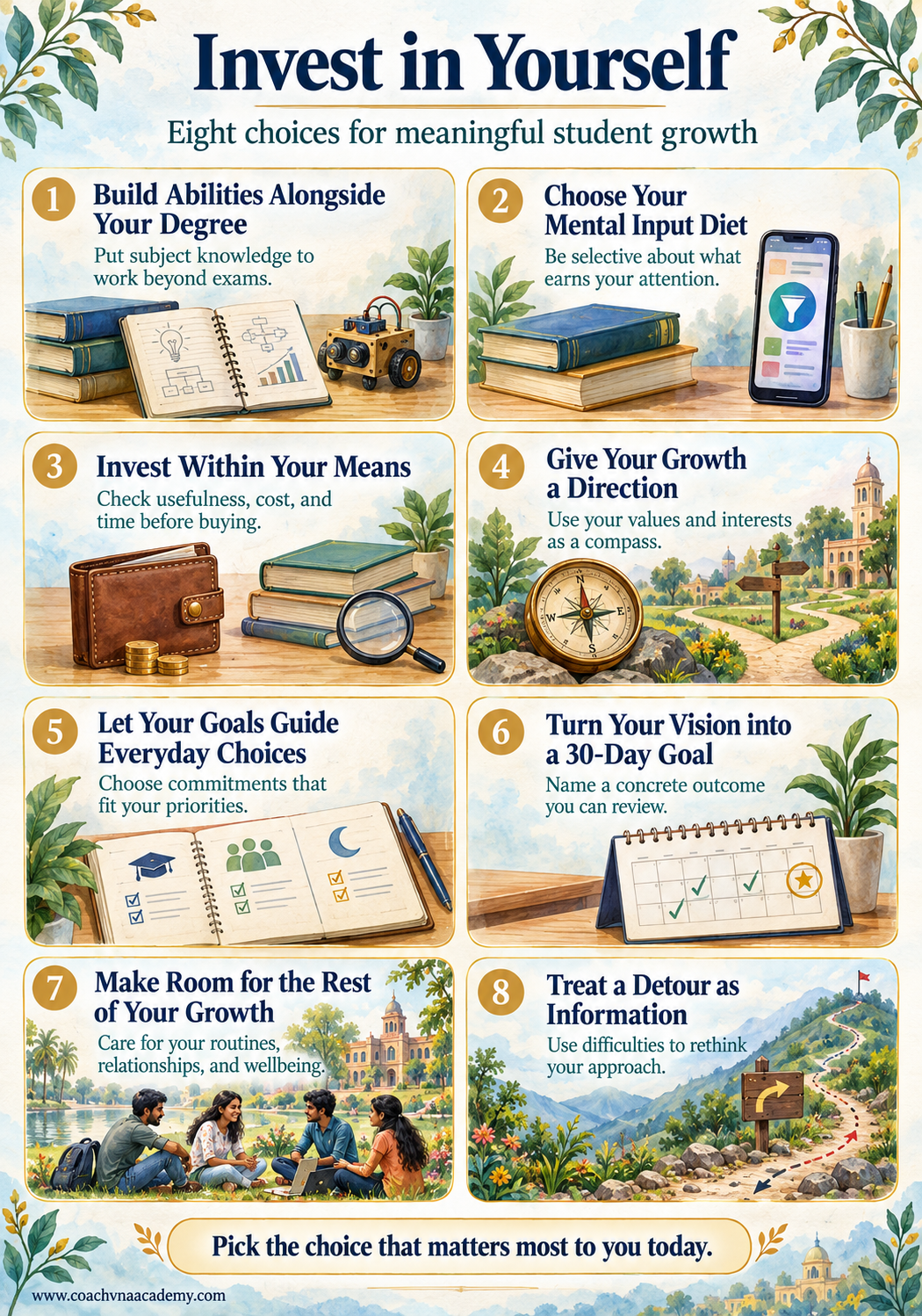
Build Abilities Alongside Your Degree
Formal education gives you subject knowledge, guidance, qualifications, and opportunities. In many professions, qualifications and supervised training are essential.
Alongside your studies, personal development builds on that foundation. Knowing a concept, applying it, and explaining it require different kinds of practice.
Aadarsh could remember the answer in his notebook. Speaking it aloud revealed a gap he had not noticed during revision. He needed practice organising his explanation.
A commerce student can apply classroom spreadsheet learning by creating an expense tracker. A pharmacy student can practise explaining an academic concept clearly and checking the reliability of a source. Professional patient counselling requires appropriate training and supervision; a classroom explanation is a suitable place to begin practising communication.
| What you learn | How you can practise | What to check |
| Subject knowledge | Explain one topic without reading every line | Can someone follow your explanation? |
| Spreadsheet concepts | Create a simple expense tracker | Do the formulas and totals work? |
| Communication principles | Prepare a two-minute presentation | Is your message clear and organised? |
| Teamwork | Complete one agreed task in a group project | Was your contribution accurate and on time? |
A certificate records an achievement. A completed task can show how you use what you learned.
Choose Your Mental Input Diet
Every day, your attention meets lectures, messages, videos, news, conversations, and social media posts.
Entertainment belongs in student life. It is also worth making deliberate space for material that helps you understand something, think carefully, or try a useful approach.
This is your mental “input diet.”
Aadarsh did not need twenty more confidence videos. He chose one short resource about structuring an explanation and tested its advice in his recording.
Try the same approach:
- Choose one relevant book, article, lecture, or conversation.
- Check whether the source is credible and suited to your needs.
- Write one idea in your own words.
- Decide where you will try it.
- Review what happened.
Reading can introduce an idea. Applying it helps you discover whether you understand it.
You do not need to finish a compulsory number of books or subscribe to several journals. Start with material you can access, understand, and use.
Invest Within Your Means
An advertisement may suggest that the next course will transform your life. Before paying, pause.
Ask whether the resource addresses a real need, suits your current level, and fits your budget. Consider whether you have time to use it and whether a free alternative would serve the same purpose.
| Before you buy | Question to ask |
| Relevance | What exact ability will this help me develop? |
| Quality | Are the teaching, examples, and practice opportunities useful? |
| Affordability | Can I pay without disturbing essential expenses? |
| Time | When will I use the resource? |
| Alternatives | Could my library, teacher, or a free resource help me begin? |
Aadarsh started with a phone recorder, his notes, and a friend who could give feedback. His first investment was ten minutes of attention.
There is also a cost to postponing practice. Avoiding every presentation means missing opportunities to learn. Respond with an affordable first step, rather than pressure to purchase something.
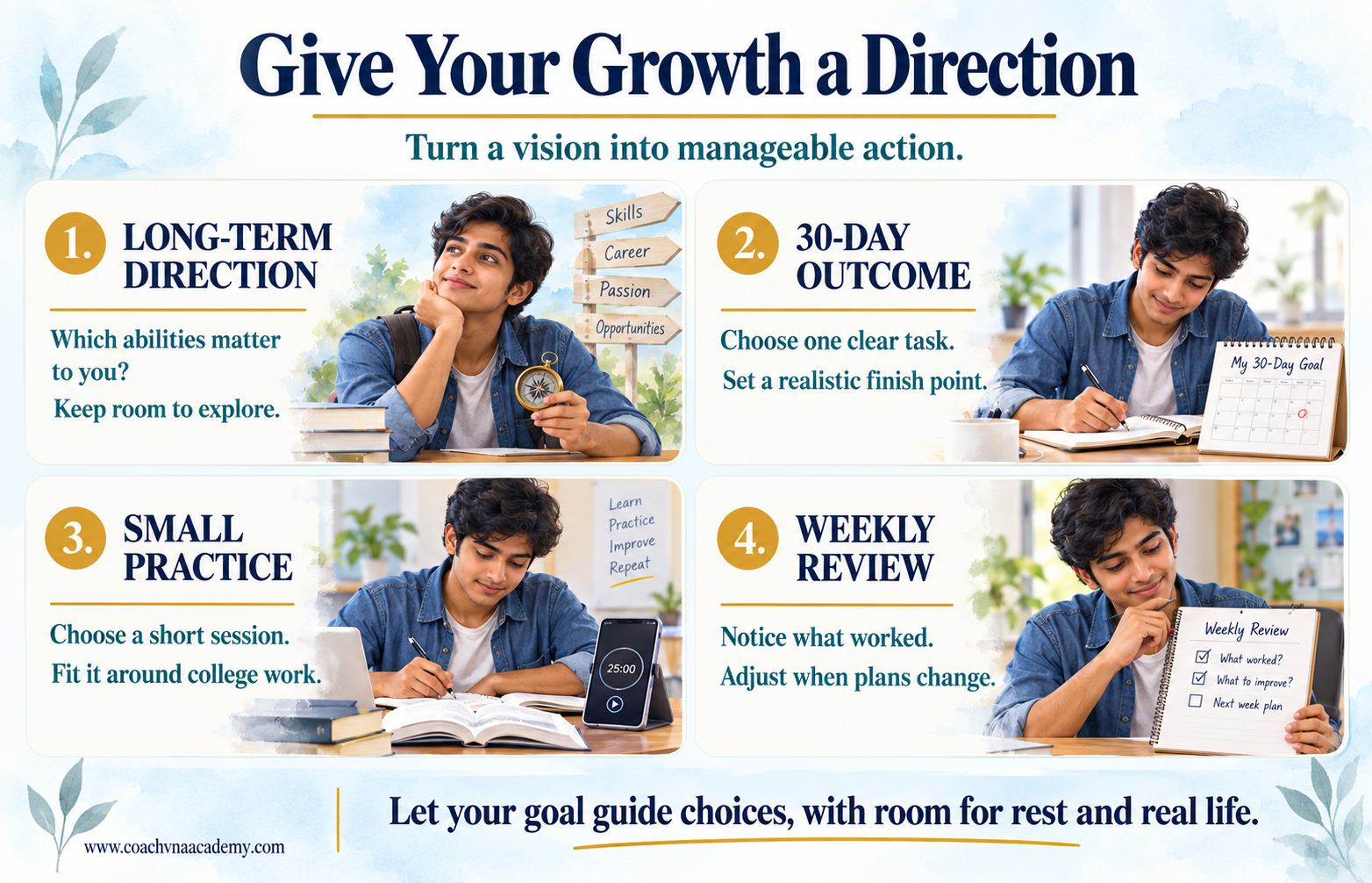
Give Your Growth a Direction
“What do you want to become?” can feel difficult when you are still exploring.
Try asking, “What abilities and qualities would I like to develop over the next five to ten years?”
Think beyond a job title. You may want to become someone who communicates clearly, checks facts carefully, works responsibly, manages everyday decisions, or contributes to a community.
Aadarsh wrote: “I want to become a knowledgeable professional who can explain ideas clearly and work well with others.”
He had not decided his entire future. He had identified a direction worth exploring.
Treat a long-term vision as a compass. Review it when you gain experience, discover new interests, or face changing circumstances.
If you are unsure what to choose, begin by reviewing real experiences. Notice which tasks interest you, what others ask you to help with, and where practice could make a useful difference.
Let Your Goals Guide Everyday Choices
A goal becomes useful when it changes a decision.
If communication is your current priority, you might ask one question in class, explain a topic to a friend, or volunteer for a small part of a presentation.
Before committing your time, ask, “How does this activity fit my current priorities?”
The answer will not always be study or skill practice. Rest, friendship, family responsibilities, and enjoyment also deserve space. Personal growth does not require making every minute productive.
Aadarsh chose a ten-minute practice slot before evening scrolling. He kept his notes ready and silenced notifications for that short session.
Clear goals can guide you. They do not automatically make every decision correct. Keep checking whether your plan fits your workload and circumstances.
Turn Your Vision into a 30-Day Goal
“I want to improve myself” gives you little guidance when you sit down to begin.
A clearer goal names a task, a realistic finish point, and a way to review it.
Aadarsh chose: “Within 30 days, I will prepare and deliver a five-minute explanation to two friends and ask them which parts were unclear.”
| Planning level | Aadarsh’s example |
| Long-term direction | Explain ideas clearly and work confidently with others |
| 30-day outcome | Prepare and deliver a five-minute explanation |
| Small practice action | Explain one idea aloud for ten minutes on four days each week |
| Weekly review | Listen to a recording and ask for specific feedback |
| Evidence of progress | Compare an early attempt with a later one |
Choose one main outcome to begin with. A daily step can be small, and a practice routine does not have to mean practising every single day.
Thirty days gives you a useful review period. It does not promise complete transformation.
Make Room for the Rest of Your Growth
A useful skill deserves attention, but student life includes more than performance.
Your routines, relationships, responsibilities, and use of money affect how you manage everyday life. Choose actions that fit your circumstances.
| Area | A manageable student action |
| Self-awareness | Note one task that interested you and one difficulty you want to understand |
| Health and routines | Make room for meals, rest, and physical activity around your schedule |
| Money habits | Record spending for a week and review optional purchases |
| Relationships | Listen without checking your phone during a conversation |
| Career exploration | Ask a teacher or professional about the everyday work in a field |
| Practical experience | Complete a small project, volunteer, or take a limited role in a college activity |
| Time and attention | Protect a short period for your chosen task |
You do not need to begin all these activities together. Select the one most relevant to your present situation.
Treat a Detour as Information
During Aadarsh’s first week, a practical assignment took longer than expected. He missed two practice sessions.
His first thought was familiar: “Mera routine phir toot gaya.”
Then he looked at the reason. The plan had not allowed enough room for his academic workload. He moved two sessions to the weekend and reduced one session to five minutes.
A missed session can prompt a practical question: “What made the plan difficult, and what can I adjust?”
Sometimes you need smaller tasks. Sometimes you need clearer instructions, a quieter place, feedback, or support.
A disappointing result deserves attention, but it does not describe your whole worth. A detour may require a new route. Occasionally, new information may show that a different goal suits you better.
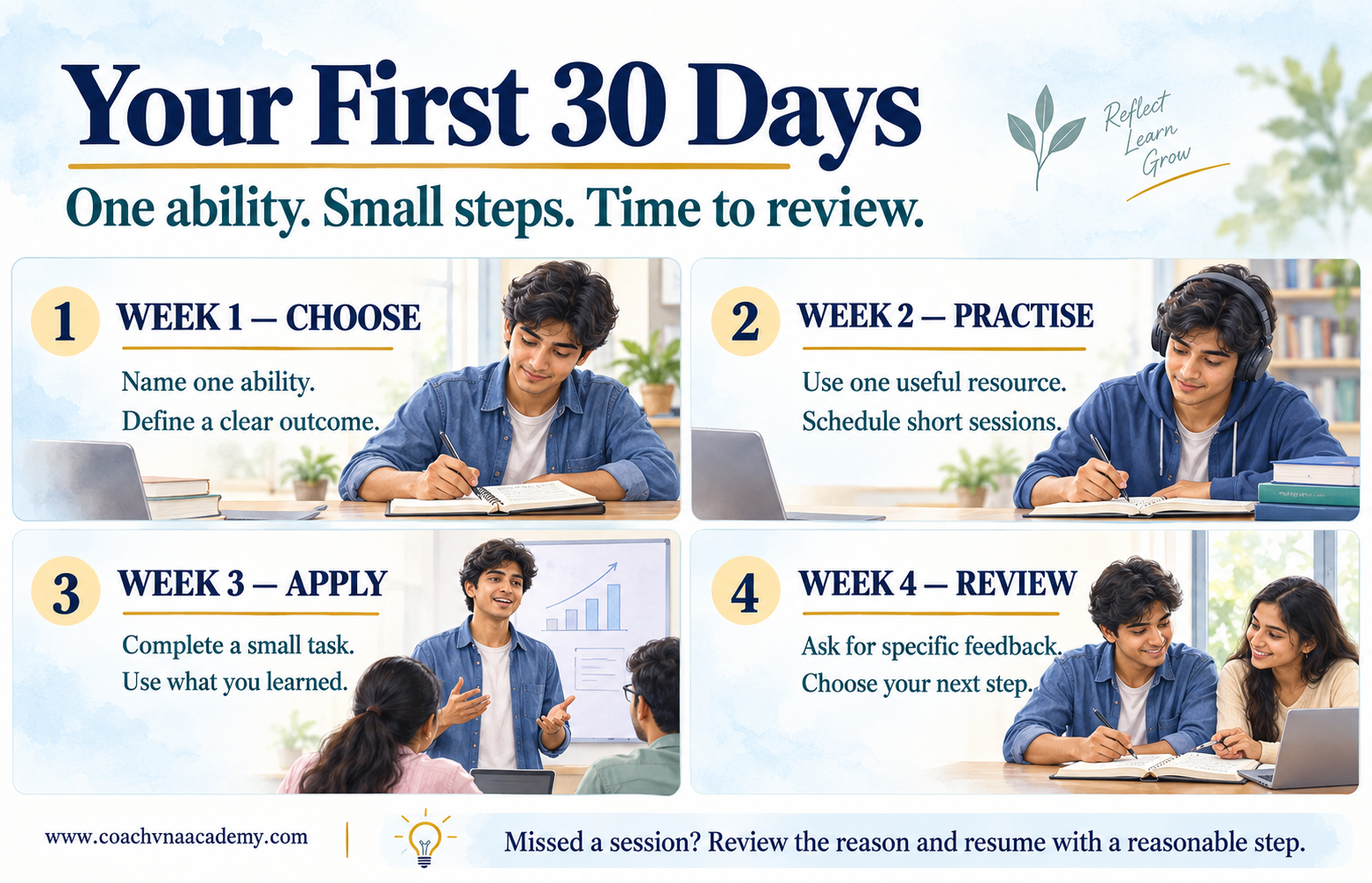
Your First 30 Days
Use this as a flexible starting plan.
| Week | Focus | What to do | What to review |
| Week 1 | Choose a direction | Select one ability and define a manageable outcome | Is the goal clear and realistic? |
| Week 2 | Learn and practise | Use one helpful resource and schedule four short sessions | Which part is difficult? |
| Week 3 | Apply your learning | Complete a small task, project, or presentation | Can you use what you learned? |
| Week 4 | Seek feedback | Ask for one specific observation and compare attempts | What will you continue or change? |
Common Mistakes to Avoid
Collecting resources without using them. Saved videos and unfinished courses do not tell you how your ability is developing. Choose one resource and try one relevant idea.
Trying to change everything together. A long list can become difficult to maintain. Begin with one outcome and add more only when your routine has room.
Comparing your first attempt with someone else’s experience. A confident classmate may have years of practice. Use your own earlier attempt as a useful comparison.
Spending beyond your budget. Self-investment should fit your means. Free resources and feedback can be valuable starting points.
Treating rest as failure. Plan for academic responsibilities and recovery. A workable routine needs space for real life.
Expecting goals to remove every doubt. Uncertainty may remain. Use small experiments, conversations, and review to decide your next step.
A Five-Minute Weekly Self-Check
You can review your effort without turning it into a judgement about yourself.
| Reflection question | Your note |
| What did I actually practise? | Write one task or session |
| What useful idea did I apply? | Describe what you tried |
| What feedback did I receive? | Record one specific observation |
| What made practice difficult? | Note the circumstances |
| What will I change next week? | Choose one reasonable adjustment |
The purpose is to notice what happened and make a better-informed next choice.
Aadarsh One Month Later
At the end of the month, Aadarsh compared his first recording with his latest one.
Although he still paused and felt nervous when someone listened, his newer explanation had a clearer beginning and fewer repeated points. In addition, he included an example that helped his friend understand.
His friend said, “This part is clear now. Slow down a little near the end.”
As a result, Aadarsh knew exactly what to practise next.
He had not become a different person in thirty days. He had built a small routine, completed a task, and learned how to use feedback.
The change was visible in what he could do.
Coach VNA Academy Takeaway
Investing in yourself brings together a willingness to learn, thoughtful inputs, practical action, and review.
Ideas for Your 30-Day Commitment
| Element | What it means in student life |
| Mindset | Be willing to ask questions and learn from feedback |
| Inputs | Choose reliable resources and useful conversations |
| Direction | Identify an ability that matters to your current goal |
| Action | Practise through a small task or project |
| Review | Check progress and adjust the approach |
Choose Your First Step
Your degree remains part of your foundation. Your circumstances, opportunities, and support also influence your journey. Self-investment gives you a practical way to participate in shaping it.
Write one sentence today:
“Over the next 30 days, I will invest in myself by __________.”
Then choose the first small action and decide when you will take it. You can complete the sentence with a small, specific action:
| Focus | Suggested answer |
| Communication | Over the next 30 days, I will invest in myself by explaining one topic aloud for five minutes, four days a week. |
| Confidence | Over the next 30 days, I will invest in myself by asking one question or sharing one idea in class each week. |
| Reading | Over the next 30 days, I will invest in myself by reading for ten minutes a day and trying one useful idea each week. |
| Digital skills | Over the next 30 days, I will invest in myself by learning basic Excel functions and creating a personal expense tracker. |
| Focus | Over the next 30 days, I will invest in myself by keeping my phone away during one 25-minute study session each day. |
| Time management | Over the next 30 days, I will invest in myself by planning three priorities each morning and reviewing them each evening. |
| Career readiness | Over the next 30 days, I will invest in myself by preparing my first résumé and asking a teacher for feedback. |
| Practical experience | Over the next 30 days, I will invest in myself by completing one small project related to my course. |
| Money habits | Over the next 30 days, I will invest in myself by recording my daily spending and reviewing it every Sunday. |
| Self-awareness | Over the next 30 days, I will invest in myself by noting one strength, one difficulty, and one next step each week. |