

Gaurav’s Lesson: Listen Before You Judge
When Gaurav became the leader of his college project group, he wanted everything to be perfect. He divided the work, set deadlines, and created a WhatsApp group.
Everyone submitted their sections on time—except Meera.
At first, Gaurav felt annoyed.
“Everyone is busy. Why can’t she do her part?” he thought.
During the next meeting, he almost criticised her in front of the group. Instead, he decided to speak with her privately.
“Meera, we haven’t received your section. Is something making it difficult?”
She hesitated before answering.
“I understand the topic, but my laptop has stopped working. I’m typing on my phone, and the tables are taking much longer than I expected.”
Gaurav had assumed that everyone had the same facilities he did. He had never asked.
They agreed that Meera would use a college computer during a free period and submit her section the next afternoon. Another teammate offered to help her check the formatting.
Meera completed the work. The group met its deadline.
Gaurav learned something too: before deciding that someone does not care, take a moment to understand what is happening.
That is where empathetic leadership begins.
This story is an illustration of a situation students may face.
What Is Empathetic Leadership?
Empathetic leadership means understanding another person’s situation before deciding how to respond.
For college students, it can be as simple as listening to a teammate, considering a friend’s budget, or helping a classmate ask a question without feeling embarrassed.
You do not need to be a class representative or club president to practise it. Whenever you work with others, your choices can make things easier or harder for them.
A useful question is:
“If I were in their situation, what would I need?”
Then talk to the person. Your first guess may not tell you the whole story.
Everyone Comes to College with a Different Story
Students may sit in the same classroom, attend the same lectures, and receive the same assignments. Their lives outside college can still be very different.
One student may have a quiet room and a laptop at home. Another may share a room and depend on a phone.
One may live near campus. Another may spend two hours travelling each day.
Some students speak confidently. Others need more time to organise their thoughts.
You will not know every detail of someone’s life, and they do not have to share private information with you. But you can leave room for the possibility that their situation is different from yours.
That small change in thinking can improve the way you treat people.
Your Choice May Not Suit Everyone
Imagine your friends are planning a farewell party. You suggest a restaurant that costs ₹1,500 per person.
“That sounds reasonable,” you say.
A few friends agree. Two others stay quiet.
You might assume they are not interested. But perhaps they cannot afford it and feel uncomfortable saying so.
Before finalising the plan, you could ask everyone to share a comfortable budget privately. You might find an option where more people can join.
The same idea applies to project meetings, study materials, college trips, and event timings.
Something that works for you may need adjusting to work for the group.
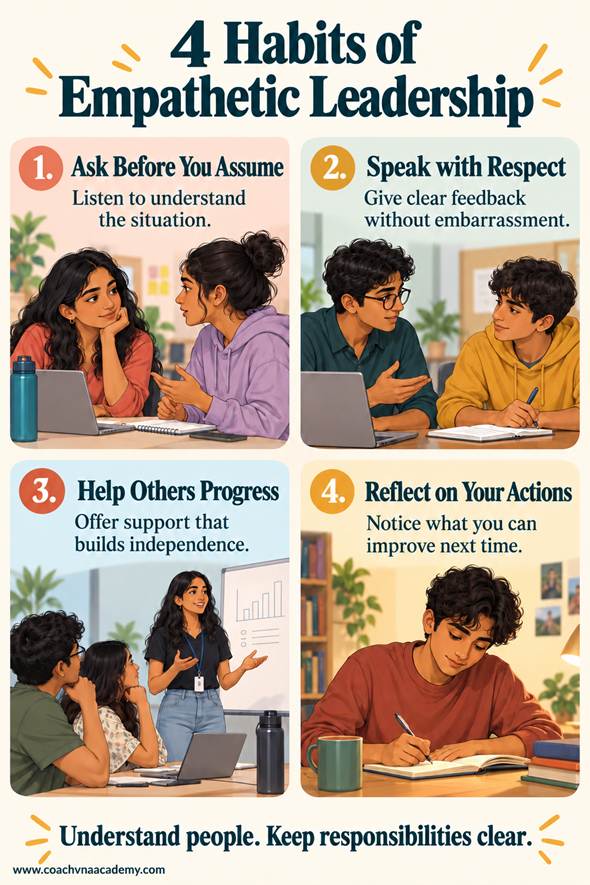
Four Simple Ways to Practise Empathetic Leadership
1. Ask Before You Assume
When someone misses a meeting or leaves work incomplete, it is easy to give them a label.
“They are lazy.”
“They are not serious.”
“They never care.”
Sometimes a person does need to take more responsibility. But first, find out what happened.
You could ask:
“I noticed your part is still pending. What is holding it up?”
Listen, then agree on the next step. Understanding the problem helps you decide what support or action is needed.
2. Speak with Respect
Think about how you feel when someone points out your mistake in front of everyone.
The problem may need attention, but the way it is discussed matters.
Instead of saying:
“You have made the whole presentation wrong.”
Try:
“These slides need a few corrections. Let’s check the information and decide what to change.”
Be clear about the work. Give the person a chance to improve.
When a concern is sensitive, speak privately. A respectful conversation can make it easier for someone to explain a difficulty or accept feedback.
3. Help People Move Forward
Suppose a teammate is nervous about presenting.
You could complain that they lack confidence. Or you could help them practise a short section before the presentation.
Suppose a classmate does not understand a topic.
You could explain one example and then let them try the next one.
Helpful support gives people a chance to learn and take responsibility for their own work.
You can also notice progress:
“Your explanation was much clearer today.”
“The examples you added made this section easier to understand.”
Specific encouragement shows people what they are doing well.
4. Look at Your Own Behaviour
After a group task, ask yourself a few honest questions:
- Did I listen to everyone?
- Did I divide the work fairly?
- Did I check whether the meeting time suited the group?
- Did I give quieter members a chance to contribute?
- Did I handle mistakes respectfully?
You may realise that you interrupted someone or made a decision too quickly.
Use that information. In the next meeting, pause a little longer, ask for another opinion, or check before assigning a task.
Reflection becomes useful when it leads to a small change.
What Does This Look Like in College?
| Situation | A thoughtful response |
| A teammate misses a deadline | Ask what happened and agree on a clear plan to complete the work. |
| A friend cannot afford an outing | Suggest an affordable option without making them feel singled out. |
| A classmate is quiet in discussions | Invite their ideas and allow them time to respond. |
| Someone struggles with a topic | Explain patiently and encourage them to try an example. |
| Your group disagrees | Listen to the different views before choosing a way forward. |
| You are organising an event | Consider students’ budgets, travel, timing, and access needs. |
These are ordinary moments. They are also opportunities to practise leadership.

Empathy Does Not Mean Doing Everything for Others
You can understand someone’s difficulty and still expect them to do their part.
If a teammate repeatedly leaves work unfinished, you might say:
“I understand that you are struggling. We still need your section by Thursday. What can you complete by then?”
If a friend asks you to write their assignment, you can say:
“I can help you understand the question, but you will need to write your own answer.”
Being considerate includes being honest about your limits. Your time and responsibilities matter too.
The aim is to find a fair way forward for everyone involved.
Two Questions to Ask Before You Decide
When your decision affects other people, pause and ask:
“What matters to them in this situation?”
Think about their time, budget, confidence, resources, and responsibilities. Ask them rather than relying only on your assumptions.
“How would this message feel if I received it?”
Read your words once before sending them. Are they clear? Are they respectful? Do they explain what needs to happen next?
These questions can help with a WhatsApp message, a difficult conversation, or a group decision.
What Should We Learn from Gaurav’s Story?
Gaurav began by looking at an unfinished task. Once he spoke to Meera, he understood the difficulty behind it.
He still kept the deadline clear. He also helped the group find a practical solution.
The learning is something we can use every day:
- Ask before judging. A short conversation may reveal something you have missed.
- Consider different circumstances. Others may not have the same time, money, or facilities as you.
- Offer useful support. Help people complete their responsibilities and develop their abilities.
- Keep expectations clear. Understanding and accountability can work together.
- Learn from your own actions. Notice what you could handle better next time.
During your next group assignment, outing, or disagreement, take a moment to understand the people involved.Learning to lead begins with learning to listen.
Frequently Asked Questions
Can I be a leader without holding a college position?
Yes. You show leadership when you take responsibility, help a group work fairly, listen to others, and follow through on your commitments.
Does empathy mean agreeing with everyone?
No. You can understand someone’s point of view and still disagree. Explain your concerns calmly and discuss what would be fair.
How can I become more empathetic?
Start by listening without interrupting. Ask a question before making a judgement, and check whether your assumptions match the person’s situation.
What if someone takes advantage of my help?
Set a clear boundary. Explain what help you can offer and what they need to do themselves.
How can this help me after college?
You will continue working with people who have different experiences and priorities. Practising these habits in college gives you experience in listening, sharing responsibility, giving feedback, and handling disagreements.