Introduction and Definition
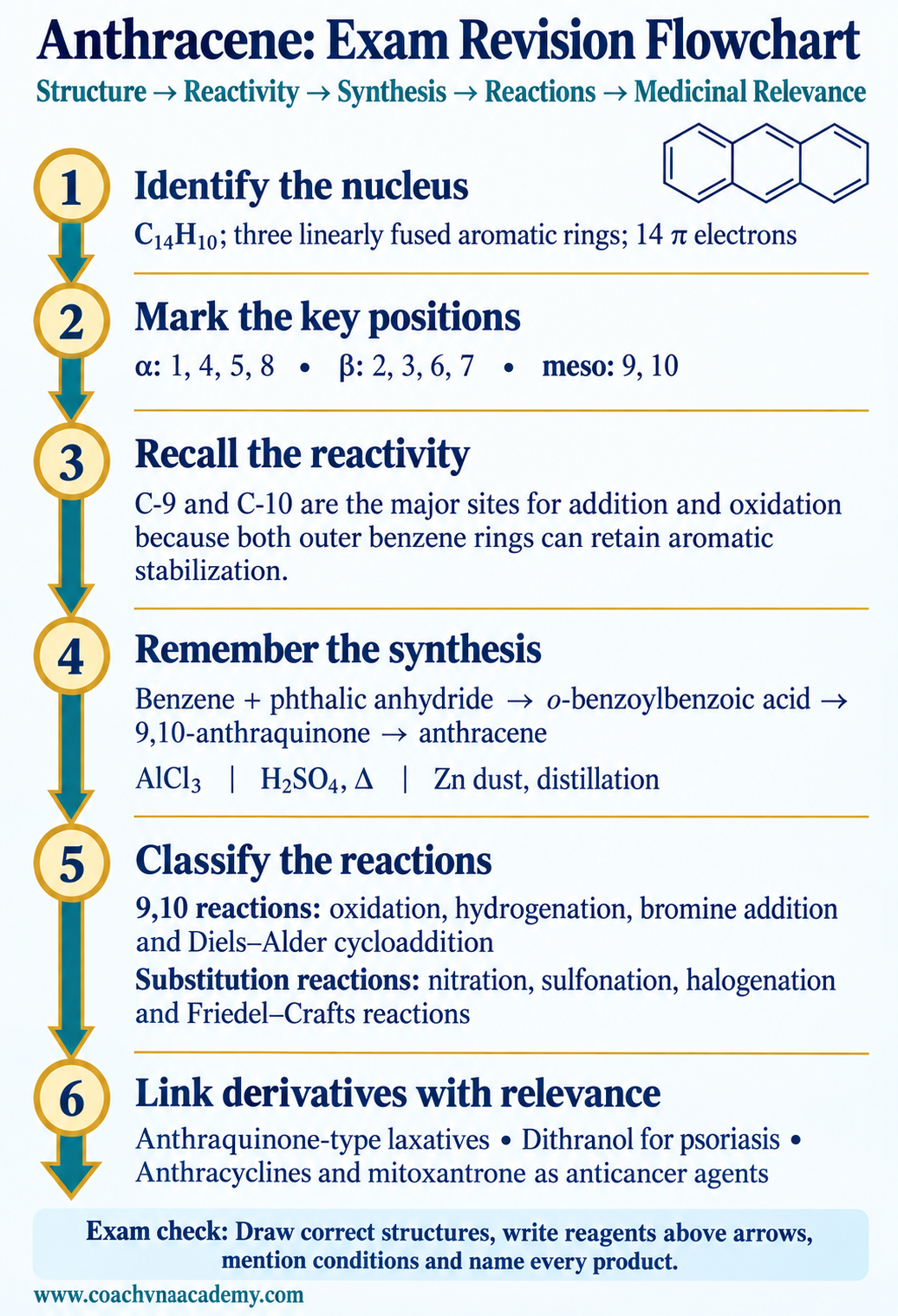
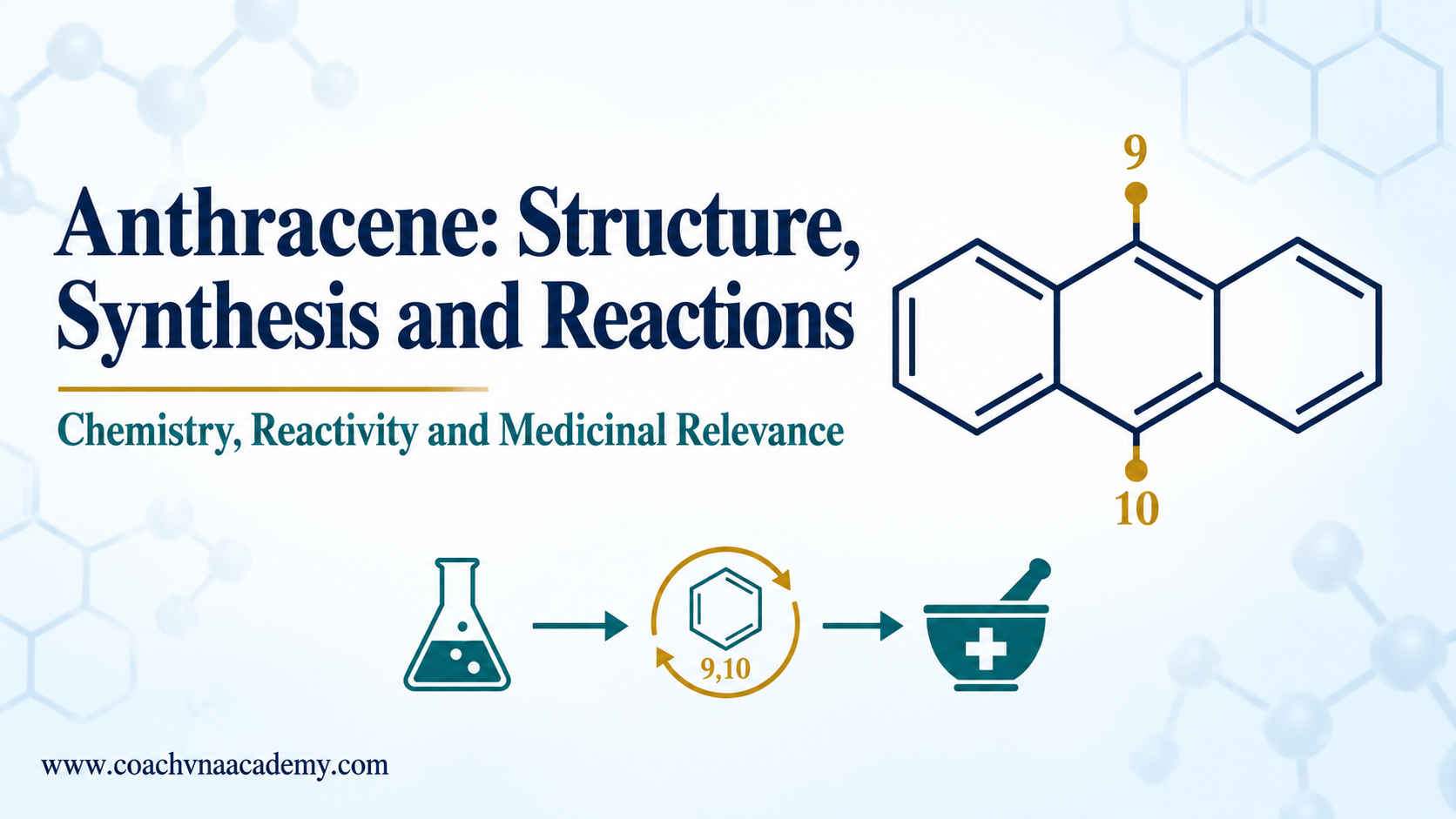
Anthracene is a polynuclear aromatic hydrocarbon composed of three benzene rings fused in a straight, linear arrangement. Its molecular formula is C14H10. It is an isomer of phenanthrene, but it has an angular arrangement of three fused rings. Anthracene occurs in the high-boiling fraction of coal tar and provides an important starting nucleus for dyes, organic materials, and anthraquinone-related compounds.
Structure of Anthracene
| Feature | Correct statement | Common error to avoid |
| Ring arrangement | Three six-membered rings fused linearly; adjacent rings share one C-C bond. | Do not draw three rings joined by single external bonds. |
| Formula | C₁₄H₁₀ | Do not write C₁₄H₁₂. |
| Hybridization | All 14 carbon atoms are sp²-hybridized in anthracene. | Do not show tetrahedral carbon in the parent molecule. |
| Pi system | Fourteen p orbitals form a continuous conjugated pi system containing 14 pi electrons. | Do not treat each ring as an isolated benzene molecule. |
| Geometry | The parent anthracene skeleton is essentially planar. | Do not draw the middle ring perpendicular to the outer rings. |
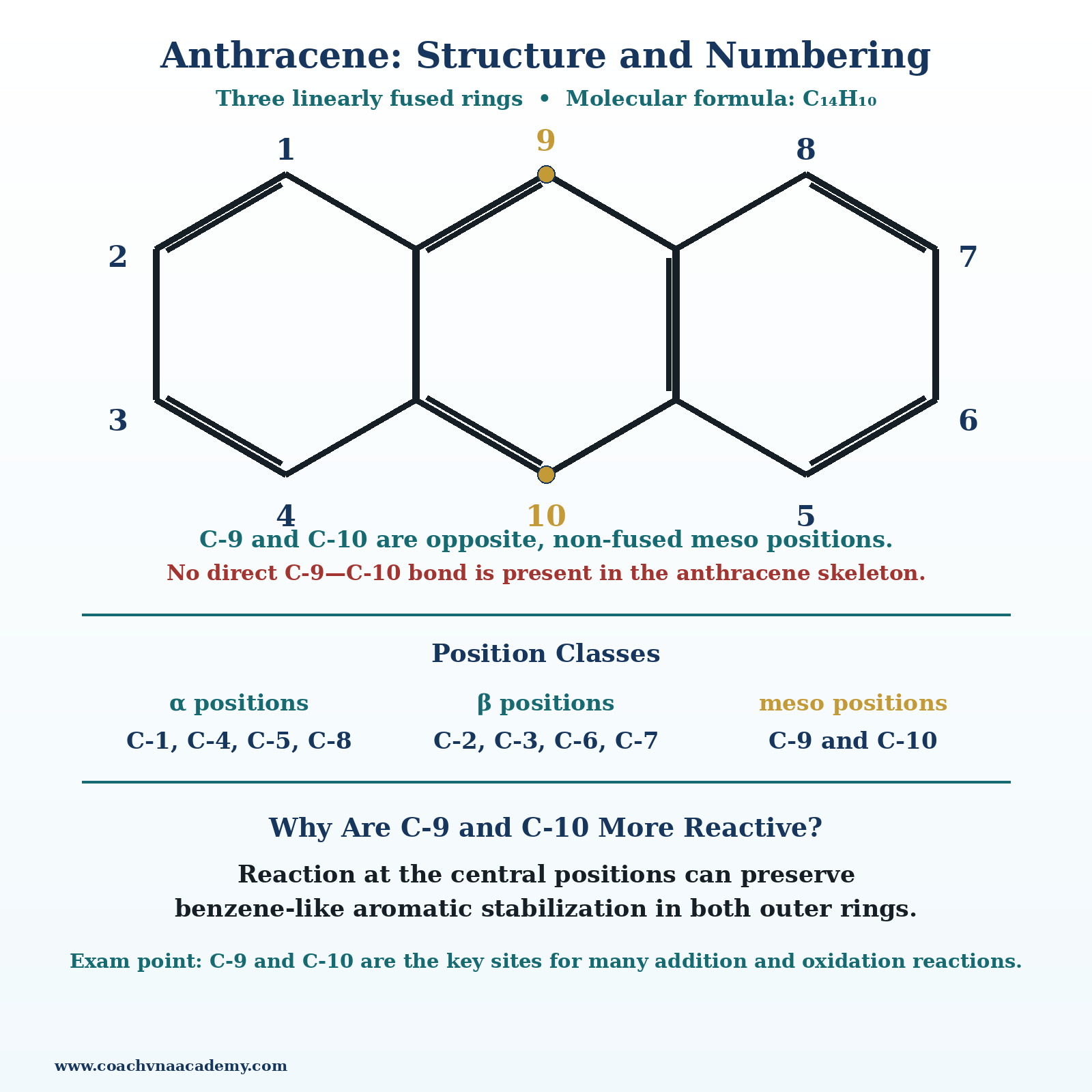
| Key positions | C-9 and C-10 lie in the central ring and are opposite each other. | Do not place 9 and 10 on an outer-ring fusion bond. |
Numbering and Position Classes
First, draw three linearly fused hexagons to represent anthracene. Next, label the upper non-fused carbon of the central ring as C-9 and the lower one as C-10. Then, follow the standard numbering around the outer framework. Positions 1, 4, 5 and 8 are alpha positions, whereas positions 2, 3, 6 and 7 are beta positions. Finally, remember that C-9 and C-10 are commonly called the meso positions.
| NUMBERING CHECKPOINT |
| C-9 and C-10 are the two central-ring carbons that carry hydrogen in anthracene. They are not the four ring-junction carbons shared with the outer rings. |
Aromaticity and Resonance
Anthracene has a planar, conjugated framework containing 14 π electrons. Thus, its electron count matches the Hückel expression 4n + 2 when n = 3. However, these electrons extend across the fused framework rather than forming three independent benzene sextets. Moreover, resonance contributors show different arrangements of π bonds, whereas the actual molecule is a resonance hybrid.
Why the 9,10 Positions Are Especially Reactive
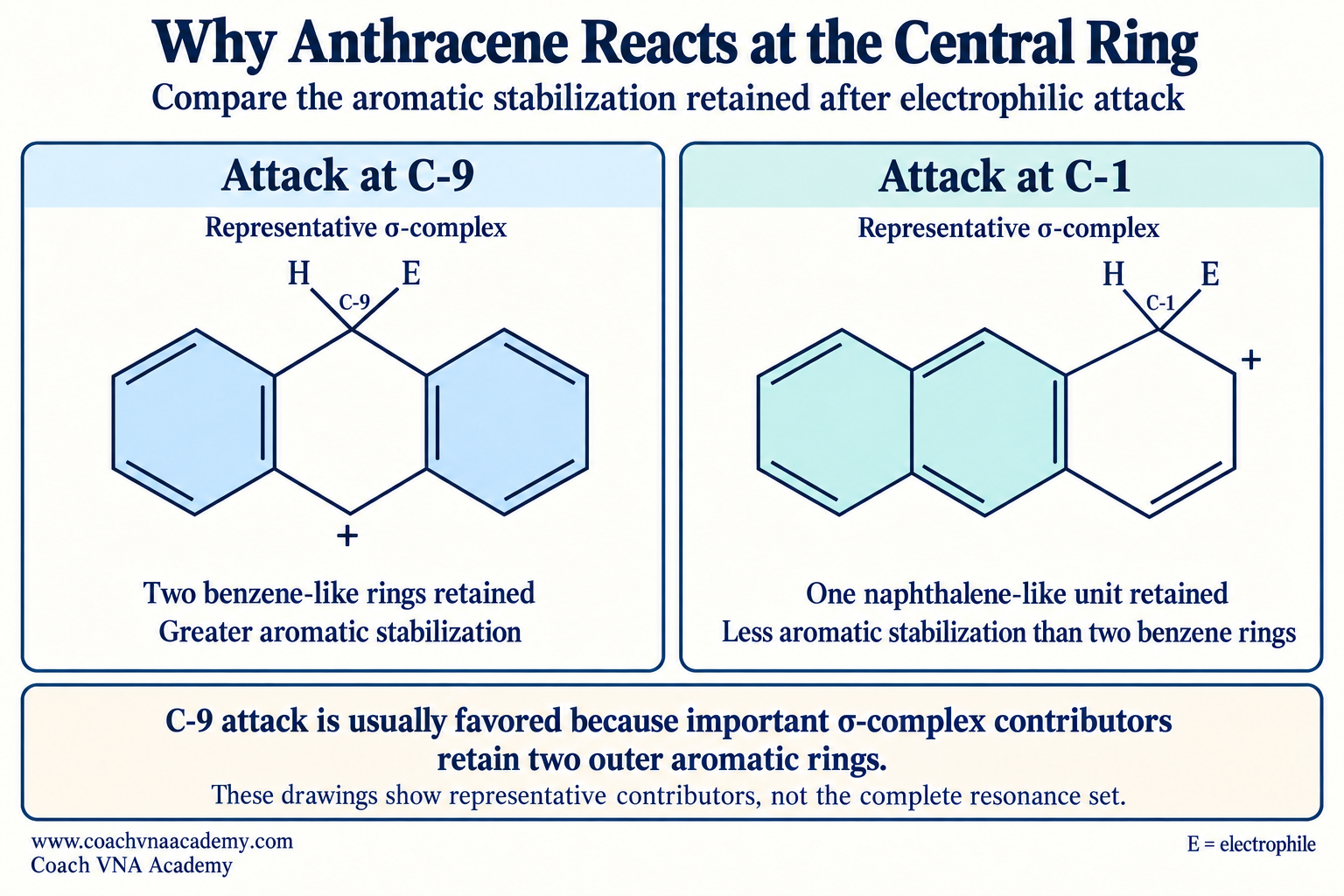
Electrophilic attack at C-9 can produce an intermediate whose important resonance contributors retain two outer benzene-like aromatic rings. Therefore, this pathway preserves substantial aromatic stabilization. Similarly, addition across C-9 and C-10 can preserve the aromaticity of both outer rings. Consequently, many anthracene reactions involve these central positions. In addition, oxidation readily converts C-9 and C-10 into carbonyl groups, producing anthracene-9,10-dione, commonly called anthraquinone.
| SCIENTIFIC QUALIFICATION |
| Say “reaction at 9,10 retains aromatic stabilization in the two outer rings.” Do not say “only the outer rings are aromatic” or “the central ring has no aromatic character” in the parent anthracene molecule. |
Physical Properties and Occurrence
- Anthracene forms colorless to pale-yellow crystalline plates. However, impurities may give commercial samples a stronger yellow appearance.
- Although anthracene is practically insoluble in water, it dissolves in several organic solvents, especially on heating.
- In addition, it sublimes and shows blue fluorescence under ultraviolet light.
- Traditionally, manufacturers obtain anthracene from coal tar. They first separate it from anthracene oil and then purify it.
Synthesis of Anthracene
Haworth-Type Synthesis from Benzene and Phthalic Anhydride
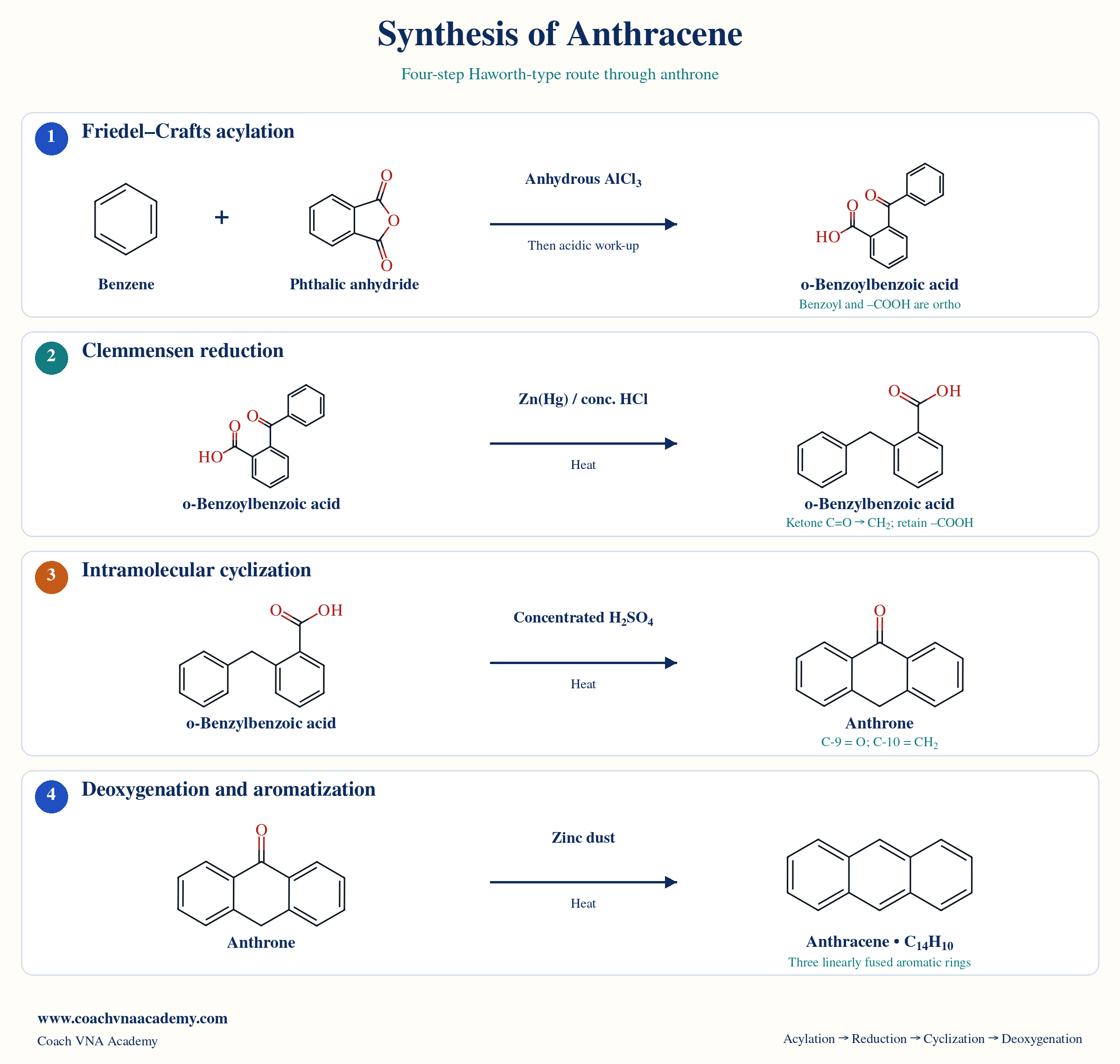
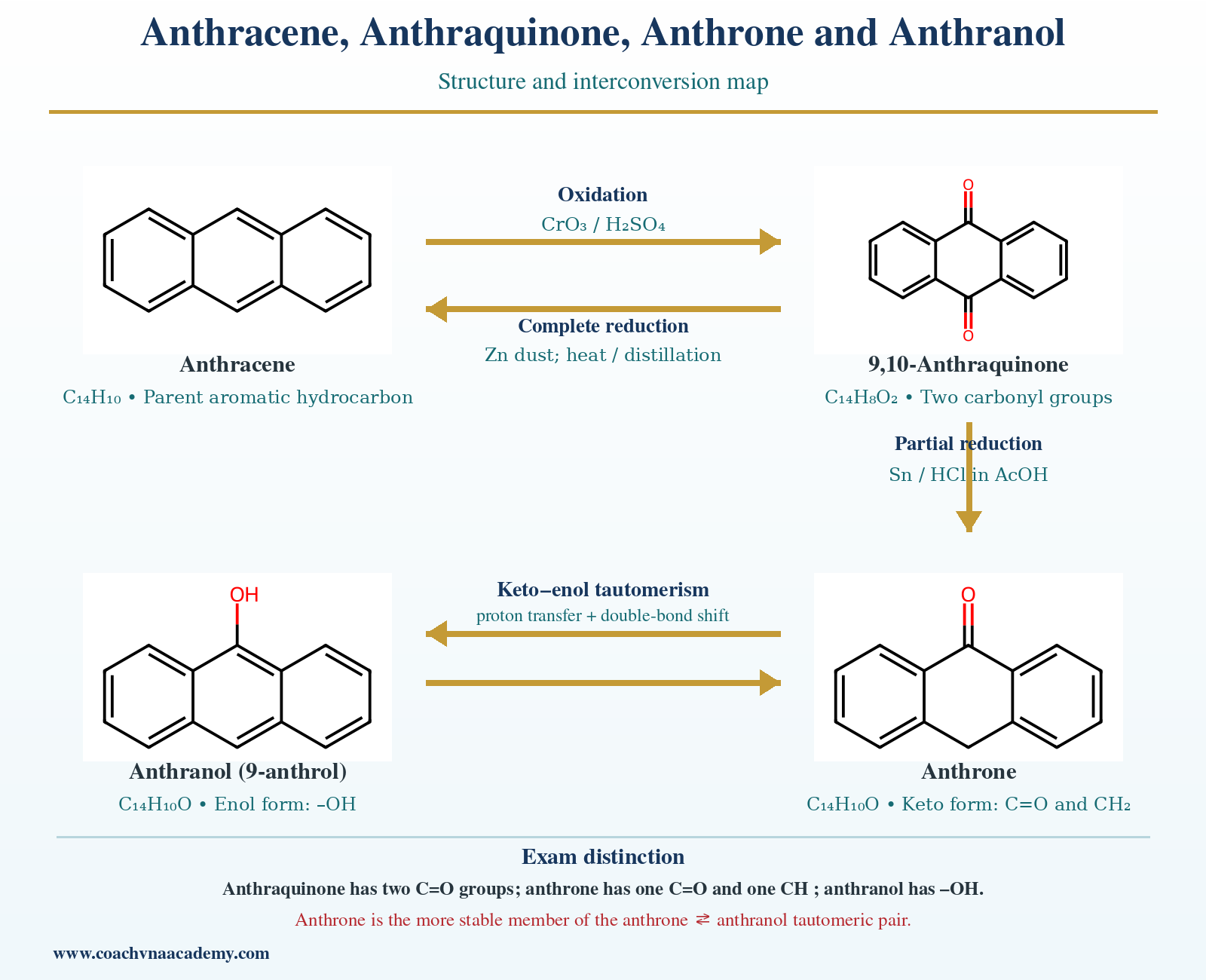
This multistep synthesis provides a useful framework for a long-answer examination question. First, Friedel–Crafts acylation produces o-benzoylbenzoic acid. Next, Clemmensen reduction converts its ketone group into CH₂ while retaining the carboxyl group. Subsequently, intramolecular cyclization forms anthrone. Finally, heating anthrone with zinc dust removes oxygen and produces anthracene. Thus, the sequence connects carbon-skeleton construction, reduction, ring closure and deoxygenation.
| Step | Transformation | Reagent/condition | Product and structural checkpoint |
| 1. Friedel-Crafts acylation | Benzene + phthalic anhydride | Anhydrous AlCl₃; then acidic work-up | o-Benzoylbenzoic acid (2-benzoylbenzoic acid). The benzoyl and carboxyl groups must be ortho on the same ring. |
| 2. Carbonyl reduction | Reduce only the benzoyl C=O to -CH₂- | Zn(Hg)/concentrated HCl (Clemmensen reduction) | o-Benzylbenzoic acid. Retain the -COOH group. |
| 3. Intramolecular cyclization | Close the third ring by acylation | Concentrated H₂SO₄; heat | Anthrone (anthracen-9(10H)-one). Show one carbonyl at C-9 and CH₂ at C-10. |
| 4. Deoxygenation | Remove the anthrone oxygen and restore the aromatic system | Zn dust; heat/distillation | Anthracene, C₁₄H₁₀. |
Overall sequence
| Benzene + phthalic anhydride → o-benzoylbenzoic acid → o-benzylbenzoic acid → anthrone → anthracene |
| Conditions: 1. AlCl₃; 2. Zn(Hg)/HCl; 3. concentrated H₂SO₄, heat; 4. Zn dust, heat |
| Exam point: Never omit the o-benzylbenzoic acid stage or change anthrone into anthraquinone in this sequence. |
Reduction of Anthraquinone
Anthraquinone can be reduced/deoxygenated to anthracene by heating with zinc dust. This route is short and frequently asked as a named conversion.
Anthraquinone to anthracene
| Anthracene-9,10-dione → anthracene |
| Conditions: Zn dust; heat/distillation |
| Exam point: Both carbonyl oxygens are removed and the 9,10 double-bond/aromatic framework is restored. |
Reactions of Anthracene
Oxidation to Anthraquinone
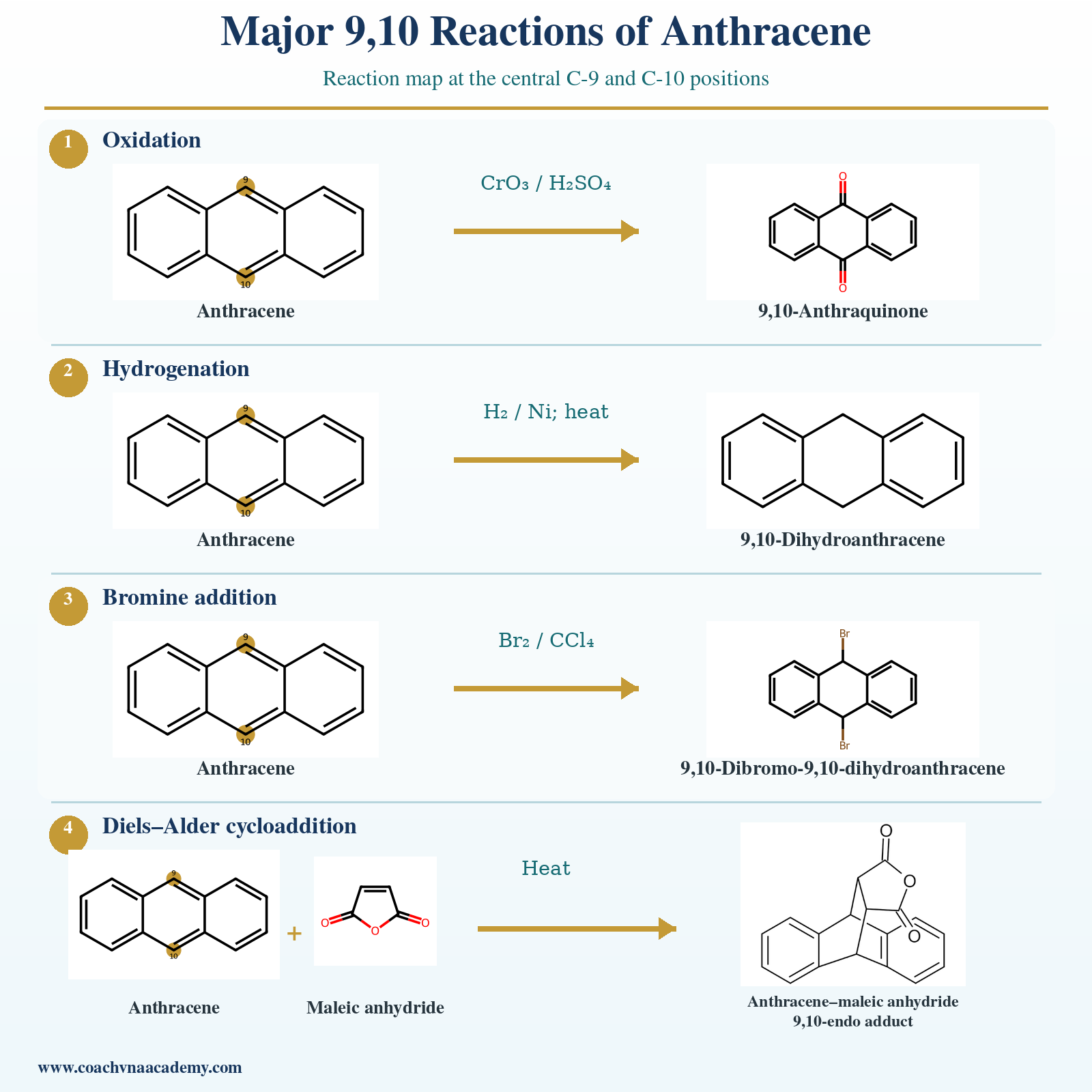
Strong oxidation converts the two meso carbons into carbonyl groups. The product is anthracene-9,10-dione, commonly called anthraquinone.
Oxidation
| Anthracene → anthracene-9,10-dione (anthraquinone) |
| Conditions: CrO₃/H₂SO₄ or Na₂Cr₂O₇/H₂SO₄; heat |
| Exam point: Place one C=O at C-9 and the second C=O at C-10. Keep all three fused rings. |
Catalytic Reduction
Controlled hydrogenation occurs preferentially at the central 9,10 bond and gives 9,10-dihydroanthracene. More vigorous hydrogenation can reduce additional rings, so the stated conditions and required product must be shown.
Hydrogenation
| Anthracene + H₂ → 9,10-dihydroanthracene |
| Conditions: Ni, Pt, or Pd catalyst; controlled conditions |
| Exam point: C-9 and C-10 each become sp³ carbon bearing an additional hydrogen; the two outer benzene rings remain intact. |
Halogen Addition at C-9 and C-10
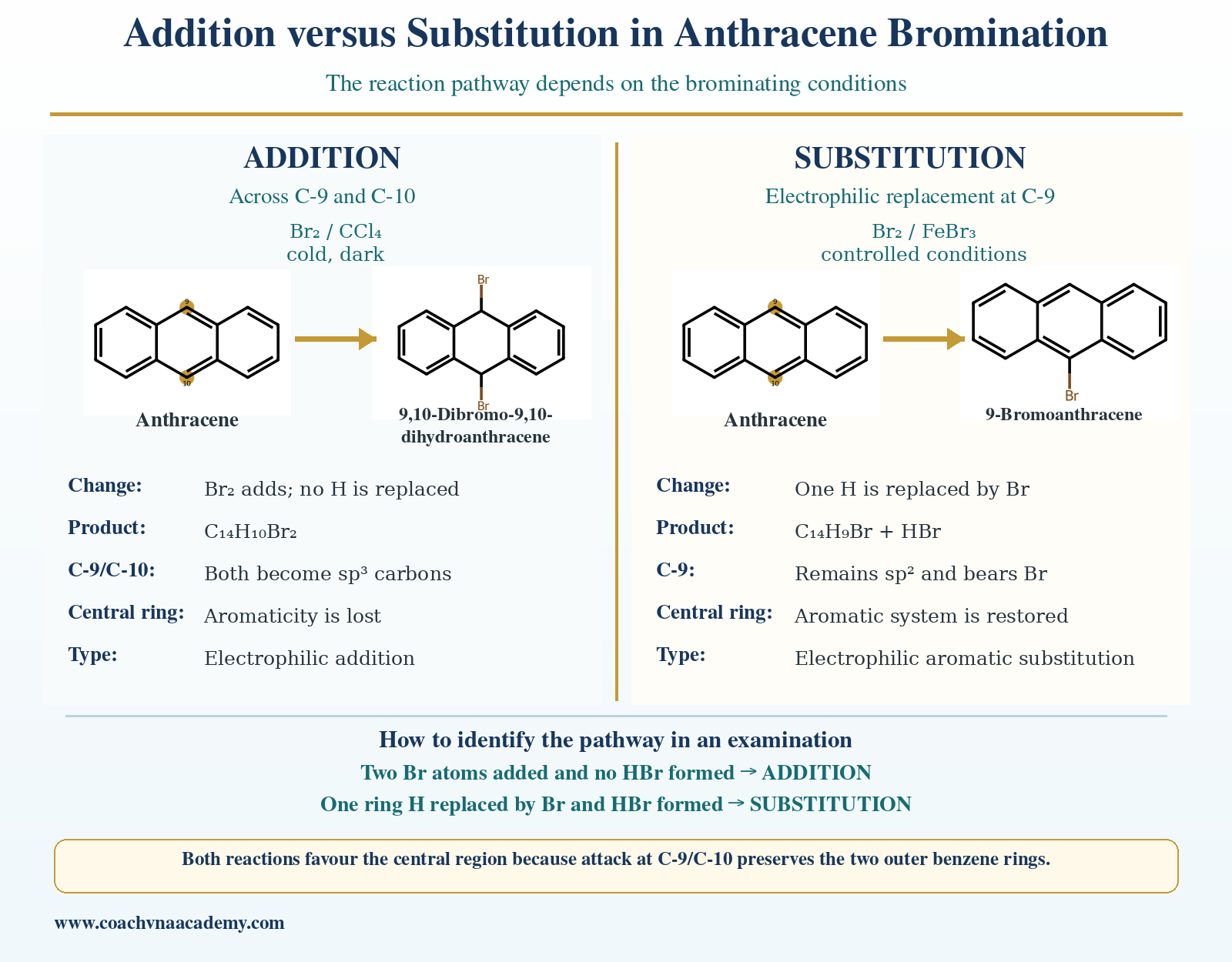
In an inert solvent and without conditions favoring radical substitution, bromine adds rapidly across the 9,10 positions to form 9,10-dibromo-9,10-dihydroanthracene. The reaction decolorizes bromine solution.
Bromine addition
| Anthracene + Br₂ → 9,10-dibromo-9,10-dihydroanthracene |
| Conditions: Br₂ in CCl₄ or another inert solvent; room temperature |
| Exam point: This is an addition product: show Br on C-9 and Br on C-10 and remove the 9,10 pi bond. Do not label it 9-bromoanthracene. |
Electrophilic Substitution
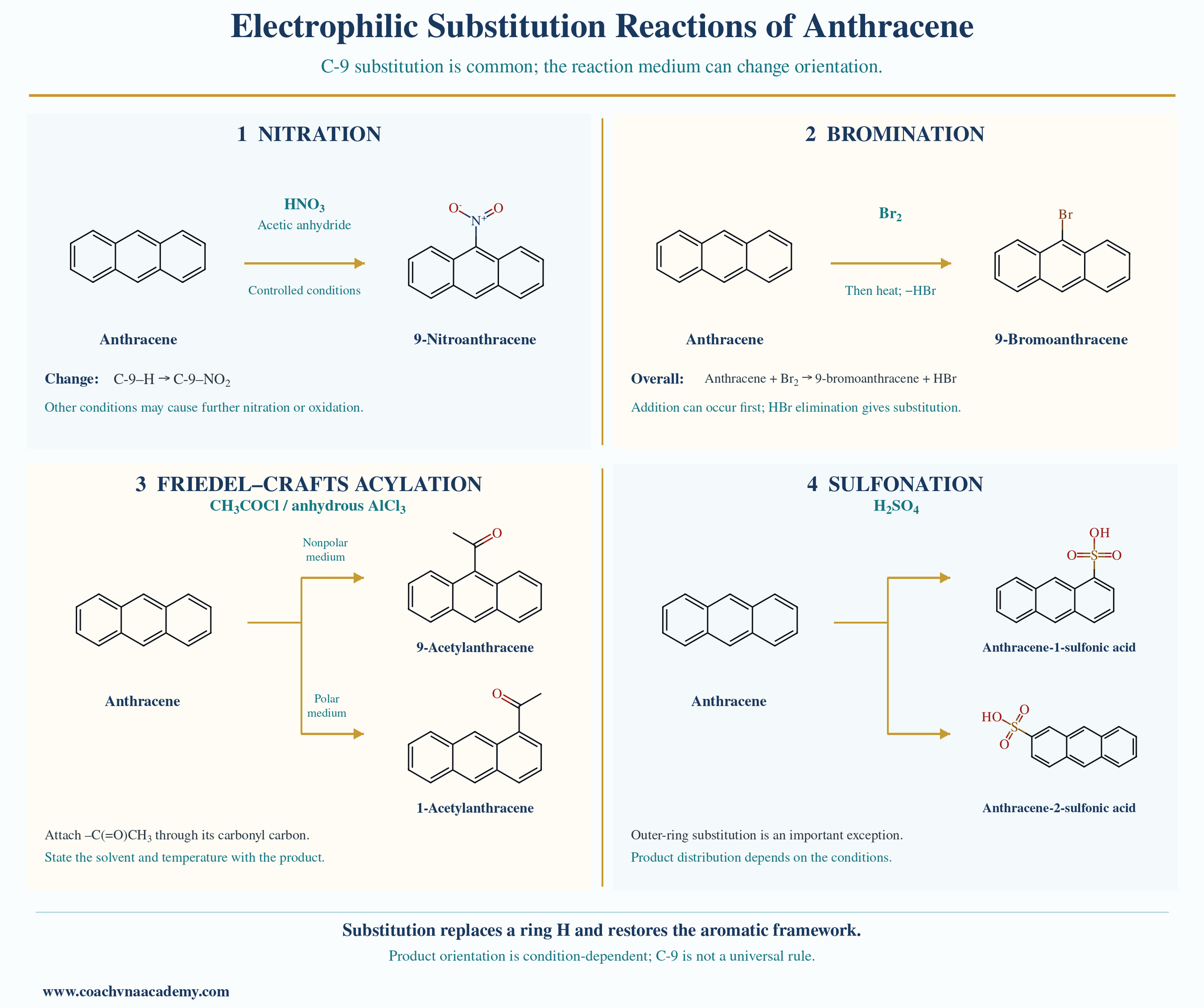
Anthracene undergoes electrophilic substitution more readily than benzene. Under standard textbook conditions, attack is commonly represented at C-9 because the corresponding sigma complex retains benzene-like aromaticity in both outer rings. Reaction conditions matter because addition, oxidation, or mixtures may occur under unsuitable conditions.
| Reaction | Reagent/condition | Main textbook product | Drawing instruction |
| Nitration | HNO₃ in acetic anhydride or carefully controlled nitrating conditions | 9-Nitroanthracene | Attach -NO₂ directly to C-9; do not place it at a fusion carbon. |
| Halogen substitution | Br₂/FeBr₃ under substitution conditions | 9-Bromoanthracene | Show one Br replacing H at C-9 and preserve the anthracene pi system. |
| Friedel-Crafts substitution | Suitable RCl or RCOCl/anhydrous AlCl₃; controlled conditions | 9-substituted anthracene commonly represented | State the exact reagent and product; avoid implying every Friedel-Crafts reaction is clean or equally practical. |
| Sulfonation | Concentrated H₂SO₄; product distribution depends on temperature | Anthracenesulfonic acids | Do not claim one universal isomer without specifying conditions; low-temperature and higher-temperature distributions differ. |
| IMPORTANT DISTINCTION |
| Br₂ in an inert solvent is commonly taught as 9,10-addition. Br₂ with a Lewis-acid catalyst is represented as electrophilic substitution. The infographic must not combine these two products in one unlabeled scheme. |
Diels-Alder Reaction at the 9,10 Positions
The central ring of anthracene can act as the diene component in a [4+2] cycloaddition. Maleic anhydride is a common dienophile. The adduct forms across C-9 and C-10 while the two outer benzene rings remain aromatic. This reaction is an excellent structural proof of the special reactivity of the central ring.
Diels-Alder cycloaddition
| Anthracene + maleic anhydride → 9,10-cycloaddition adduct |
| Conditions: Heat in a suitable solvent |
| Exam point: Draw the bridged adduct explicitly; do not show maleic anhydride merely attached through one bond. |
Photodimerization
Ultraviolet irradiation can join two anthracene molecules through their 9 and 10 positions in a [4+4] photocycloaddition to form dianthracene. Heating or irradiation under suitable shorter-wavelength conditions can reverse the dimerization. The reaction is used to illustrate reversible photochemistry.
Photodimerization
| 2 anthracene ⇌ dianthracene |
| Conditions: Forward: ultraviolet light; reverse: heat or suitable irradiation |
| Exam point: The dimer contains two new C-C bonds: 9-9′ and 10-10′. Do not draw a single-bond-linked dimer. |
Reaction Classification at a Glance
| Reaction type | What changes at C-9/C-10? | Characteristic product |
| Oxidation | Both C-H sites become carbonyl groups. | Anthraquinone |
| Hydrogenation | Hydrogen adds across the central 9,10 bond. | 9,10-Dihydroanthracene |
| Halogen addition | One halogen attaches to each of C-9 and C-10. | 9,10-Dihalo-9,10-dihydroanthracene |
| Electrophilic substitution | One H, usually at C-9 in the simple textbook representation, is replaced. | 9-Substituted anthracene |
| Diels-Alder reaction | A diene segment of the central ring forms two new sigma bonds. | 9,10-Cycloadduct |
| Photodimerization | Two anthracene units form two new bonds through 9,10 sites. | Dianthracene |
Important Derivatives and Medicinal Relevance
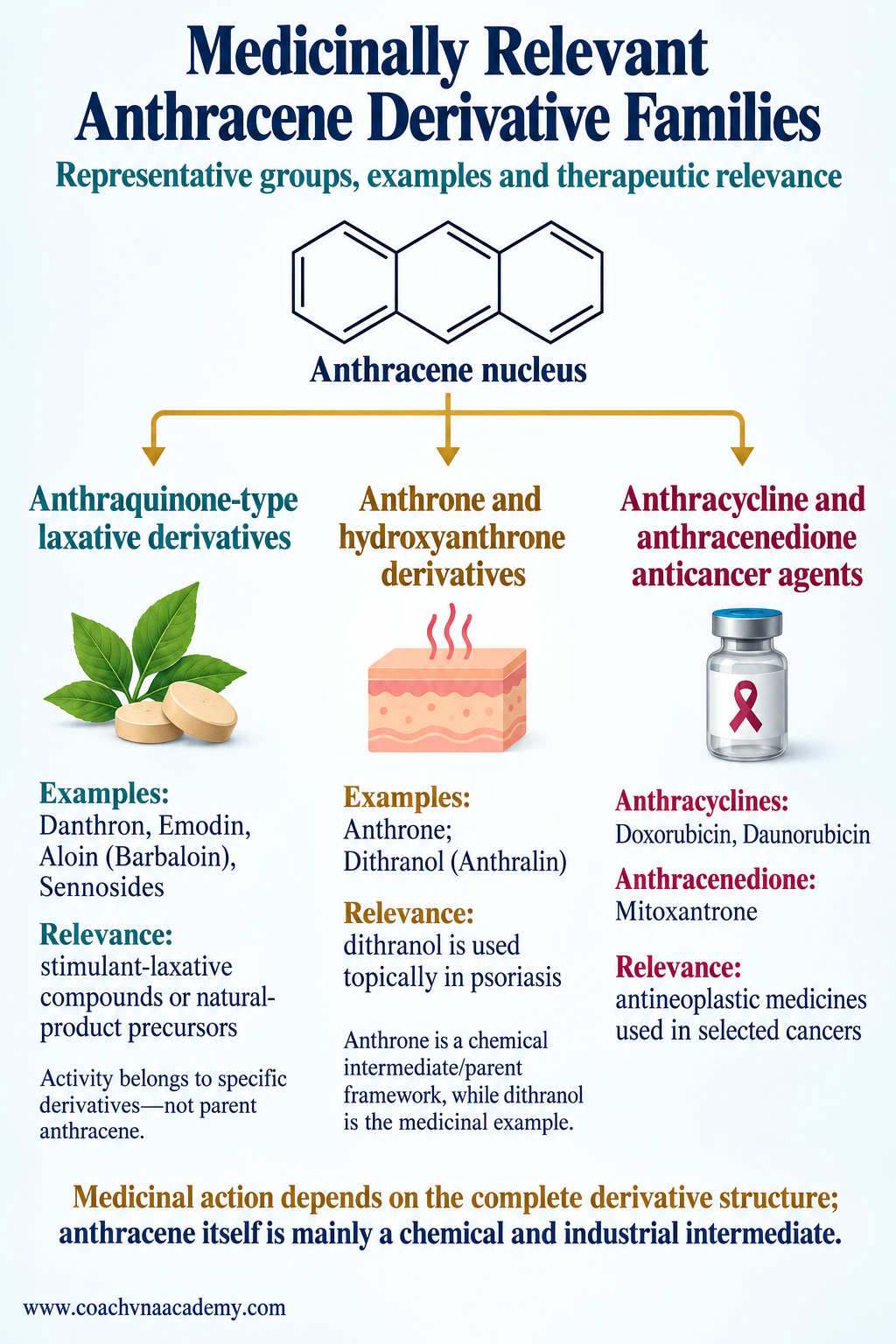
The unsubstituted anthracene hydrocarbon is mainly a chemical intermediate and is not used as a routine medicine. Medicinal importance arises chiefly from oxygenated and substituted anthracene-related nuclei. Uses must be assigned to the correct derivative, not to anthracene itself.
| Derivative / class | Structural identity | Medicinal or pharmaceutical relevance | Safety/accuracy note |
| Anthraquinone | Anthracene-9,10-dione; two C=O groups at C-9 and C-10. | Core scaffold of many dyes and naturally occurring anthraquinone glycosides. | Do not call anthraquinone an anthracene hydrocarbon; it contains oxygen. |
| Anthrone | Anthracen-9(10H)-one; one C=O and one central CH₂. | Synthetic intermediate; anthrone-related compounds occur in medicinal chemistry. | Do not draw two carbonyls. |
| Anthranol | Enol tautomer of anthrone, commonly represented as anthracen-9-ol. | Important for understanding anthrone-anthranol tautomerism. | Show the OH and corresponding double-bond arrangement consistently. |
| Dithranol (anthralin) | 1,8-Dihydroxy-9-anthrone derivative. | Topical antipsoriatic agent used under medical supervision. | It can irritate and stain skin/fabrics; do not describe it as a cosmetic cream. |
| Danthron | 1,8-Dihydroxyanthraquinone. | Historically used as a stimulant laxative; use is restricted/obsolete in many settings. | Do not recommend self-medication or present it as a current first-line drug. |
| Emodin | 1,3,8-Trihydroxy-6-methylanthraquinone. | Natural anthraquinone studied for biological activities; found in several plants. | Research activity does not equal approved clinical indication. |
| Aloin / barbaloin | Anthrone C-glycoside from Aloe species. | Associated with stimulant-laxative action in traditional products. | Safety and regulatory status vary; avoid treatment claims. |
| Sennosides | Dianthrone glycosides obtained from Senna. | Used as stimulant laxatives; intestinal bacteria generate active metabolites. | They are dimers/glycosides, not simple anthracene molecules. |
| Doxorubicin / daunorubicin | Anthracycline antibiotics containing an anthraquinone-like tetracyclic aglycone plus amino sugar. | Important anticancer medicines. | They are not simple anthracene derivatives; state the broader anthracycline relationship. |
| Mitoxantrone | Synthetic anthracenedione derivative. | Antineoplastic medicine used for selected cancers and other approved indications. | Anthracenedione is related to anthraquinone; do not draw parent anthracene as the drug. |
| EXAM-SAFE USE STATEMENT |
| Anthracene itself mainly serves as an industrial and synthetic intermediate. Medicinal importance is associated with derivatives such as anthraquinone glycosides, dithranol, anthracyclines, and anthracenediones. Always write the use beside the correct derivative. |
Anthracene versus Phenanthrene
| Point | Anthracene | Phenanthrene |
| Arrangement | Three rings fused linearly. | Three rings fused angularly. |
| Formula | C₁₄H₁₀ | C₁₄H₁₀ |
| Characteristic reactive region | C-9/C-10 of central ring. | C-9/C-10 region is also important, but the framework and reaction details differ. |
| Relative stability | Less resonance-stabilized than phenanthrene. | More resonance-stabilized than anthracene. |
| Common oxidation product | Anthraquinone (9,10-dione). | Phenanthrene-9,10-quinone under suitable oxidation conditions. |