

A frightened child, a teenager asking for privacy and an older adult struggling to read a medicine label may all need clear health information. Yet the same explanation will not work equally well for each person. Understanding human developmental stages helps healthcare professionals adapt their language, support and expectations to the individual.
This article explains development across the lifespan, Erikson’s psychosocial theory, Piaget’s cognitive theory and their application to patient communication. The key principle is simple: use age to guide your approach, then assess the person’s actual needs.
What is human development
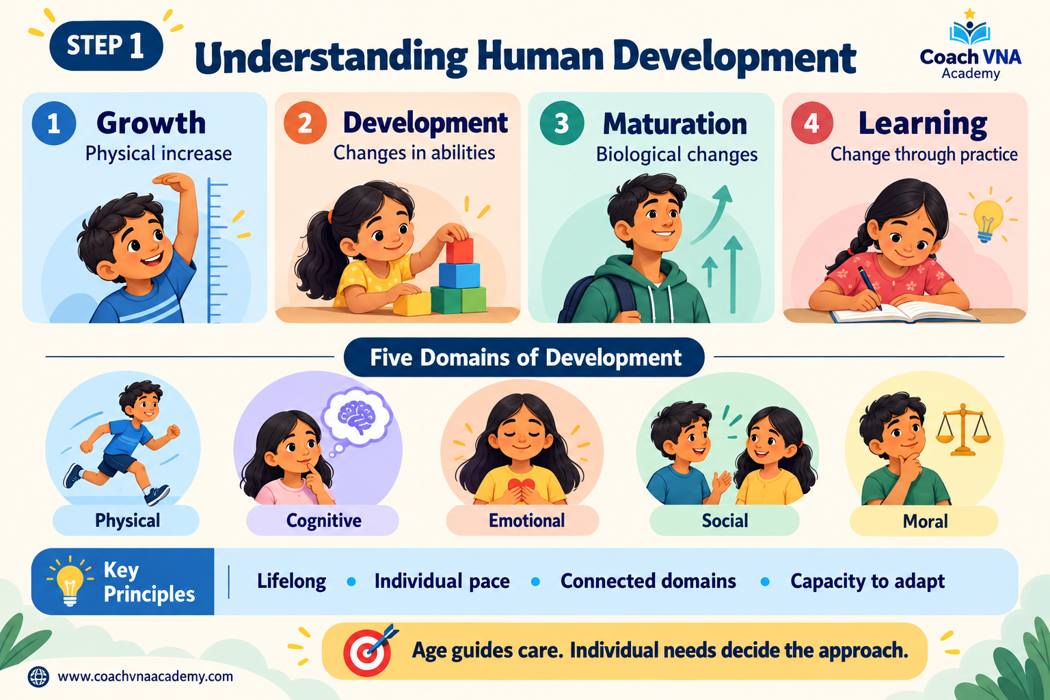
Human development is the lifelong process of change in physical functioning, thinking, emotions, relationships and independence. It begins before birth and continues through older adulthood. Development includes gaining abilities, adjusting to new roles and managing changes or losses. It does not mean that every ability improves continuously.
Growth development maturation and learning
| Term | Meaning | Example |
| Growth | A measurable physical increase. | A child becomes taller. |
| Development | Changes in abilities and functioning over time. | A child learns to explain pain. |
| Maturation | Biologically guided changes. | Physical changes during puberty. |
| Learning | Change through experience and practice. | Learning to use a health device. |
Hinglish learning support: Development sirf height aur weight badhna nahi hai. Thinking, emotions, relationships aur independence mein badlav bhi development ka hissa hain.
Principles and domains of development
Why people develop differently
Development generally follows an organised sequence, but its timing differs. Genetics, nutrition, education, family relationships, culture, illness, disability and access to healthcare all influence how a person develops. A difficulty should prompt assessment and support rather than blame.
Development is lifelong and multidimensional. Physical health can affect attention; anxiety can affect learning; and social support can influence confidence. It also shows plasticity: people can learn new strategies and improve functioning through practice, rehabilitation and appropriate support.
Changes include both gains and losses. An older person may need more time to process unfamiliar information while drawing on considerable experience. A young adult may understand a complex explanation but still feel too anxious to remember it.
The main domains of development
| Domain | What it includes | Healthcare example |
| Physical | Growth, movement, strength and sensory function. | Check whether the patient can read a label or open a container. |
| Cognitive | Attention, memory, language and reasoning. | Explain one step at a time and check understanding. |
| Emotional | Recognising and managing feelings. | Acknowledge fear before giving instructions. |
| Social | Relationships, roles and participation. | Explore available support with the patient. |
| Moral | Values, fairness and responsibility. | Discuss choices respectfully and avoid pressure. |
Assess ability rather than making assumptions
Chronological age is the number of years a person has lived. Developmental functioning describes what the person can understand and do. The two are related, but they are not interchangeable. Language differences, pain, unfamiliar terminology and limited schooling can make an explanation difficult without indicating low intelligence.
Ask what the patient already knows, which language they prefer and whether they need help with hearing, vision or reading. Notice the environment too: noise, interruptions and embarrassment can make communication harder.
Developmental stages across the lifespan
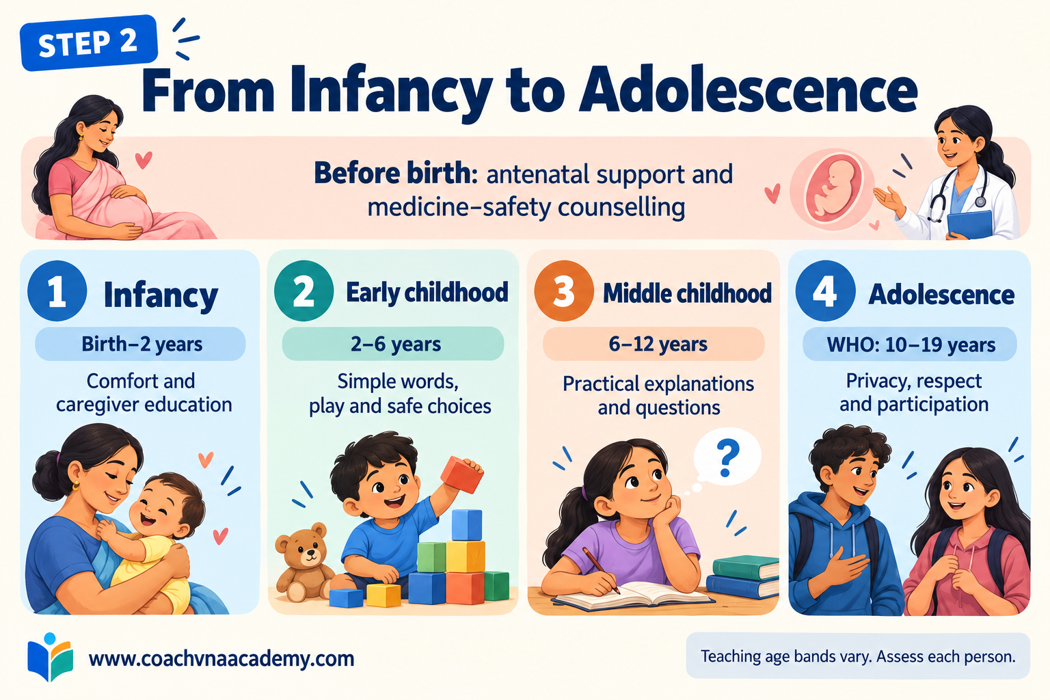
The following age bands preserve the broad teaching framework in the supplied notes. Boundaries are approximate and differ between frameworks. WHO defines adolescence as 10–19 years [1], whereas the notes use 12–18 years; these are different conventions rather than an exact biological boundary.
| Teaching stage | Common developmental features | Healthcare focus |
| Prenatal period | Body structures and nervous system develop before birth. | Antenatal support, nutrition and professional advice on medicine safety. |
| Infancy Birth to 2 years | Rapid growth, attachment and early sensory and motor learning. | Caregiver education, feeding support, growth monitoring and preventive care. |
| Early childhood 2 to 6 years | Language, play and independence expand. | Short explanations, demonstration, reassurance and safe choices. |
| Middle childhood 6 to 12 years | Concrete reasoning, school skills and confidence develop. | Speak directly to the child, explain practical steps and invite questions. |
| Adolescence 12 to 18 in notes | Identity, peer relationships and independence become prominent. | Respect privacy, listen without judgement and support participation. |
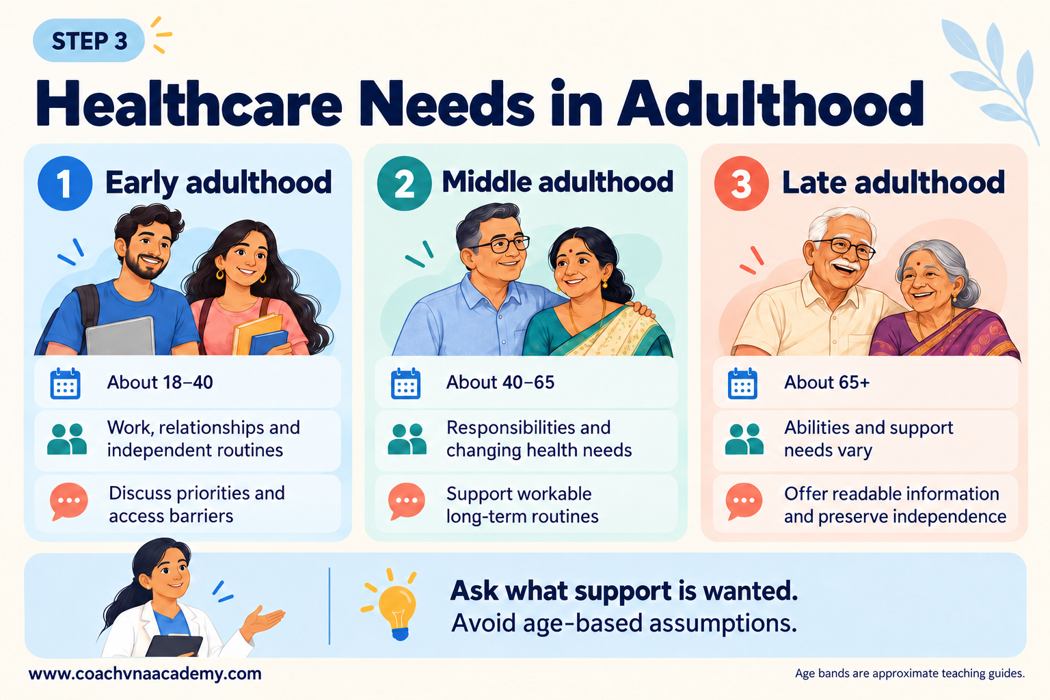
| Early adulthood 18 to 40 years | Work, education, relationships and independent routines vary. | Explore priorities, access barriers and shared decisions. |
| Middle adulthood 40 to 65 years | Changing roles and competing responsibilities are common. | Support preventive care and workable long-term routines. |
| Late adulthood 65 years and above | Sensory, mobility or cognitive changes may occur. | Adapt information and equipment while supporting independence. |
Age bands are guides rather than rules
An adolescent may need both privacy and trusted family support. An older adult may manage medicines independently. Ask what support is wanted before involving a caregiver, subject to safeguarding responsibilities and applicable consent requirements.
WHO’s ageing guidance warns against assuming that older people are uniformly frail or dependent [2]. For students, the practical lesson is to assess function and preferences before choosing a communication method.
Erikson and Piaget in healthcare
Erikson’s psychosocial theory
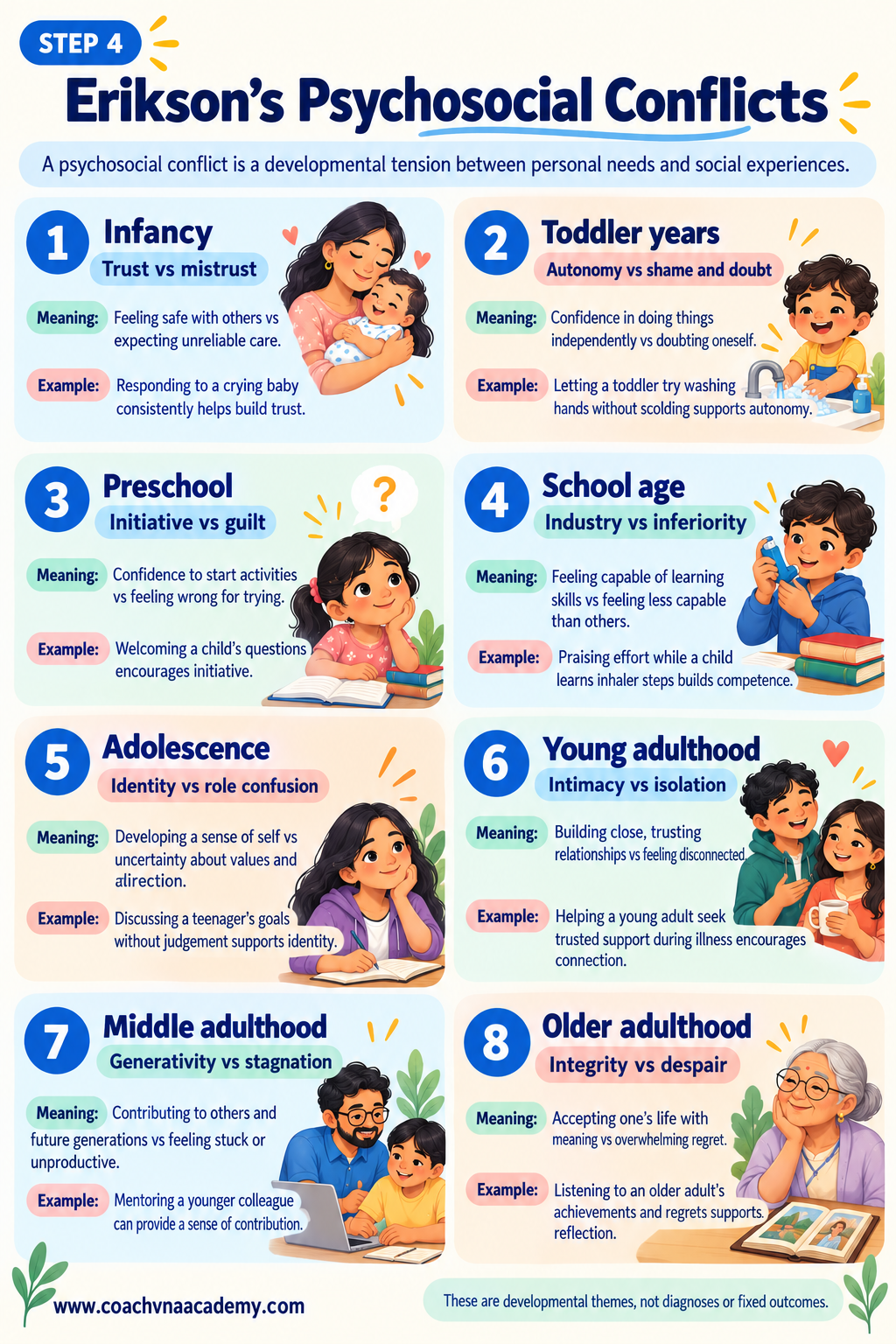
Erikson described eight psychosocial conflicts across life. Each concerns a developmental task, such as building trust or establishing identity. The framework helps students reflect on care interactions; it should not be used as a diagnostic label or a rigid prediction of behaviour.
A psychosocial conflict is a turning point or internal struggle that a person faces at a specific stage of their life.
To understand it easily, let’s break down the word into its two parts:
- Psycho (Psychological): This is your inner world—your thoughts, feelings, identity, and emotions.
- Social: This is the outside world—your relationships, family, friends, culture, and society.
Therefore, a psychosocial conflict happens when your inner emotional needs clash with the demands and expectations of the world around you.
| Life stage | Psychosocial conflict | Supportive interaction |
| Infancy | Trust versus mistrust | Provide consistent, responsive care. |
| Toddler years | Autonomy versus shame and doubt | Offer safe choices and avoid shaming. |
| Preschool | Initiative versus guilt | Welcome questions and participation. |
| School age | Industry versus inferiority | Recognise effort and growing skills. |
| Adolescence | Identity versus role confusion | Listen respectfully and protect dignity. |
| Young adulthood | Intimacy versus isolation | Respect relationships and choices. |
| Middle adulthood | Generativity versus stagnation | Connect care with meaningful roles. |
| Older adulthood | Integrity versus despair | Respect life history and current goals. |
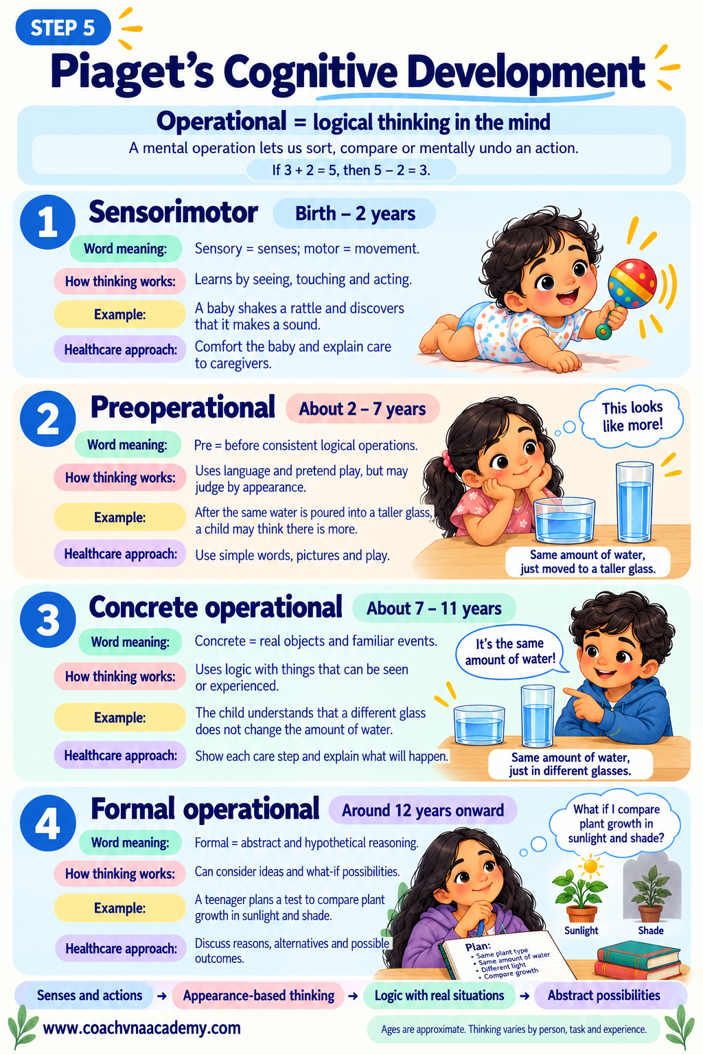
Piaget’s cognitive development theory
Piaget’s stages describe broad changes in childhood thinking. The ages are approximate. People may demonstrate different abilities across tasks, so check understanding directly rather than assuming a stage from age alone.
| Stage and approximate age | Main feature | Teaching approach |
| Sensorimotor Birth to 2 years | Learns through senses and action. | Provide comfort and educate caregivers. |
| Preoperational 2 to 7 years | Symbolic thought develops; reasoning is often intuitive. | Use familiar words, pictures and play. |
| Concrete operational 7 to 11 years | Logical reasoning about concrete situations. | Demonstrate steps and explain observable effects. |
| Formal operational Around 12 years onward | Abstract and hypothetical reasoning develops. | Discuss reasons, alternatives and consequences. |
Applying development to patient communication
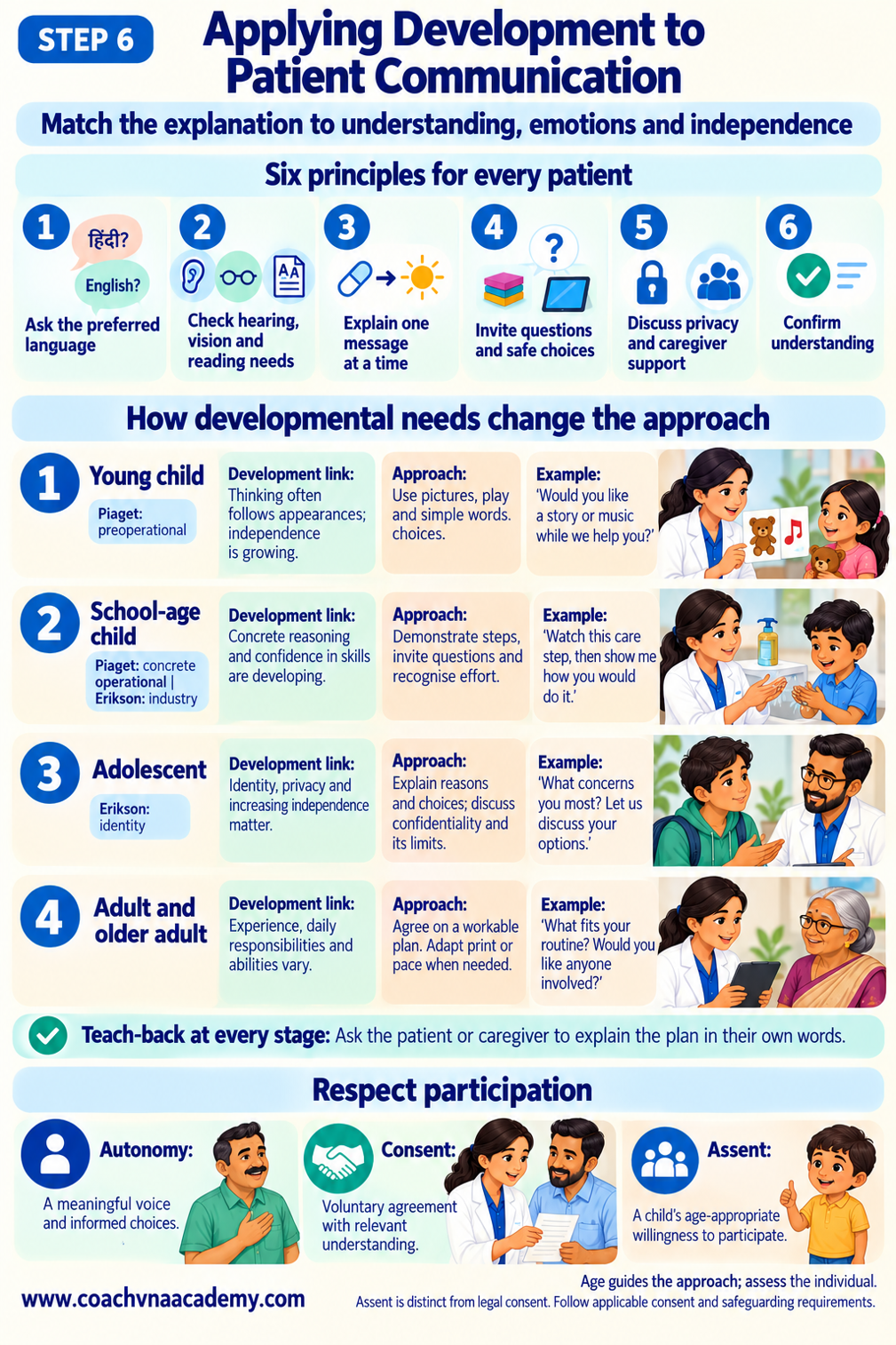
A teenager asking a sensitive question
Listen without teasing or judgement. Explain how privacy is handled, including relevant limits, before discussing sensitive information. Do not promise unconditional secrecy. Support age-appropriate participation while following applicable consent, safeguarding and institutional requirements.
An adult finding a routine difficult
Instead of assuming that the person is careless, ask what makes the plan difficult. Shift work, cost, side effects, transport or an unclear explanation may interfere with a routine. Explore practical barriers within your professional role and refer concerns when needed.
An older adult who cannot read a label
Offer readable written information, adequate lighting and an unhurried explanation. Ask whether the patient wants a caregiver involved. Hearing loss or poor eyesight does not automatically mean that a person cannot make decisions.
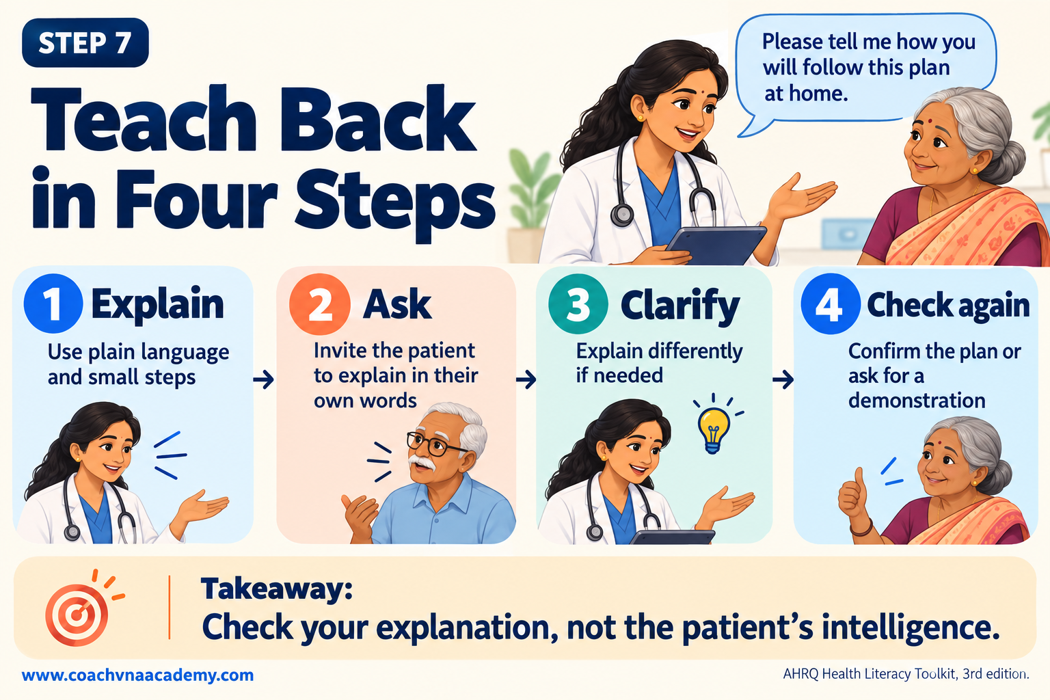
Check understanding with teach back
AHRQ’s third-edition health literacy toolkit recommends asking patients to explain instructions in their own words [3]. The purpose is to check the explanation, not to test or embarrass the patient.
An example prompt is: “To check that my explanation was clear, please tell me how you will follow this plan at home.” Give information in small portions, listen to the response and explain differently if needed. For a practical skill, ask for a demonstration. Avoid relying only on “Do you understand?”
Autonomy consent and caregiver involvement
Autonomy means having a meaningful voice in care. Informed consent involves voluntary agreement with relevant understanding and decision-making capacity. A child’s assent is their age-appropriate agreement or willingness; it is distinct from legally valid consent. Exact requirements depend on the situation and applicable law. Caregiver support should help the patient participate whenever possible.
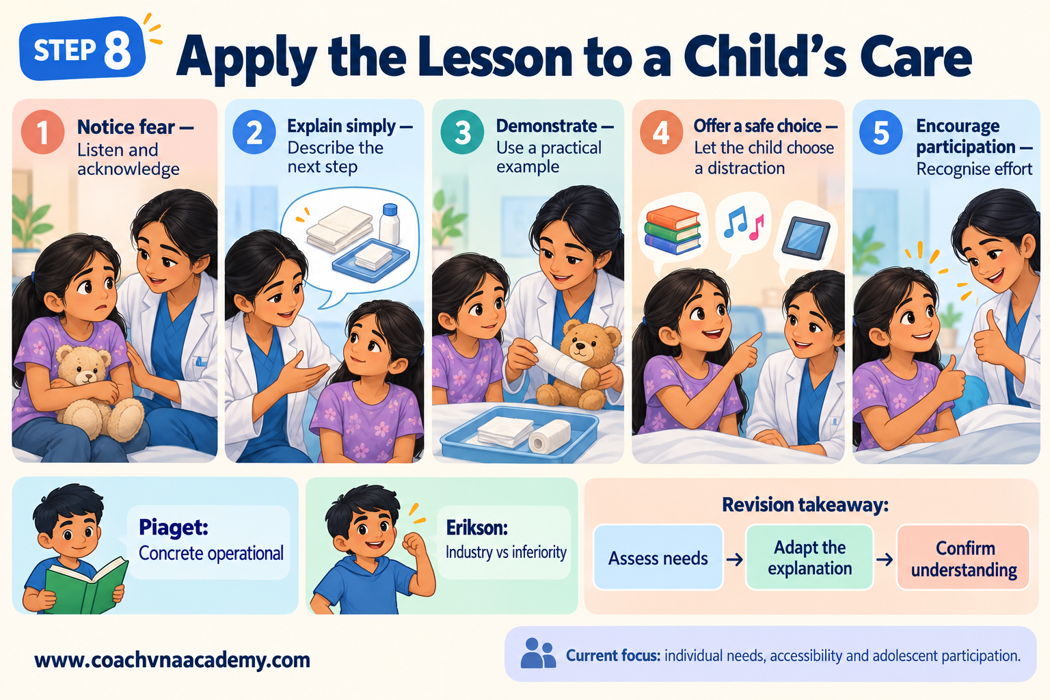
A child who is afraid of a procedure
Consider an illustrative case: a nine-year-old child cries before a dressing change. Begin by acknowledging the fear. Explain the next step using concrete words, demonstrate with suitable materials and offer a safe choice, such as which distraction activity to use. Involve the caregiver while still speaking to the child.
Piaget’s concrete operational stage helps explain why a demonstration may be useful. Erikson’s industry versus inferiority stage is particularly relevant at this age: encourage participation and recognise effort. Safe choices also support the child’s developing independence.
References and further reading
[1] WHO. Adolescent health. https://www.who.int/health-topics/adolescent-health
[2] WHO. Ageing and health. Updated 1 October 2025. https://www.who.int/news-room/fact-sheets/detail/ageing-and-health
[3] AHRQ. Use the Teach-Back Method, Tool 5. Third-edition toolkit; reviewed April 2024. https://www.ahrq.gov/health-literacy/improve/precautions/tool5.html
[4] WHO. Adolescent-Responsive Health Systems Framework 2026–2030. Published 23 July 2026. https://www.who.int/publications/i/item/9789292800093