
Heterocyclic compounds, characterized by cyclic structures containing one or more heteroatoms such as nitrogen, oxygen, or sulfur, constitute the most diverse and essential class of organic molecules in drug discovery. These structures are not merely passive frameworks; they serve as critical pharmacophores that facilitate specific interactions with biological targets, including enzymes, receptors, and nucleic acids. From the simple pyrrole rings in life-sustaining heme to complex fused systems like quinoline in antimalarials, heterocyclic chemistry provides the fundamental building blocks necessary for designing potent, selective, and life-saving therapeutic agents.
The Significance of Heterocycles in Medicine
Heterocyclic rings are not just structural skeletons; they are functional components that dictate how a drug behaves in the human body. They are found in over 75% of FDA-approved drugs. Their importance can be summarized by several key factors:
- Biological Mimicry: Many essential biological molecules are heterocyclic. For example, the bases in our DNA (Purines and Pyrimidines), essential amino acids like Proline and Histidine, and vital vitamins like B12 and Thiamine all contain these rings. By incorporating these structures, drugs can “mimic” natural molecules to block or activate biological pathways.
- Hydrogen Bonding: Heteroatoms like nitrogen and oxygen can form hydrogen bonds with biological receptors (proteins or enzymes). This allows a drug molecule to “lock” into a target site with high precision, much like a key in a lock.
- Bioisosterism: In drug design, chemists often replace one atom or group with another that has similar physical or chemical properties. For instance, Thiophene is often used as a replacement for a benzene ring to enhance a drug’s ability to cross cell membranes or to make it last longer in the bloodstream.
- Physicochemical Tuning: The presence of a heteroatom significantly alters the solubility (how well it dissolves in water vs. fat) and the acidity/basicity (pKa) of a molecule. This is crucial for ensuring a pill can survive the stomach’s acidity and be absorbed into the blood.
Medicinal uses of Heterocyclic Compounds
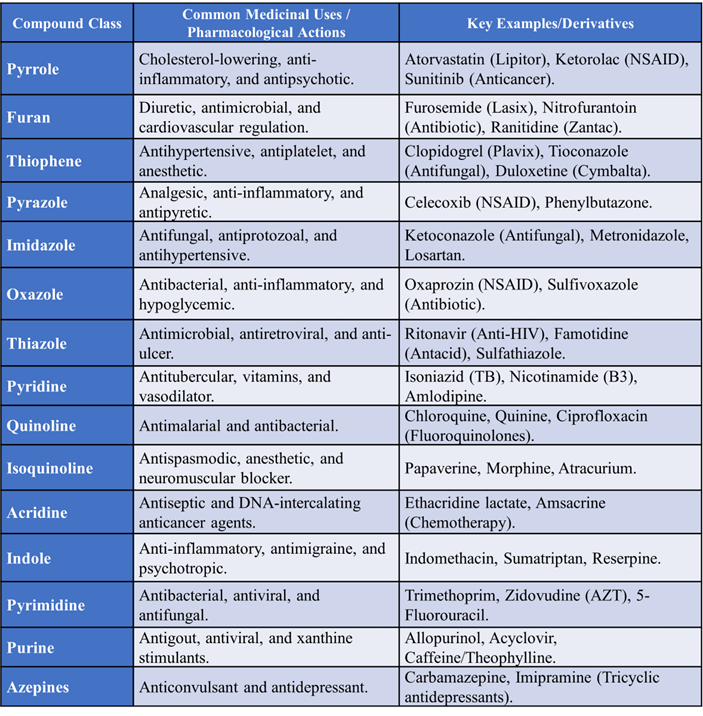
Structural and Therapeutic Context
- Pyrrole: This ring is perhaps most famous for being the core of Heme (in hemoglobin) and Chlorophyll. In synthetic medicine, the pyrrole ring is a central feature of many “blockbuster” drugs, most notably the statins used to manage heart health.
- Furan: While simple furan is rarely used due to toxicity, its derivatives are highly effective. For example, the nitro group attachment in Nitrofurantoin creates a powerful tool for treating urinary tract infections, while the furan ring in Furosemide helps manage fluid retention.
- Thiophene: Thiophene is often used as a “bioisostere” for the benzene ring. Because sulfur is similar in size to a -CH=CH- group, replacing a benzene ring with thiophene can often improve a drug’s solubility or metabolic stability without losing its effectiveness.
- Five-Membered Rings: Pyrazole (two nitrogens), Imidazole (two nitrogens at 1,3 positions), Oxazole (oxygen and nitrogen), and Thiazole (sulfur and nitrogen). Compounds like Imidazole and Thiazole are critical in metabolic processes. The imidazole ring, for instance, is found in the essential amino acid Histidine.
- Six-Membered Rings: Pyridine (one nitrogen), Pyrimidine (two nitrogens at 1,3 positions). Pyridine and Pyrimidine are found everywhere in nature; pyrimidines (Cytosine, Thymine, Uracil) are fundamental components of DNA and RNA.
- Fused Rings: Quinoline and Isoquinoline (benzene fused to pyridine), Indole (benzene fused to pyrrole), Purine (imidazole fused to pyrimidine), and Acridine (three fused rings with nitrogen in the center).Quinoline and Isoquinoline derivatives are historically significant, particularly in the development of treatments for tropical diseases and pain management.
- Seven-Membered Rings: Azepines (a seven-membered unsaturated ring containing one nitrogen atom).Azepines (specifically dibenzazepines) are vital in neurology for stabilizing mood and treating seizure disorders.