
Introduction
Benzene is aromatic and unusually stable because its six π electrons are delocalized over the ring. However, despite this stability, benzene reacts with strong electrophiles. Nitration of benzene is an important electrophilic aromatic substitution reaction in which a hydrogen atom of the benzene ring is replaced by a nitro group through the action of the nitronium ion (NO₂⁺). During nitration, the benzene ring temporarily loses its aromaticity while forming the sigma complex, but aromaticity is restored in the final step to produce nitrobenzene.
Important Terms
| Term | Examination-oriented meaning |
| Electrophile | An electron-deficient species that accepts an electron pair. |
| Electrophilic aromatic substitution | Replacement of an aromatic hydrogen by an electrophile with regeneration of the aromatic ring. |
| Sigma complex / Arenium ion (Carbonium ion) | Positively charged, non-aromatic intermediate formed after the electrophile makes a sigma bond with the ring. |
| Deprotonation | Removal of H⁺ from the sigma complex to restore the pi bond and aromaticity. |
| Rate-determining step | The slowest step that largely controls the reaction rate. |
| Lewis acid | An electron-pair acceptor that activates a reagent or helps generate an electrophile. Examples: FeCl₃ and AlCl₃ |
| Carbonium ion (older term) | Some older teaching sources use this term for the positively charged intermediate. In electrophilic aromatic substitution, sigma complex or arenium ion is the more precise term. |
Why Benzene Undergoes Substitution Rather Than Addition
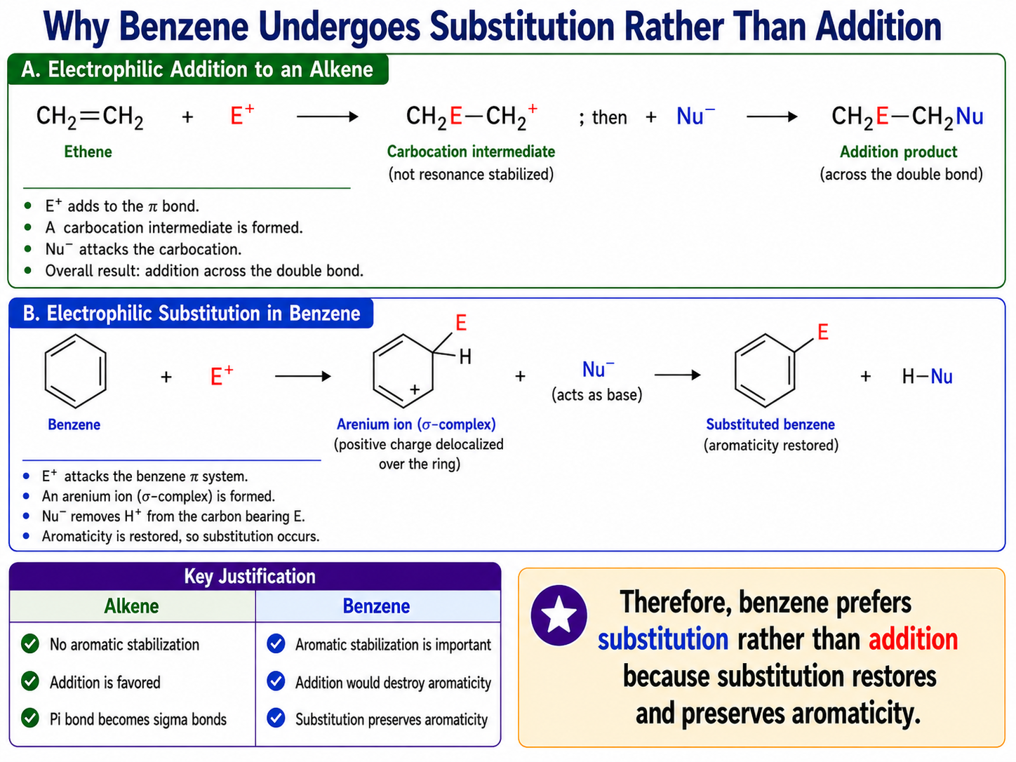
Both benzene and alkenes contain exposed pi electrons; therefore, both can attack electrophiles. However, the two systems treat the cationic intermediate differently. In an alkene, a nucleophile usually attacks the carbocation and gives an addition product. In benzene, a base removes a proton from the sigma complex, and the C-H bond electrons restore the aromatic pi system. Consequently, benzene gives substitution rather than overall addition.
Alkene + E⁺ + Nu⁻ → electrophilic addition product
Ar-H + E⁺ → Ar-E + H⁺ (aromatic substitution)
Reaction-pathway comparison:
| System | Initial electrophilic attack | Fate of cationic intermediate | Overall result |
| Alkene | The pi bond attacks E⁺ and forms a carbocation. | A nucleophile, Nu⁻, attacks the carbocation. | Addition product |
| Benzene | The aromatic pi cloud attacks E⁺ and forms a sigma complex. | A base removes H⁺; C-H electrons restore aromaticity. | Substitution product |
Electrophilic Aromatic Substitution:
General Mechanism:
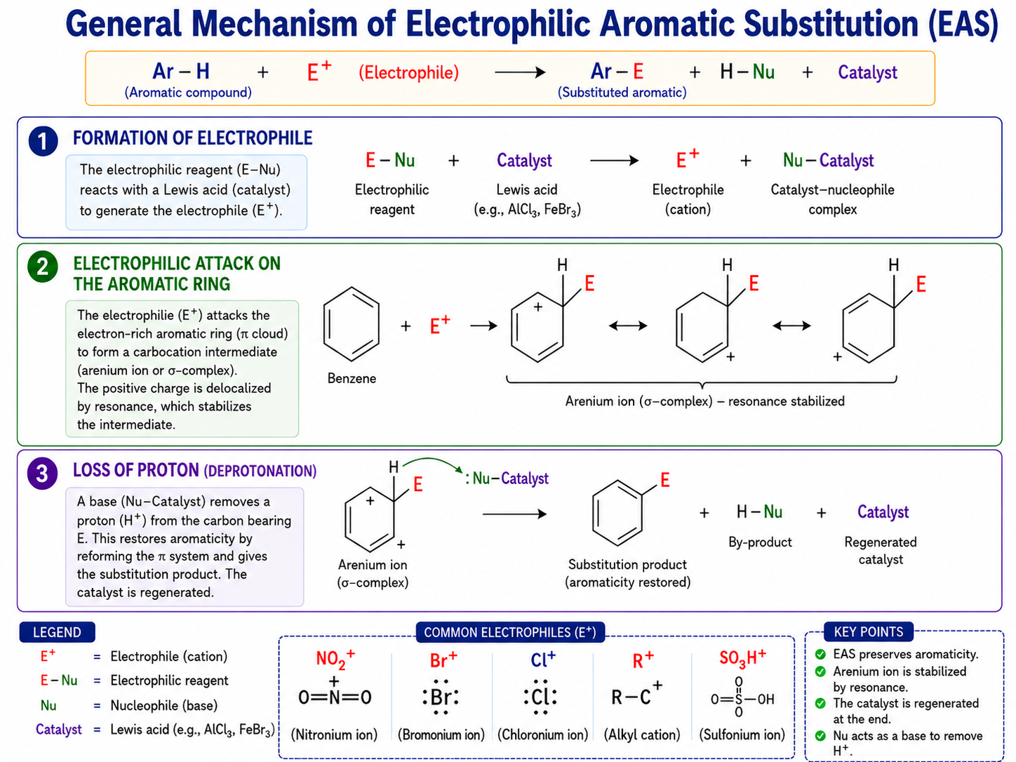
All major electrophilic substitution reactions of benzene follow the same basic pattern. Moreover, the reagents differ because each reaction must generate a different electrophile.
A reagent reacts with an acid or Lewis-acid catalyst to generate a strong electrophile, E⁺. This step prepares the electron-deficient attacking species.
Step 1 – Formation of the Electrophile
Two common routes generate the electrophile. A Bronsted acid may protonate a reagent, as H₂SO₄ protonates HNO₃ during nitration. Alternatively, a Lewis acid such as FeCl₃ or AlCl₃ may accept an electron pair, polarize a covalent bond, and produce a more strongly electrophilic species. Thus, the catalyst activates the reagent before the aromatic ring attacks.
Step 2 – Formation of the Sigma Complex
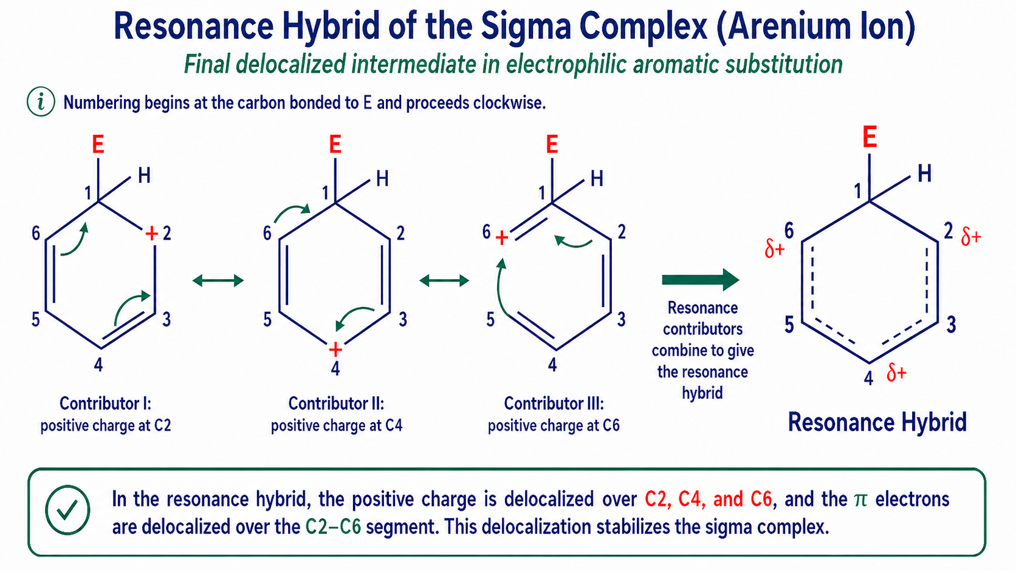
The electron-rich benzene pi cloud attacks the electrophile and forms a new C-E sigma bond. Moreover, one carbon temporarily stops participating through its p orbital; consequently, continuous conjugation breaks and the ring become non-aromatic. A positively charged sigma complex (carbonium ion) is formed. As a result, the positive charge is delocalized over three ring positions through resonance.
Step 3 – Deprotonation and Restoration of Aromaticity
A base removes H⁺ from the carbon bearing the electrophile. Moreover, the electrons of the C-H bond form a new pi bond in the ring. Therefore, the final step restores aromaticity and forms the substituted benzene product.
Ar-H + E⁺ → Ar-E + H⁺
| Mechanistic stage | Main event | Aromaticity |
| Step I: Electrophile formation | The reagents produce a strong electrophile, E⁺ | Benzene not yet involved |
| Step II: Sigma-complex formation | Ring forms a C-E bond | Temporarily lost |
| Step III: Deprotonation | H⁺ is removed and pi bond reforms | Restored |
Sigma Complex or Arenium Ion
The sigma complex is the most important intermediate in electrophilic aromatic substitution. Moreover, it has a new sigma bond between the ring and the electrophile, one carbon bearing both H and E, and an overall positive charge. The positive charge can be represented at three positions by resonance. Resonance gives some stabilization, but the intermediate remains high in energy because it is not aromatic.
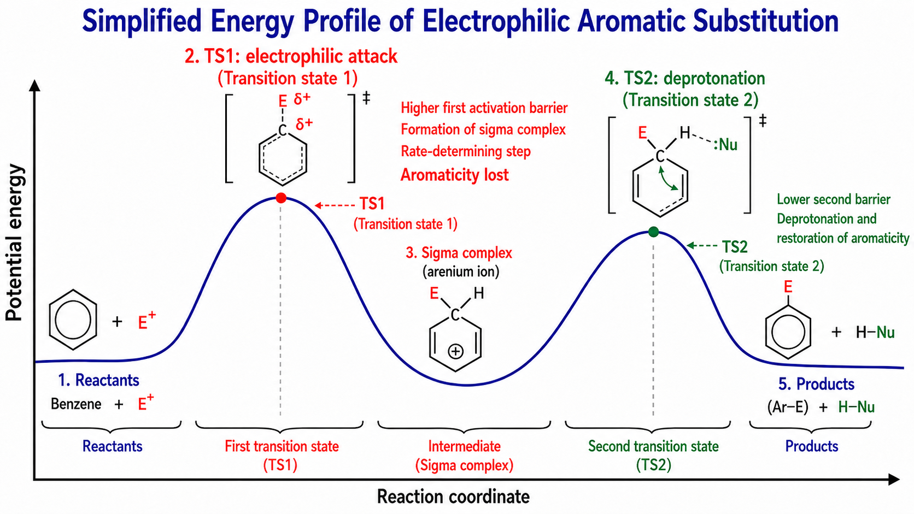
| Why Sigma-Complex Formation Is Slow? Benzene begins as a strongly stabilized aromatic molecule. However, forming the sigma complex converts one part of the delocalized pi system into a new sigma bond and temporarily removes aromaticity. This requires higher amount of activation energy. It is converted into a higher-energy non-aromatic intermediate. Therefore, it is usually the slow and rate-determining step. Deprotonation is faster because it restores the aromatic system. |
| Important Point: Do not draw the aromatic circle inside the sigma complex. The ring is temporarily non-aromatic. |
Simplified Energy Profile
The first energy barrier is high because aromaticity is lost. Therefore, the second barrier is smaller because deprotonation restores the stable aromatic product. Therefore, sigma-complex formation is slow and deprotonation is fast.
Reaction Roadmap: Common Electrophilic Aromatic Substitution Reactions
The following table connects the major benzene reactions with the electrophile generated in each case. It provides a unit-level roadmap:
| Reaction | Typical reagents | Electrophilic species | Main product/group introduced |
| Nitration | conc. HNO₃/conc. H₂SO₄ | NO₂⁺ (nitronium ion) | Nitrobenzene; -NO₂ introduced |
| Halogenation | Cl₂/FeCl₃ or Br₂/FeBr₃ | Cl⁺ or Br⁺ equivalent | Chlorobenzene or bromobenzene |
| Sulphonation | SO₃/H₂SO₄ or fuming H₂SO₄ | SO₃ or protonated SO₃ | Benzene sulphonic acid; -SO₃H introduced |
| Friedel-Crafts alkylation | R-X/anhydrous AlCl₃ | R⁺ or carbocation-like species | Alkylbenzene; -R introduced |
| Friedel-Crafts acylation | RCOCl /anhydrous AlCl₃ | RCO⁺ (acylium ion) | Aromatic ketone; -COR introduced |
Nitration of Benzene
Definition and reaction:
Nitration is an electrophilic aromatic substitution reaction in which a nitro group, -NO₂, replaces a hydrogen atom of benzene. Moreover, Benzene reacts with a nitrating mixture of concentrated nitric acid and concentrated sulfuric acid, generally at about 50-60 °C, to form nitrobenzene.
C₆H₆ + HNO₃ → C₆H₅NO₂ + H₂O (conc. H₂SO₄, about 50-60 °C)
| Point | Answer |
| Reagents | Concentrated HNO₃ and concentrated H₂SO₄ |
| Electrophile | NO₂⁺, Nitronium ion |
| Intermediate | Sigma complex / Arenium ion |
| Product | Nitrobenzene |
| Reaction type | Electrophilic aromatic substitution |
| Rate-determining step | Formation of the sigma complex |
Formation of Nitronium Ion (Role of Sulfuric Acid)
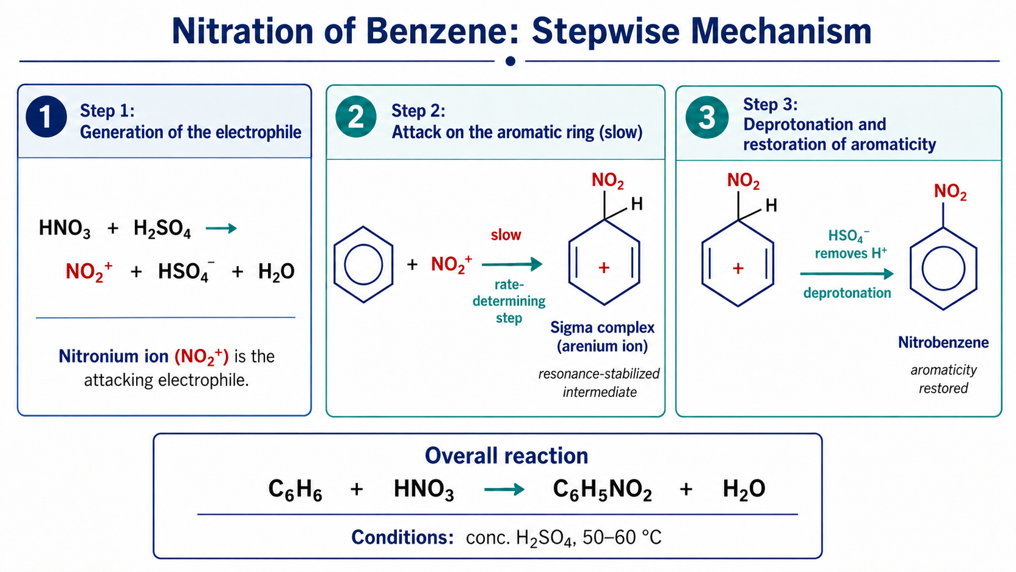
Concentrated sulfuric acid is a stronger acid than nitric acid. It protonates nitric acid to form H₂NO₃⁺. Moreover, this protonated species loses water and produces the nitronium ion, NO₂⁺. HSO₄⁻ formed in the medium acts as a base during deprotonation. Moreover, the reaction regenerates sulfuric acid at the end; therefore, it acts as an acid catalyst.
HNO₃ + H₂SO₄ ⇌ H₂NO₃⁺ + HSO₄⁻; H₂NO₃⁺ → NO₂⁺ + H₂O
The simplified overall equation is:
HNO₃ + H₂SO₄ → NO₂⁺ + HSO₄⁻ + H₂O
The nitrogen atom of NO₂⁺ is electron deficient; therefore, the benzene pi-electron cloud attacks it.
| Do Not Write: H₂SO₄ supplies the -NO₂ group. The nitro group comes from HNO₃; H₂SO₄ generates the active electrophile. |
Complete Mechanism of Nitration
Step 1 – Generation of NO₂⁺: Concentrated H₂SO₄ protonates HNO₃. Loss of water produces NO₂⁺.
Step 2 – Attack on NO₂⁺: A pair of pi electrons from benzene attacks the electrophilic nitrogen atom. A C-N bond forms and a resonance-stabilized sigma complex forms. Aromaticity is lost. This is the slow step.
Step 3 – Deprotonation: HSO₄⁻ removes H⁺ from the carbon bearing NO₂. The C-H bond electrons form the missing pi bond. The final step restores aromaticity, forms nitrobenzene, and regenerates H₂SO₄.
| Three-Step Recall: NO₂⁺ generation → slow sigma-complex formation → fast deprotonation and aromaticity restoration. |
Common Errors
| Incorrect idea | Correct idea |
| HNO₃ is the attacking electrophile | NO₂⁺ is the attacking electrophile. |
| Nitration is addition | Nitration is substitution of H by NO₂. |
| Sigma complex is aromatic | Sigma complex is non-aromatic. |
| Deprotonation is slow | Sigma-complex formation is slow. |
| Arrow starts from NO₂⁺ | Arrow starts from benzene pi electrons. |
| H₂SO₄ is permanently consumed | H₂SO₄ is regenerated. |
| Final product is nitrite ester | Final product is nitrobenzene. |
General EAS versus Nitration
| General stage | Nitration example |
| Generate E⁺ | Generate NO₂⁺ from HNO₃/H₂SO₄ |
| Aromatic ring attacks E⁺ | Benzene attacks nitrogen of NO₂⁺ |
| Sigma complex forms | Nitro-substituted arenium ion forms |
| Base removes H⁺ | HSO₄⁻ removes H⁺ |
| Aromatic product forms | Nitrobenzene forms |
Examination-Oriented Mechanism Writing
1. Write the overall reaction and reaction conditions.
2. Write formation of the nitronium ion.
3. Draw benzene attacking the nitrogen atom of NO₂⁺.
4. Draw the sigma complex with a positive charge and, where asked, its resonance contributors.
5. Show HSO₄⁻ removing H⁺.
6. Show re-formation of the pi bond and nitrobenzene.
7. State that aromaticity and H₂SO₄ are regenerated.
8. Label sigma-complex formation as the slow or rate-determining step.
Practice & Exam Preparation
Strengthen your understanding through MCQs, model answers, and university-examination preparation resources.