
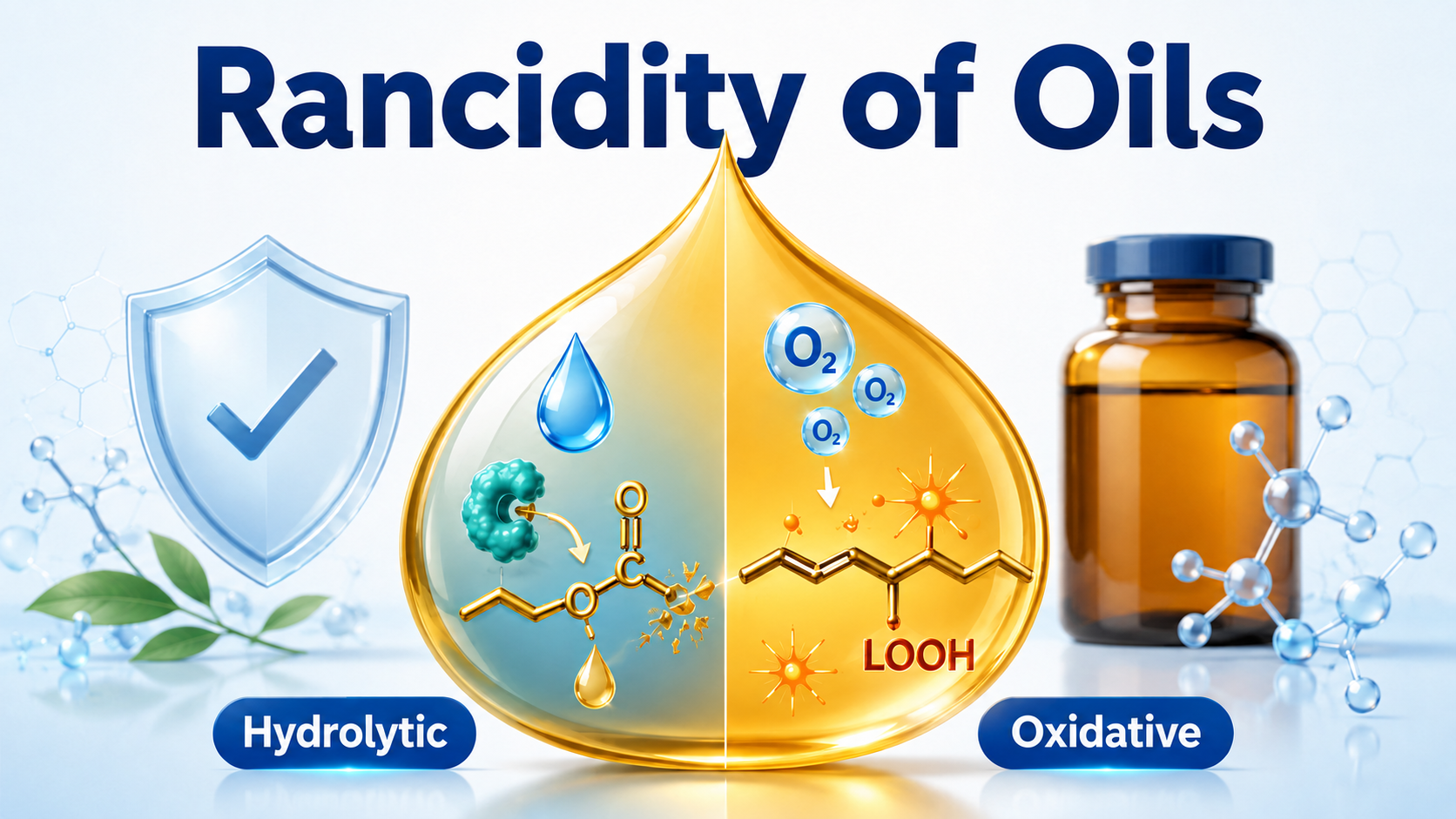
Rancidity of oils is an important deterioration process that affects the quality, stability, odor, taste, and therapeutic acceptability of fats and oil-containing pharmaceutical products. It may occur through hydrolysis of triglyceride ester bonds or free-radical oxidation of unsaturated fatty acids. Therefore, understanding its mechanisms, contributing factors, detection methods, prevention, and antioxidant control is essential for B.Pharm students and pharmaceutical formulators.
Meaning of rancidity
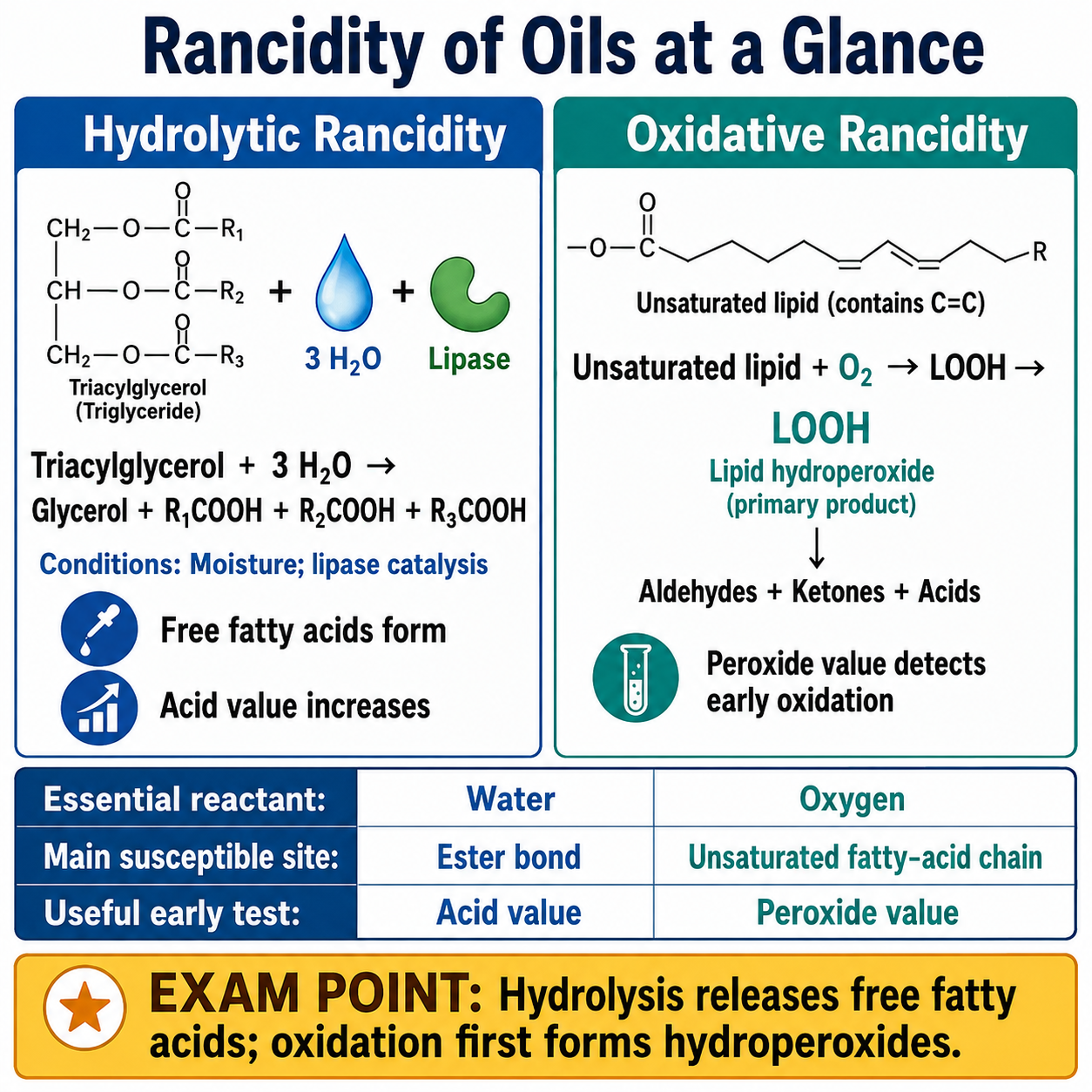
Rancidity refers to the development of an objectionable odor and taste due to the chemical or enzymatic deterioration of fats and oils. Based on the principal reaction involved, it is classified into hydrolytic rancidity and oxidative rancidity.
| Hydrolytic rancidity | Oxidative rancidity |
| Ester bonds undergo cleavage in the presence of water. | Unsaturated fatty-acid chains react with oxygen through a radical chain reaction. |
| Lipase, moisture, heat, acid, or alkali may promote it. | Light, heat, metals, oxygen, and higher unsaturation accelerate it. |
| Main products: glycerol/partial glycerides and free fatty acids. | Primary products: hydroperoxides; secondary products: aldehydes, ketones, acids, hydrocarbons. |
| Acid value or free-fatty-acid content helps detection. | Peroxide, p-anisidine, TBARS, Totox, UV, and GC methods help detection. |
Hydrolytic rancidity
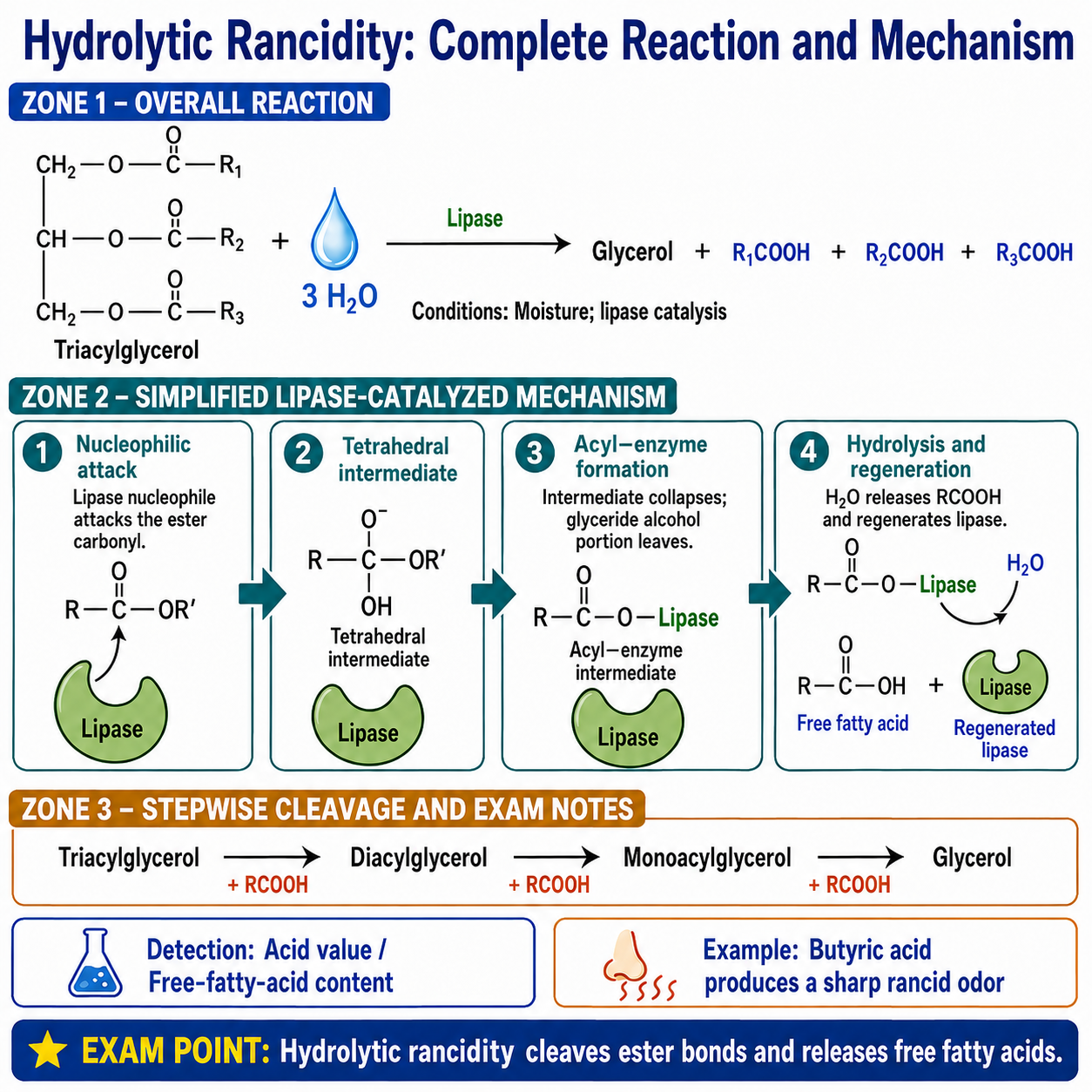
Hydrolytic rancidity occurs when water cleaves one or more ester bonds of a triglyceride. Lipase enzymes are especially important because they act at the oil–water interface and release free fatty acids efficiently. The reaction often proceeds stepwise through diacylglycerol and monoacylglycerol.
Complete reaction:
Triacylglycerol + 3 H₂O → Glycerol + R₁COOH + R₂COOH + R₃COOH
Conditions: moisture; lipase-catalyzed or accelerated by heat and suitable acid/alkali conditions.
Simplified lipase-catalyzed mechanism
- The ester carbonyl of the triglyceride becomes the reaction center.
- The active-site nucleophile of lipase attacks the carbonyl carbon and produces a tetrahedral intermediate.
- The intermediate collapses and releases the alcohol portion of the glyceride, while an acyl–enzyme intermediate remains.
- Water attacks the acyl–enzyme intermediate and releases a free fatty acid. The enzyme is regenerated.
- Repeated cycles convert triacylglycerol into diacylglycerol, monoacylglycerol, glycerol, and free fatty acids.
| Characteristic example: Hydrolysis of milk fat can release butyric acid, which has a sharp and unpleasant rancid odor. |
Oxidative rancidity
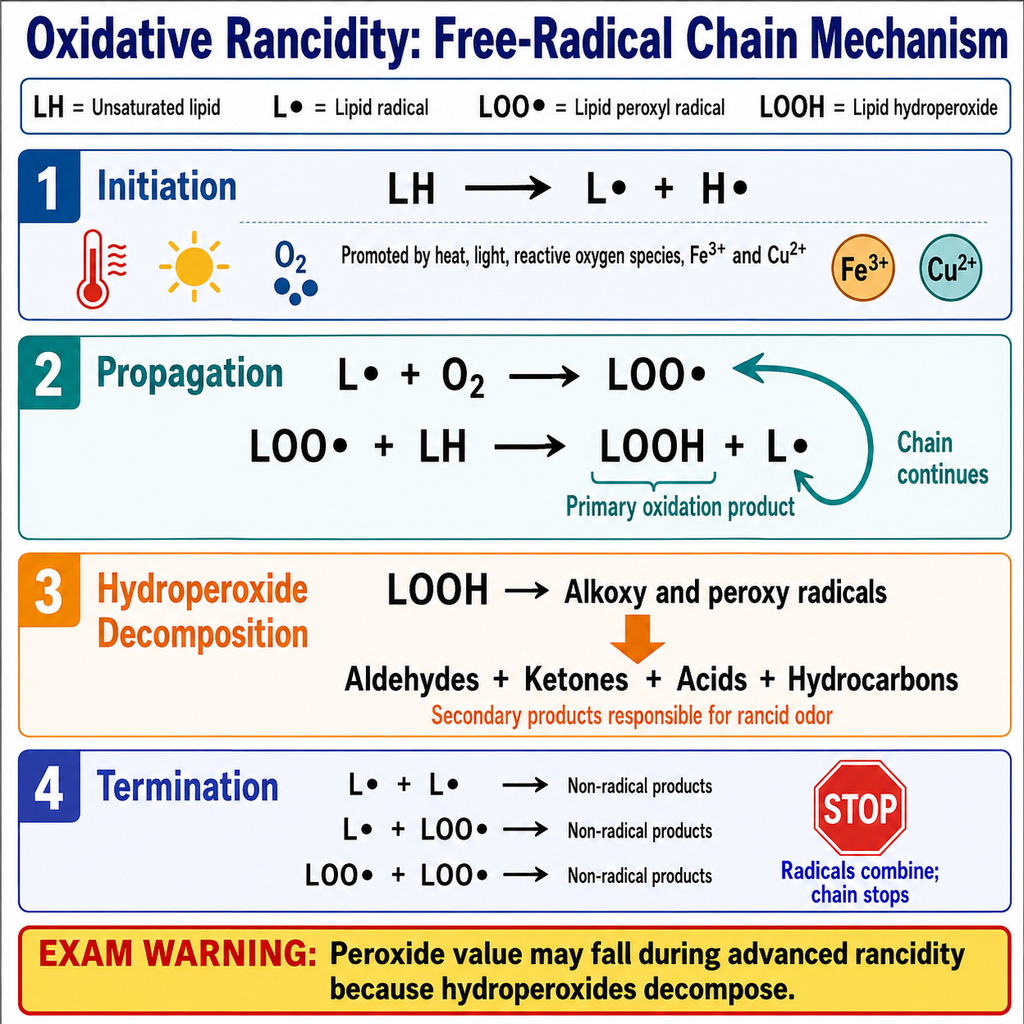
Oxidative rancidity, also called autoxidation, primarily affects unsaturated lipids. It follows a free-radical chain mechanism. A hydrogen atom is removed most easily from an allylic or bis-allylic position. The resulting lipid radical reacts rapidly with oxygen.
Symbols
LH = unsaturated lipid; L• = lipid radical; LOO• = lipid peroxyl radical; LOOH = lipid hydroperoxide; AH = antioxidant.
Initiation
Reaction
LH → L• + H•
Initiators: heat, light, radiation, reactive oxygen species, or transition metals.
Initiation produces the first lipid radical. Although the equation is simplified, it helps explain how a relatively stable lipid enters the radical chain process.
Propagation
Reactions
L• + O₂ → LOO•
LOO• + LH → LOOH + L•
The lipid peroxyl radical abstracts hydrogen from another lipid molecule. Consequently, lipid hydroperoxide forms and a fresh lipid radical continues the chain. One initiating event can therefore damage many lipid molecules.
Hydroperoxide decomposition
General change
LOOH → alkoxy/peroxy radicals → aldehydes + ketones + acids + hydrocarbons
Hydroperoxides are usually odorless but unstable. Their breakdown products, especially low-molecular-mass aldehydes and ketones, create the typical stale or rancid odor. This distinction explains why an old oil may smell strongly even after its peroxide value begins to fall.
Termination
Reactions
L• + L• → non-radical product
L• + LOO• → non-radical product
LOO• + LOO• → non-radical products
Termination removes radicals when two radical species combine. However, natural termination may occur too late to protect product quality, so formulation and storage controls remain necessary.
Why some oils oxidize faster
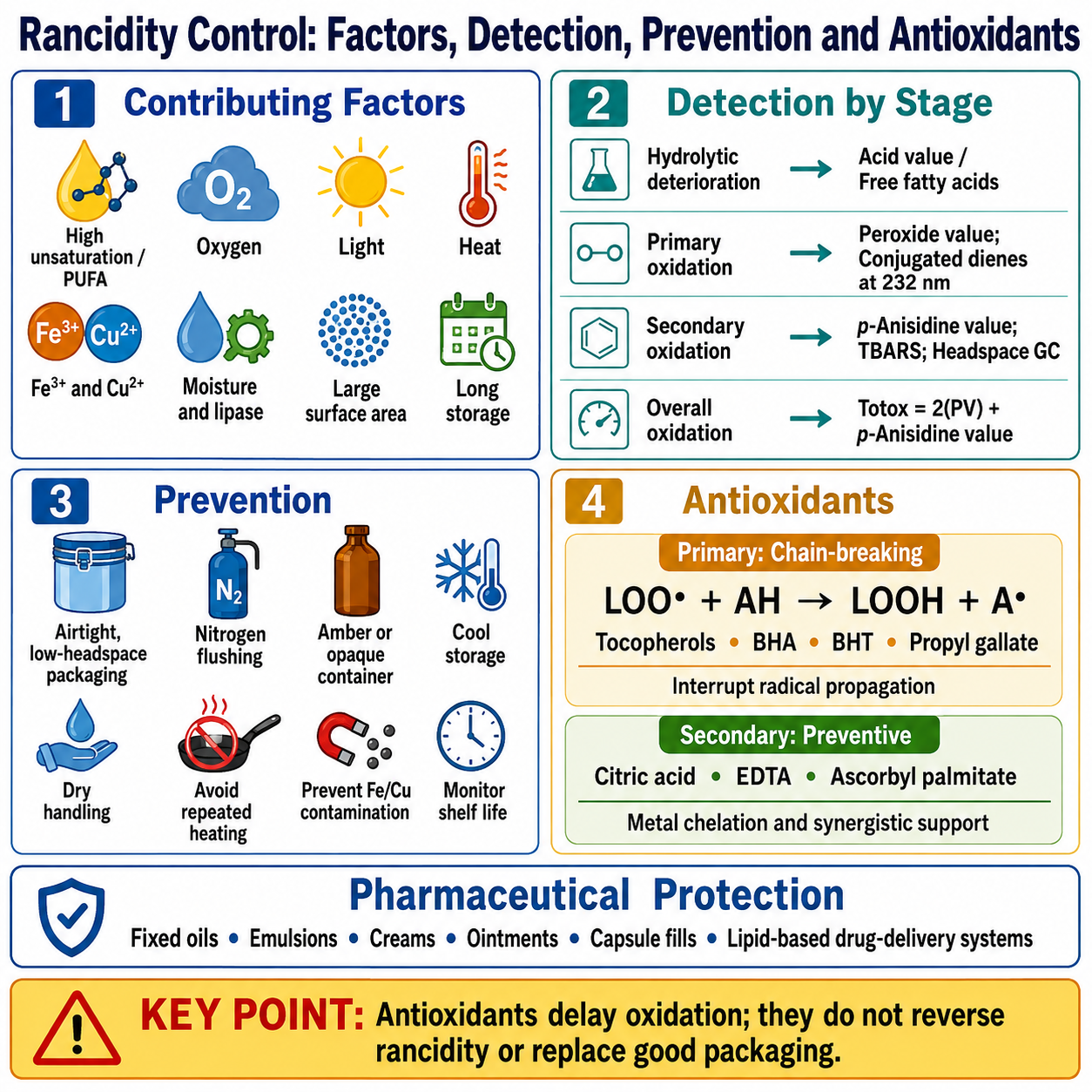
| Contributing factor | Effect on rancidity |
| More double bonds | More allylic/bis-allylic sites are available for hydrogen abstraction. In general: PUFA > MUFA > saturated fat for oxidation susceptibility. |
| Oxygen | Increases formation of peroxyl radicals; headspace oxygen and repeated opening matter. |
| Light | Promotes photooxidation and radical generation; transparent containers offer less protection. |
| Heat | Speeds initiation, propagation, and hydroperoxide decomposition. |
| Iron and copper | Catalyze hydroperoxide breakdown and generate new radicals. |
| Moisture and lipase | Promote hydrolytic rancidity by cleaving ester bonds. |
| Large surface area / agitation | Raises contact between oil and oxygen. |
| Long storage / poor barrier packaging | Provides time and conditions for deterioration to progress. |
Detection of rancidity
No single method describes every stage of rancidity. Therefore, quality control often combines a primary-oxidation test with a secondary-oxidation test and interprets the results together with storage history and sensory changes.
| Test | Target | Important exam point |
| Sensory examination | Odor, taste, color | Rapid but subjective; do not taste unknown/pharmaceutical samples. |
| Acid value / FFA | Free fatty acids | Supports hydrolytic rancidity. |
| Peroxide value | Lipid hydroperoxides | Best suited to primary oxidation; may fall in advanced rancidity. |
| p-Anisidine value | Mainly aldehydic secondary products | Useful with peroxide value. |
| TBARS / TBA | Malondialdehyde and related compounds | Measures secondary oxidation but may show matrix interference. |
| Totox value | Combined oxidation status | Totox ≈ 2(PV) + p-anisidine value. |
| Conjugated diene UV test | Early PUFA oxidation | Conjugated dienes commonly absorb near 232 nm. |
| Headspace GC | Volatile breakdown products | Sensitive and compound-specific, but instrument-dependent. |
| Do not misinterpret: A low peroxide value does not prove that an oil is fresh. If hydroperoxides have already decomposed, secondary oxidation tests and odor may show severe deterioration. |
Prevention of rancidity
- Use fresh, refined, low-peroxide raw materials and follow good manufacturing practice.
- Limit oxygen through airtight containers, minimum headspace, vacuum packing, or nitrogen flushing.
- Use amber, opaque, or UV-protective packaging and avoid direct sunlight.
- Store at a suitable low temperature and avoid repeated heating.
- Control water activity and prevent lipase-producing microbial contamination.
- Avoid contact with copper or iron; use compatible chelating agents when permitted.
- Choose an oil with suitable oxidative stability for the intended product.
- Add appropriate antioxidants at a validated concentration.
- Monitor stability throughout the proposed shelf life.
Role of antioxidants
Antioxidants delay oxidation by interrupting the radical chain or by preventing radical formation. They work best before extensive oxidation begins. They cannot remove an established rancid odor or restore degraded fatty acids.
Primary or chain-breaking antioxidants
Mechanism
LOO• + AH → LOOH + A•
A• is relatively stable and does not readily continue lipid oxidation.
Tocopherols, butylated hydroxyanisole (BHA), butylated hydroxytoluene (BHT), and propyl gallate are common examples. Their phenolic structure allows hydrogen donation and stabilization of the antioxidant radical by resonance.
Secondary or preventive antioxidants
- Chelators such as citric acid or EDTA bind iron and copper and reduce metal-catalyzed radical production.
- Oxygen scavengers and reducing agents reduce available oxidizing species.
- Singlet-oxygen quenchers reduce photooxidation.
- Ascorbyl palmitate can support antioxidant systems in lipid-rich formulations.
Synergism and selection
Antioxidant combinations may work better than one component alone. For example, a primary antioxidant can trap peroxyl radicals while a chelator removes trace metals. Selection depends on oil type, solubility, processing temperature, product pH, compatibility, route of administration, regulatory limits, packaging, and stability data. Excessive concentration is not automatically beneficial and may sometimes produce pro-oxidant behavior.
Pharmaceutical significance
- Fixed oils may serve as vehicles, emollients, capsule fills, nutritional ingredients, or lipid-delivery components.
- Rancidity may change appearance, odor, viscosity, pH, palatability, and patient acceptance.
- Oxidation may reduce essential fatty acids and fat-soluble vitamins and generate reactive degradation products.
- Emulsions and creams need special attention because oil, water, oxygen, and metal traces can coexist at interfaces.
- Stability studies should evaluate the finished dosage form because antioxidant performance in bulk oil may differ after formulation.
Exam-ready comparison
| Point | Hydrolytic rancidity | Oxidative rancidity |
| Chemical event | Hydrolysis of ester bonds | Free-radical oxidation of unsaturated chains |
| Essential reactant | Water | Oxygen |
| Major promoters | Lipase, moisture, heat | Light, heat, metals, oxygen |
| Early products | Free fatty acids and partial glycerides | Hydroperoxides |
| Later odor compounds | Especially short-chain fatty acids | Aldehydes, ketones, acids, hydrocarbons |
| Useful tests | Acid value / FFA | PV, p-anisidine, TBARS, Totox, UV, GC |
| Main controls | Dry handling, lipase control, cool storage | Oxygen/light exclusion, cool storage, chelators, antioxidants |