
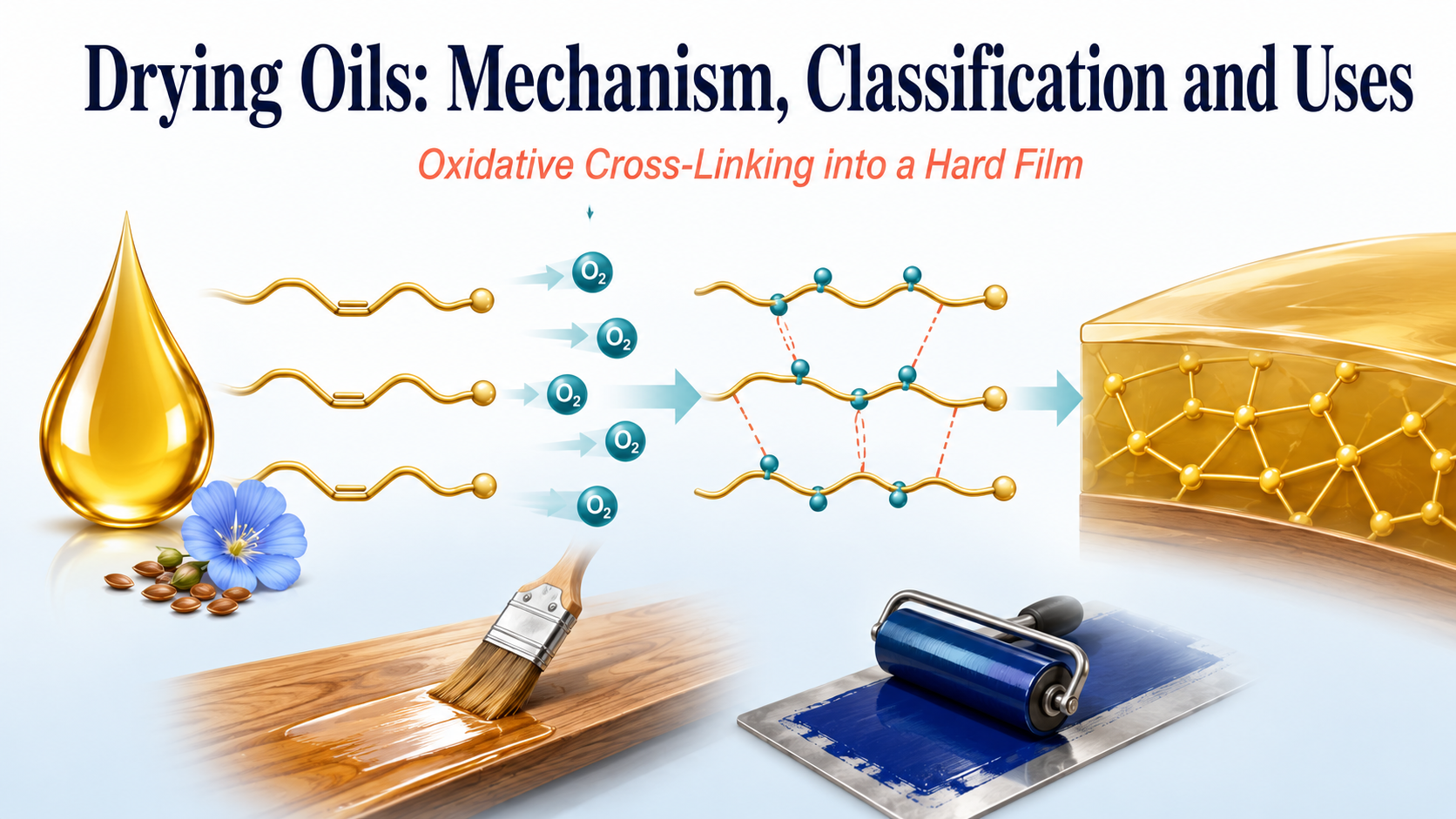
Drying oils are highly unsaturated fixed oils that absorb oxygen and form a hard, protective film. This property explains their use in paints, varnishes, printing inks and coatings. In this exam-oriented guide, you will learn the definition, free-radical drying mechanism, iodine-value classification, examples, factors, tests, applications and safety precautions in a simple sequence.
Definition and Key Idea
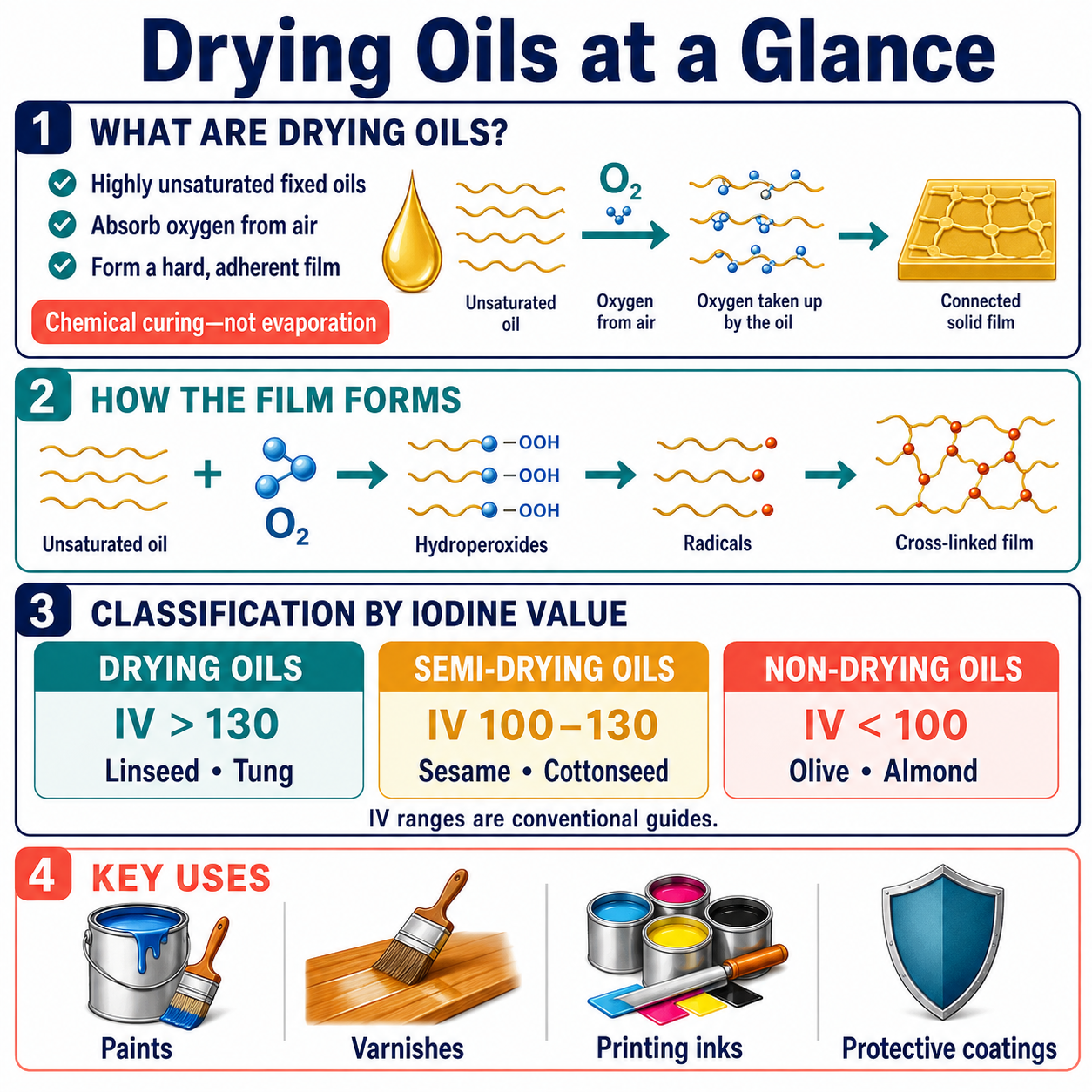
Drying oils are fixed oils that absorb oxygen from the atmosphere and gradually form a hard, dry, elastic and adherent film. They contain a high proportion of unsaturated, especially polyunsaturated, fatty-acid residues. When a thin layer contacts air, oxidation starts at reactive sites in the hydrocarbon chains. The resulting radicals connect different chains and produce a three-dimensional polymeric network.
| Exam definition A drying oil is a highly unsaturated fixed oil that absorbs atmospheric oxygen and forms a hard, adherent film through oxidative polymerization and cross-linking. |
The term “drying” can mislead students. Water does not leave the oil, and the triglycerides do not simply evaporate. Instead, the oil gains oxygen and undergoes a chemical curing process.
Why Do Some Oils Dry?
A triglyceride contains three fatty-acid chains attached to glycerol. When these chains contain several carbon–carbon double bonds, they also contain allylic and bis-allylic carbon–hydrogen bonds. Hydrogen abstraction at these positions produces resonance-stabilized lipid radicals. Oxygen then reacts with those radicals and begins a chain reaction.
| Fatty-acid pattern | Relative tendency | Reason |
| Mainly saturated chains | Very low | Few reactive allylic sites; poor oxygen uptake and cross-linking. |
| Mainly monounsaturated chains, such as C18:1 | Low | Some allylic reactivity, but fewer opportunities for network formation. |
| Rich in C18:2 and C18:3 chains | High | More reactive allylic/bis-allylic sites and more opportunities for radical coupling. |
| Conjugated polyunsaturated chains | Often very high | Conjugation can promote rapid oxidation and polymerization. |
Therefore, a higher degree of unsaturation usually increases iodine value and drying tendency. Nevertheless, iodine value does not predict exact drying time by itself. Conjugation, oxygen supply, catalysts, film thickness, temperature and antioxidants also change the rate.
Classification of Oils According to Drying Behavior
| Type | Common iodine-value guide | Behavior on air exposure | Examples |
| Drying oils | Above 130 | Form a firm, dry, elastic film | Linseed, tung, perilla and poppy-seed oils |
| Semi-drying oils | 100–130 | Thicken slowly; form a softer or slower film | Sesame, cottonseed, sunflower and often soybean oils |
| Non-drying oils | Below 100 | Remain greasy or liquid; do not form a useful hard film | Olive, almond, groundnut and castor oils |
Important note: These iodine-value limits are widely used teaching ranges, but exact boundaries and the position of borderline oils may vary among references because natural oil composition changes with variety, climate and processing.
Complete Mechanism of Drying of Oils
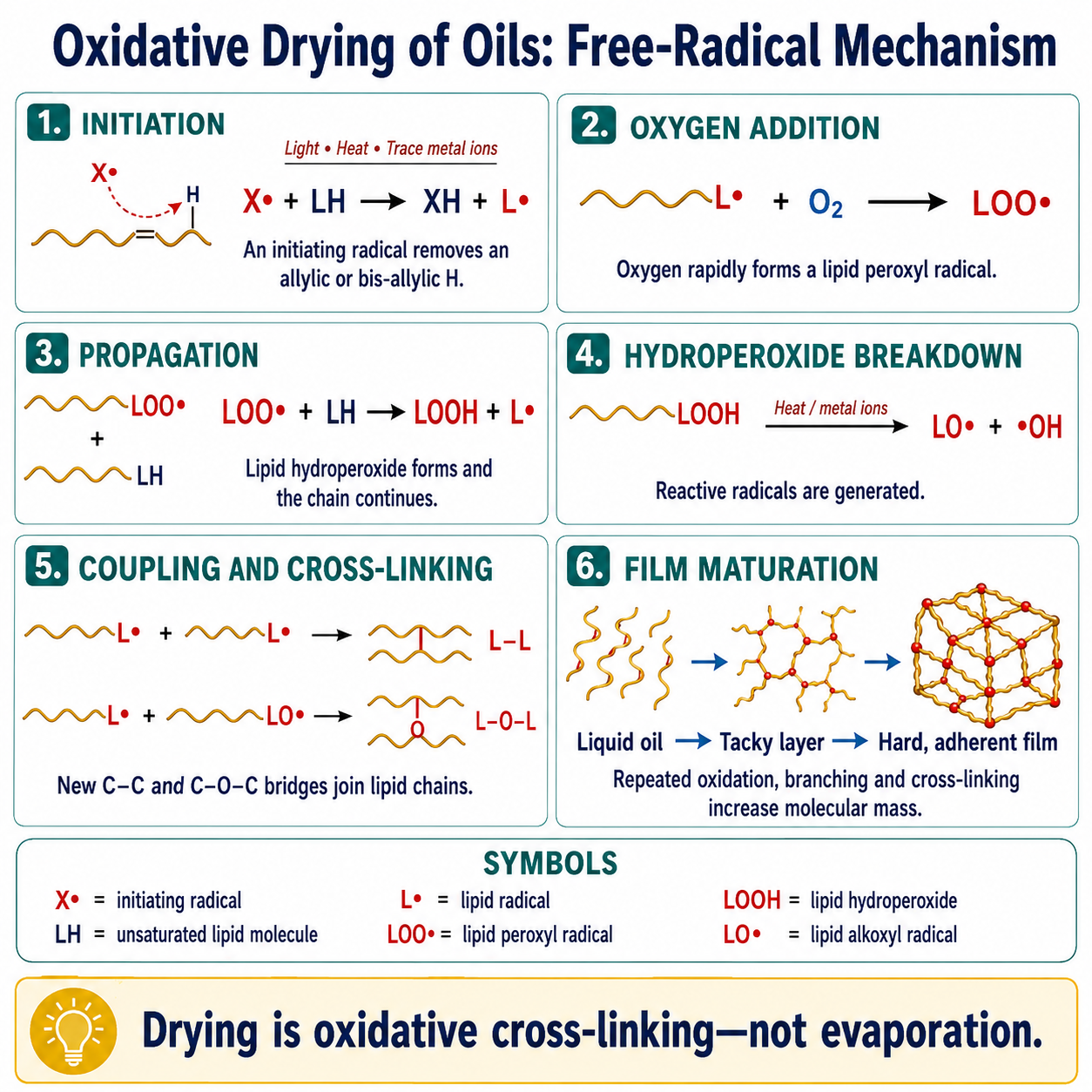
Let LH represent an unsaturated lipid chain. L• represents a lipid radical, LOO• a lipid peroxyl radical, LOOH a lipid hydroperoxide, and LO• a lipid alkoxyl radical.
Step 1: Initiation—formation of a lipid radical
Reaction X• + LH → XH + L•
(X• = initiating radical; initiation promoted by light, heat or trace metal ions)
A reactive species removes hydrogen from an allylic or bis-allylic position. The lipid radical becomes resonance-stabilized, and the chain reaction begins.
Step 2: Rapid addition of oxygen
Reaction L• + O₂ → LOO•
The carbon-centered lipid radical reacts rapidly with molecular oxygen and forms a lipid peroxyl radical.
Step 3: Propagation and hydroperoxide formation
Reaction LOO• + LH → LOOH + L•
The peroxyl radical removes hydrogen from another lipid molecule. Consequently, a lipid hydroperoxide forms and a new lipid radical continues the chain.
Step 4: Hydroperoxide decomposition
Representative reaction LOOH → LO• + •OH (accelerated by heat and metal ions)
Hydroperoxides are unstable. Their breakdown generates alkoxyl, peroxyl and other radicals. Metallic driers accelerate this step, so the number of reactive radical sites rises.
Step 5: Radical coupling and cross-linking
Representative reactions
L• + L• → L–L and L• + LO• → L–O–L
Radicals on different fatty-acid chains combine. Thus, new carbon–carbon and carbon–oxygen–carbon bridges connect triglyceride molecules. Additional radical addition near double bonds also promotes branching.
Step 6: Film maturation
Repeated oxygen uptake, branching and cross-linking increase molecular mass. The oil first becomes viscous and tacky; later, it forms a hard, insoluble, adherent polymeric film. Continued oxidation may eventually make an old film brittle or yellow.
| Mechanism flow Unsaturated lipid → lipid radical → peroxyl radical → hydroperoxide → reactive radicals → cross-linked film |
Factors That Affect the Drying Rate
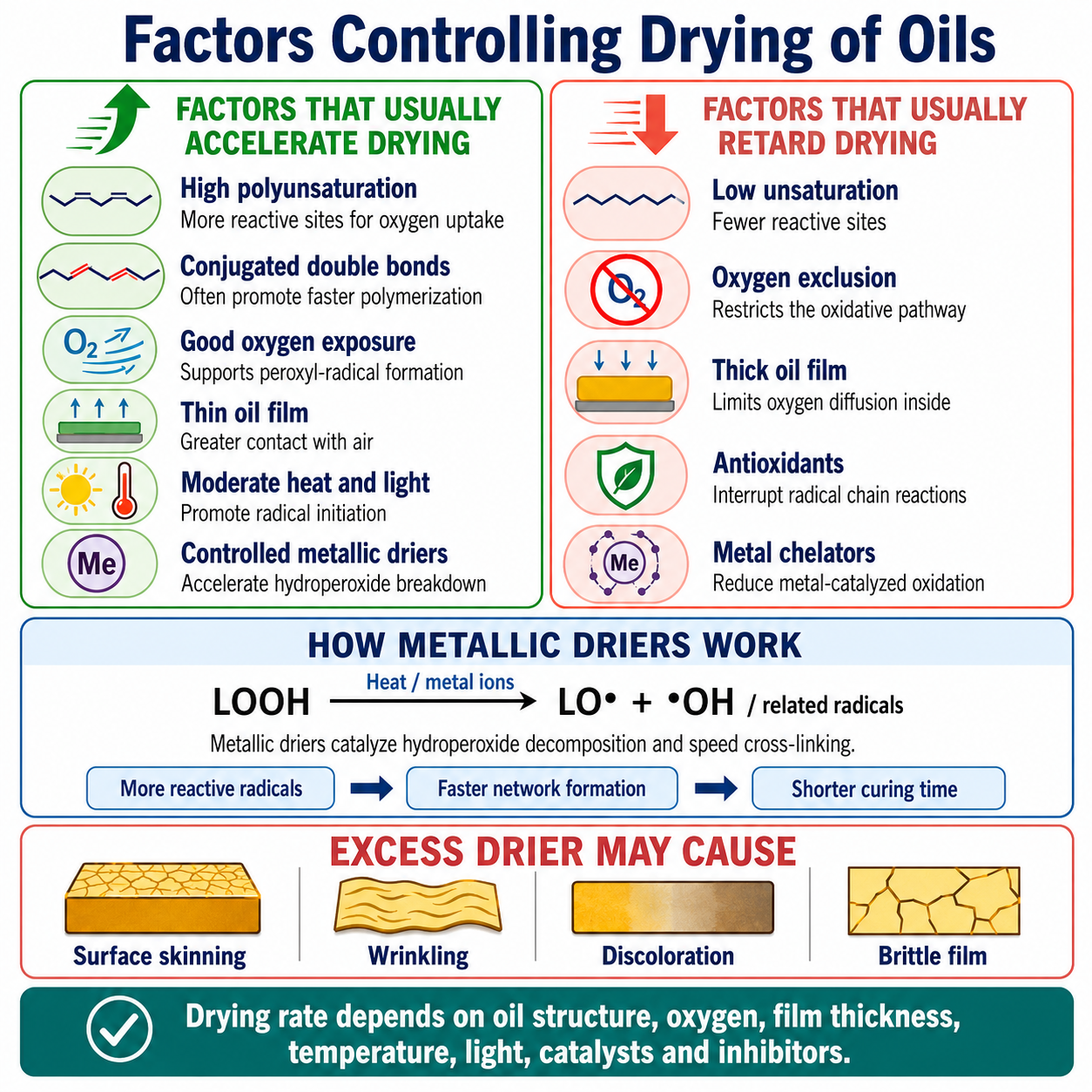
| Factor | Effect on drying |
| Unsaturation | A greater number of suitable unsaturated sites generally accelerates oxygen uptake and cross-linking. |
| Conjugated double bonds | Often increase reactivity and film formation; tung oil is a key example. |
| Oxygen supply | Good air contact promotes drying. Oxygen exclusion slows or stops the main oxidative pathway. |
| Film thickness | Thin films dry faster and more uniformly. Thick films may develop a surface skin while remaining soft inside. |
| Temperature | Moderate warming increases reaction rate; excessive heat may damage or discolor the film. |
| Light | Can initiate radical formation and accelerate oxidation. |
| Metallic driers | Cobalt, manganese, iron, zirconium or calcium compounds can catalyze hydroperoxide decomposition and shorten curing time. |
| Antioxidants and chelators | Interrupt radical chains or bind metals; therefore, they extend the induction period and retard drying. |
| Pigments and impurities | May catalyze or inhibit oxidation and can change film color, strength and uniformity. |
Metallic Driers: Function and Limitation
Metallic driers, also called siccatives, are metal-containing catalysts added in small controlled amounts to oil-based coatings. A siccative is a chemical substance or catalyst that accelerates the hardening and drying of oil-based paints, varnishes, and printing inks. They participate in redox reactions that accelerate hydroperoxide breakdown and radical generation. This makes the coating dry faster. Cobalt and manganese compounds commonly promote surface drying, while other metals can support through-drying or improve film properties.
Too much drier can produce rapid surface skinning, wrinkling, discoloration, poor internal curing or brittle films. In addition, formulators must follow current toxicological and regulatory requirements for particular metals. Therefore, a drier should never be described as a simple “drying agent” that absorbs water.
Tests and Evaluation of Drying Oils
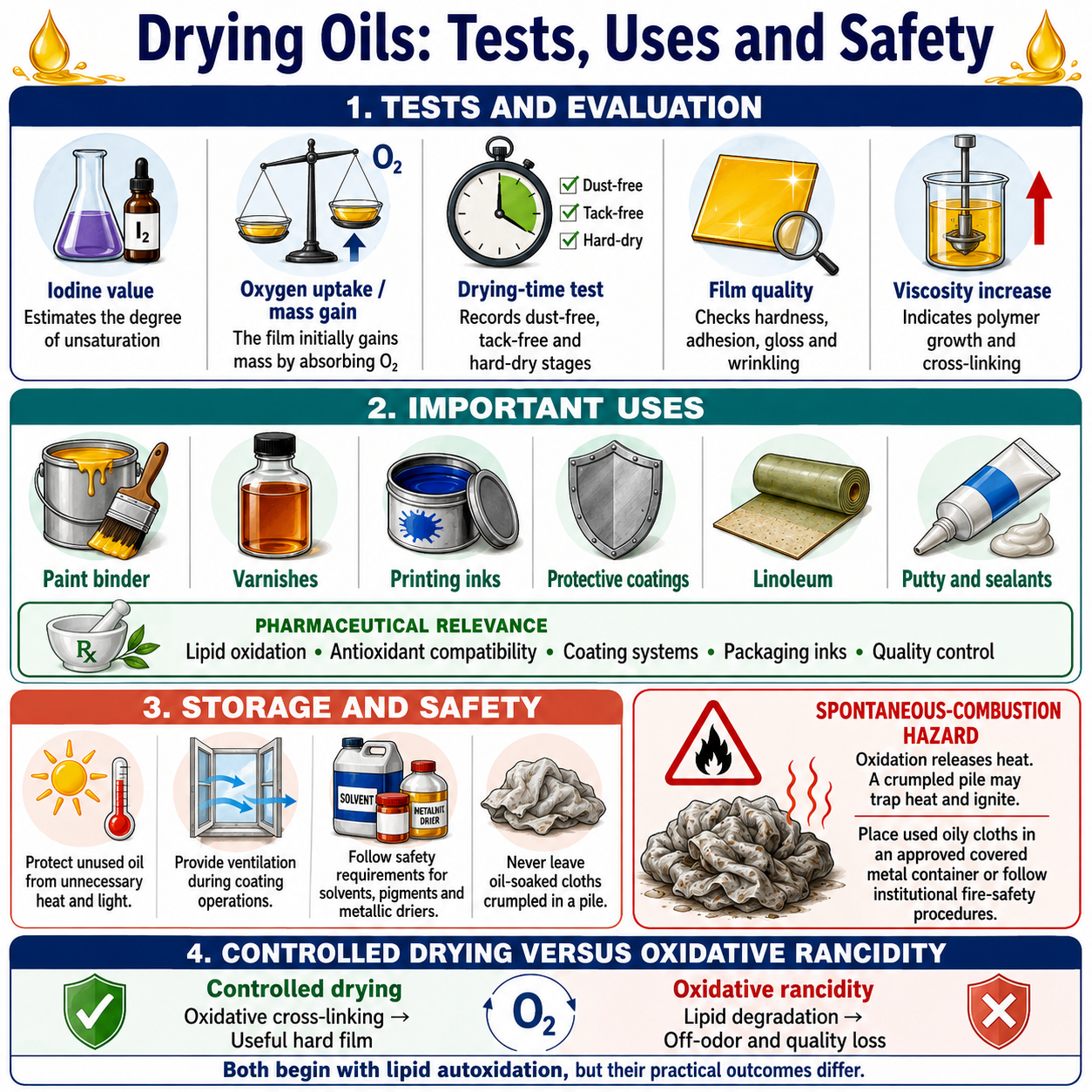
| Test / observation | Principle or interpretation |
| Iodine value | Measures the amount of halogen absorbed by unsaturation. A high value generally supports a higher drying tendency. |
| Oxygen uptake / mass gain | A thin oil film gains mass initially as it incorporates oxygen. |
| Drying-time test | Records the time required to reach dust-free, tack-free i.e. no longer sticky to the touch or hard-dry stages under defined conditions. |
| Film test on glass or metal | Examines tackiness, hardness, adhesion, gloss (a smooth, shiny surface), wrinkling and uniformity after exposure to air. |
| Viscosity change | Increasing viscosity indicates polymer growth and network formation. |
| Spectroscopic or instrumental analysis | Can monitor loss or rearrangement of double bonds, formation of peroxides and development of oxidation products. |
Drying Oils Versus Oxidative Rancidity
| Feature | Drying of oils | Oxidative rancidity |
| Starting event | Free-radical oxidation of unsaturated lipid chains | Free-radical oxidation of unsaturated lipid chains |
| Desired or undesired | Desired when used for controlled film formation | Undesired deterioration |
| Dominant practical result | Cross-linked, high-molecular-mass film | Off-odor, off-flavor, discoloration and quality loss |
| Products emphasized | Polymeric network and nonvolatile cross-links | Aldehydes, ketones, acids and other low-molecular-mass products |
| Control approach | Optimize oxygen, thickness, catalysts and curing conditions | Limit oxygen, light, heat and metals; use antioxidants and suitable packaging |
Examples of Important Drying Oils
Linseed oil
Linseed oil, obtained from flaxseed, contains a high proportion of α-linolenic-acid residues. It readily absorbs oxygen and forms a strong film. Therefore, industries use it in paints, varnishes, printing inks, linoleum and protective coatings. Boiled linseed oil is commonly processed or combined with driers to shorten curing time; it is not simply oil heated to its boiling point.
Tung oil
Tung oil contains eleostearic-acid residues with conjugated double bonds. It cures rapidly and produces a water-resistant, durable film. Consequently, it is valuable in varnishes and wood finishes.
Other examples
Perilla, poppy-seed and walnut oils can show drying behavior. Their exact performance depends on fatty-acid composition, refining and curing conditions.
Applications and Pharmaceutical Relevance
- Paints and varnishes: drying oils serve as film-forming binders and help pigments adhere to surfaces.
- Printing inks: oxidative curing fixes the printed layer to paper or another substrate.
- Protective coatings: cross-linked films resist moisture and provide surface protection.
- Linoleum and related materials: oxidized oil contributes to the solid binder matrix.
- Putty and sealants: oil-based systems harden after exposure to air.
- Pharmaceutical and laboratory relevance: the concept helps students understand oxidation of fixed oils, compatibility of antioxidants, behavior of oil-based coating or printing systems, packaging labels and storage of unsaturated excipients.
- Quality control: iodine value, peroxide formation, viscosity and drying-time behavior help characterize oils and detect changes during processing or storage.
| Balanced pharmaceutical point Drying oils are better known as industrial film-formers than as routine internal pharmaceutical vehicles. Their main pharmacy value lies in understanding lipid oxidation, excipient stability, coatings, packaging inks and quality evaluation. |
Storage and Safety Precautions
- Store bulk oil in well-closed, suitable containers away from unnecessary heat and light when premature oxidation is undesirable.
- Use antioxidants or inert-gas protection when the formulation requires storage stability before application.
- Provide ventilation during coating operations and follow the safety information for solvents, pigments and metallic driers.
- Do not leave oil-soaked cloths crumpled in open piles. Oxidation releases heat, and poor heat dissipation can lead to spontaneous combustion.
- Place used oily cloths in an approved covered metal container or handle them according to institutional fire-safety procedures.
Quick Comparison for Examination
| Point | Drying oil | Semi-drying oil | Non-drying oil |
| Typical Iodine Value | >130 | 100–130 | <100 |
| Film | Hard and coherent | Slow/soft or partial | No useful hard film |
| Unsaturation | Usually high | Intermediate | Usually lower |
| Example | Linseed | Sesame | Olive |