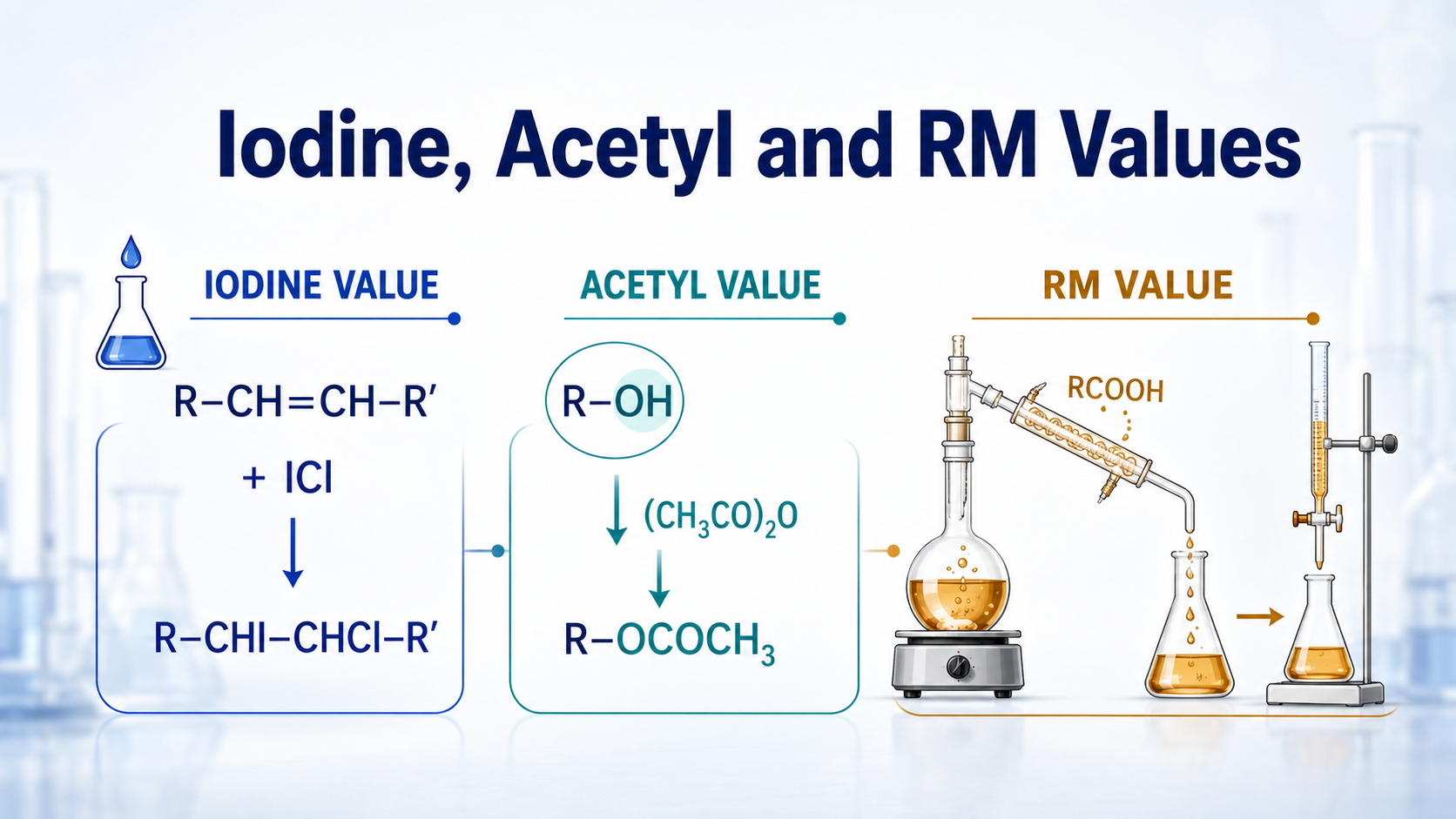
Iodine, Acetyl and Reichert–Meissl (RM) values are important analytical constants used to evaluate the structure, identity and quality of fats and oils. Iodine value estimates carbon–carbon unsaturation, acetyl value measures acetylatable hydroxyl groups, while RM value determines volatile, water-soluble fatty acids. Therefore, these values help characterize oils, assess processing changes and screen samples for possible adulteration. This article explains their principles, reactions, methods, calculations, applications and limitations through student-friendly notes, worked examples and infographics.
Quick Comparison of the Three Analytical Values
| Value | What it measures | Reported as | Major use |
| Iodine value | Degree of carbon-carbon unsaturation | g iodine absorbed by 100 g sample | Characterization, drying tendency, adulteration screening |
| Acetyl value | Free hydroxyl groups in the oil or fat | mg KOH equivalent to acetic acid from 1 g acetylated sample | Hydroxy-fatty-acid oils, especially castor oil |
| Reichert-Meissl (RM) value | Volatile, water-soluble fatty acids | mL of 0.1 N alkali for distillate from 5 g sample | Butter/ghee identity and adulteration screening |
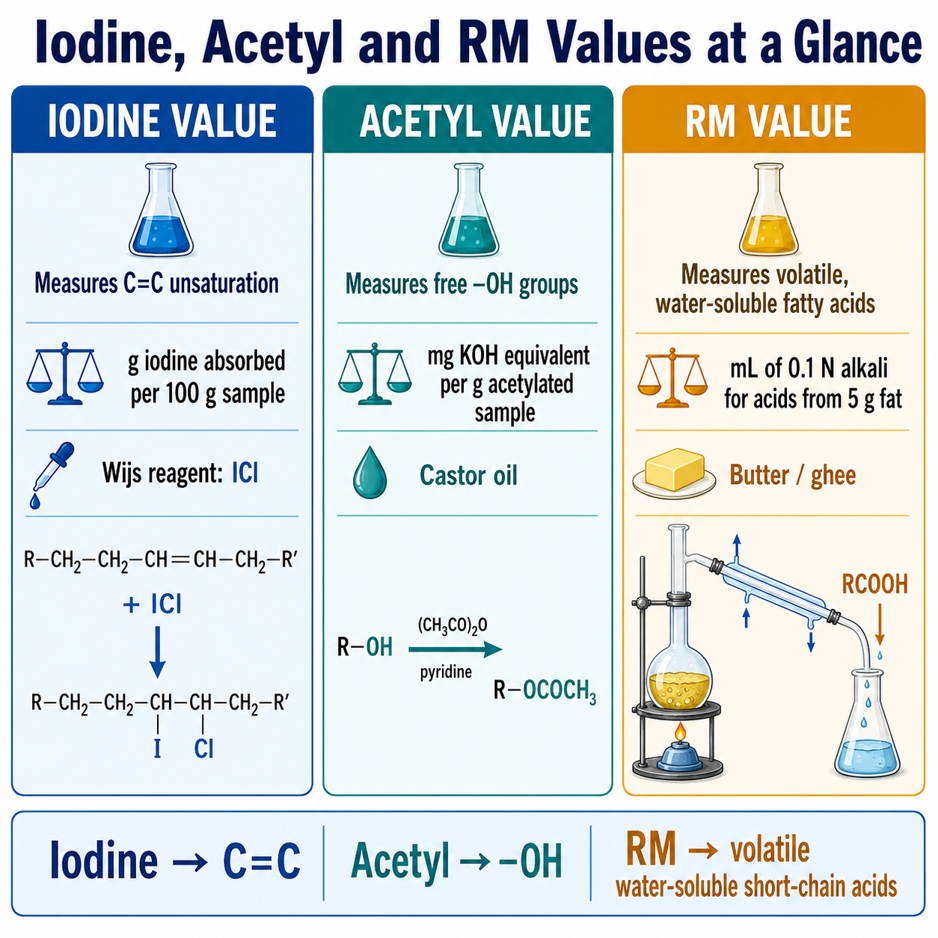
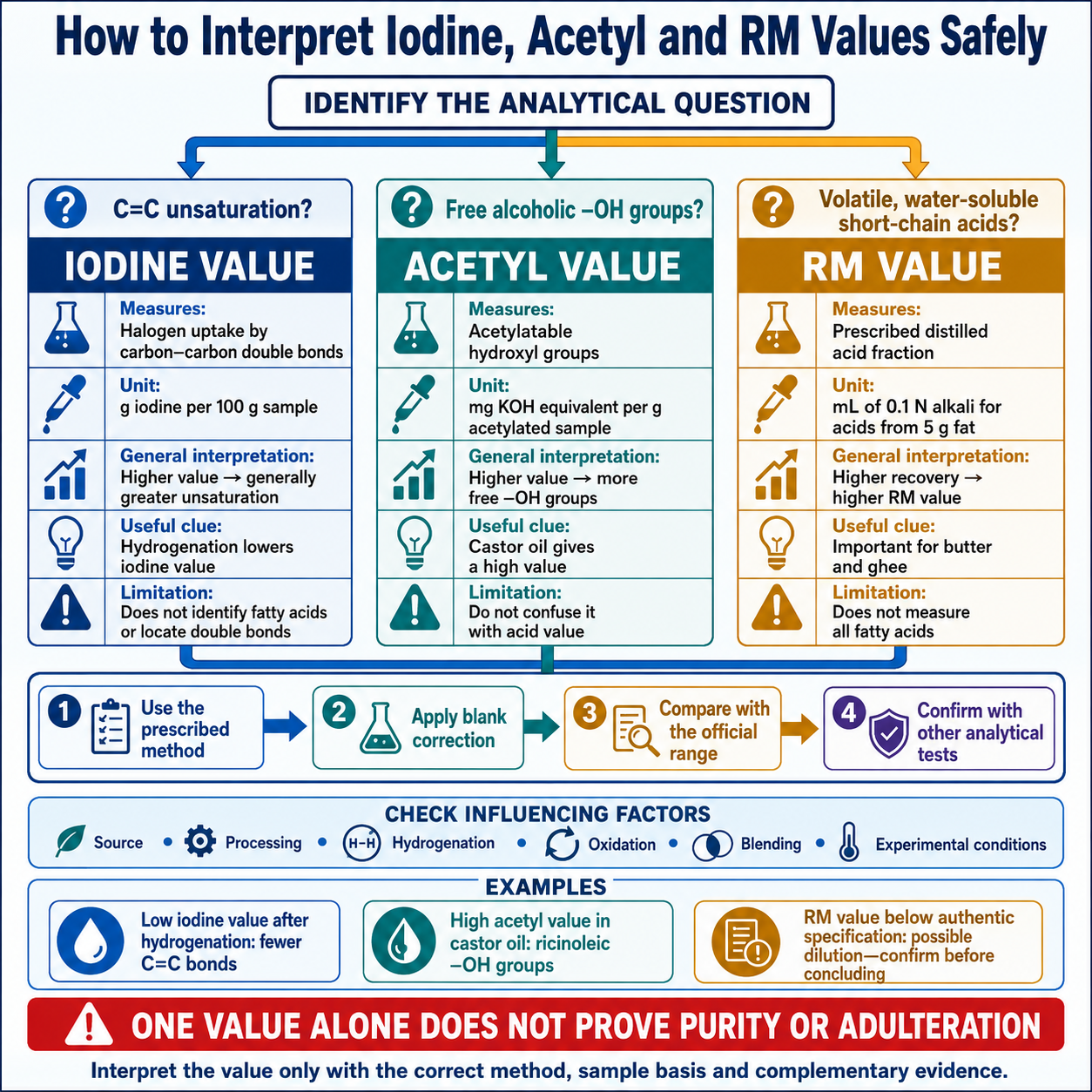
| Memory key: Iodine → C=C; Acetyl → –OH; RM → volatile water-soluble short-chain acids. |
How These Analytical Constants Should Be Used
An analytical value is a method-defined number rather than the concentration of one isolated compound. Therefore, compare a result with the official specification for the named oil, the stated method and other identity tests. Natural source, climate, processing, hydrogenation, oxidation and blending can change the result. A single value can support an identity decision, but it rarely proves authenticity on its own.
Structural Information Supplied by Each Value
| Question asked | Best value | What it cannot establish alone |
| How much C=C unsaturation is present? | Iodine value | Exact fatty-acid identity, C=C position or cis/trans configuration |
| How many acetylatable alcoholic –OH groups are present? | Acetyl value | Exact –OH location or identity of every hydroxy compound |
| How much prescribed volatile water-soluble acid fraction is recovered? | RM value | Complete fatty-acid composition or proof of milk-fat purity |
Iodine Value of Fats and Oils
Definition and Unit
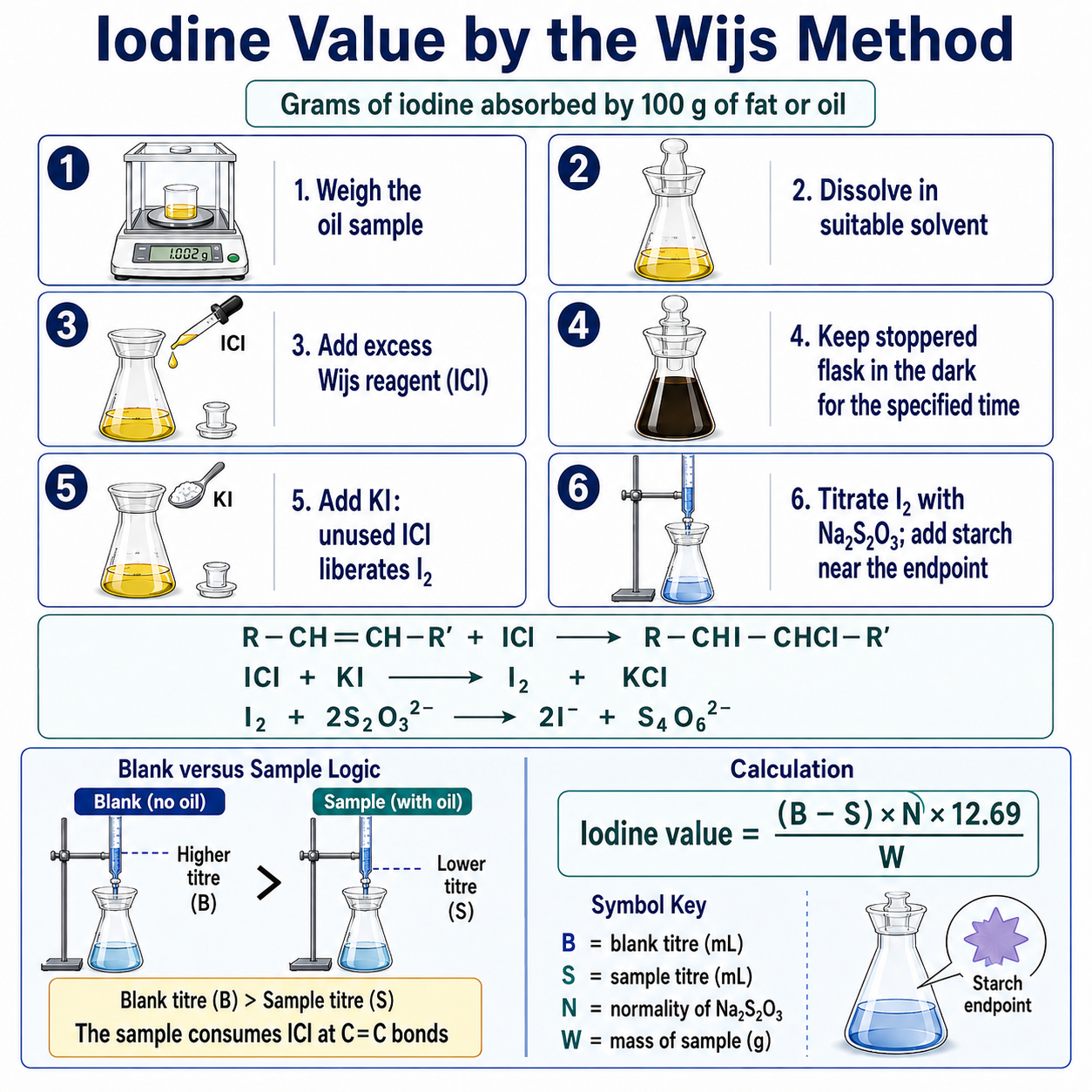
The iodine value is the number of grams of iodine absorbed by 100 g of a fat or oil under specified conditions. It is often called the iodine number. The result provides an operational measure of total unsaturation rather than an exact count or location of every double bond.
Why Unsaturated Oils Absorb Halogen Reagent
A carbon-carbon double bond contains a reactive π bond. In the Wijs method, iodine monochloride adds across this bond. Therefore, an oil with more accessible double bonds consumes more reagent and usually gives a higher iodine value.
R–CH=CH–R′ + ICl → R–CHI–CHCl–R′
| Interpretation: Higher iodine value generally means greater unsaturation. However, conjugation, oxidation, steric effects and method conditions can influence reagent uptake. |
Principle of the Wijs Method
1. Dissolve a known mass of oil in a suitable solvent.
2. Add a measured excess of Wijs reagent (ICl in glacial acetic acid).
3. Keep the stoppered flask protected from light for the specified reaction time.
4. Add potassium iodide. It converts unused ICl into iodine.
5. Titrate the liberated iodine with standard sodium thiosulfate. Add starch near the endpoint.
6. Run a reagent blank under identical conditions. Calculate uptake from B − S.
ICl + KI → I₂ + KCl
I₂ + 2Na₂S₂O₃ → 2NaI + Na₂S₄O₆
Calculation of Iodine Value
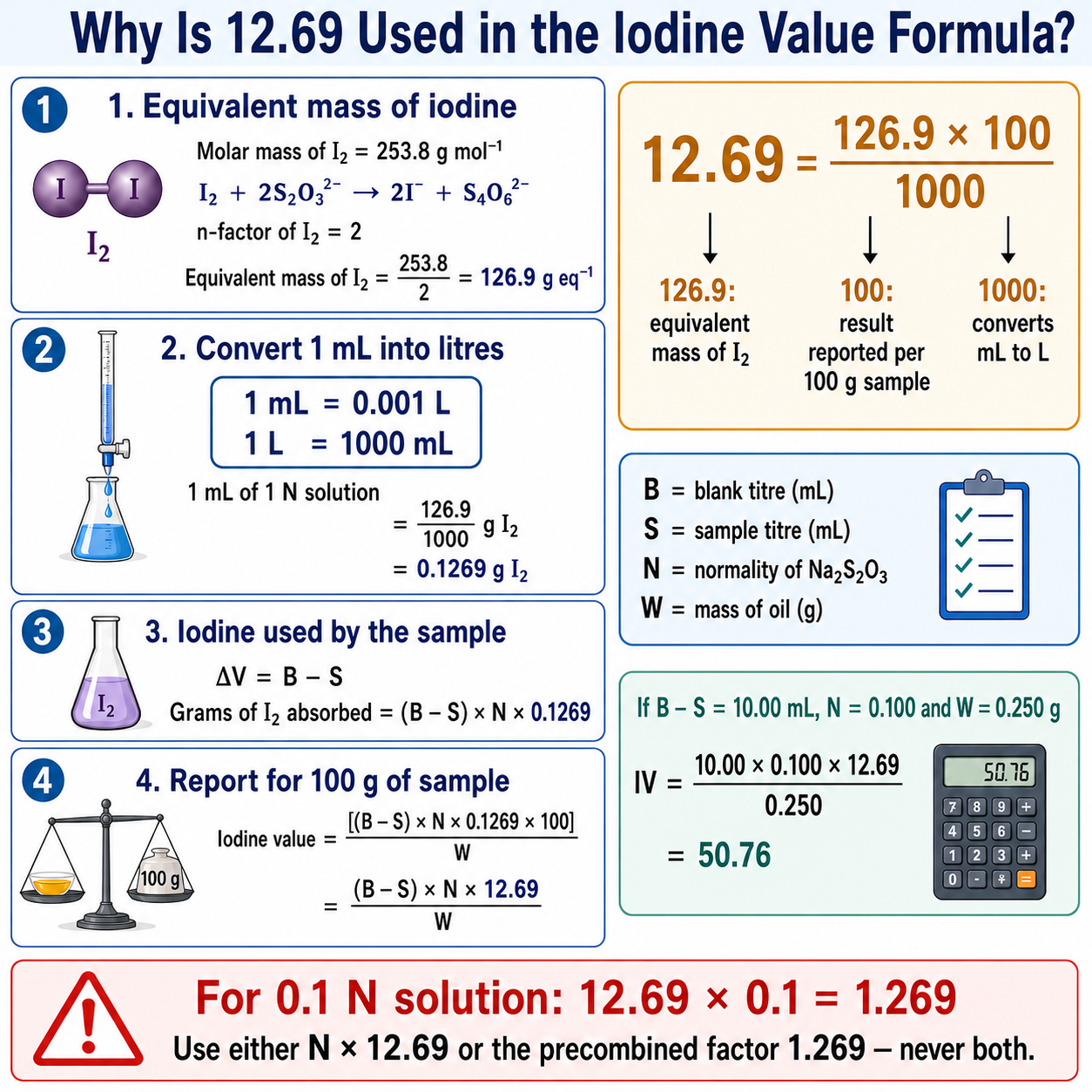
Iodine value = (B − S) × N × 12.69 / W
| Symbol | Meaning |
| B | Blank titre of sodium thiosulfate, mL |
| S | Sample titre of sodium thiosulfate, mL |
| N | Normality of sodium thiosulfate |
| W | Mass of sample, g |
| 12.69 | Factor derived from iodine equivalent mass and the 100 g reporting basis |
Worked Example
A 0.250 g oil sample requires 14.80 mL of 0.100 N Na₂S₂O₃, whereas the blank requires 24.60 mL.
IV = (24.60 − 14.80) × 0.100 × 12.69 / 0.250
IV = 49.74
Thus, the iodine value is 49.74 g iodine per 100 g oil. Compare this result with the specified range for the stated oil before drawing an identity or purity conclusion.
Significance, Applications and Limitations
- Classifies oils broadly by unsaturation and drying tendency.
- Supports raw-material identity and batch comparison.
- Helps detect some substitutions when combined with other constants.
- Indicates susceptibility to oxidation because highly unsaturated oils often oxidize more readily.
- Does not identify the individual fatty acids or positions/configurations of double bonds.
- Cannot prove purity by itself; official specifications and complementary analyses remain necessary.
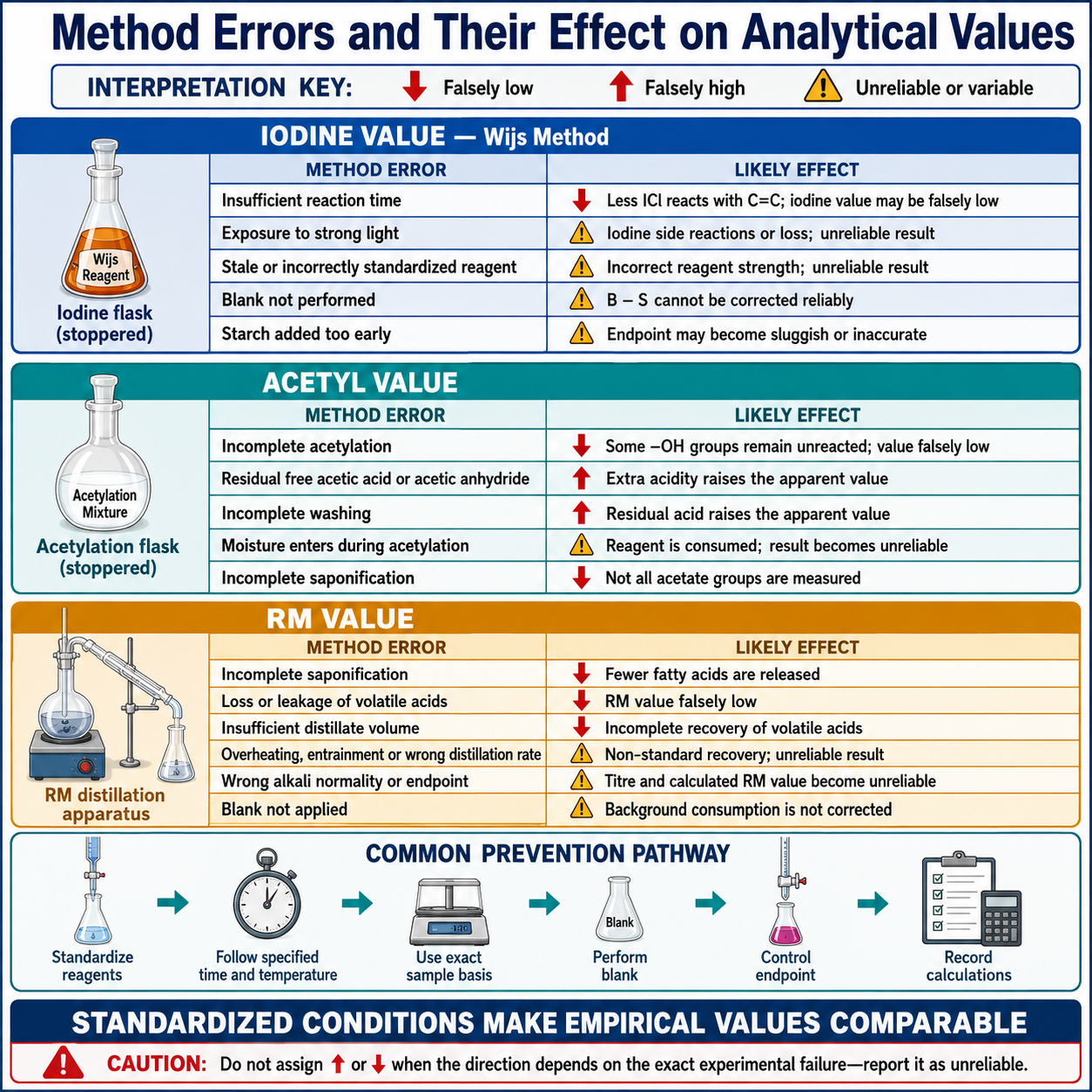
Precautions in the Wijs Method
- Use clean, dry glassware and a fresh standardized reagent.
- Maintain the prescribed solvent, reagent excess, time and temperature.
- Protect the reaction mixture from light.
- Run the blank alongside the sample.
- Add starch near the endpoint, not while iodine concentration is very high.
- Titrate promptly after adding KI and water.
Factors That Change the Iodine Value
| Factor | Influence and explanation |
| Number of C=C bonds | More double bonds generally increase halogen uptake and iodine value. |
| Hydrogenation | Consumption of C=C bonds lowers iodine value. |
| Oxidative deterioration | Reaction at double bonds may lower the measured value; the effect depends on oxidation stage. |
| Conjugation and accessibility | Empirical uptake may differ from a simple theoretical double-bond count. |
| Light, reaction time or deteriorated reagent | Causes systematic error and poor reproducibility. |
Iodine Value and Drying Behaviour
Oils rich in polyunsaturated chains absorb oxygen and form cross-linked films more readily. Consequently, iodine value supports broad classification into non-drying, semi-drying and drying oils. However, textbook boundaries vary, while fatty-acid distribution, conjugation, catalysts and processing also affect film formation. Use iodine value as a comparative indicator rather than an absolute film-performance test.
Theoretical Versus Experimental Iodine Value
A theoretical iodine value can be estimated from composition because one mole of an isolated C=C bond consumes one mole of iodine equivalent. The experimental Wijs value remains method-dependent. Modern standards may describe calculation from fatty-acid composition, but a calculated result does not replace the prescribed experiment when an official monograph requires testing.
Acetyl Value of Fats and Oils
Definition and Structural Meaning
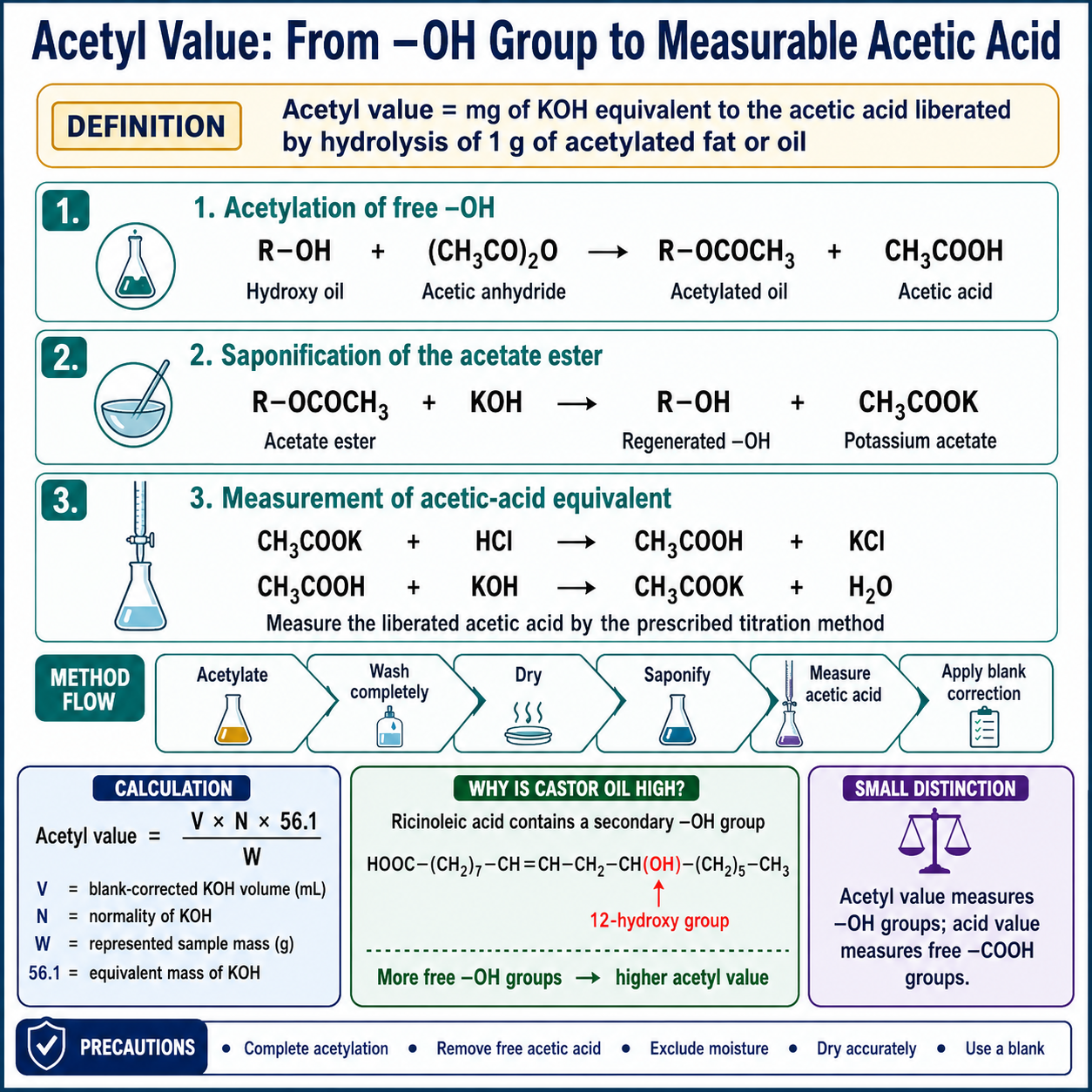
Acetyl value is the number of milligrams of KOH equivalent to the acetic acid liberated by saponification of 1 g of an acetylated fat or oil. It therefore estimates free alcoholic hydroxyl groups that were present before acetylation.
Principle and Reactions
Acetic anhydride converts each accessible –OH group into an acetate ester. After removal of free acetic acid and excess reagent, saponification cleaves the acetate group. The resulting acetic acid, or its alkali equivalent, is then measured by the prescribed procedure.
R–OH + (CH₃CO)₂O → R–OCOCH₃ + CH₃COOH
R–OCOCH₃ + KOH → R–OH + CH₃COOK
Experimental Outline
1. Heat the sample with acetic anhydride under the specified conditions.
2. Wash thoroughly to remove unreacted reagent and free acetic acid.
3. Dry the acetylated product; incomplete washing falsely raises the result.
4. Saponify a known amount of the acetylated sample.
5. Determine the acetic acid liberated using the official method and apply blank correction.
6. Calculate the KOH equivalent per gram of represented acetylated sample.
Calculation
Acetyl value = V × N × 56.1 / W
Here, V is the blank-corrected volume (mL) of KOH corresponding to liberated acetic acid, N is KOH normality, W is represented sample mass (g), and 56.1 is the equivalent mass of KOH in mg per milliequivalent. Because official procedures may define the represented mass and corrections differently, always use the formula stated in the method being followed.
Worked Example
A 1.20 g represented portion gives a corrected titre of 3.60 mL with 0.100 N KOH.
Acetyl value = 3.60 × 0.100 × 56.1 / 1.20 = 16.83 mg KOH g⁻¹
Why Castor Oil Has a High Acetyl Value
Castor oil contains a large proportion of triacylglycerols rich in ricinoleic-acid residues. Ricinoleic acid contains a secondary hydroxyl group in addition to its carboxyl group and double bond. These –OH groups undergo acetylation; therefore, castor oil gives a much higher acetyl value than ordinary non-hydroxylated oils.
Applications, Limitations and Precautions
- Identifies and evaluates oils containing hydroxy fatty acids.
- Supports characterization of castor oil and related materials.
- Can reveal substitution with low-hydroxyl oils when used with other tests.
- Does not reveal the position of –OH groups or distinguish every hydroxy compound.
- Remove free acetic acid completely, prevent moisture entry, dry the acetylated oil and perform an accurate blank.
Acetyl, Hydroxyl and Acid Values: Do Not Confuse Them
| Value | Reactive group or fraction | Core measurement |
| Acetyl value | Acetylatable alcoholic –OH groups | KOH equivalent of acetic acid released from acetylated sample |
| Hydroxyl value | Free hydroxyl groups | KOH equivalent related to acylation of –OH by a standardized method |
| Acid value | Free carboxylic acids | Direct KOH needed to neutralize free acidity |
All three may involve mg KOH per gram, but their chemical meanings differ. A method may also require acid-value or blank corrections. Therefore, use the exact formula specified by the adopted official procedure rather than combining formulas from different protocols.
Sources of Error in Acetyl-Value Determination
- Incomplete acetylation leaves some –OH groups unmeasured and lowers the result.
- Residual acetic anhydride or free acetic acid raises the apparent result.
- Moisture consumes acetic anhydride and changes effective reagent strength.
- Loss of sample during washing changes the represented mass.
- Incomplete saponification or inaccurate blank correction biases the titre.
Reichert-Meissl (RM) Value
Definition and Scope
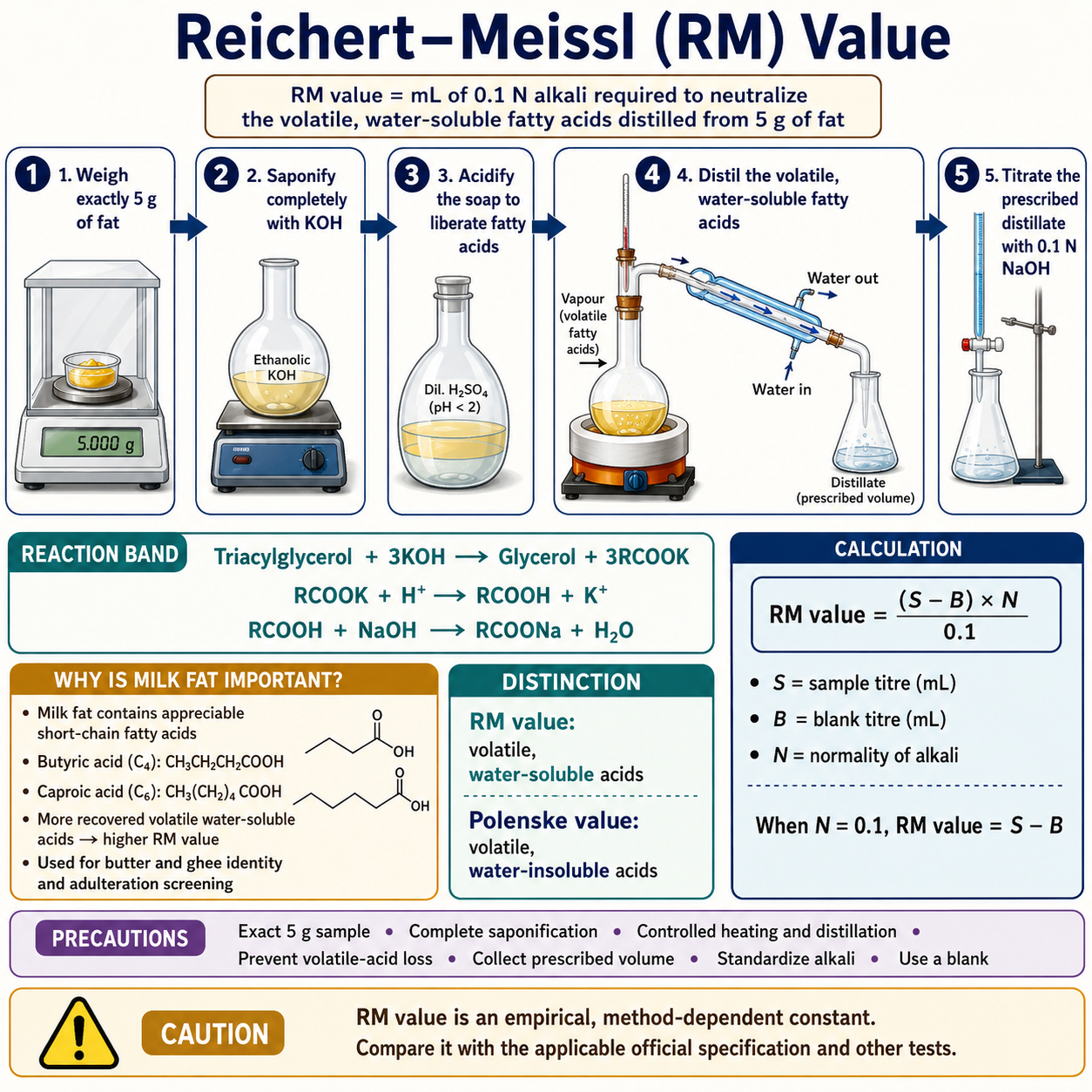
The Reichert-Meissl value is the number of millilitres of 0.1 N alkali needed to neutralize the volatile, water-soluble fatty acids obtained from 5 g of fat under the prescribed procedure. The method is especially important for milk fat because it contains appreciable short-chain fatty acids, notably butyric and caproic acids.
Why Short-Chain Acids Can Be Separated
After saponification, mineral acid releases fatty acids from their soaps. Short-chain acids have greater volatility and water solubility than long-chain acids. Controlled distillation therefore transfers a defined part of this fraction into the distillate, which is titrated with standard alkali.
Principle and Main Reactions
Triacylglycerol + 3KOH → Glycerol + 3RCOOK
RCOOK + H⁺ → RCOOH + K⁺
RCOOH + NaOH → RCOONa + H₂O
Stepwise RM Method
1. Accurately weigh 5 g of melted, filtered fat.
2. Saponify it completely using the prescribed glycerol-alkali or official reagent system.
3. Add water, then acidify to release fatty acids.
4. Distil under the specified apparatus, rate and volume conditions.
5. Filter the distillate when required and titrate the prescribed aliquot/fraction with 0.1 N alkali using the specified indicator.
6. Perform a blank and apply the official correction.
Calculation and Worked Example
RM value = (S − B) × N / 0.1
This general expression applies when the prescribed 5 g sample and complete official distillate procedure are used. S = sample titre (mL), B = blank titre (mL), and N = alkali normality. If N = 0.1, the corrected titre is numerically equal to RM value.
Example: S = 27.40 mL, B = 0.30 mL and N = 0.100 N.
RM value = (27.40 − 0.30) × 0.100 / 0.100 = 27.10
Significance and Interpretation
- Authentic butterfat and ghee generally show a distinctly higher RM value than most common vegetable oils because of their short-chain fatty acids.
- A lower-than-expected result may suggest dilution with a fat containing fewer volatile water-soluble acids; however, analysts must compare it with the applicable official standard.
- Coconut and palm-kernel oils contain several shorter fatty acids but their fatty-acid distribution and water solubility differ; RM value must not be interpreted alone.
- Use RM value together with other constants, chromatographic profiles and authenticity tests when regulatory certainty is required.
Why Butyric Acid Strongly Influences RM Value
Butyric acid has a short four-carbon chain. Compared with long-chain fatty acids, it is more water-soluble and more readily carried with steam during prescribed distillation. Milk fat contains butyrate residues that are uncommon at comparable levels in most vegetable oils. Their recovery therefore contributes strongly to the characteristic RM response of butterfat and ghee.
RM Value Versus Polenske Value
| Feature | RM value | Polenske value |
| Fraction measured | Volatile, water-soluble fatty acids | Volatile, water-insoluble fatty acids |
| Analytical portion | Filtered aqueous distillate under prescribed conditions | Water-insoluble volatile-acid fraction recovered by the prescribed method |
| Main teaching use | Milk-fat identity and ghee/butter screening | Complementary information for fats rich in volatile insoluble acids |
Both are empirical constants. The water-soluble versus water-insoluble distinction is essential; writing “all volatile fatty acids” for RM value is incomplete.
Factors That Affect RM Results
- Exact 5 g sample mass and complete saponification.
- Acid strength and complete release of fatty acids from soaps.
- Apparatus geometry, heating rate, distillation time and collected volume.
- Loss of volatile acids, leakage, entrainment or incomplete transfer.
- Filtration, aliquot selection, endpoint, alkali standardization and blank correction.
- Natural milk-fat composition, feeding, season, adulteration and blending.
Critical Precautions
- Use exactly the prescribed sample mass, apparatus, heating rate, distillation time and collected volume.
- Ensure complete saponification before acidification.
- Prevent loss of volatile acids and avoid bumping or entrainment.
- Standardize the alkali and perform a blank.
- Do not substitute a casual distillation procedure; RM is an empirical value defined by controlled conditions.
Integrated Comparison
| Feature | Iodine value | Acetyl value | RM value |
| Structural target | C=C bonds | Free alcoholic –OH groups | Volatile water-soluble fatty acids |
| Core chemical event | Addition of ICl | Acetylation then saponification | Saponification, acidification, distillation |
| Measurement | Back titration of unused halogen | KOH equivalent of liberated acetic acid | Alkali titre of distillate |
| Typical clue | Unsaturated/drying oils | Castor oil | Butter/ghee |
| Main limitation | No fatty-acid identity or C=C location | No –OH location or compound identity | Strongly method-dependent empirical fraction |
Common Errors to Avoid
- Do not write mg KOH/g as the unit of iodine value.
- Do not confuse acetyl value with acid value or saponification value.
- Do not describe RM acids as all volatile fatty acids; the definition specifies the volatile, water-soluble fraction recovered under standard conditions.
- Do not omit the blank, sample basis or reagent normality from a calculation.
- Do not claim adulteration from a single result without comparing official limits and confirmatory evidence.