
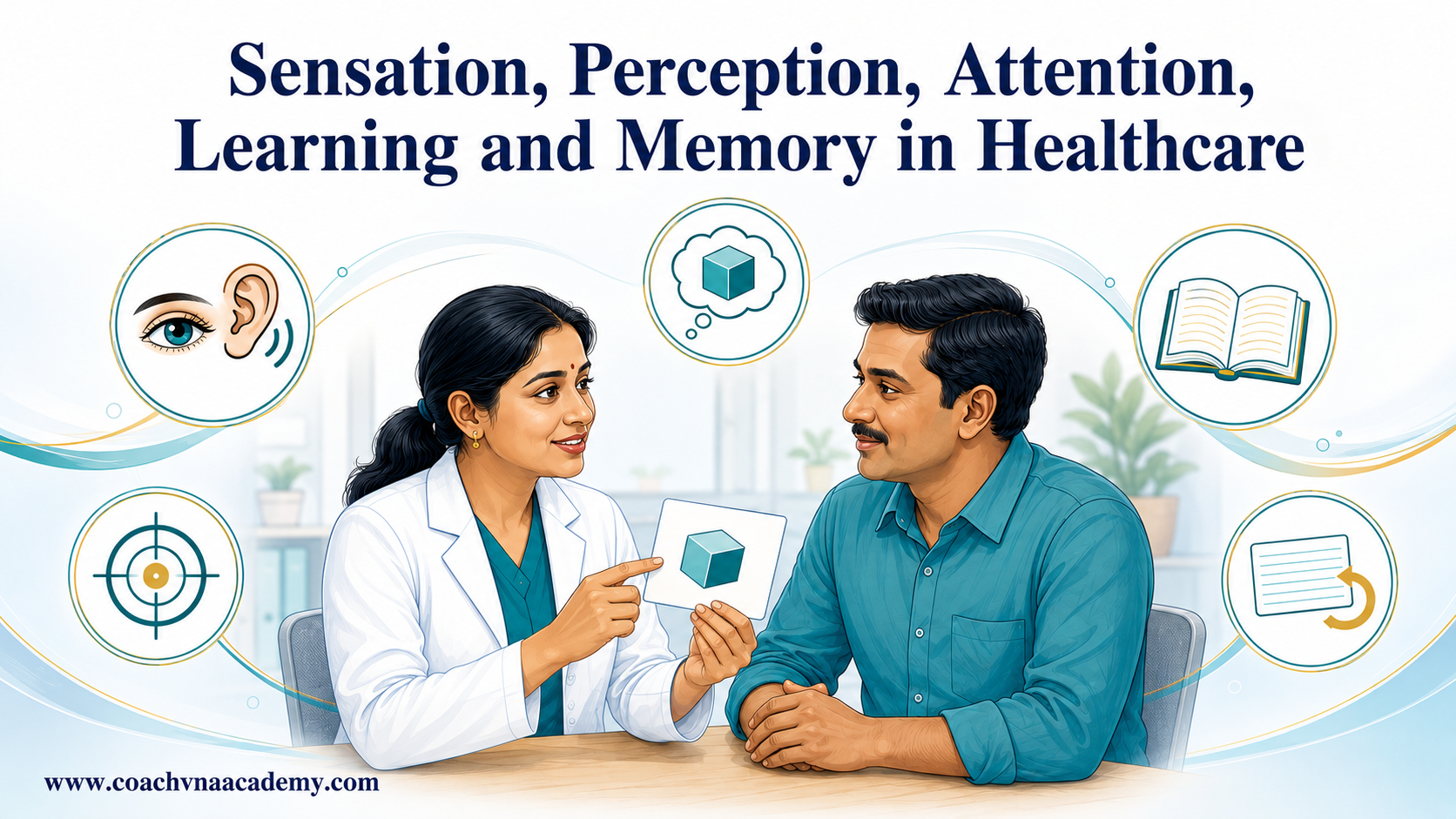
Patients may hear a healthcare explanation yet struggle to understand, remember, or use it later. Sensation, perception, attention, learning, and memory help explain these differences. Reinforcement adds another perspective by showing how consequences influence future behavior. This lecture connects these psychological processes with familiar pharmacy situations so that students can understand the concepts and communicate more clearly and respectfully.
Sensation: Detecting Information
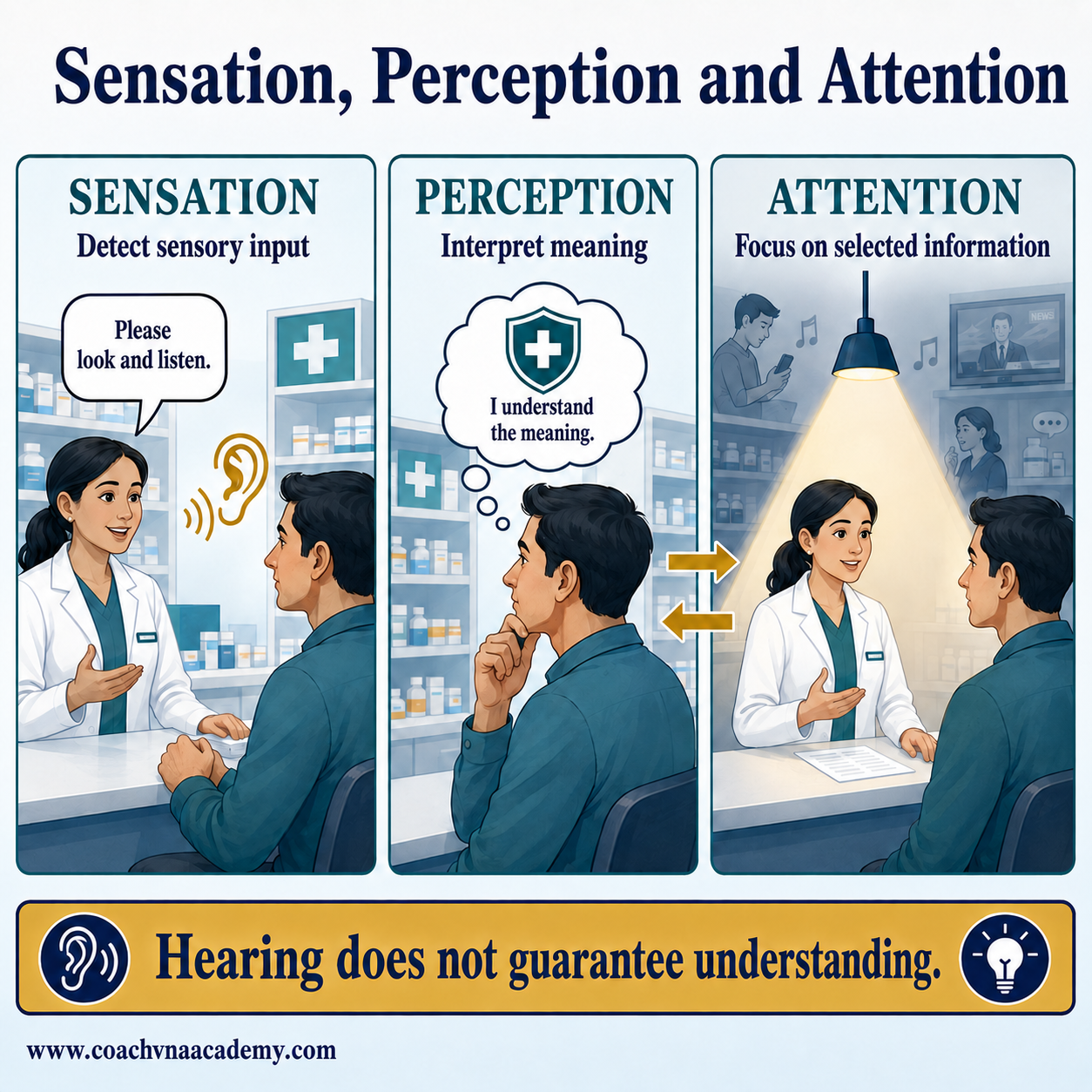
Sensation is the process through which sensory receptors detect stimulation and the nervous system receives information about it. Light, sound, pressure, temperature and chemicals provide different kinds of sensory input. For example, a patient sees printed words on a label and hears a pharmacist speaking. These sensory events provide information, but they do not by themselves show that the patient understands the message.
Sensory transduction converts physical or chemical stimulation into neural signals. For this introductory lecture, the key idea is detection: the information must first be accessible. Small print, poor contrast, background noise or an unaddressed sensory difficulty can obstruct communication before a detailed explanation begins.
Thresholds and adaptation
An absolute threshold is the minimum stimulation detected on about half of the occasions under specified conditions. A difference threshold is the smallest detectable change between stimuli, also defined probabilistically. These are laboratory concepts, not fixed cutoffs that a pharmacist should estimate by observing a patient. Sensory adaptation means reduced sensitivity during continuing, relatively unchanging stimulation, such as becoming less aware of a constant odor.
In healthcare communication, check access instead of assuming it. Ask whether the person can comfortably read the material or hear the explanation, offer an appropriate accessible format, and reduce avoidable noise. Speaking more loudly does not solve every difficulty; language, meaning and attention may also require support.
Perception: Giving Meaning to Information
Perception organizes and interprets sensory information. A sound may become a meaningful sentence, while a printed symbol may become a warning in the reader’s mind. Consequently, two people can encounter the same information but interpret it differently. Prior experience, expectations, language, culture, context and current concerns can influence the meaning they assign.
Bottom-up and top-down processing
Bottom-up processing begins with features of incoming information. A patient notices the letters, color and arrangement on an appointment card and identifies its contents. Top-down processing uses existing knowledge and expectations to interpret information. A patient who previously experienced a difficult consultation may expect another explanation to be alarming. Both forms of processing contribute to everyday perception; neither proves that a person’s interpretation is accurate.
Clear layout can support perception. Readers tend to group nearby items and similar-looking elements, so instructions placed too close together may appear to belong to one step. Separate distinct messages, use familiar terms, and explain unfamiliar symbols. Color alone should not carry an essential meaning because people differ in color perception and displays may change colors.
CONCEPT CLARITY: A perceptual interpretation is not the same as the external message. Explore what a patient understood before correcting an assumed misunderstanding. Do not infer a diagnosis from one unusual interpretation.
Attention: Selecting and Sustaining Focus
Attention directs mental resources toward selected information or activity. During a pharmacy conversation, a patient may focus on the explanation, a ringing phone, pain, or a worry about returning to work. Because attention is limited, several competing demands can reduce the information available for meaningful learning.
Main forms of attention
Selective attention involves focusing on relevant information while other inputs compete. Sustained attention maintains focus over time, such as during a short demonstration. Divided attention attempts to manage more than one task at once; performance often suffers when tasks demand the same limited resources. Alternating attention shifts focus between tasks, such as looking at a written plan and then listening to an explanation.
Novelty, contrast, personal relevance and a clear purpose can attract attention. However, fatigue, distress, discomfort, interruptions and unfamiliar language can make focus harder. These influences vary across people and situations. A missed detail therefore should not automatically be interpreted as disinterest or low ability.
| Process | Main function | Healthcare example |
| Sensation | Detect stimulation | Hears the spoken instruction. |
| Perception | Interpret meaning | Understands what the instruction means. |
| Attention | Prioritize information | Focuses on the explanation despite nearby noise. |
These processes interact rather than operate as completely separate steps. For example, attention can change which details a patient notices, while expectations can influence interpretation. A practical explanation should therefore be accessible, meaningful and focused.
Learning: Change Through Experience and Practice
Learning is a relatively lasting change in knowledge, skill, understanding or behavior that develops through experience or practice. Simply hearing a message once does not establish learning. Similarly, a temporary change caused only by fatigue or a brief change in alertness is not sufficient evidence of learning. Healthcare education aims to support understanding and usable skills, not merely exposure to information.
Classical conditioning: Learning associations
Classical conditioning occurs when a previously neutral cue / signal becomes associated with a stimulus that naturally evokes a response. After learning, the cue itself may evoke a similar response. Ivan Pavlov’s work provides the traditional experimental foundation. In a fictional healthcare example, a treatment room initially has little emotional meaning. Repeated experiences involving a frightening procedure may lead the room itself to evoke apprehension before the procedure begins.
| Element | Meaning in the fictional example |
| Unconditioned stimulus (US) | Frightening or painful procedure. |
| Unconditioned response (UR) | Immediate fear or distress associated with that procedure. |
| Neutral stimulus (NS) | Treatment-room cue before the association develops. |
| Conditioned stimulus (CS) | Treatment-room cue after the association develops. |
| Conditioned response (CR) | Learned apprehension when encountering the cue. |
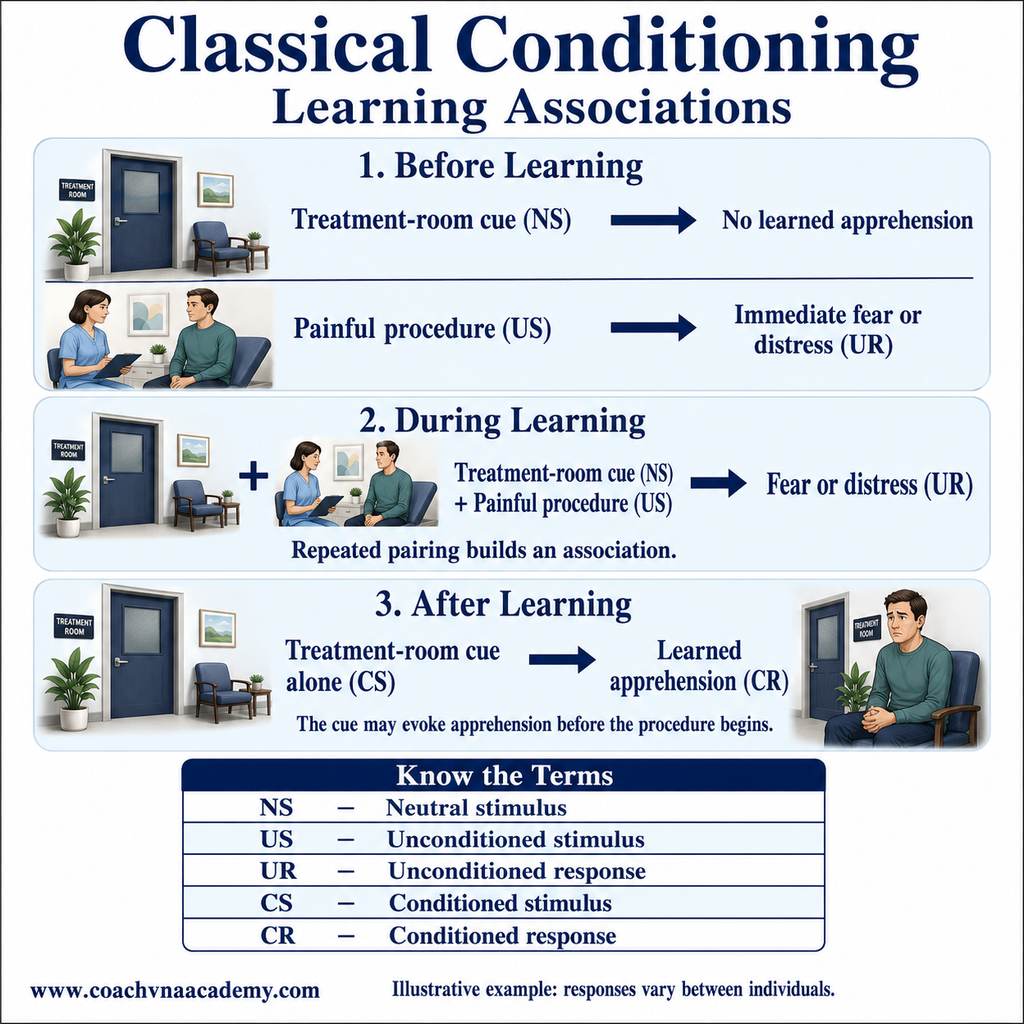
Acquisition is the initial stage of classical conditioning in which a person learns an association between a previously neutral cue or signal and a stimulus that naturally produces a response. For example, a patient may gradually associate a treatment room with a painful procedure and begin to feel apprehensive when entering the room. Generalization occurs when similar cues evoke a response; discrimination occurs when responses differ between cues.
| Concept | Simple meaning | Healthcare example |
|---|---|---|
| Generalization | The learned response extends to similar cues. | After associating one treatment room with a painful procedure, a patient may also feel apprehensive in other similar-looking treatment rooms, even without a painful experience there. |
| Discrimination | The person learns that different cues predict different experiences. | The patient learns that one room is used for painful procedures, while another is used for counseling. They feel apprehensive in the procedure room but relatively comfortable in the counseling room. |
Operant conditioning: Learning from consequences
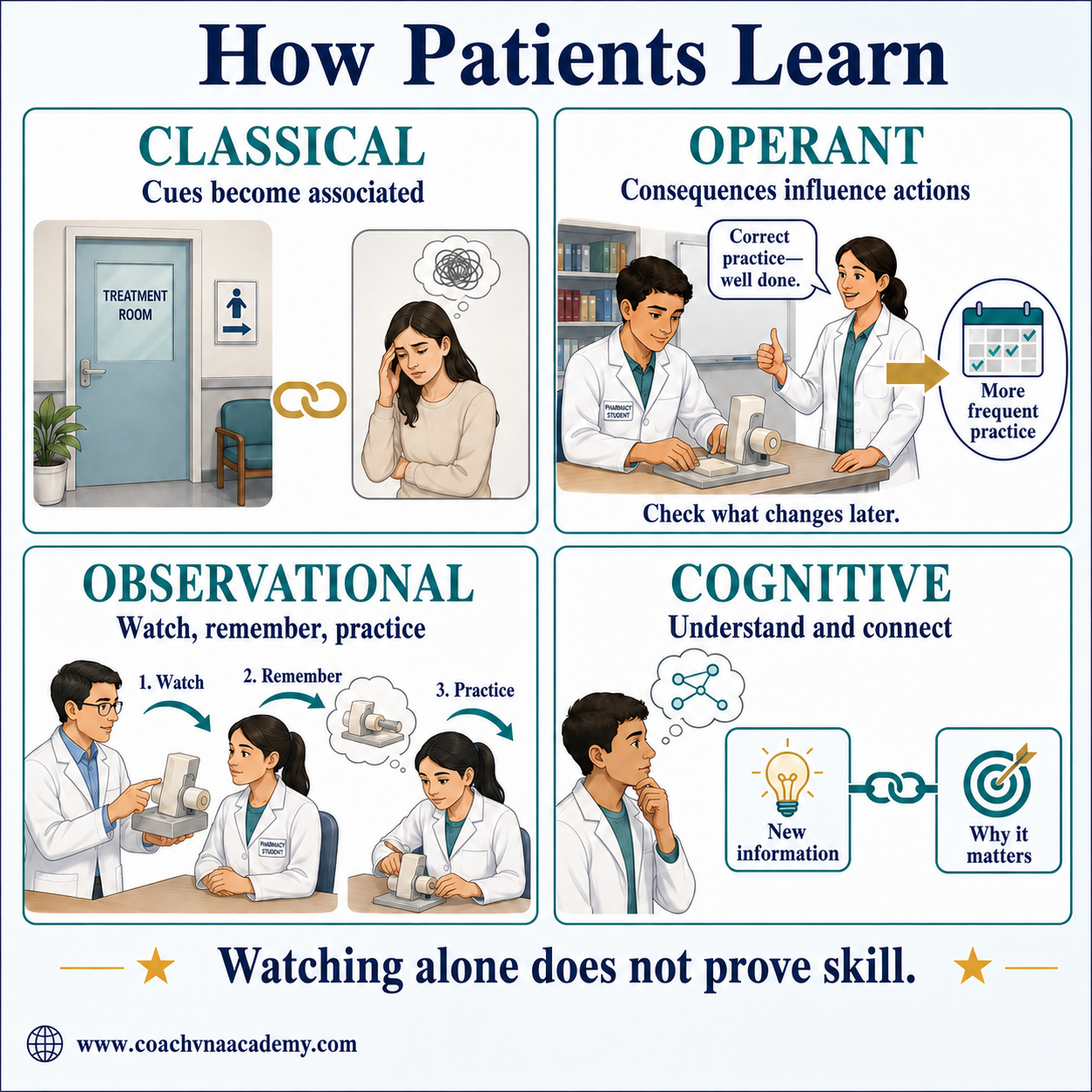
Operant conditioning describes how consequences change the future frequency of behavior. B. F. Skinner developed this approach from earlier work that included Thorndike’s law of effect. A learner who receives useful, valued feedback after correct practice may repeat that practice more often. The classification depends on what happens to later behavior, not simply on whether the teacher intended to encourage the learner.
An antecedent occurs before behavior and can serve as a cue. A consequence follows behavior. For example, an agreed reminder may prompt a practice session; specific feedback after the session may influence whether practice continues. Thus, a reminder and a reinforcer occupy different places in a behavioral explanation.
Observational and cognitive learning
Observational learning occurs through watching another person. Albert Bandura emphasized attention to a model, retention of what was observed, the ability to reproduce it, and motivation to perform it. A pharmacy student can watch a supervisor demonstrate a training device and then practice the technique. Watching alone does not establish competence; the supervisor must observe the learner’s performance and correct errors.
Cognitive learning emphasizes understanding, mental organization and problem solving. A learner connects new information with existing knowledge and recognizes relationships between steps and purposes. Explaining why a step matters can therefore support learning more effectively than asking for mechanical repetition alone. Observational, cognitive and conditioning processes can contribute to the same learning situation.
| Approach | What changes learning? | Healthcare illustration |
| Classical conditioning | A previously neutral cue becomes associated with an event and begins to trigger a learned response. | After repeated uncomfortable procedures in a treatment room, a patient may feel apprehensive simply on entering that room. |
| Operant conditioning | Consequences influence whether a behavior becomes more or less frequent. | A student receives encouraging feedback after correctly demonstrating a skill. If this feedback increases later practice, it acts as reinforcement. |
| Observational learning | A person learns by watching a model’s behavior and its consequences. | A student watches a pharmacist demonstrate a counseling technique, then applies the observed steps during practice. |
| Cognitive learning | Attention, understanding, and organization help a person make sense of information. | A student understands the purpose of each step in a procedure, connects it with prior knowledge, and can explain the sequence meaningfully. |
Reinforcement in Health Behavior
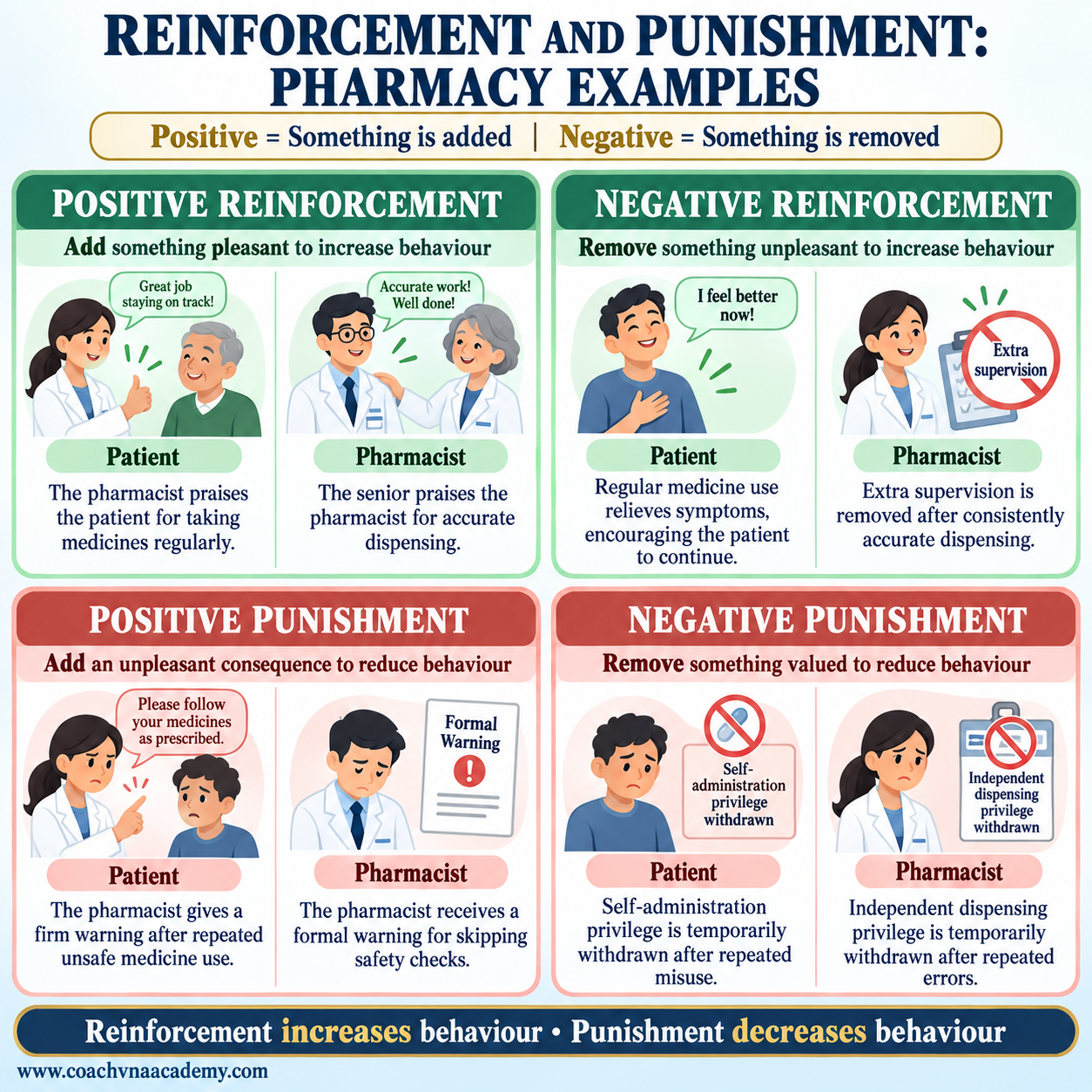
Reinforcement is a consequence that increases the future probability or frequency of a behavior. Positive reinforcement adds something that strengthens behavior. Negative reinforcement removes or prevents something unpleasant and thereby strengthens behavior. In both cases, behavior increases. The words positive and negative describe addition and removal, rather than good and bad.
Reinforcement versus punishment
| Type | Consequence | Effect on future behavior |
| Positive reinforcement | Something valued is added. | Behavior increases. |
| Negative reinforcement | Something unpleasant is removed or avoided. | Behavior increases. |
| Positive punishment | An unwanted consequence is added. | Behavior decreases. |
| Negative punishment | A valued consequence is removed. | Behavior decreases. |
For positive reinforcement, consider specific praise after accurate practice: if the learner subsequently practices more often, the praise has functioned as a reinforcer. For negative reinforcement, consider fastening a seat belt to stop an unpleasant warning sound: if fastening becomes more likely, removal of the sound reinforces the behavior. This nonclinical example avoids confusing symptom relief with permission to take a medicine.
Punishment aims to reduce behavior, although an intended punishment may not have the expected effect. A reprimand that reduces interruptions illustrates addition of a consequence; removal of a game privilege that reduces a rule-breaking action illustrates removal. These are classification examples, not recommendations for patient counseling. Humiliation, threats, deprivation and withholding necessary care are unacceptable teaching strategies.
Schedules, shaping and practical limits
Continuous reinforcement follows every occurrence of a target behavior and can support initial learning. Intermittent reinforcement follows only some occurrences. Ratio schedules depend on the number of responses; interval schedules depend on elapsed time, with reinforcement following an eligible response. Fixed schedules use a predictable requirement, while variable schedules vary that requirement. Detailed experimental response patterns are enrichment rather than the core classroom focus.
Shaping reinforces successive approximations toward a target behavior. For example, a supervisor can acknowledge progressively more complete performance during a simulated skill task. Feedback should be timely, specific and acceptable to the learner. An intended reward is not automatically a reinforcer, and the same feedback may affect different people differently.
HEALTHCARE APPLICATION: Agree on a meaningful, achievable action; explore barriers; acknowledge progress respectfully; review what actually changes. Reinforcement cannot resolve every problem with cost, access, side effects, language or understanding. Never make essential care conditional on behavior.
Memory: Encoding, Storage and Retrieval
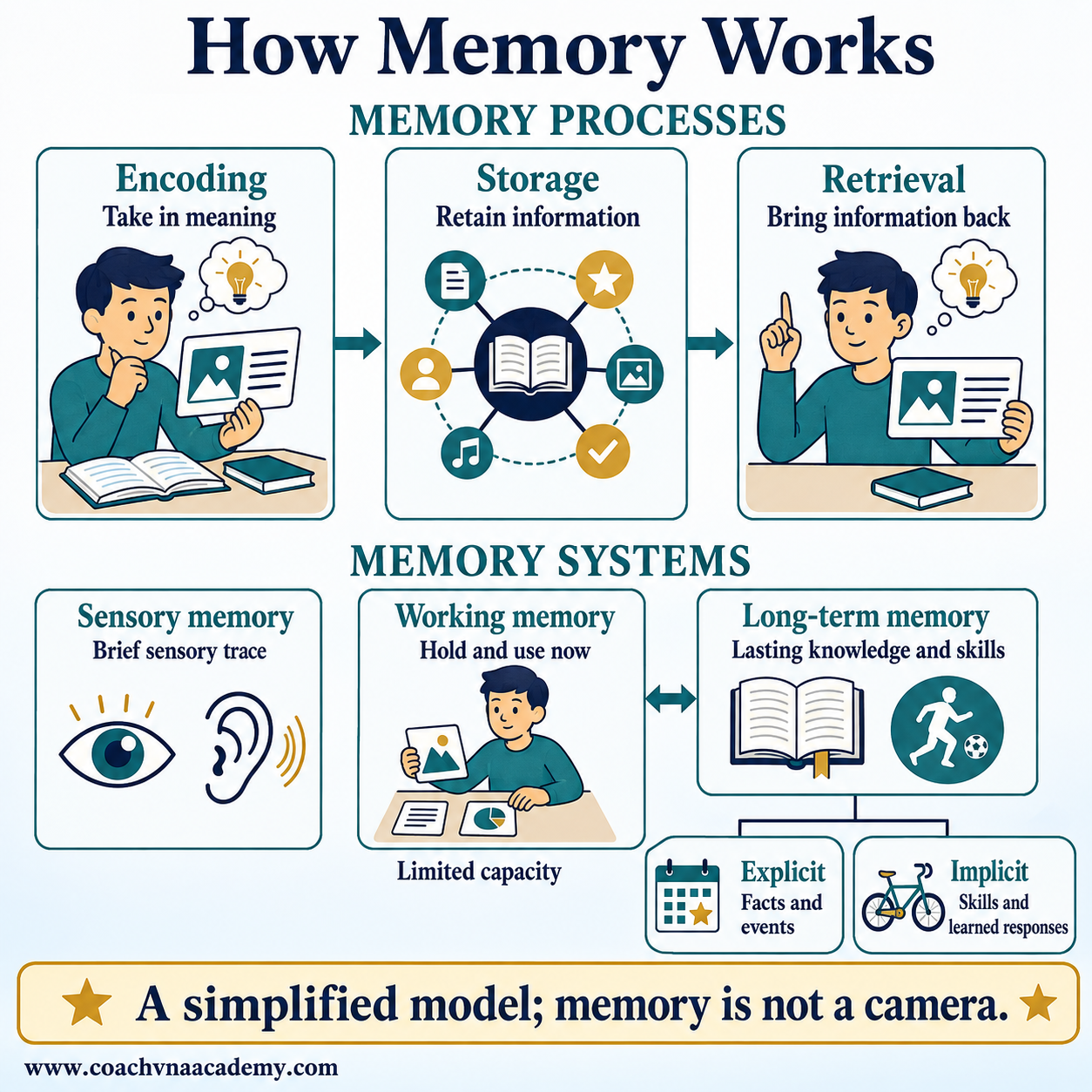
Memory involves encoding information, retaining it over time and retrieving it when needed. Encoding develops a mental representation, storage maintains information, and retrieval makes it available again. A patient may hear an explanation but encode little because attention is elsewhere. Another patient may understand it initially yet have difficulty retrieving the details at home.
Memory processes
Meaningful encoding connects information with existing knowledge. Storage involves retaining information across time, supported by processes that stabilize learning. Retrieval includes recalling without a full prompt and recognizing information when it appears again. Remembering to carry out an intended action later is prospective memory, which matters when a person plans an appointment or an agreed daily task.
Memory systems
| System | Main characteristic | Example |
| Sensory memory | Very brief trace of sensory input. | A momentary impression of a sound. |
| Short-term / working memory | Short-term retention; working memory also actively manipulates information. | Holding steps in mind during practice. |
| Long-term memory | More enduring knowledge, events and skills. | Recalling a familiar routine or learned skill. |
Long-term memory includes explicit memory, which supports conscious recall of facts and events, and implicit memory, which can influence performance without conscious recollection. Semantic memory concerns knowledge and facts; episodic memory concerns personally experienced events. Procedural memory supports learned skills. These categories help describe memory but should not be used to diagnose a patient from a single conversation.
Working memory has limited capacity, especially when information is unfamiliar or competing demands are high. Therefore, divide explanations into meaningful chunks and allow processing time. Learning concerns acquiring change through experience; memory concerns retaining and retrieving what was learned. The two processes support each other but are not identical.
Forgetting and Ways to Support Remembering
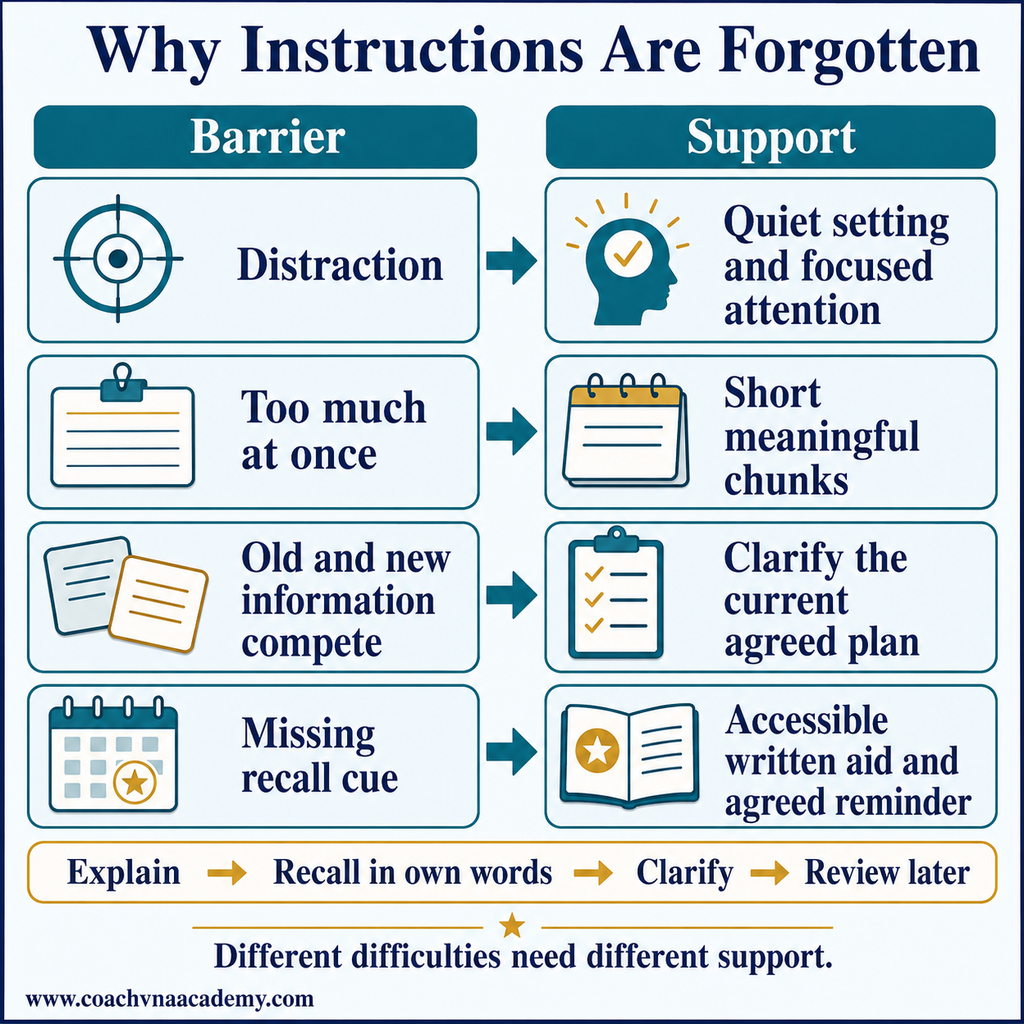
Forgetting may reflect weak initial encoding, difficulty retrieving stored information, interference or changes in retention over time. A person can appear to have forgotten a message that never received enough attention to be learned well. Avoid describing every lapse as poor memory or assuming that one missed instruction indicates a disorder.
Interference and retrieval difficulties
Proactive interference occurs when older learning makes newer learning harder to recall. For example, an earlier appointment time may intrude when a person tries to remember a revised time. Retroactive interference occurs when newer learning makes earlier information harder to recall. Learning a new contact number may make recalling the previous number more difficult. These examples explain the direction of interference without suggesting changes to treatment.
Retrieval cues can help bring information to mind. A clear written summary, a relevant context or an agreed reminder may support later recall. However, cues cannot replace understanding, and their usefulness depends on accessibility and the person’s circumstances. Memory is reconstructive, so confidence alone does not guarantee accuracy.
Supporting meaningful learning and recall
Start with the main message and explain its purpose in familiar language. Present a small amount, check its meaning, and then continue. Link new information with an existing routine only when the link fits the agreed care plan. Use readable written or visual support and avoid contradictory instructions. With consent, involve a caregiver when appropriate.
Active retrieval asks the learner to bring information to mind rather than only reread it. Spaced review revisits learning after a delay instead of relying entirely on one long session. For students, a useful pattern is to explain the concept after class, recall it on a later day, and correct gaps from the notes. For patients, choose a feasible follow-up and an accessible reminder rather than imposing a fixed universal schedule.
Applying the Concepts in a Pharmacy Conversation
Consider a fictional patient who nods throughout an explanation but cannot describe the next step. Several possibilities remain: the message was not audible, an unfamiliar word caused confusion, worry competed for attention, too many details overloaded working memory, or a practical barrier prevented an achievable plan. Nodding alone cannot distinguish these possibilities.
Make the message accessible and check understanding
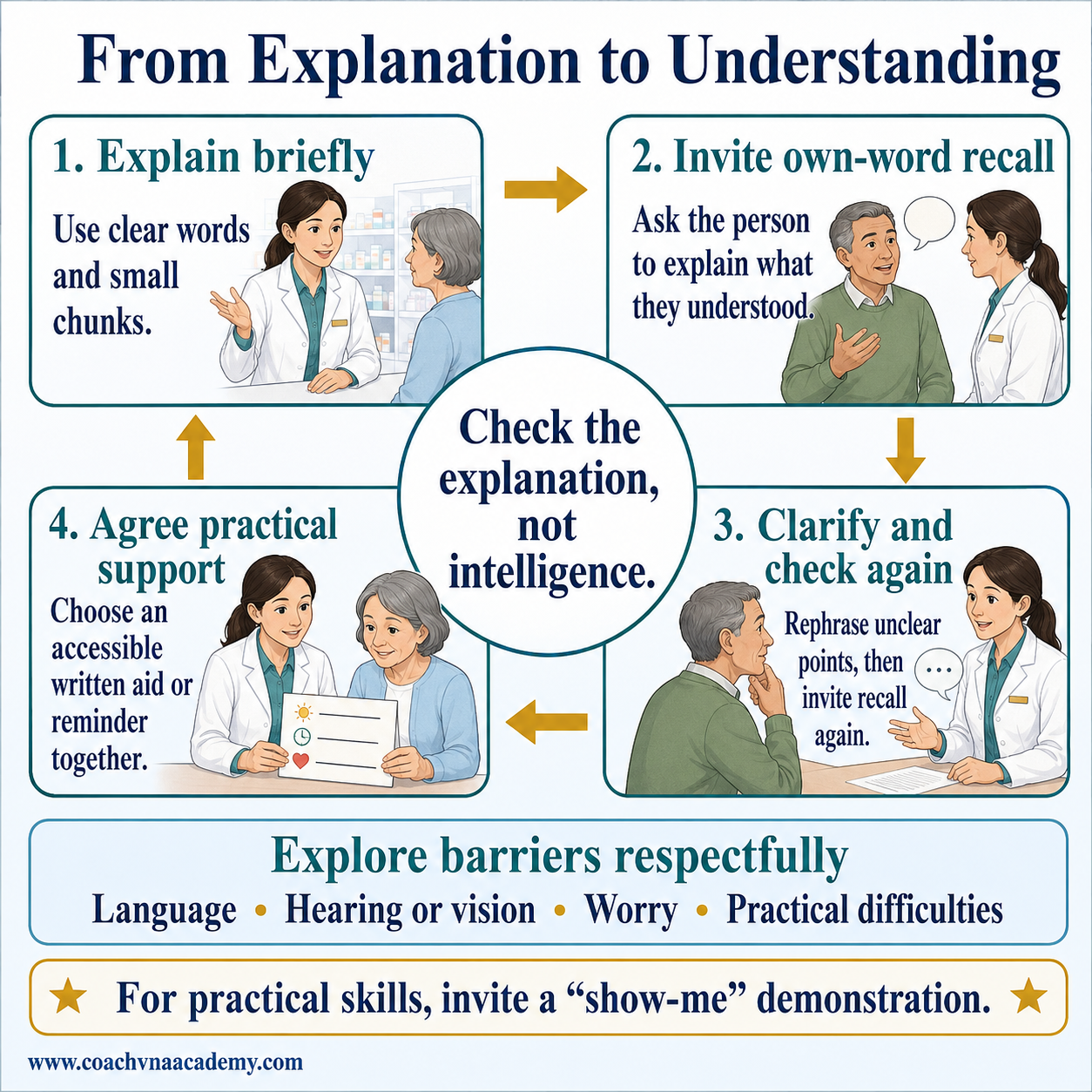
First, ask about language and sensory access and reduce distractions. Next, explain one main point in familiar words. Invite the patient to describe the meaning in their own words, clarify any mismatch, and check again. This teach-back approach checks how clearly the professional explained the message; it does not test intelligence. For a practical skill, an observed return-demonstration can show what the person can do. AHRQ describes these complementary teach-back and show-me approaches.
Then explore what may make the next step difficult and agree support within the professional’s role. Acknowledge an accurate explanation or successful practice specifically and respectfully. A reminder can provide a cue, but it cannot remove every barrier. Do not change medicines or prescribe a new schedule in this learning exercise; refer treatment questions to the appropriate supervising professional.
Key Learning Summary
Sensation detects information, perception assigns meaning, and attention selects what receives focus. Learning produces relatively lasting change through experience, whereas memory encodes, stores and retrieves information. Conditioning explains associations and consequences; observational and cognitive learning add modeling and understanding. Both positive and negative reinforcement increase behavior, while punishment decreases it. Accessible explanations, meaningful chunks, practice, retrieval and respectful feedback can support understanding without guaranteeing adherence.
References and Further Reading
The explanations and fictional examples are prepared for this lecture. These references support education, not patient-specific treatment decisions.
1. Sensation and perception: https://openstax.org/books/psychology-2e/pages/5-1-sensation-versus-perception
2. Operant conditioning: https://openstax.org/books/psychology-2e/pages/6-3-operant-conditioning
3. Memory processes and systems: https://openstax.org/books/psychology-2e/pages/8-1-how-memory-functions
4. Teach-back and show-me: https://www.ahrq.gov/health-literacy/improve/precautions/tool5.html