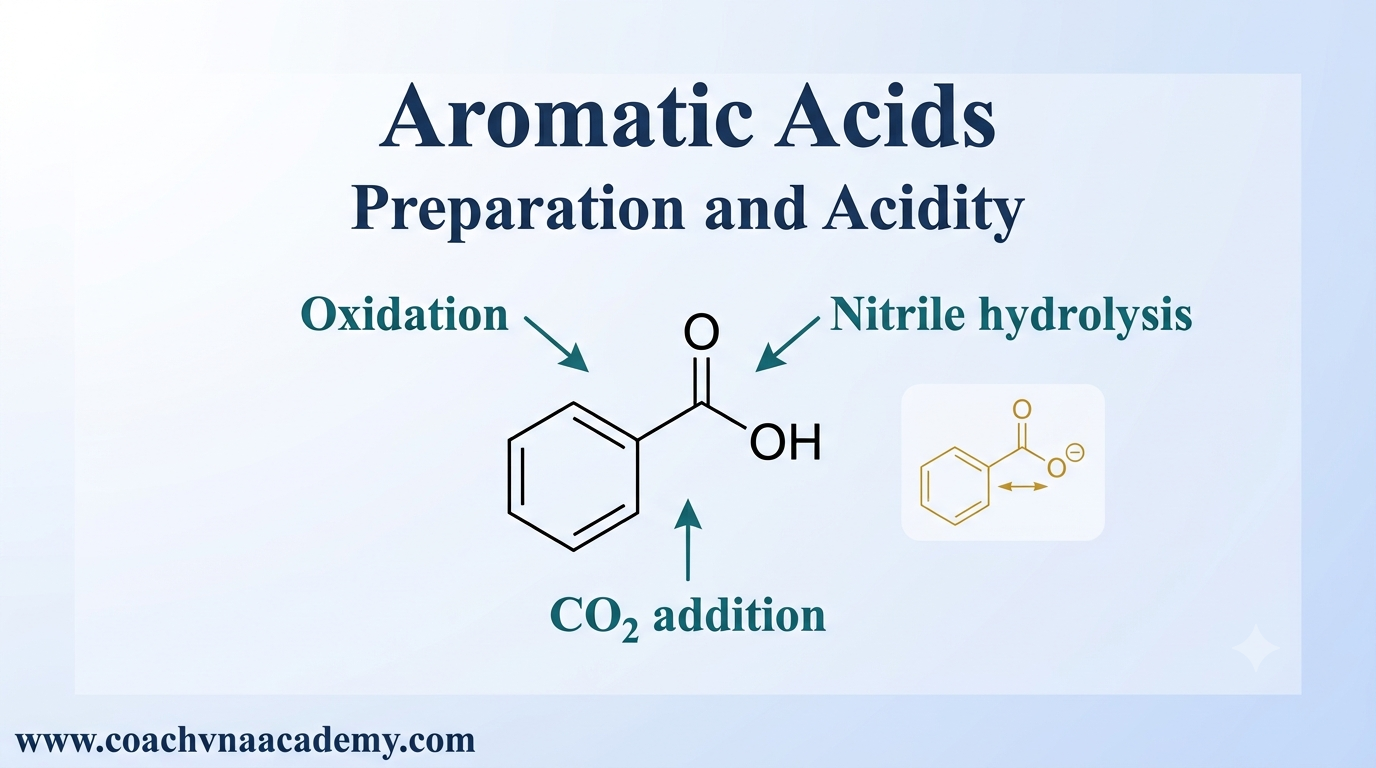
This lecture explains how to prepare benzoic acid and how its structure controls acidity. By the end, you should be able to select a preparation route, explain benzoate resonance, compare substituent effects, and apply the ortho effect without treating it as an absolute rule.
In the scope of this lecture, aromatic carboxylic acids have –COOH attached directly to an aromatic ring. Benzoic acid has the condensed structure C₆H₅–C(=O)–OH and molecular formula C₇H₆O₂. Its carboxyl carbon lies outside the six-membered ring. Ph means phenyl, C₆H₅–; Ar means a general aryl group.
For substituted benzoic acids, take the ring carbon bearing –COOH as position 1: positions 2/6 are ortho, 3/5 meta, and 4 para.
Preparation by side-chain oxidation
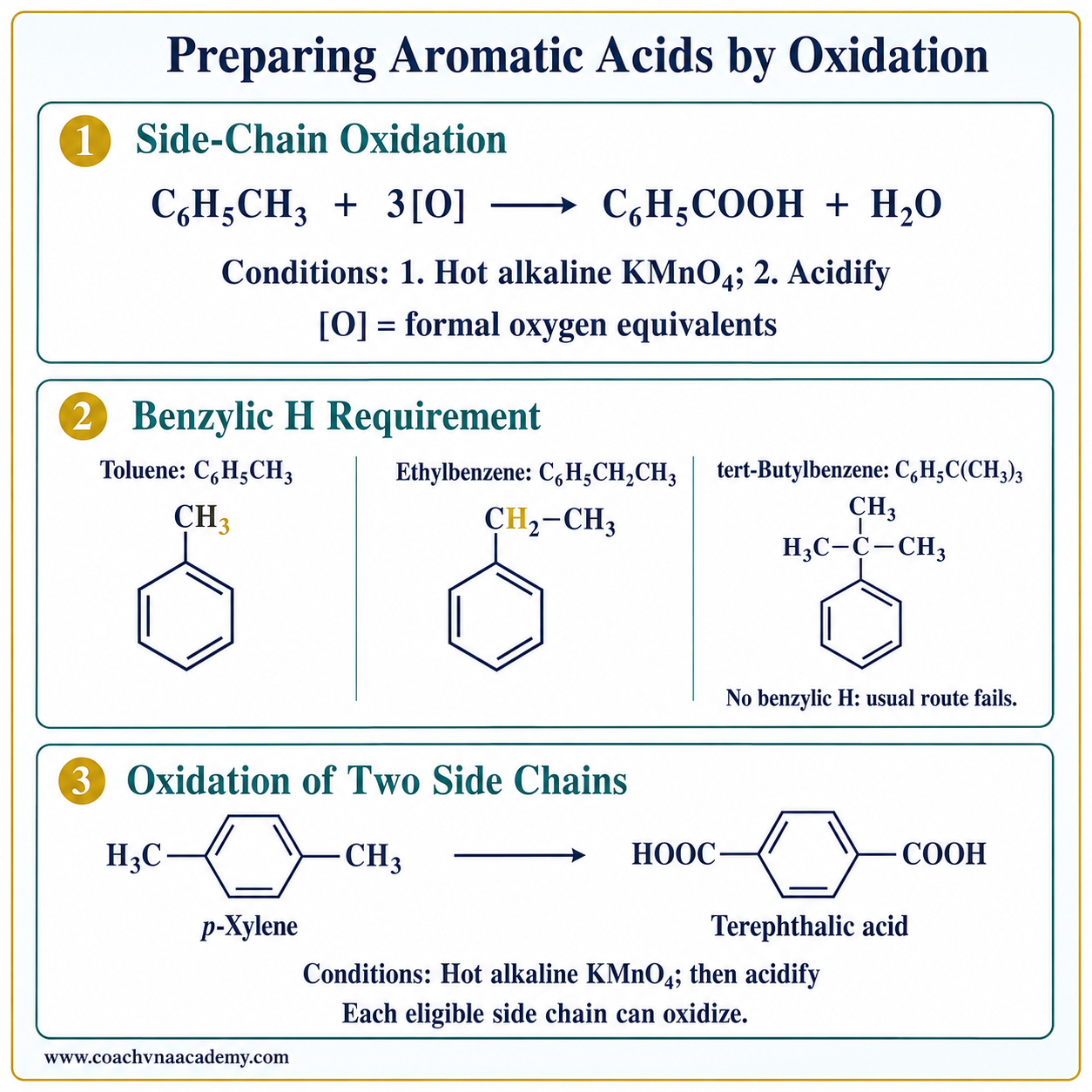
Hot potassium permanganate oxidizes a suitable alkylbenzene side chain to a carboxyl group. The key requirement is at least one hydrogen on the benzylic carbon—the side-chain carbon directly attached to the ring. Toluene and ethylbenzene meet this requirement; tert-butylbenzene does not.
Conditions: 1. Hot alkaline KMnO₄; 2. acidic work-up. [O] denotes formal oxygen equivalents; this is the overall organic transformation.
C₆H₅CH₃ + 3[O] → C₆H₅COOH + H₂O
In alkaline solution, the immediate isolated ionic product is a benzoate salt; acidification supplies the proton needed for benzoic acid. Oxidation of longer eligible side chains retains the benzylic carbon as the carboxyl carbon and removes the remaining side-chain carbons into further oxidation products.
Oxidation: complete equation, examples, and limitations
For toluene oxidation with potassium permanganate in alkaline medium, a balanced representative equation is:
Conditions: Hot alkaline permanganate; potassium benzoate forms.
C₆H₅CH₃ + 2KMnO₄ → C₆H₅COOK + 2MnO₂ + KOH + H₂O
Conditions: Acidification after oxidation/work-up.
C₆H₅COOK + HCl → C₆H₅COOH + KCl
| Starting compound | Benzylic H? | Expected result under standard side-chain oxidation |
| Toluene, C₆H₅CH₃ | Yes | Benzoic acid after acidification |
| Ethylbenzene, C₆H₅CH₂CH₃ | Yes | Benzoic acid after acidification |
| Isopropylbenzene, C₆H₅CH(CH₃)₂ | Yes | Benzoic acid after acidification |
| tert-Butylbenzene, C₆H₅C(CH₃)₃ | No | Does not follow the usual benzylic oxidation route |
| p-Xylene, 1,4-C₆H₄(CH₃)₂ | Yes, on both groups | Terephthalic acid, 1,4-C₆H₄(COOH)₂ |
Reaction logic and examination boundary
Side-chain oxidation is a multistep oxidation process; do not present it as one electrophilic aromatic substitution step. Benzyl alcohol and benzaldehyde represent useful oxidation-level connections, but the final product under vigorous conditions is the carboxylate/acid.
The phrase “side-chain length does not matter” is a shortcut, not a statement that every alkylbenzene behaves identically. First check benzylic hydrogen, the number of oxidizable side chains, and other oxidation-sensitive functional groups. Do not predict a monocarboxylic acid from a substrate with two oxidizable methyl groups.
Conditions: Vigorous side-chain oxidation, followed by acidification; formal organic equation.
1,4-C₆H₄(CH₃)₂ + 6[O] → 1,4-C₆H₄(COOH)₂ + 2H₂O
Preparation by hydrolysis of benzonitrile
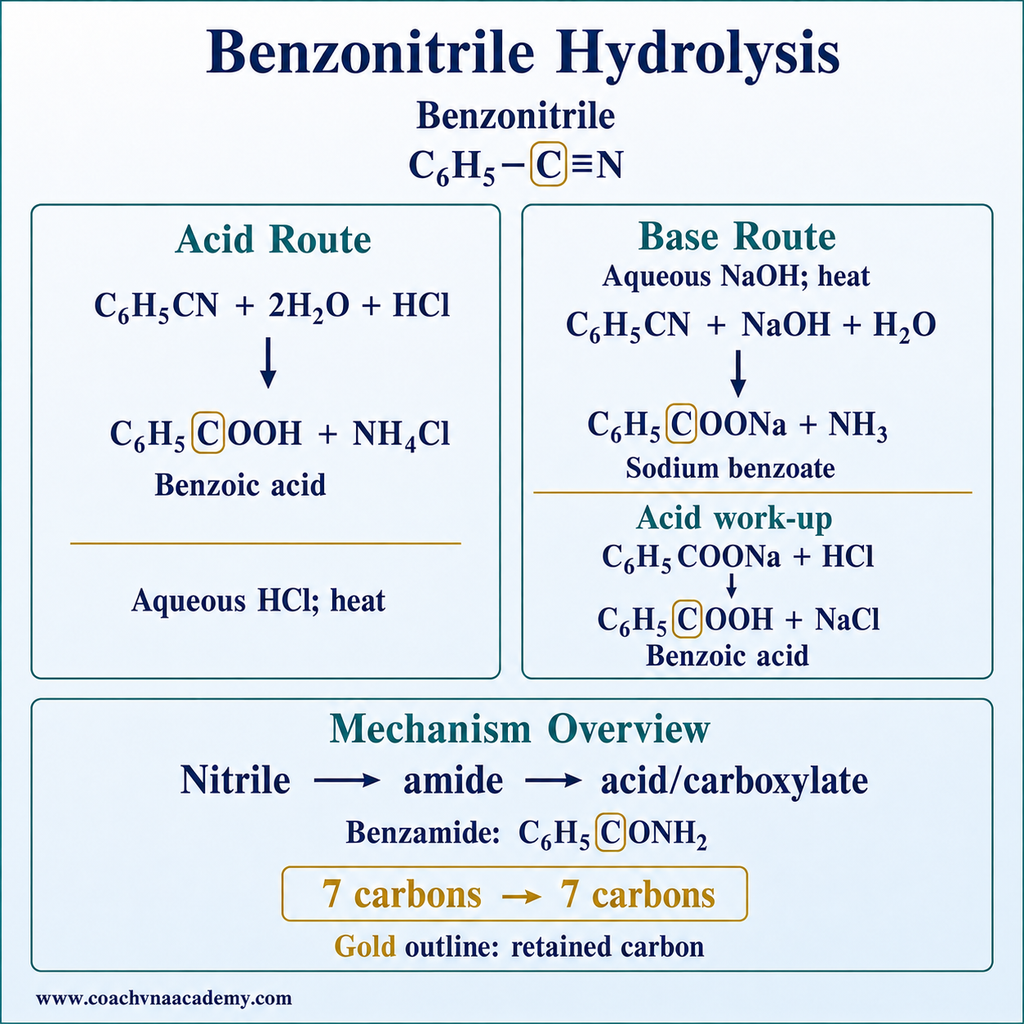
Benzonitrile, C₆H₅–C≡N, undergoes hydrolysis with hot aqueous acid or base. The nitrile carbon becomes the carboxyl carbon. Thus, benzonitrile and benzoic acid both contain seven carbons; hydrolysis itself does not add a new carbon.
Acidic hydrolysis
C₆H₅CN + 2H₂O + HCl → C₆H₅COOH + NH₄Cl
The reaction passes through an amide stage. The following component equations summarize the two hydrolytic changes:
Conditions: Acid-catalyzed hydration; benzamide is an intermediate.
C₆H₅CN + H₂O → C₆H₅CONH₂
Conditions: Further acidic hydrolysis with heating.
C₆H₅CONH₂ + H₂O + HCl → C₆H₅COOH + NH₄Cl
Alkaline hydrolysis and acidification
Conditions: Aqueous NaOH; heat/reflux. Sodium benzoate is the product in alkaline solution.
C₆H₅CN + NaOH + H₂O → C₆H₅COONa + NH₃
Conditions: Separate acidic work-up.
C₆H₅COONa + HCl → C₆H₅COOH + NaCl
Mechanistic explanation
In acid, protonation at nitrile nitrogen increases the electrophilicity of the nitrile carbon. Water attacks that carbon; proton transfers and imidic-acid/amide interconversion give benzamide. Acid-catalyzed addition of water to the amide carbonyl, followed by proton transfers and C–N cleavage, completes hydrolysis. Nitrogen leaves as ammonia and becomes ammonium in the acid medium.
In base, hydroxide attacks the nitrile carbon. Proton transfers and conversion to the amide precede further hydrolysis to carboxylate and ammonia. Do not show OH⁻ and H₃O⁺ as simultaneous reaction conditions; alkaline hydrolysis and acid work-up are successive stages.
Unit II connection: Aniline → diazonium salt → benzonitrile → benzoic acid links aromatic amines with aromatic acids. CuCN replaces the diazonium group; ordinary bromobenzene does not undergo a simple alkyl-type Sₙ2 displacement with CN⁻.
Preparation by Grignard carboxylation
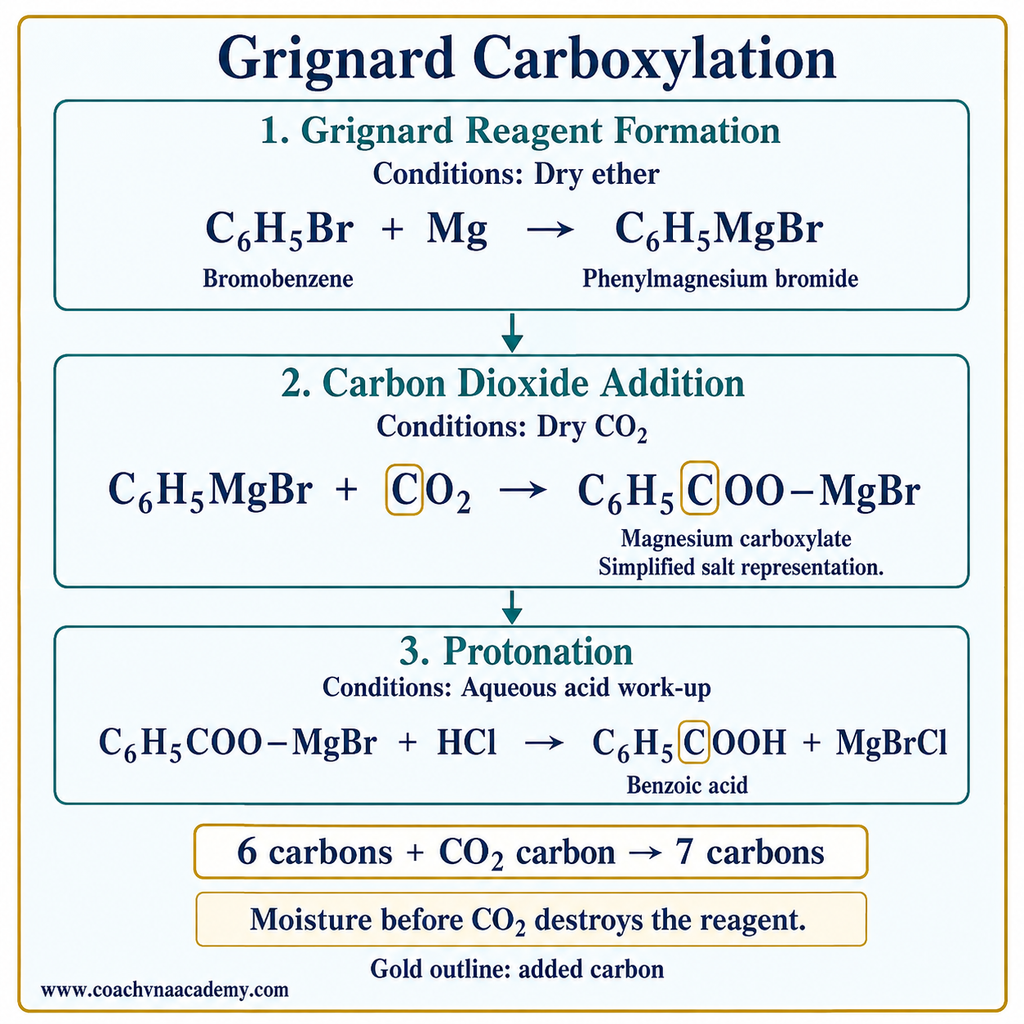
Phenylmagnesium bromide reacts with carbon dioxide to form a magnesium carboxylate. Acid work-up gives benzoic acid. Unlike nitrile hydrolysis itself, carboxylation adds one carbon: the CO₂ carbon becomes the carbon of –COOH.
Three-stage preparation
Conditions: Dry ether; prepare phenylmagnesium bromide under anhydrous conditions.
C₆H₅Br + Mg → C₆H₅MgBr
Conditions: Dry CO₂; anhydrous ether. C₆H₅COO–MgBr is a simplified representation of the magnesium carboxylate.
C₆H₅MgBr + CO₂ → C₆H₅COO–MgBr
Conditions: Separate aqueous acid work-up; MgBrCl represents the magnesium-halide salt in the simplified equation.
C₆H₅COO–MgBr + HCl → C₆H₅COOH + MgBrCl
Bond-making mechanism
The C–Mg bond is strongly polarized toward carbon. The phenyl carbon therefore behaves as a nucleophile and attacks the electrophilic carbon of CO₂. One C=O π bond shifts toward oxygen, forming the carboxylate. Protonation during work-up then gives the acid. This creates a new carbon–carbon bond; it is not substitution on the aromatic ring.
Conditions: Schematic ionic representation; actual organomagnesium species are solvated/associated.
Ph–MgBr + O=C=O → Ph–C(=O)O⁻·MgBr⁺
Why moisture must be excluded
Conditions: Unwanted protonation if moisture reaches the Grignard reagent before carboxylation.
C₆H₅MgBr + H₂O → C₆H₆ + MgBrOH
Water or an unprotected acidic –OH/–COOH group consumes the Grignard reagent. Therefore, “add acid” belongs after the CO₂ reaction, not before it. A route starting from a molecule with another incompatible functional group may require protection or a different preparation method.
Carbon-count check: Bromobenzene and phenylmagnesium bromide: 6 carbons. Benzoic acid: 7 carbons. The extra carbon comes from CO₂—not from ether, magnesium, or the acid used in work-up.
Important Reactions of Benzoic Acid
Salt formation and the bicarbonate test
Benzoic acid transfers a proton to a base and forms a benzoate salt. Sodium hydroxide gives sodium benzoate and water. Sodium bicarbonate also reacts; unstable carbonic acid then gives carbon dioxide and water, causing visible effervescence.
Conditions: Aqueous sodium hydroxide.
C₆H₅COOH + NaOH → C₆H₅COONa + H₂O
Conditions: Aqueous sodium bicarbonate; ordinary laboratory conditions.
C₆H₅COOH + NaHCO₃ → C₆H₅COONa + CO₂↑ + H₂O
Ordinary phenol does not produce appreciable effervescence with aqueous sodium bicarbonate. Therefore, this test distinguishes benzoic acid from phenol in the present comparison; it does not identify benzoic acid uniquely among all carboxylic acids.
Conditions: Acidification of aqueous sodium benzoate; benzoic acid may precipitate.
C₆H₅COONa + HCl → C₆H₅COOH + NaCl
Esterification: principle and complete mechanism
In Fischer esterification, benzoic acid reacts reversibly with an alcohol to form a benzoate ester. With ethanol, the product is ethyl benzoate. Acid catalysis activates the carbonyl group; excess alcohol or removal of water favors ester formation.
Conditions: Concentrated H₂SO₄ as acid catalyst; heat under reflux. Reflux temperature depends on the mixture; no universal temperature is assigned.
C₆H₅COOH + C₂H₅OH ⇌ C₆H₅COOC₂H₅ + H₂O
The following condensed intermediates show bonding and charge explicitly. Et means C₂H₅–. All stages are reversible; proton transfers occur through the reaction medium.
Stage 1 — Protonation. The carbonyl oxygen accepts H⁺, increasing the electrophilicity of the carbonyl carbon.
Ph–C(=O)–OH + H⁺ ⇌ Ph–C(=OH⁺)–OH
Stage 2 — Nucleophilic addition. An ethanol oxygen lone pair attacks the carbonyl carbon; the C=O π electrons move to oxygen.
Ph–C(=OH⁺)–OH + EtOH ⇌ Ph–C(OH)(OH)–O⁺(H)–Et
Stage 3 — Proton transfer. Deprotonation of the ethoxy oxygen and protonation of an –OH group create a water leaving group.
Ph–C(OH)(OH)–O⁺(H)–Et ⇌ Ph–C(OH)(OH₂⁺)–O–Et
Stage 4 — Water elimination. An oxygen lone pair restores C=O as water leaves.
Ph–C(OH)(OH₂⁺)–O–Et ⇌ Ph–C(=OH⁺)–O–Et + H₂O
Stage 5 — Catalyst regeneration. Loss of H⁺ gives the neutral ester.
Ph–C(=OH⁺)–O–Et ⇌ Ph–C(=O)–O–Et + H⁺
Exam point: Draw curved arrows from an electron pair or bond to its destination. Do not start an electron-flow arrow from H⁺. Water, rather than unprotonated OH⁻, leaves in the acid-catalyzed mechanism.
Benzoyl chloride and benzamide formation
Formation of benzoyl chloride
Thionyl chloride replaces the carboxyl –OH group with chlorine. The product is benzoyl chloride, C₆H₅–C(=O)–Cl. Sulfur dioxide and hydrogen chloride are gaseous by-products; their removal helps drive the conversion.
Conditions: Thionyl chloride; anhydrous conditions; warming as required by the method.
C₆H₅COOH + SOCl₂ → C₆H₅COCl + SO₂↑ + HCl↑
Mechanism overview: activation gives an acyl chlorosulfite, Ph–C(=O)–O–S(=O)Cl. Chloride attacks the acyl carbon, a tetrahedral intermediate forms, and collapse with fragmentation of the leaving group produces benzoyl chloride. This is nucleophilic acyl substitution, not ring chlorination.
Formation of benzamide through benzoyl chloride
Conditions: Excess ammonia; controlled addition. One equivalent supplies –NH₂, and another neutralizes HCl.
C₆H₅COCl + 2NH₃ → C₆H₅CONH₂ + NH₄Cl
Ammonia attacks the carbonyl carbon. The tetrahedral intermediate Ph–C(O⁻)(Cl)–NH₃⁺ collapses with loss of Cl⁻; another ammonia molecule removes a proton to give benzamide. Benzamide contains C₆H₅–C(=O)–NH₂, so it differs from aniline, C₆H₅–NH₂.
Why acid plus ammonia is not an immediate amide reaction?
Conditions: Initial acid–base reaction: ammonium benzoate forms.
C₆H₅COOH + NH₃ ⇌ C₆H₅COO⁻ NH₄⁺
Conditions: Strong heating/dehydration of ammonium benzoate; distinct from simple mixing.
C₆H₅COO⁻ NH₄⁺ → C₆H₅CONH₂ + H₂O
Simple Hinglish explanation: SOCl₂ carboxyl group ko activate karta hai. Benzoyl chloride par NH₃ attack karke benzamide banata hai. Benzoic acid aur ammonia ko sirf milane par pehle salt banta hai.
Reduction and decarboxylation
Reduction to benzyl alcohol
Lithium aluminum hydride reduces the carboxyl group to a primary alcohol. The carboxyl carbon remains in the product; therefore, benzoic acid and benzyl alcohol both contain seven carbon atoms. The aromatic ring remains intact under the usual conditions of this transformation.
Conditions: 1. LiAlH₄ in dry ether or THF; 2. controlled aqueous work-up. [H] denotes formal reducing equivalents, not molecular hydrogen.
C₆H₅COOH + 4[H] → C₆H₅CH₂OH + H₂O
Hydride first reacts with the acidic proton. Subsequent reduction of the aluminum-bound carboxylate produces an aldehyde-level intermediate, which undergoes rapid further reduction. Work-up protonates the resulting alkoxide. Benzaldehyde is not the isolated product of ordinary LiAlH₄ reduction of benzoic acid.
Soda-lime decarboxylation
Heating sodium benzoate with soda lime gives benzene. Soda lime contains NaOH and CaO. The carboxyl carbon enters sodium carbonate, so the organic product loses one carbon atom. CaO is part of the reaction mixture and is not a consumed reagent in the net equation shown.
Conditions: Soda lime (NaOH/CaO), strong heating. Use the temperature specified by the laboratory method if one is supplied.
C₆H₅COONa + NaOH → C₆H₆ + Na₂CO₃
Important correction: The net soda-lime equation produces Na₂CO₃, not a separate CO₂ molecule. “Decarboxylation” describes removal of the carboxyl carbon from the organic substrate.
| Feature | Reduction | Decarboxylation |
| Starting compound | Benzoic acid | Sodium benzoate |
| Key reagent | LiAlH₄; then work-up | Soda lime; heat |
| Organic product | Benzyl alcohol, C₆H₅CH₂OH | Benzene, C₆H₆ |
| Organic carbon count | 7 → 7 | 7 → 6 |
Ring substitution: why –COOH directs meta
The –COOH group withdraws electron density through its negative inductive (−I) and resonance (−M) effects. Consequently, benzoic acid undergoes electrophilic aromatic substitution less readily than benzene. Its major substitution products usually place the incoming electrophile meta to –COOH.
Nitration reaction
Conditions: Concentrated HNO₃/concentrated H₂SO₄; heat as required by the nitration method.
C₆H₅COOH + HNO₃ → 3-NO₂–C₆H₄–COOH + H₂O
The major product is 3-nitrobenzoic acid (m-nitrobenzoic acid). Number the ring carbon attached to –COOH as C1; the meta positions are C3 and C5, which are equivalent in unsubstituted benzoic acid.
Electrophilic aromatic substitution mechanism
Electrophile generation: Sulfuric acid promotes formation of the nitronium ion, NO₂⁺.
HNO₃ + H₂SO₄ ⇌ NO₂⁺ + HSO₄⁻ + H₂O
Ring attack: A ring π bond attacks NO₂⁺ at a meta position and forms a nonaromatic σ-complex (arenium ion). The attacked carbon temporarily bears both H and NO₂.
Orientation: Ortho and para attack give especially unfavorable resonance contributors with positive charge on the ring carbon bonded to the electron-withdrawing –COOH group. The meta σ-complex avoids that particular contributor, so meta substitution is relatively favored.
Rearomatization: HSO₄⁻ removes H⁺ from the carbon bearing the new NO₂ group. Electrons from the C–H bond restore aromaticity and regenerate the acid catalyst.
Exam point: “Meta directing” does not mean “activating.” All pathways are slower than the corresponding reaction of benzene; the meta pathway is relatively less unfavorable. Write “mainly meta,” not “only meta.”
Ring versus functional-group chemistry
Do not treat thionyl chloride as a ring-chlorinating reagent in this lecture. It forms C₆H₅COCl by changing the acyl group. Similarly, LiAlH₄ converts –COOH to –CH₂OH rather than replacing a ring hydrogen.
Acidity of benzoic acid and benzoate stability
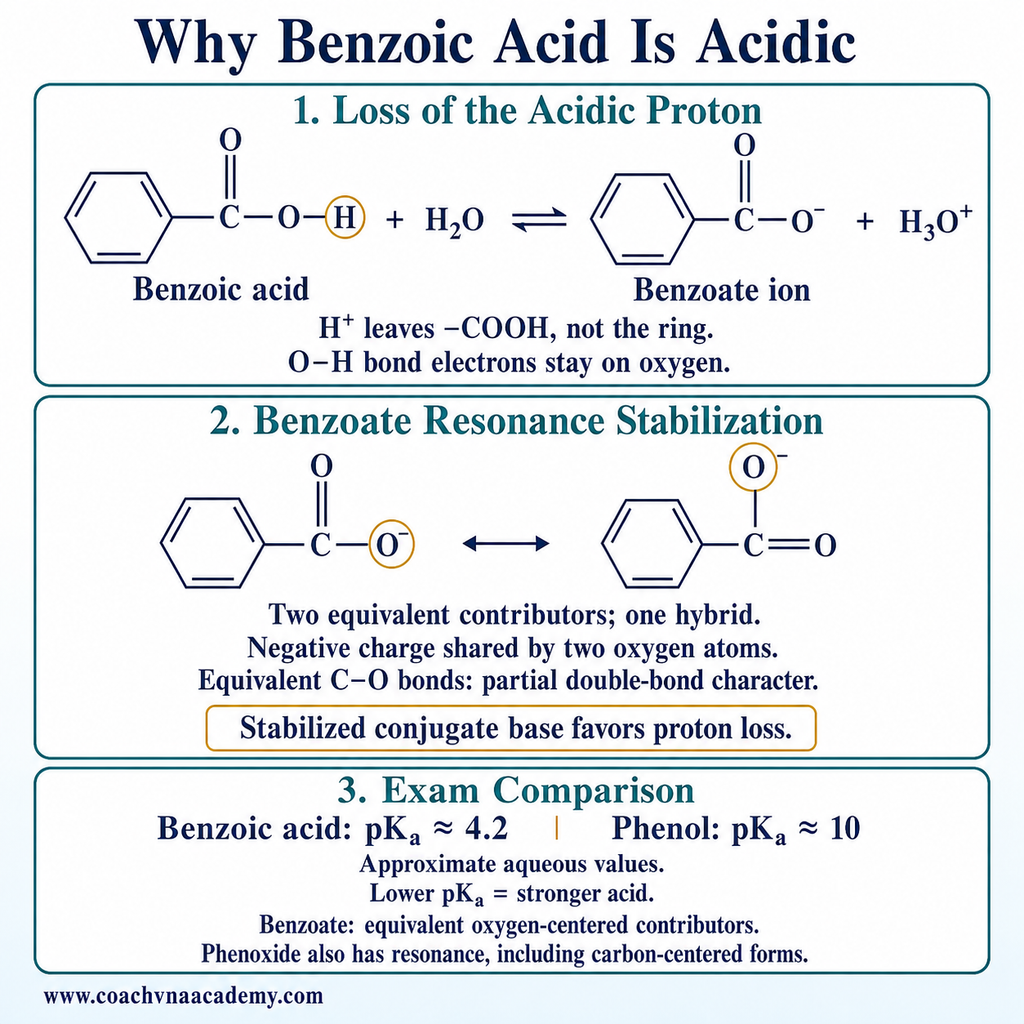
Benzoic acid donates the proton of its carboxyl –OH group to water. This equilibrium produces benzoate and hydronium. It does not involve removal of a hydrogen from the aromatic ring.
C₆H₅COOH + H₂O ⇌ C₆H₅COO⁻ + H₃O⁺
Kₐ = [C₆H₅COO⁻][H₃O⁺] / [C₆H₅COOH]
pKₐ = −log₁₀Kₐ
A larger Kₐ or a smaller pKₐ indicates a stronger acid under comparable solvent and temperature conditions. Approximate aqueous reference values are pKₐ ≈ 4.2 for benzoic acid and ≈ 10 for phenol; they illustrate the large acidity difference, not universal values for every solvent.
Resonance in the benzoate ion
Ph–C(=O)–O⁻ ↔ Ph–C(–O⁻)=O
The two principal resonance contributors are equivalent and distribute negative charge over the two oxygen atoms. The real ion is a resonance hybrid with equivalent C–O bonds in the carboxylate group. The two drawings are not separate ions that rapidly exchange; the double-headed resonance arrow does not represent an equilibrium.
Why benzoic acid is more acidic than phenol
Phenoxide also shows resonance, but some contributors place negative charge on ring carbon. Oxygen accommodates negative charge more effectively than carbon, so equivalent oxygen-centered delocalization stabilizes benzoate more effectively. This favors loss of H⁺ from benzoic acid relative to phenol.
Do not say that neutral benzoic acid has no resonance: it does. An acidity explanation compares the relative stabilization of the acid and its conjugate base. Benzoate gains the particularly favorable pair of equivalent oxygen-centered contributors.
Observable acid behavior
Conditions: Aqueous sodium bicarbonate; benzoic acid gives effervescence, ordinary phenol does not appreciably do so.
C₆H₅COOH + NaHCO₃ → C₆H₅COONa + CO₂↑ + H₂O
Exam point: Lower pKₐ means stronger acid. Stronger acid does not mean more concentrated solution. Acidity and concentration describe different properties.
Effect of substituents: group and position both matter
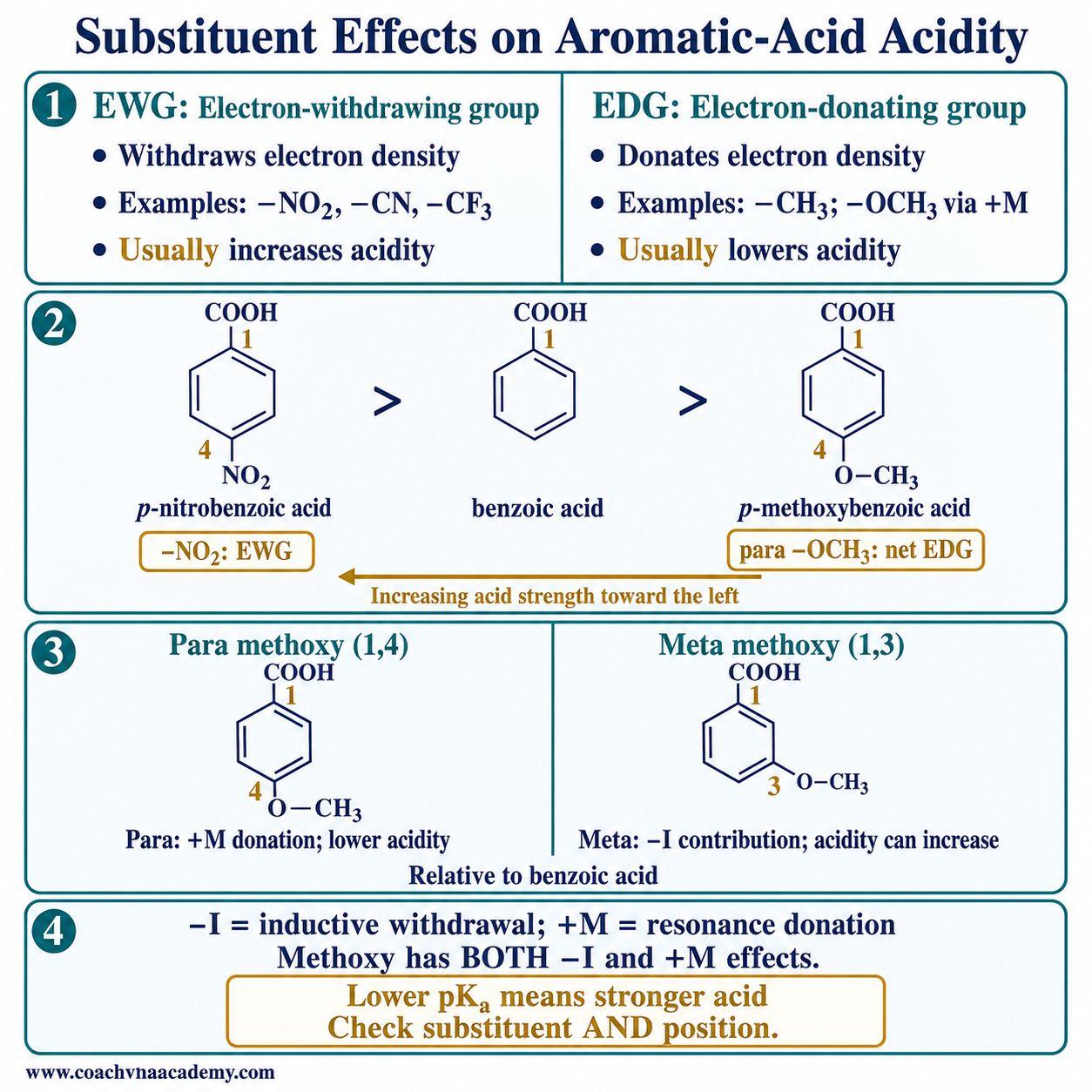
A ring substituent can alter acidity through inductive/field effects and, at suitable positions, resonance effects. Compare the acid–conjugate-base pair under the same conditions. As a practical first rule, electron withdrawal favors benzoate formation and increases acidity; electron donation generally has the opposite effect.
Electron-withdrawing substituents
Nitro and cyano groups withdraw electrons. Their −I effect operates through the molecular framework; resonance withdrawal can contribute strongly at ortho and para positions. Halogens also withdraw inductively, although they can donate by resonance. Their net effect commonly increases substituted-benzoic-acid acidity relative to benzoic acid.
Electron-donating substituents and the methoxy qualification
Alkyl groups such as –CH₃ generally reduce acidity through electron donation. Methoxy, –OCH₃, has competing effects: oxygen withdraws inductively (−I), while its lone pair donates by resonance (+M). At para, resonance donation generally reduces acidity. At meta, the direct resonance connection to the carboxyl substituent is absent in the usual resonance analysis, so induction can instead increase acidity.
| Substituent / position | Main interpretation | Compared with benzoic acid |
| p-NO₂ | −I and −M withdrawal | More acidic |
| m-NO₂ | Withdrawal; strong inductive contribution | More acidic |
| p-CH₃ | Electron donation | Less acidic |
| p-OCH₃ | +M donation outweighs −I in the net acidity effect | Less acidic |
| m-OCH₃ | −I can dominate the positional comparison | Slightly more acidic |
| m-/p-Cl | Net withdrawal despite resonance donation | Usually more acidic |
A reliable comparison sequence
First identify the substituent and its position. Next identify competing induction and resonance effects. Then compare their net influence on acid/conjugate-base stability. Finally check for ortho-specific effects and solvent-dependent behavior before assigning an order.
Useful acidity order: p-Nitrobenzoic acid > benzoic acid > p-methoxybenzoic acid. The corresponding pKₐ order is reversed.
The ortho effect and worked comparisons
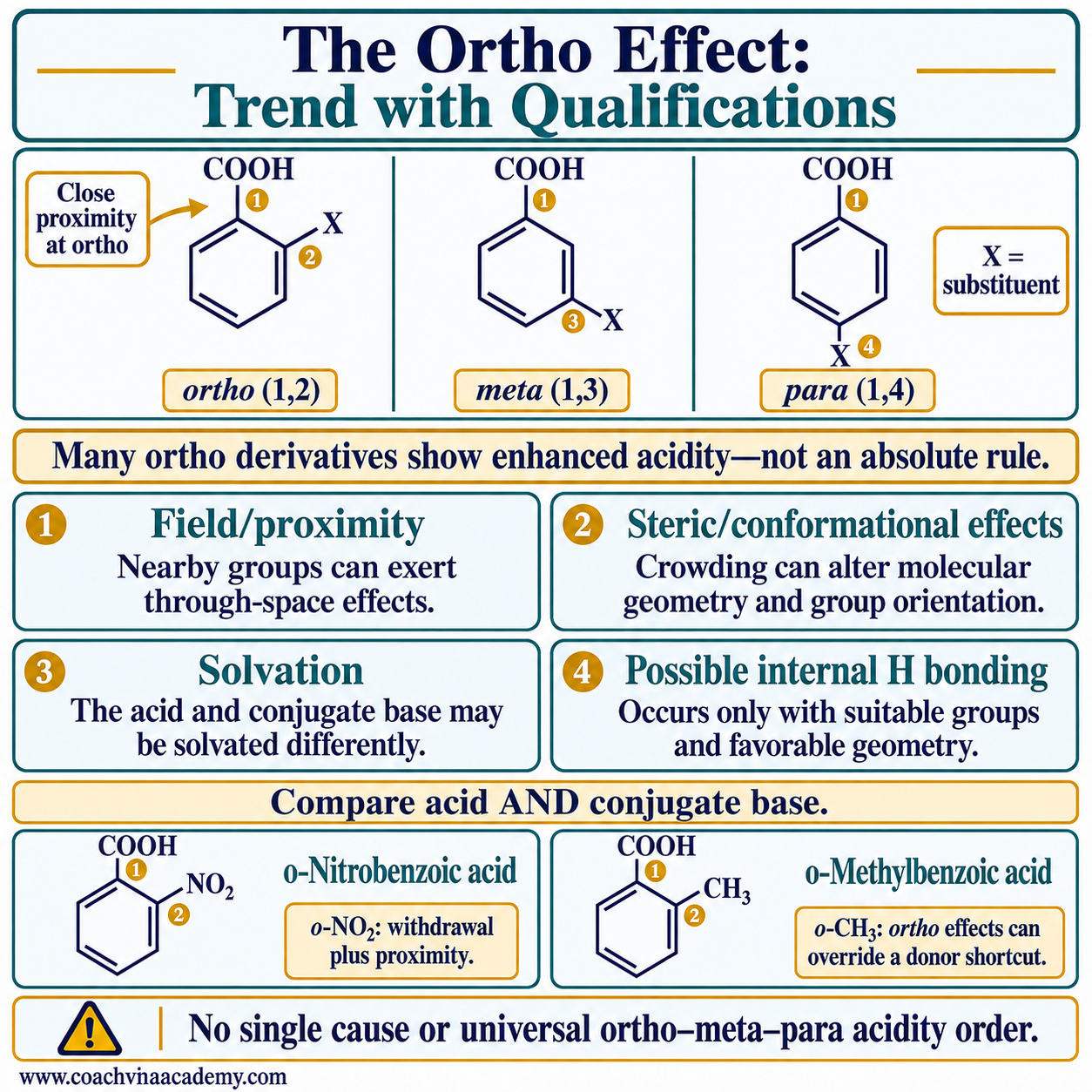
Many ortho-substituted benzoic acids are more acidic than their meta and para isomers and often more acidic than benzoic acid itself. This frequently observed enhancement is called the ortho effect. It is a useful trend, but it is not a universal rule with one mechanism that applies to every group.
Factors that can contribute
| Factor | How it can affect the comparison |
| Proximity / field effect | A nearby substituent can influence the carboxyl group strongly through space. |
| Steric interaction | Crowding can change conformation and the relative energies of acid and conjugate base. |
| Solvation | Substitution can change access of solvent to the acid and benzoate ion. |
| Intramolecular hydrogen bonding | Some groups can form internal H bonds; stabilization of acid and anion must both be considered. |
A twisted carboxyl group is sometimes used in elementary discussions, but “steric inhibition of resonance” alone does not explain every ortho result. Likewise, an intramolecular hydrogen bond does not always imply greater acidity: the direction depends on which species it stabilizes more.
Worked example: nitrobenzoic acids
Question: Why is o-nitrobenzoic acid strongly acidic compared with benzoic acid?
Answer: The nitro group withdraws electrons, and its close ortho position adds strong proximity-related effects. Together they favor dissociation relative to the unsubstituted acid. Do not use this single example to claim that every ortho substituent has identical steric or hydrogen-bonding behavior.
Worked example: methylbenzoic acids
Question: Is “methyl always decreases acidity at every position” a safe rule?
Answer: No. Methyl donation generally lowers acidity at meta/para, but o-methylbenzoic acid illustrates that ortho-related effects can override a simple donor-group prediction. Identify the position before applying an electron-donating-group shortcut.