
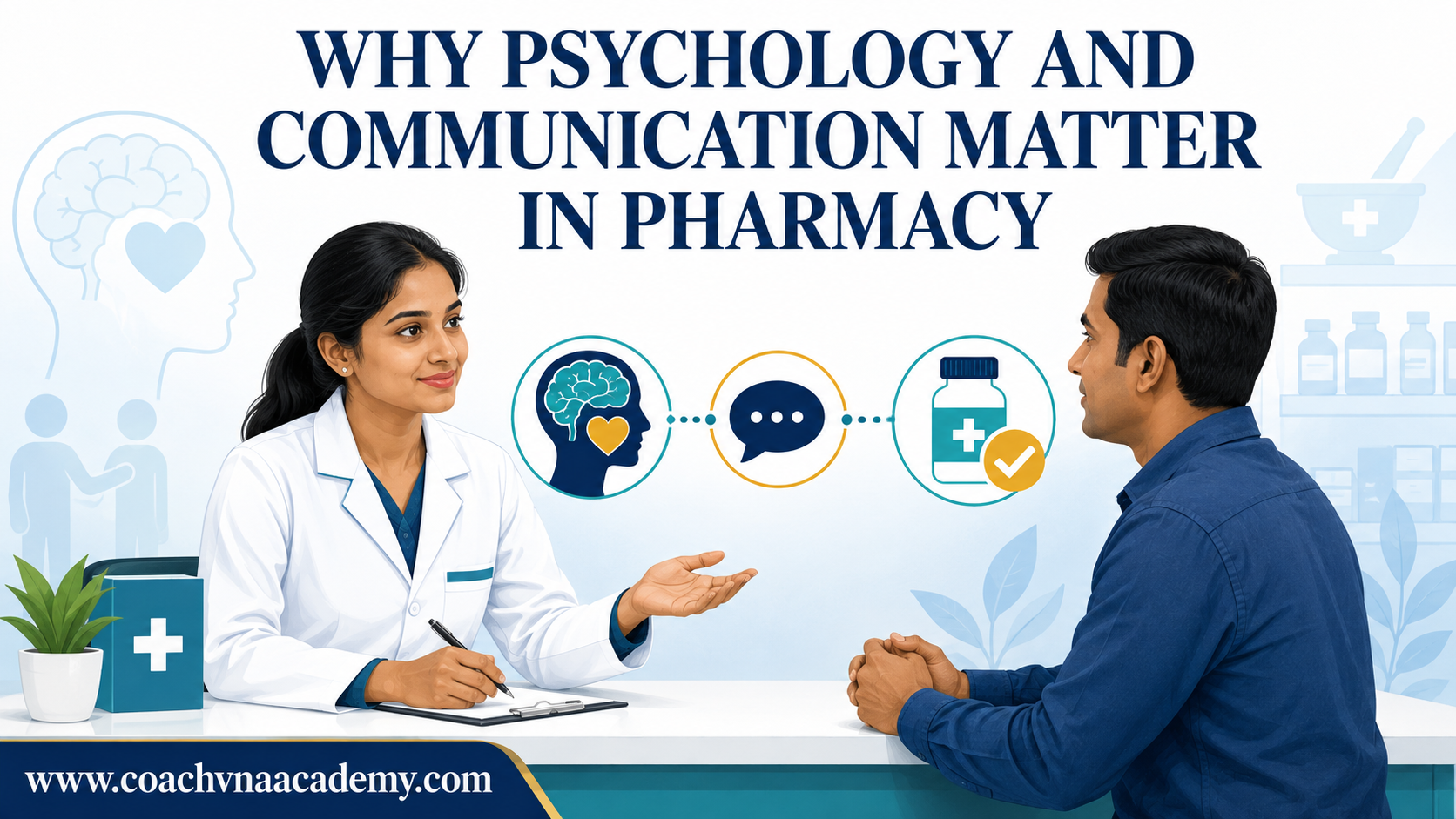
A pharmacist may dispense the correct medicine, in the correct dose, with the correct label—and the treatment may still not produce the expected result. Why? The patient may fear side effects, misunderstand the directions, forget doses, distrust the treatment or stop the medicine after feeling better.
This simple situation explains the importance of psychology and communication in pharmacy. Medicines act through science, but medicine use happens through human thoughts, emotions, beliefs, habits, relationships and everyday circumstances. BP103T—Healthcare Psychology and Communication Skills—helps pharmacy students understand this human side of care.
| QUICK ANSWER Psychology helps pharmacists understand why patients behave as they do. Communication helps pharmacists listen, explain, check understanding and respond in a respectful, practical way. |
What Is Healthcare Psychology?
Healthcare psychology examines how thoughts, emotions, beliefs, personality, stress, family influences and social conditions affect health, illness and treatment behaviour. For a pharmacy student, this does not mean becoming a psychologist. It means learning to recognise the human factors that influence medicine use and knowing when sensitive communication or referral may be needed.
For example, a patient may avoid an injection because of fear, stop an antibiotic when symptoms improve, or miss a daily medicine because the treatment has not become part of a routine. These actions are not explained by pharmacology alone. They require curiosity about the patient’s perspective.
What Are Communication Skills in Pharmacy?
Communication skills are the abilities used to exchange information clearly, accurately, respectfully and empathetically. Pharmacy communication includes speaking, listening, observing nonverbal cues, asking useful questions, writing clear instructions, checking understanding and collaborating with other healthcare professionals.
Effective communication is not the same as talking more. A strong pharmacist listens carefully, identifies the real concern, gives medicine-specific information in plain language and confirms that the patient knows what to do next.
Why Psychology Is Relevant to Pharmacy Students?
Patients are people, not medicine containers
Every patient brings personal experiences, expectations, fears and social circumstances to the pharmacy. One person may fear becoming dependent on medicines; another may expect immediate relief. An older adult may struggle with a complicated schedule, while a patient with a chronic illness may become tired of long-term treatment. Understanding the reason behind a behaviour is the first step toward useful support.
Psychology influences medication adherence
Medication adherence means following the agreed treatment plan, including the dose, timing, frequency and duration. Barriers may include forgetfulness, fear of adverse effects, cost, complex schedules, poor understanding, lack of perceived benefit, cultural beliefs, anxiety, depression or denial.
Calling a patient ‘careless’ does not identify the barrier. A respectful question—such as ‘What makes it difficult to take this medicine every day?’—can reveal whether the patient needs clearer information, a simpler reminder system or discussion with the prescriber.
Beliefs shape health behaviour
People interpret illness in different ways. Some delay professional care, depend completely on home remedies, use medicines suggested by friends or social media, or discontinue treatment after temporary relief. Psychology helps pharmacists explore these beliefs without ridicule or immediate judgement.
Emotions affect the illness experience
Fear, stress, anger, grief, anxiety and depression can influence sleep, appetite, pain perception, motivation, decision-making and willingness to continue treatment. Pharmacists should communicate sensitively and recognise when a concern is outside their professional scope and needs referral to an appropriate clinician.
Different patients need different approaches
| Patient situation | Helpful communication approach |
| Child | Use simple words, reassurance and appropriate caregiver involvement. |
| Older adult | Give clear explanations, readable written instructions and repetition when useful. |
| Anxious patient | Use a calm tone, acknowledge the concern and provide clear, honest information. |
| Low health literacy | Use plain language, demonstration and teach-back; avoid unnecessary jargon. |
| Angry patient | Listen actively, remain respectful and focus on de-escalation and the next practical step. |
| Hearing difficulty | Ask the patient’s preferred method; use face-to-face and written support when appropriate. |
Why Communication Skills Are Essential for Pharmacists?
Clear communication can prevent misunderstandings
The instruction ‘Take one tablet twice daily’ may still leave questions: At what times? With or without food? For how many days? What should the patient do after a missed dose? Can it be taken with other medicines? The answers are medicine-specific, so a pharmacist must avoid vague, one-size-fits-all advice.
Communication builds trust
Patients share more accurate information when they feel respected rather than judged. They may otherwise hesitate to mention pregnancy, alcohol use, herbal products, missed doses, financial difficulty, previous adverse effects or an embarrassing symptom. Trust supports a more complete medication history and safer decisions.
Communication improves patient counselling
Depending on the medicine and the pharmacist’s role, counselling may cover the medicine’s purpose, dose, timing, route, duration, precautions, relevant side effects and warning signs, storage and medicine-specific missed-dose advice. The pharmacist should then check understanding respectfully.
| TEACH-BACK EXAMPLE ‘To make sure I explained it clearly, could you tell me how you will take this medicine?’ This checks the explanation without blaming or testing the patient. |
Communication strengthens teamwork
Pharmacists also communicate with caregivers, physicians, nurses, colleagues, suppliers and public-health teams. Accurate, timely communication supports medication histories, prescription clarification, adverse drug reaction reporting, complaint handling and coordinated patient care.
How Psychology and Communication Work Together?
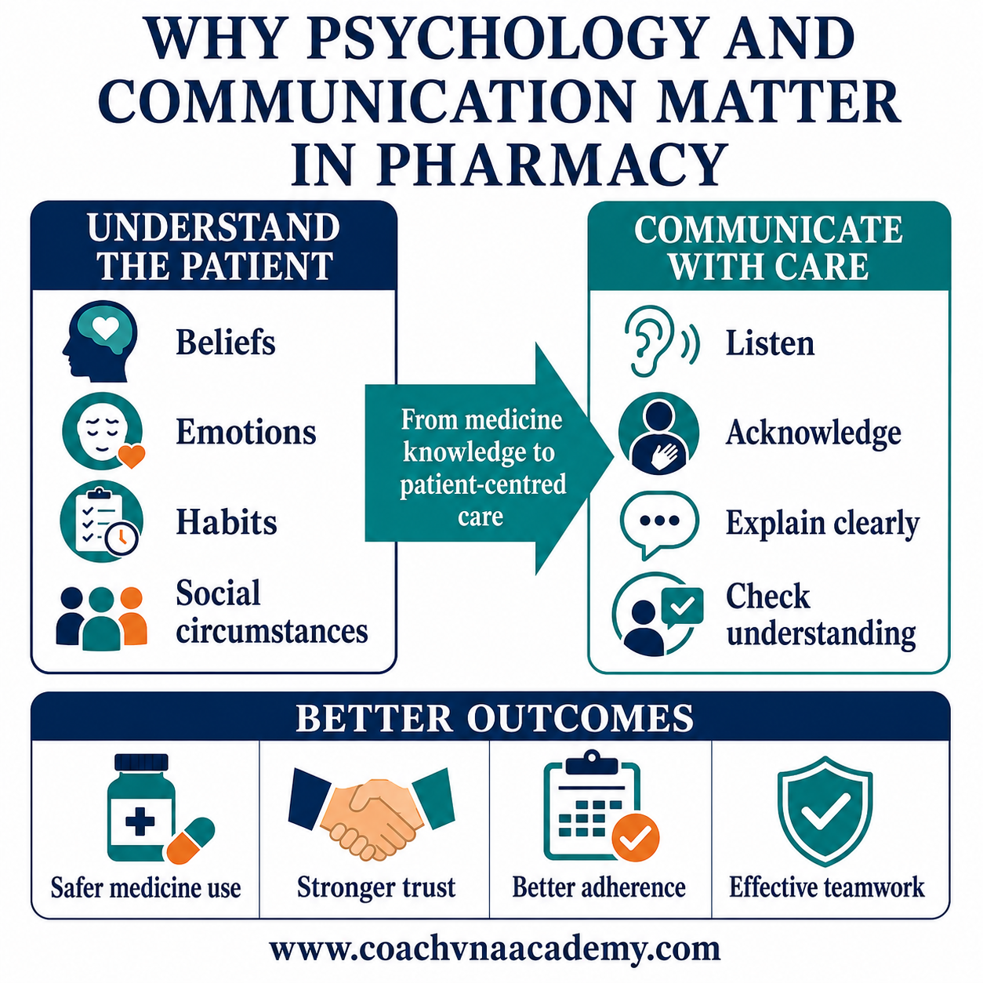
Psychology and communication are closely connected in pharmacy practice. Psychology helps the pharmacist understand what a patient may be thinking, feeling or believing. Communication helps the pharmacist respond to those thoughts, emotions and beliefs clearly and respectfully.
For example, a patient may refuse a medicine because of fear of side effects. Psychological understanding helps the pharmacist recognise that fear—not carelessness—is influencing the patient’s decision. Communication skills then help the pharmacist listen to the concern, acknowledge it, provide accurate information and check whether the patient has understood the explanation.
The relationship can be summarised as:
Understand the patient → Communicate appropriately → Support informed and safer medicine use
Psychology without effective communication may remain only an understanding of the problem. Communication without psychological understanding may become mechanical, judgmental or unsuitable for the patient. When both skills work together, the pharmacist can provide more patient-centred care.
From Understanding to Action
| Psychological understanding | Communication response |
| The patient fears side effects | Listen, acknowledge the fear and explain relevant risks and precautions |
| The patient forgets doses | Explore the daily routine and discuss a suitable reminder |
| The patient believes the medicine is unnecessary | Ask about the belief and explain the medicine’s purpose clearly |
| The patient feels anxious | Use a calm tone, simple language and allow questions |
| The patient has difficulty understanding instructions | Use plain language, demonstration, written support and teach-back |
Key message: Psychology helps the pharmacist understand the reason behind a patient’s behaviour. Communication helps the pharmacist convert that understanding into respectful and practical support.
Three Practical Pharmacy Situations
A patient stops an antibiotic after feeling better
Human factor: The patient believes that fewer symptoms mean treatment is no longer needed.
Pharmacist response: Explore the reason, reinforce the prescribed directions in plain language, and advise the patient to seek professional guidance before changing treatment. Concerns about adverse effects need appropriate assessment.
A patient fears insulin
Human factor: The patient believes insulin causes permanent dependence.
Pharmacist response: Listen without ridicule, clarify misinformation within professional competence and encourage discussion with the treating clinician.
A patient misses antihypertensive doses
Human factor: Forgetfulness or the absence of an established routine interferes with regular use.
Pharmacist response: Explore a suitable reminder, medicine chart or routine. A pill organiser may help when appropriate. Missed-dose advice must remain medicine-specific.
Ineffective vs Patient-Centred Communication
| Ineffective response | Patient-centred response |
| “All medicines have side effects. Just take it as prescribed.” | “I understand that you are concerned about side effects. May I ask what you have heard or experienced? Let us discuss common effects, important warning signs and safe use.” |
The second response listens, acknowledges the concern, invites useful information and offers a clear next step. Patient-centred communication does not promise that a medicine is risk-free; it helps the patient understand benefits, risks and safe use.
A Simple Four-Step Communication Framework
Listen
Give the patient time to explain the concern without interruption.
Acknowledge
Name the concern respectfully: ‘I can understand why that worries you.’
Explain
Use accurate, medicine-specific information in plain language.
Check
Use teach-back and invite questions before closing the conversation.
Career Relevance for Pharmacy Students
Psychology and communication are not ‘extra’ subjects. They support everyday performance across pharmacy careers.
| Career area | How the skills are used |
| Community pharmacy | Patient counselling, responsible self-medication and complaint management. |
| Hospital or clinical pharmacy | Medication history, adherence assessment and teamwork with patients and clinicians. |
| Pharmacovigilance | Sensitive collection and accurate reporting of adverse-effect information. |
| Pharmaceutical industry | Presentations, teamwork, professional interaction and ethical communication. |
| Research | Participant communication, informed consent processes and multidisciplinary teamwork. |
| Entrepreneurship and education | Leadership, negotiation, teaching, interviews, academic writing and public communication. |
What Students Will Learn
- Human behaviour, learning, memory, motivation and emotion
- Personality, individual differences, stress and coping
- Health beliefs, illness behaviour and barriers to adherence
- Verbal and nonverbal communication, listening and empathy
- Patient counselling, teamwork and professional relationships
- Communication during difficult or sensitive healthcare situations
The detailed sequence should follow the institution’s prescribed syllabus. In the first class, the main aim is to establish curiosity and show how the subject connects with pharmacy practice.
Key Takeaway
| REMEMBER Pharmacy is the science of medicines and also a profession of human care. Psychology helps the pharmacist understand the person; communication helps the pharmacist use scientific knowledge effectively and respectfully. |