
Drying Oils: Definition, Mechanism, Classification, Examples and Uses
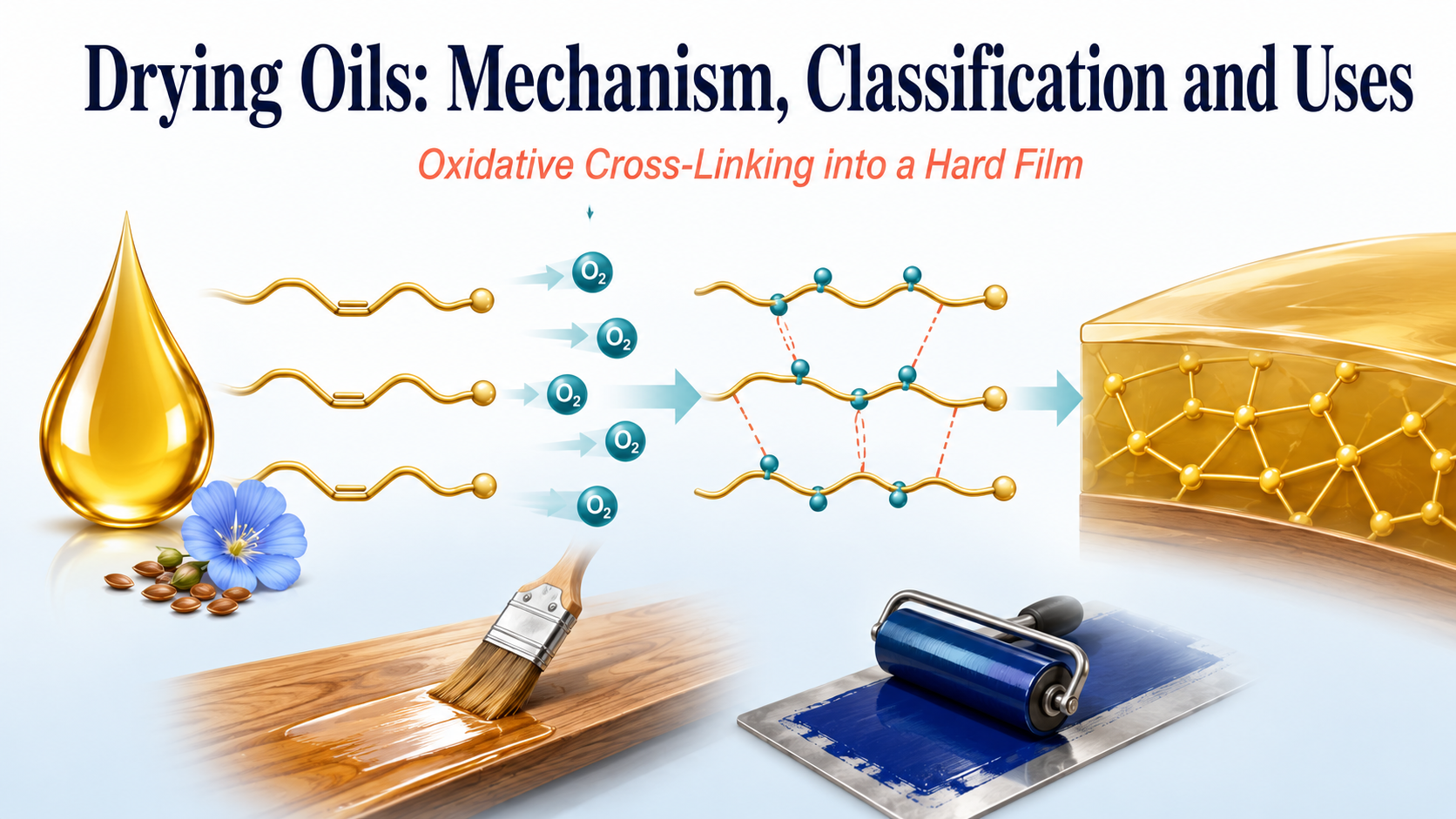
Learn drying oils through clear notes on oxidative polymerization, free-radical mechanism, iodine-value classification, examples, tests, uses, factors and safety.
Learn drying oils through clear notes on oxidative polymerization, free-radical mechanism, iodine-value classification, examples, tests, uses, factors and safety.
The Iodine Value (IV), also known as the Iodine Number. It is a fundamental analytical parameter in the analysis of fats and oils. It is a direct measure of the degree of unsaturation (number of double bonds) in a lipid sample. Definition The Iodine Value is defined as the number of grams of iodine absorbed … Read more
In the context of surface coatings and chemistry, drying oils are a vital class of materials. Definition Drying oils are liquid vegetable or animal fats that, when exposed to air, undergo a chemical reaction (polymerization) to form a tough, solid and elastic film. Contrary to the name, they do not “dry” through the evaporation of … Read more