
Building balance, resilience, self-awareness and a positive mindset
| A gentle note This article offers education and everyday self-care ideas. It does not diagnose or replace advice from a qualified mental-health professional. Asking for help is a responsible action, not a sign of weakness. |
Introduction: A Tender Age Full of Change
College students often look grown-up from the outside, but many are still learning how to understand themselves from the inside. Between late adolescence and early adulthood, they face new freedom, academic pressure, changing friendships, family expectations, body-image concerns, career uncertainty and constant comparison through social media. A student may attend class, smile with friends and submit assignments while silently carrying worry, loneliness, disappointment or self-doubt.
Consider Naina, a first-year student who had always been known as a sincere learner. After joining college, her routine changed. She began sleeping late, checking classmates’ achievements online and worrying that everyone was progressing faster than she was. A low test score made her think, “Maybe I am not capable.” Nothing dramatic had happened, yet small pressures had started collecting inside her. What Naina needed was not a lecture telling her to “be positive.” She needed sleep, perspective, supportive conversation, manageable goals and the confidence to seek help when needed.
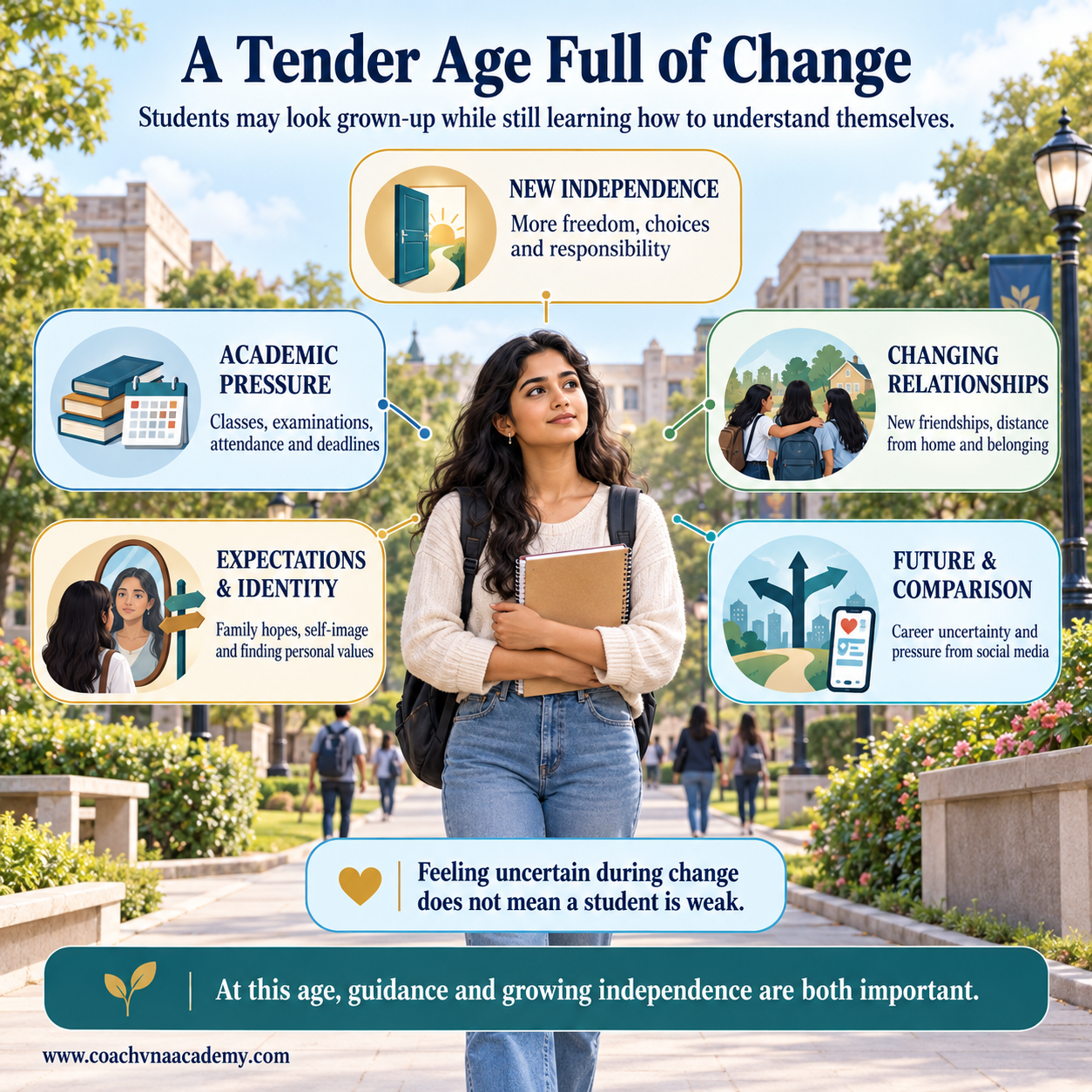
This is why mental and emotional well-being deserves the same attention as marks, attendance and physical health. It helps students think clearly, connect with others, recover after setbacks and make healthier choices. The World Health Organization describes adolescence as a formative period for developing emotional, social and coping habits. Healthy sleep, regular movement, problem-solving skills, supportive relationships and learning to manage emotions can all protect well-being. Students who want to understand how feelings influence behaviour and goals can also explore emotion and motivation in healthcare
What Do Mental and Emotional Well-Being Mean?
Mental well-being relates to how a student thinks, learns, makes decisions, handles pressure and finds meaning in daily life. Emotional well-being relates to recognizing, expressing and regulating feelings in healthy ways. They overlap, but neither means feeling happy all the time.
| Well-being does not mean | Well-being can mean |
| Never feeling worried, sad or angry | Recognizing these feelings and responding safely |
| Always being confident | Acting despite some uncertainty and learning gradually |
| Handling everything alone | Knowing when and how to ask for support |
| Ignoring problems and “thinking positive” | Seeing the difficulty honestly while looking for a useful next step |
| Getting perfect marks | Learning, adapting and protecting health alongside study |
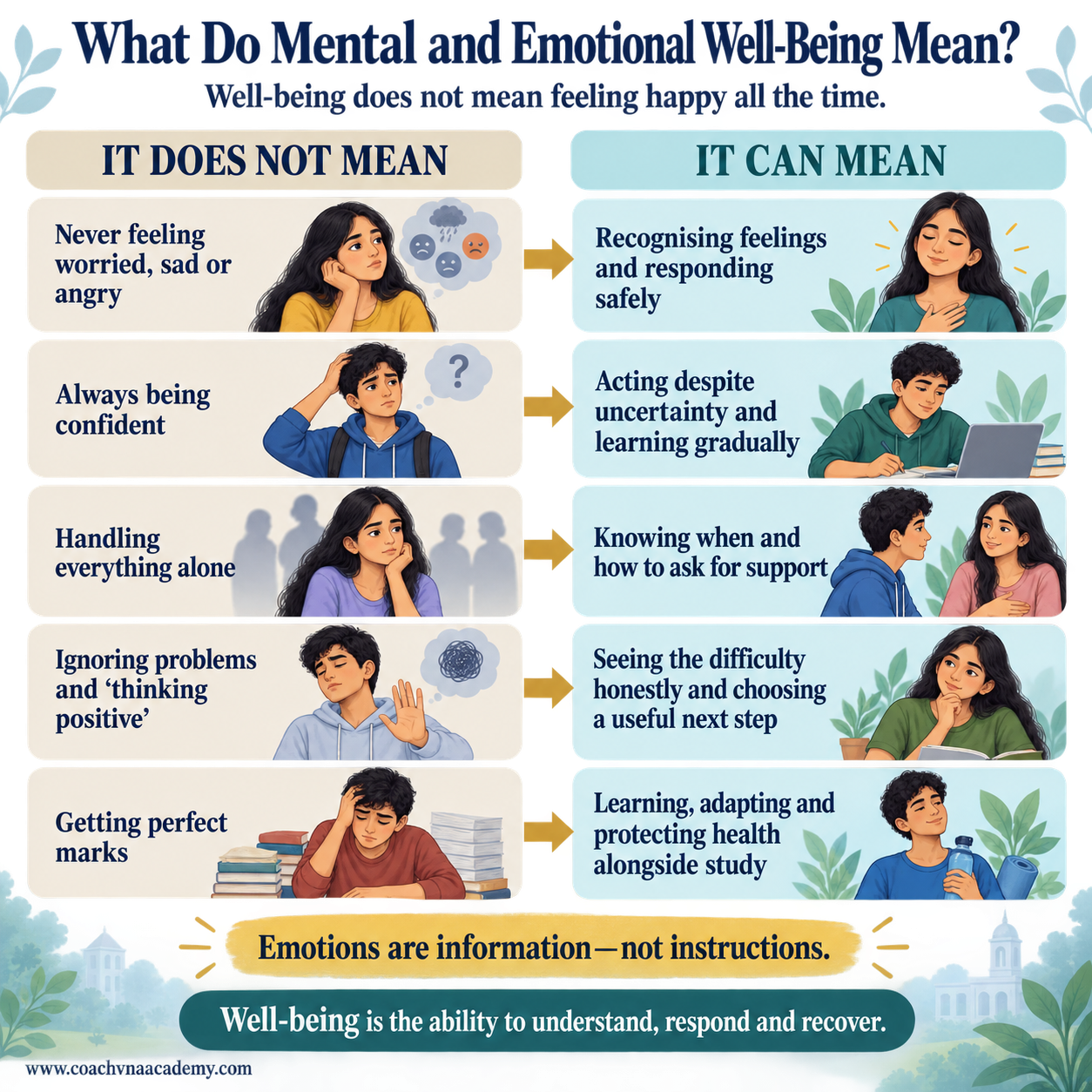
| Important idea An emotion is information, not an instruction. Anger may signal unfairness, fear may signal risk, and sadness may signal loss. A student can notice the message without allowing the emotion to control every action. |
Why Well-Being Matters at This Age
At this stage, students are shaping habits and beliefs that may continue into adult life. They are deciding how they respond to failure, whom they trust, how they treat their body and whether they speak up when something feels wrong. Strong well-being supports more than academic performance.
- Learning and concentration: A calmer, rested mind can pay attention, remember information and solve problems more effectively.
- Healthy relationships: Emotional awareness improves listening, empathy, boundaries and conflict resolution.
- Decision-making: Students are better able to pause before reacting to peer pressure, online conflict or impulsive choices.
- Physical health: Stress affects sleep, appetite, headaches, digestion, energy and daily routines; mind and body influence each other.
- Confidence and identity: Students begin to separate their real values from comparison, labels and other people’s expectations.
- Long-term coping: Learning to recover from a poor result or rejection builds skills useful in careers, relationships and adult responsibilities.
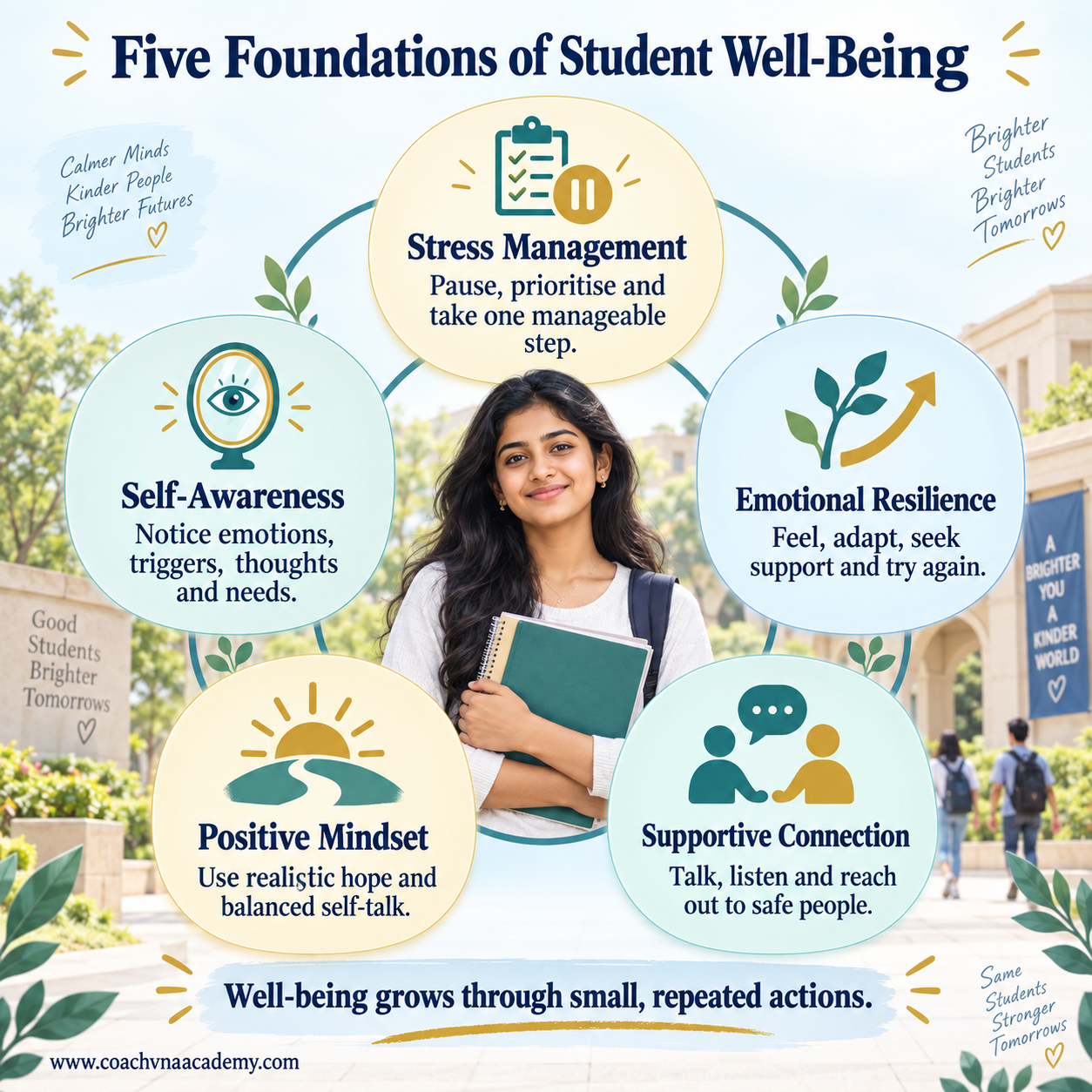
Five Foundations of Student Well-Being
Student well-being develops through five connected foundations: effective stress management, emotional resilience, self-awareness, a positive mindset and supportive relationships. These foundations work together and help students manage challenges, understand their emotions and maintain a healthier balance in everyday life.
Effective Stress Management: Respond, Do Not Simply React
Stress is a natural response to challenge. A limited amount may help a student prepare for an examination or meet a deadline. However, when demands remain high and recovery remains low, stress can affect concentration, sleep, mood and physical comfort. The aim is not a stress-free life; it is a healthier response to stress.
Examination-related stress may require more specific preparation and coping strategies. This student-friendly guide explains how to manage examination fear and academic pressure.
| Step | Student-friendly action |
| Pause | Stop for one minute. Place both feet on the floor and slow the exhalation. |
| Name | Say: “I am worried about tomorrow’s viva,” instead of “Everything is terrible.” |
| Sort | Separate what you can control, influence or only accept for now. |
| Choose | Select one small next action: revise one topic, ask a doubt or prepare your bag. |
| Recover | After focused work, take a short movement, water or breathing break. |
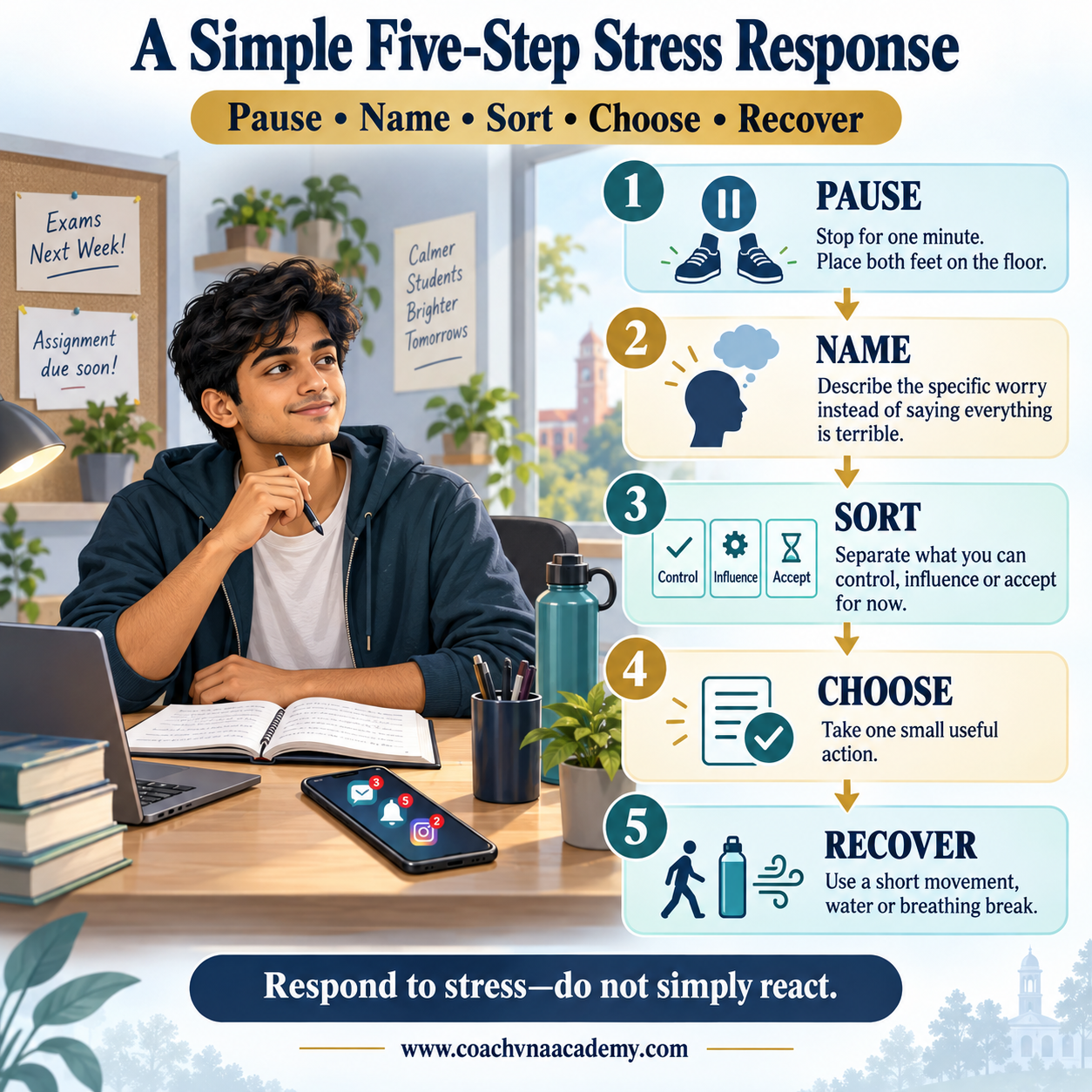
For overloaded days, students can use the 3D method: Do the urgent and important task, Divide a large task into smaller parts, and Delay or decline low-priority demands. A realistic plan reduces mental clutter better than repeatedly thinking about the whole workload.
Emotional Resilience: Recovering Without Pretending
Resilience is the ability to adapt and continue after disappointment, change or difficulty. It does not mean suppressing tears, tolerating mistreatment or immediately “bouncing back.” A resilient student can feel hurt, take time to recover, learn from the experience and seek support.
After a low score, for example, replace the identity statement “I am a failure” with the event statement “My preparation did not work well for this test.” Then review the paper, identify one knowledge gap and one study-method gap, discuss doubts, and plan the next attempt. This protects dignity while encouraging responsibility.
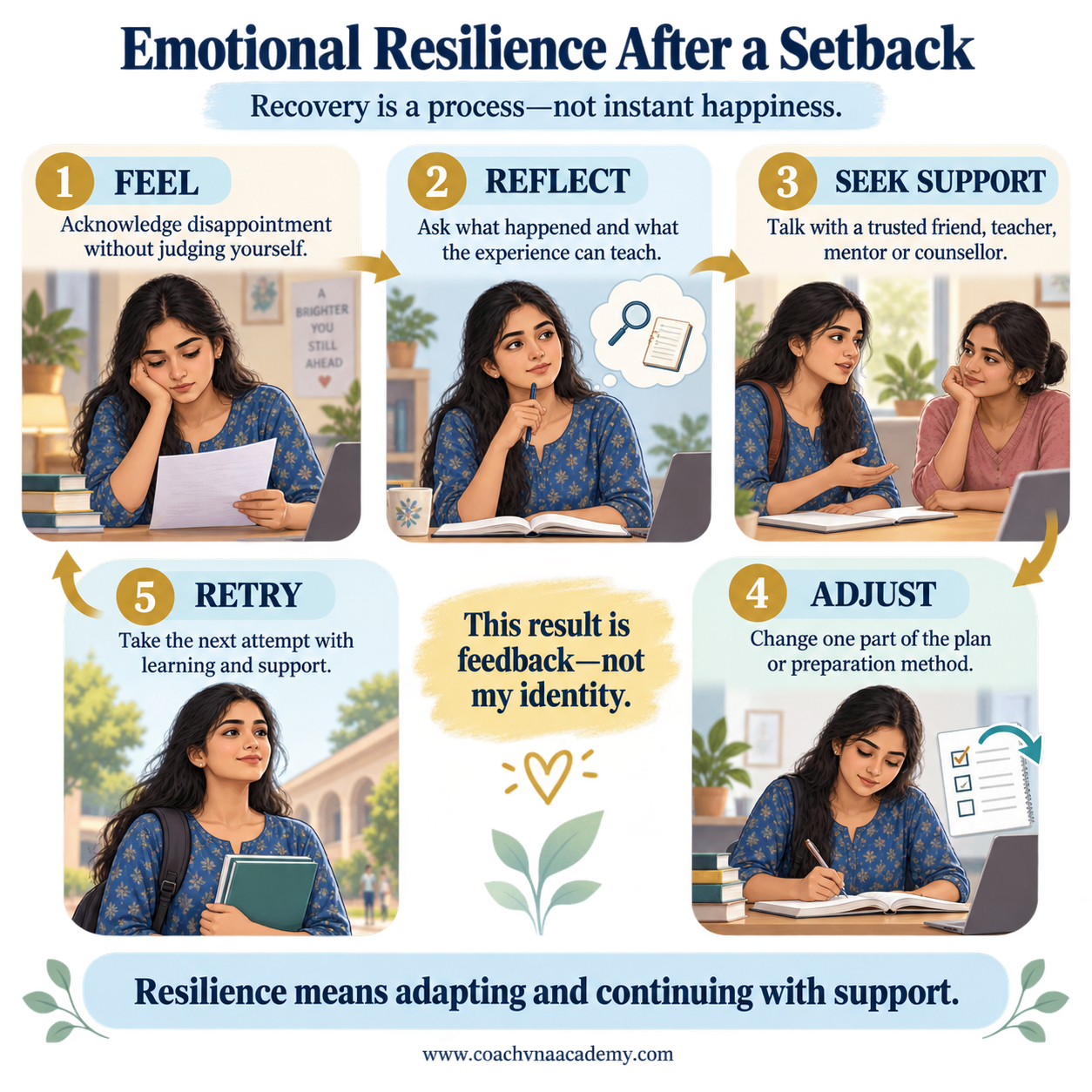
| Resilience sentence “This is difficult, but it is one part of my story. I can take one useful step and accept support.” |
Self-Awareness: Understanding the Inner Pattern
Self-awareness helps students notice what they feel, what triggers the feeling, how the body responds and what they tend to do next. Without awareness, a student may call every uncomfortable state “stress” and react through avoidance, scrolling, overeating or anger.
| Notice | Example question |
| Emotion | What am I feeling: worried, lonely, embarrassed, angry or disappointed? |
| Body | Where do I notice it: tight jaw, fast heartbeat, heavy eyes or restless hands? |
| Trigger | What happened just before this feeling became stronger? |
| Thought | What am I telling myself about the situation? Is it a fact or an assumption? |
| Need | Do I need rest, information, reassurance, a boundary, food, movement or professional help? |
| Choice | What response will help me one hour from now as well as right now? |
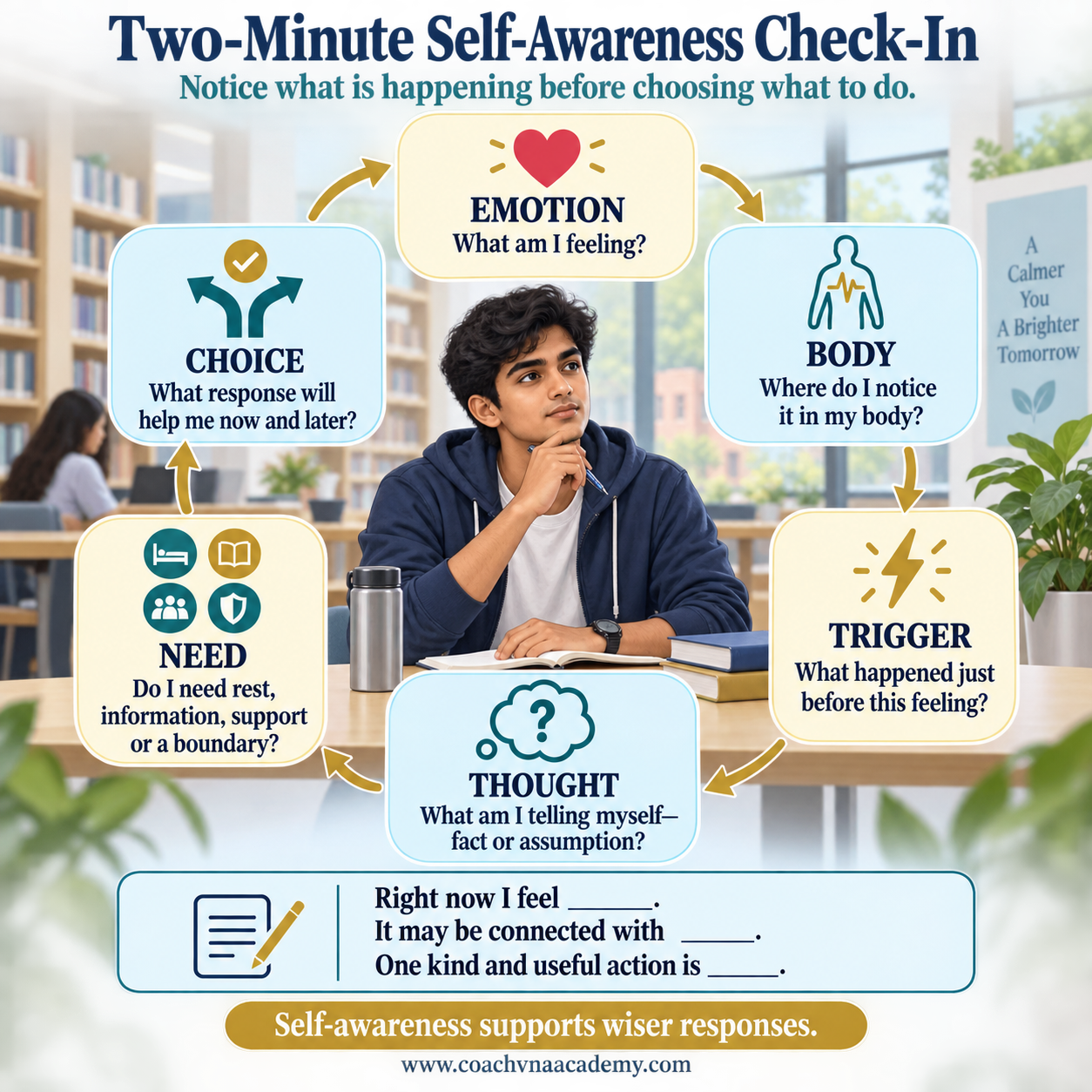
A two-minute daily check-in can be enough: “Right now I feel ____. It may be connected with ____. My body needs ____. One kind action I can take is ____.” This is not overthinking; it is structured observation.
A Positive Mindset: Realistic Hope, Not Forced Positivity
A positive mindset does not deny pain or insist that every situation is good. It helps a student believe that skills can improve, setbacks can teach something and support is available. Healthy optimism stays connected to evidence and action.
| Unhelpful thought | Balanced replacement |
| Everyone is ahead of me. | I am seeing selected parts of their lives; I can focus on my next step. |
| One poor result proves I cannot do this. | One result gives feedback about this attempt, not my total ability. |
| I must solve everything today. | I can prioritise and complete the next manageable task. |
| Asking for help will make me look weak. | Seeking the right help is a problem-solving skill. |
| I should never feel upset. | Difficult emotions are human; I can respond to them safely. |
Supportive Connection: Well-Being Is Not a Solo Project
Students need at least a few safe connections: a friend who listens, a family member who does not immediately judge, a teacher or mentor who guides, and access to a counsellor or health professional when required. Support does not always mean giving advice. Sometimes it means listening, helping the student name the problem and staying present while they take the next step.
Maintaining Balance Between Mind and Body
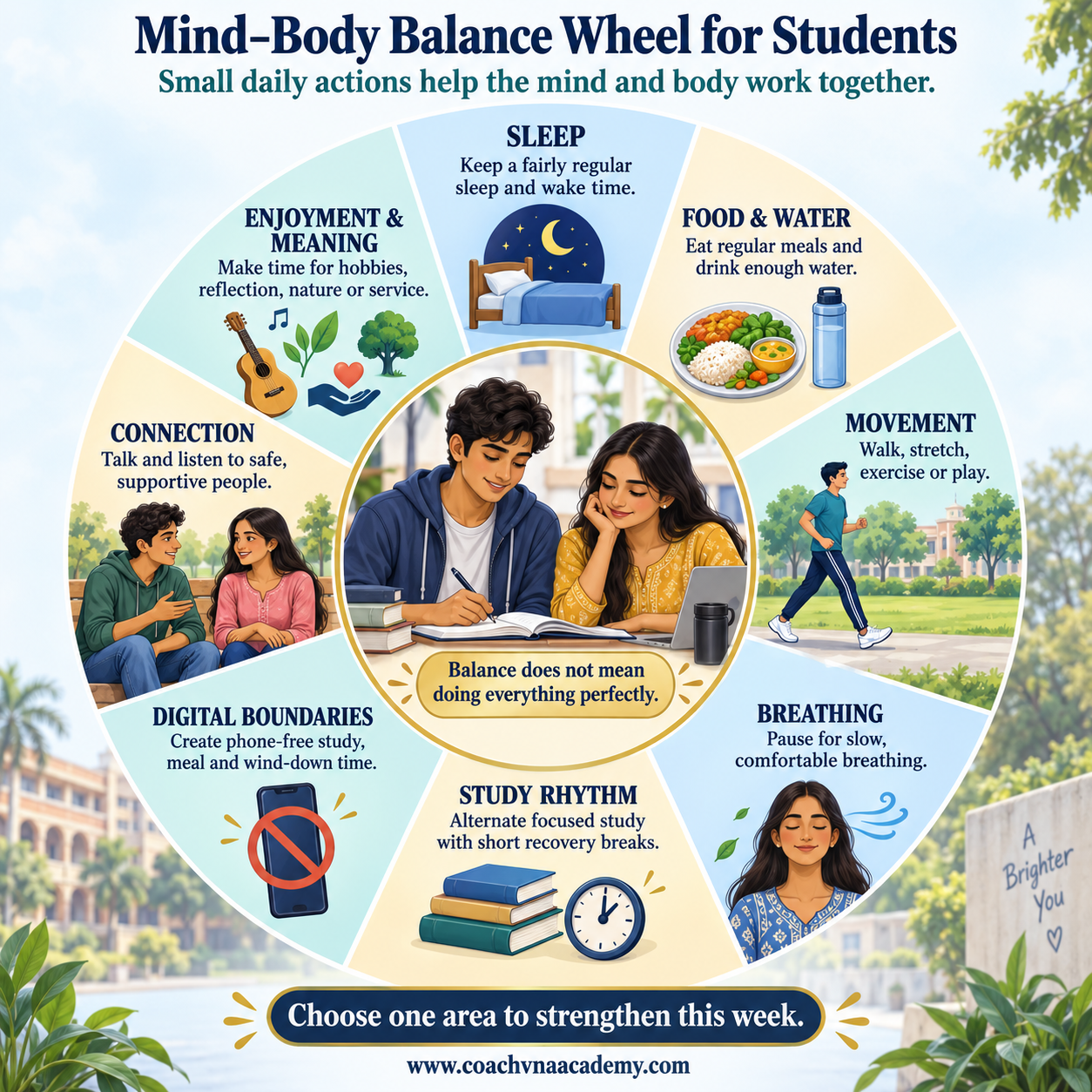
The mind does not operate separately from the body. Irregular sleep, skipped meals, dehydration, long sitting, excessive caffeine and continuous screen exposure can increase irritability, fatigue and poor concentration. Similarly, prolonged emotional distress can disturb appetite, sleep and energy. Balance grows from small repeated actions.
Sleep loss, skipped breakfast, long travel and excessive phone use can make students physically present but mentally tired in class. Read why students often feel present in class but unable to focus
Regular sleep supports concentration, emotional regulation and recovery from daily stress. Students can gradually improve their routine with these healthy sleep habits for college students
| Area | Practical strategy for students | Keep it realistic |
| Sleep | Keep a fairly regular sleep and wake time; reduce stimulating screen use before bed. | Shift the routine gradually rather than demanding perfection overnight. |
| Food and water | Eat regular balanced meals and carry water; avoid depending only on tea, coffee or packaged snacks. | Use affordable hostel, mess or home options. |
| Movement | Walk, stretch, use stairs, play a sport or exercise in short blocks. | Even brief movement breaks count; build duration gradually. |
| Breathing and grounding | Slow the breath gently and notice feet, sounds and surroundings. | Use it to settle—not to force an emotion away. |
| Study rhythm | Alternate focused study with brief recovery breaks. | Choose a rhythm that suits the task and attention span. |
| Digital boundaries | Create phone-free study, meal and wind-down periods. | Turn off non-essential notifications and keep the phone out of reach. |
| Connection | Speak honestly with a trusted person and also listen to others. | Choose safe people; privacy and boundaries matter. |
| Enjoyment and meaning | Keep time for hobbies, prayer or reflection, music, creativity, nature or service. | Rest is part of a healthy routine, not a reward for exhaustion. |
Managing Everyday Emotional Challenges
Students may experience examination anxiety, loneliness, friendship conflicts, social-media comparison, academic disappointment or family pressure. Constant notifications and online comparison can also disturb attention and emotional balance. Students facing this problem can follow these practical steps to manage mobile-phone distraction among students Instead of reacting immediately, they can pause, understand the problem and choose a calm, practical response.
| Challenge | Helpful response | Avoid |
| Examination anxiety | Prepare a small revision plan, practise under timed conditions, sleep, and use slow breathing before starting. | All-night study, excessive caffeine and comparing preparation repeatedly. |
| Homesickness or loneliness | Maintain regular contact with home while building one local routine or connection. | Staying isolated and assuming nobody will understand. |
| Friendship conflict | Cool down, describe the specific behaviour, listen and set a respectful boundary. | Public arguments, indirect posts or forwarding private messages. |
| Social-media comparison | Ask what is missing from the post; limit exposure and return to personal goals. | Using likes, appearance or achievements as a measure of worth. |
| Academic disappointment | Allow the feeling, review feedback and change one part of the preparation method. | Turning one result into a permanent identity. |
| Family or career pressure | Clarify concerns, collect reliable information and involve a trusted mentor if useful. | Making a major decision during a highly emotional moment. |
| Anger and frustration | Pause, move away briefly if safe, relax the body, then speak about the issue. | Threats, damage, impulsive messages or substance use. |
| Overthinking | Write the worry, identify whether action is possible now, schedule the action or redirect attention. | Trying to achieve absolute certainty before doing anything. |
A Simple Daily RESET for Students
The RESET method helps students respond to emotional pressure step by step. Recognise the feeling, Exhale slowly, Separate facts from assumptions, Engage in one useful action and Tend to the body through rest, food, water and movement. Regular meals and adequate water support energy, concentration and physical comfort. These healthy eating habits for college students offer practical options for home, hostel and college routines.
Students can also practise these slow-breathing techniques for study focus when they need a gentle pause before returning to their work.
| Letter | Action |
| R — Recognise | Name the emotion and body signal. |
| E — Exhale | Take several slow, comfortable breaths; do not strain or hold the breath. |
| S — Separate | Distinguish facts from assumptions and controllable from uncontrollable concerns. |
| E — Engage | Take one useful action or connect with one safe person. |
| T — Tend | Support the body with sleep, food, water, movement and recovery. |
Seven-Day Mind–Body Balance Starter Plan
This seven-day plan introduces one small well-being action each day. Students can gradually practise self-awareness, better sleep, movement, supportive connection, balanced thinking, organisation and weekly review without expecting perfection.
| Day | Small action | Reflection |
| Day 1: Notice | Complete one two-minute emotion-and-body check-in. | What feeling was easiest or hardest to name? |
| Day 2: Sleep | Choose a realistic wind-down time and place the phone away for part of it. | What made settling easier? |
| Day 3: Move | Take a purposeful walk or another enjoyable movement break. | How did energy or tension change? |
| Day 4: Connect | Have one honest conversation with a trusted person. | Did I listen as well as speak? |
| Day 5: Reframe | Rewrite one harsh thought in balanced language. | What evidence supports the balanced thought? |
| Day 6: Organise | Divide one avoided task into the smallest possible first steps. | Which step can I repeat tomorrow? |
| Day 7: Review | Identify one helpful habit and plan when to continue it. | What support or adjustment do I need? |
Students who frequently postpone tasks can also learn how to improve time management as a student through realistic planning and smaller study targets.
Once the first seven days are complete, students can use these steps to build an effective study routine without depending on an unrealistic timetable.
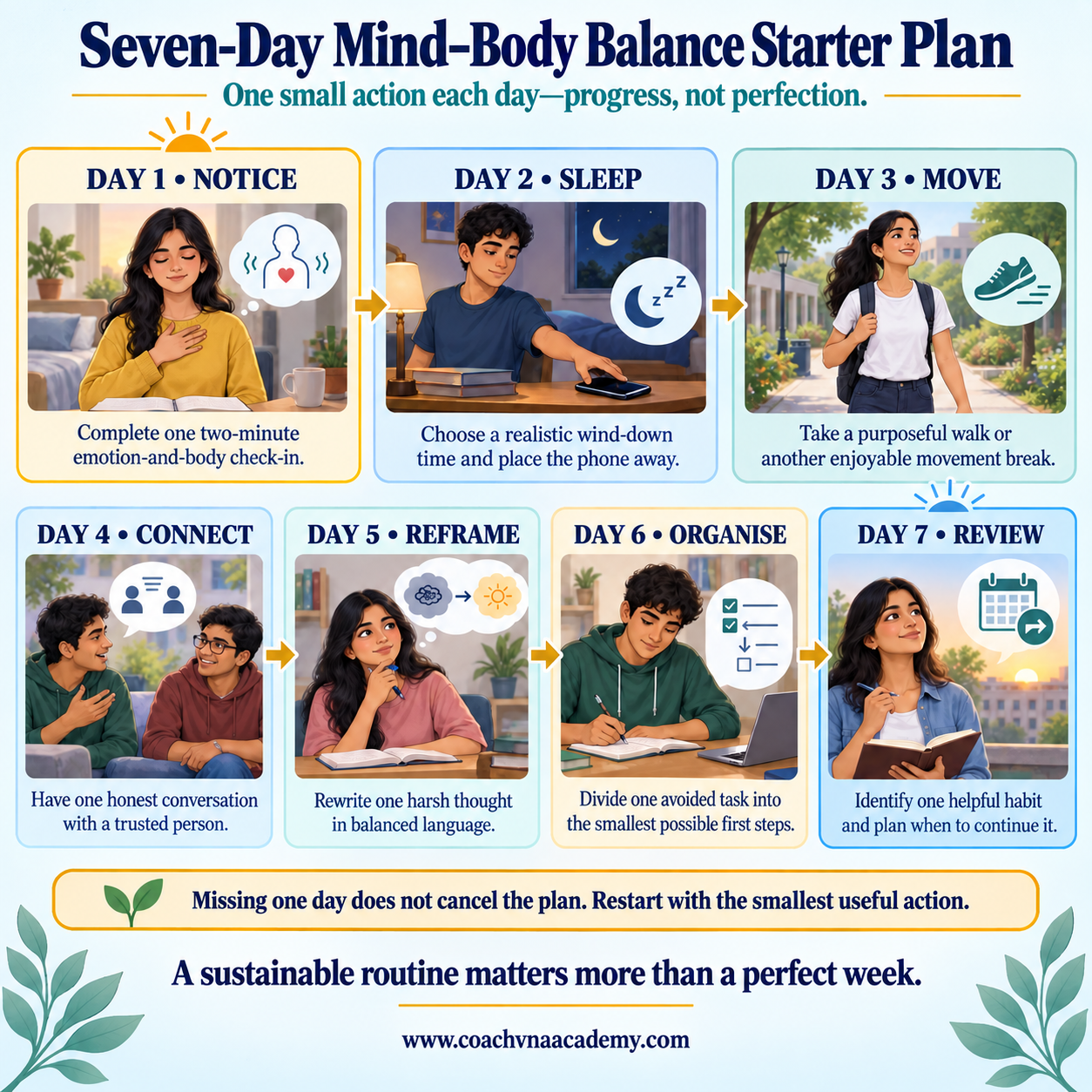
| Progress, not perfection Missing one day does not cancel the plan. Restart with the smallest useful action. A sustainable routine is more valuable than a perfect routine that lasts only two days. |
When Self-Care Is Not Enough: Seek Support
Everyday strategies can help with ordinary stress, but persistent or severe distress deserves professional attention. Speak to a parent or trusted adult, college counsellor, teacher, doctor, psychologist, psychiatrist or another qualified professional when feelings or behaviour begin to interfere with study, sleep, relationships, self-care or daily functioning.
Seek prompt support if there is persistent sadness or anxiety, frequent panic, major sleep or appetite change, strong withdrawal, loss of interest, repeated substance use to cope, unusual or frightening experiences, or a sharp decline in daily functioning. If a student talks about self-harm, suicide, feeling unsafe or being unable to continue, take it seriously. Do not leave the person alone when immediate danger is possible; contact local emergency services or a trusted responsible adult and obtain urgent professional help.
| India support option Tele-MANAS provides tele-mental-health support in India at 14416 or 1-800-891-4416. Availability and emergency response can vary by location; immediate danger requires local emergency services and in-person help. |
How Friends, Families and Teachers Can Help
- Listen without rushing to compare, lecture or dismiss the feeling.
- Use specific observations: “You have seemed very tired and withdrawn this week,” rather than labels.
- Ask what would help: listening, practical planning, company or professional support.
- Protect privacy, except when safety is at risk and responsible help must be involved.
- Encourage routines and support without controlling every decision.
- Follow up. One caring conversation is valuable, but continued connection matters.
Returning to Naina: Small Changes, Real Support
Naina did not transform in one motivational moment. She first spoke with a trusted classmate and then with a faculty mentor. She moved her phone away during study, stopped checking marks-related messages late at night and divided revision into smaller targets. When worry continued to disturb her sleep, she agreed to speak with a counsellor. Her next test was not perfect, but she approached it with more clarity. More importantly, she no longer treated every difficult emotion as proof that something was wrong with her.
That is the heart of student well-being: not a permanently cheerful life, but a growing ability to notice, respond, connect and recover. Students at this tender age need guidance that respects both their emerging independence and their continuing need for support.
Frequently Asked Questions
Is stress always harmful?
No. Short-term stress can motivate preparation. Stress becomes concerning when it is intense, persistent, difficult to manage or disrupts daily functioning.
Does emotional resilience mean hiding feelings?
No. Resilience includes acknowledging feelings, expressing them safely, adapting and seeking support.
How can a student develop a positive mindset?
Use balanced self-talk, set small achievable goals, review evidence, appreciate progress and learn from feedback without attaching identity to one result.
Can sleep and physical activity affect mood?
Yes. Sleep, movement and regular routines support both physical and mental well-being, although they do not replace professional care when symptoms are significant.
What should I say to a distressed friend?
Try: “I am glad you told me. I am here to listen. Would you like help contacting someone?” If safety is at risk, involve responsible support urgently.
When should a student contact a mental-health professional?
When distress persists, feels overwhelming, interferes with daily life, or includes self-harm, suicidal thoughts, severe withdrawal or other alarming changes.
Key Takeaway
| Mental strength is not silent suffering A healthy student learns to notice emotions, care for the body, manage stress, think realistically, recover from setbacks and seek support at the right time. |
Explore more practical resources for healthier college habits on the Student Success guides page.
References and Further Support
- World Health Organization — Mental health of adolescents
- World Health Organization — Stress: questions and answers
- World Health Organization — Physical activity
- Tele-MANAS, Government of India — National tele-mental-health support
Editorial note: Verify helpline numbers and local emergency information again immediately before website publication, because service details may change.