
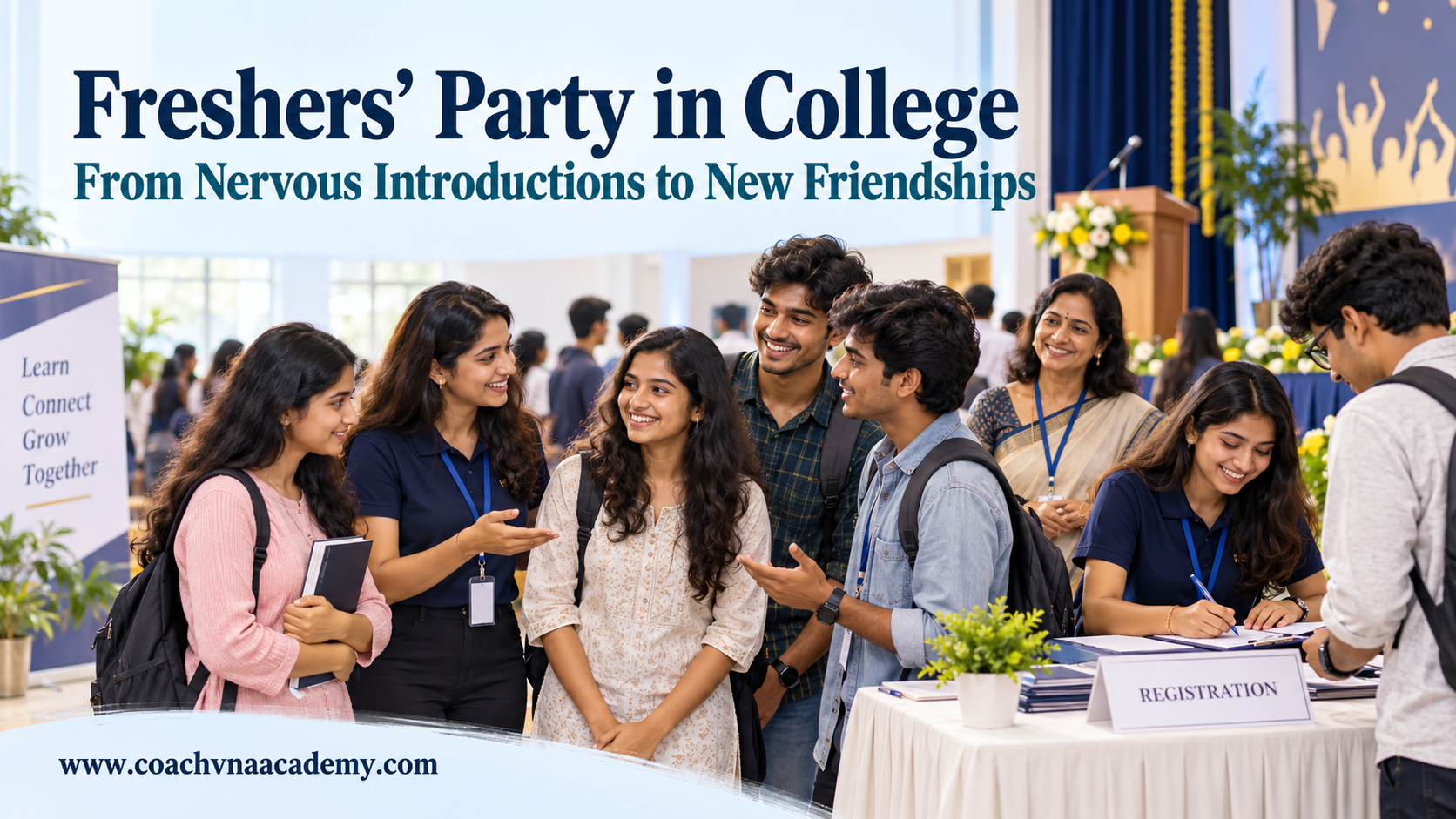
Friendship, Competition and Career Learning
The notice board outside the first-year classrooms was usually filled with examination schedules, attendance reminders and routine announcements. That Monday morning, however, one colourful notice drew a small crowd.
FRESHERS’ PARTY FOR FIRST-YEAR STUDENTS, it announced in large letters. The date was only seven days away.
Within minutes, students photographed the notice. Soon, the same information appeared in the official WhatsApp groups. Class representatives repeated the reporting time, dress guidance, venue and contact details of the student coordinators.
For some students, the message brought immediate excitement. They began discussing songs, dance performances and clothes. For others, it created a new set of worries.
Nikhil read the WhatsApp message twice but did not react to it. He had joined college only a few weeks earlier and still spoke mainly to the student sitting beside him. The thought of entering a crowded hall, introducing himself and possibly being called onto the stage made him uncomfortable.
Mehak felt interested, but her questions were practical. She travelled to college from home. What time would the programme finish? Would transport be available? What should she wear? Would she know anyone well enough to stay with throughout the event?
Faizan, who lived in the hostel, responded differently. Within ten minutes, he had created a small group to discuss a performance. The same invitation had reached everyone, but each student received it through a different emotional lens.
Preparations Begin One Week Before the Celebration
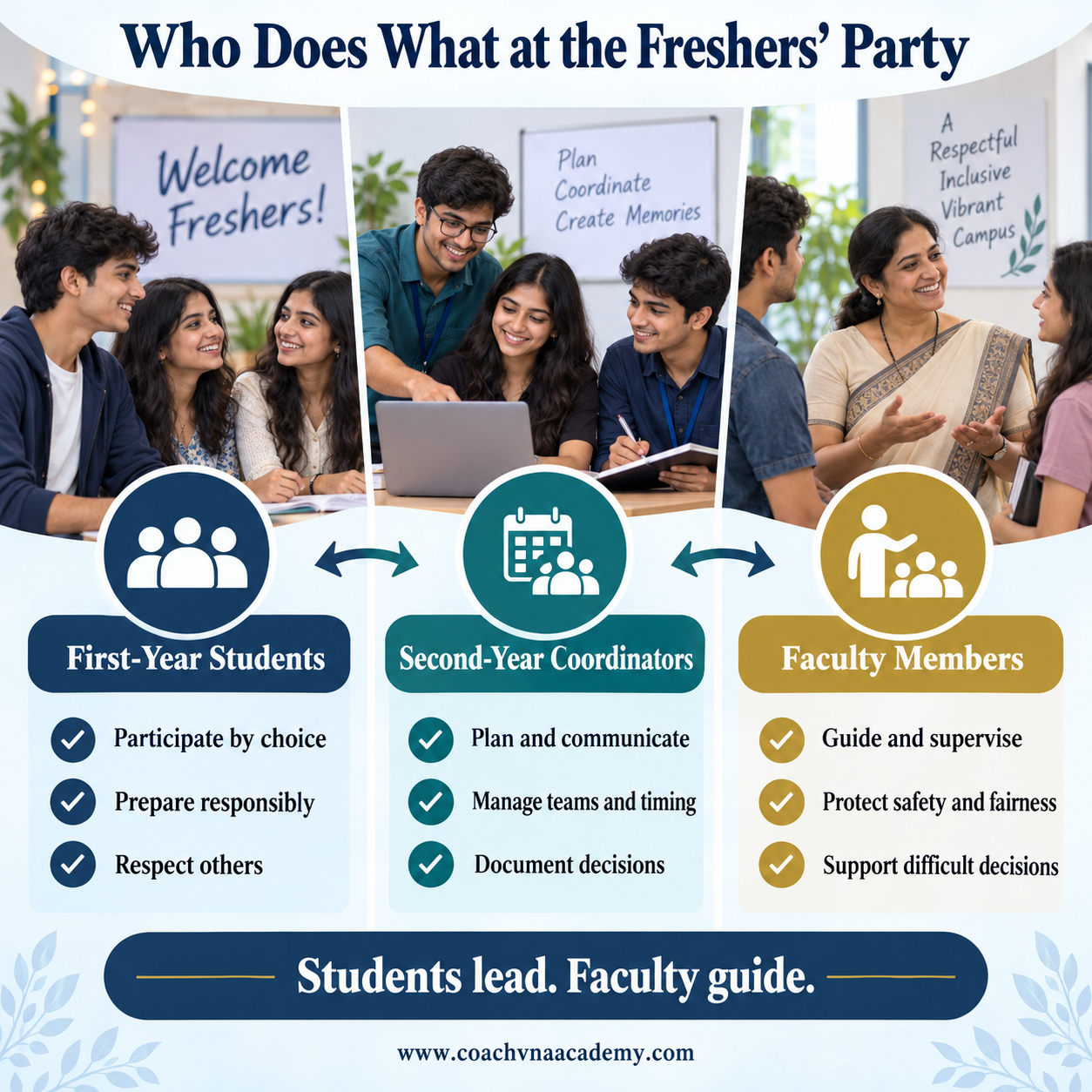
The Freshers’ Party was planned and coordinated by second-year students under the guidance of the concerned faculty members. The faculty team approved the schedule, monitored safety and discipline, and helped the coordinators handle matters that required formal decisions. The day-to-day planning, however, gave the second-year students genuine responsibility.
They divided themselves into teams for registration, performances, anchoring, decoration, hospitality, photography, music and stage coordination. Each team had a student lead, but no team worked alone. A delayed rehearsal affected the stage sequence; the stage sequence affected anchoring; anchoring depended on accurate participant information.
During a classroom announcement, Ritika, a second-year coordinator, explained the options to the first-year students.
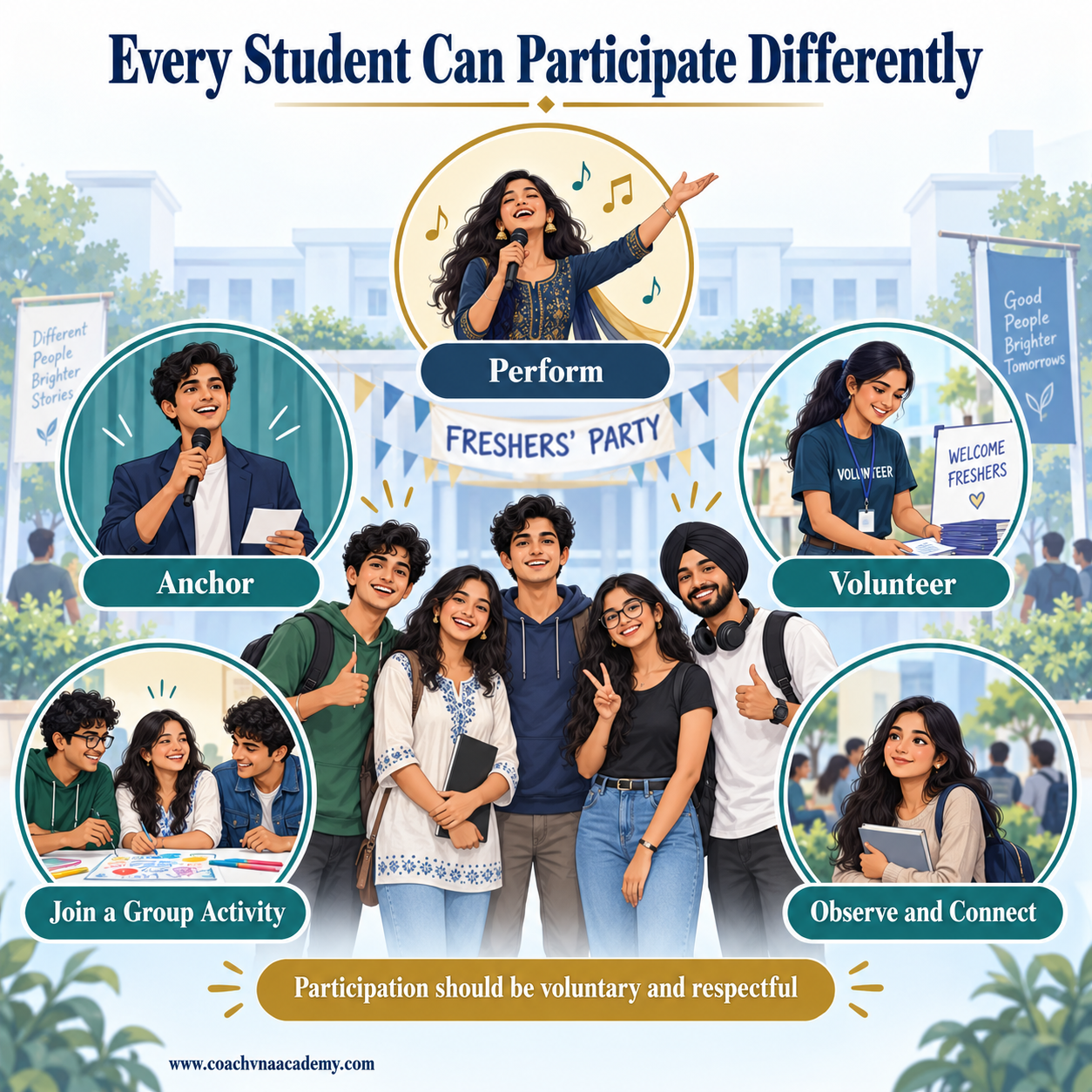
“Participation voluntary hai,” she said. “Agar aap stage performance nahi karna chahte, you can join a group activity or help in a supporting role. Kisi par pressure nahi hoga.”
That single clarification mattered to Nikhil. He had assumed that attending meant he would be forced to dance, sing or give a long introduction.
Rehearsals should not continue so late that students arrive tired on the event day. Following a healthy sleep routine for college students supports concentration, emotional control and confident participation.
Seven Days of Preparation
| Time | Main preparation |
| Seven days before | Notice-board announcement, WhatsApp communication and volunteer registration |
| Six days before | Second-year coordinators explain performances and supporting roles |
| Five days before | Auditions, team formation and initial interaction among students |
| Four days before | Rehearsals, anchoring practice and faculty review |
| Three days before | Stage sequence, decoration, hospitality and technical planning |
| Two days before | Full rehearsal and corrections in timing and transitions |
| One day before | Final checklist, reporting instructions and venue preparation |
| Event day | Welcome, participation, professional interaction and celebration |
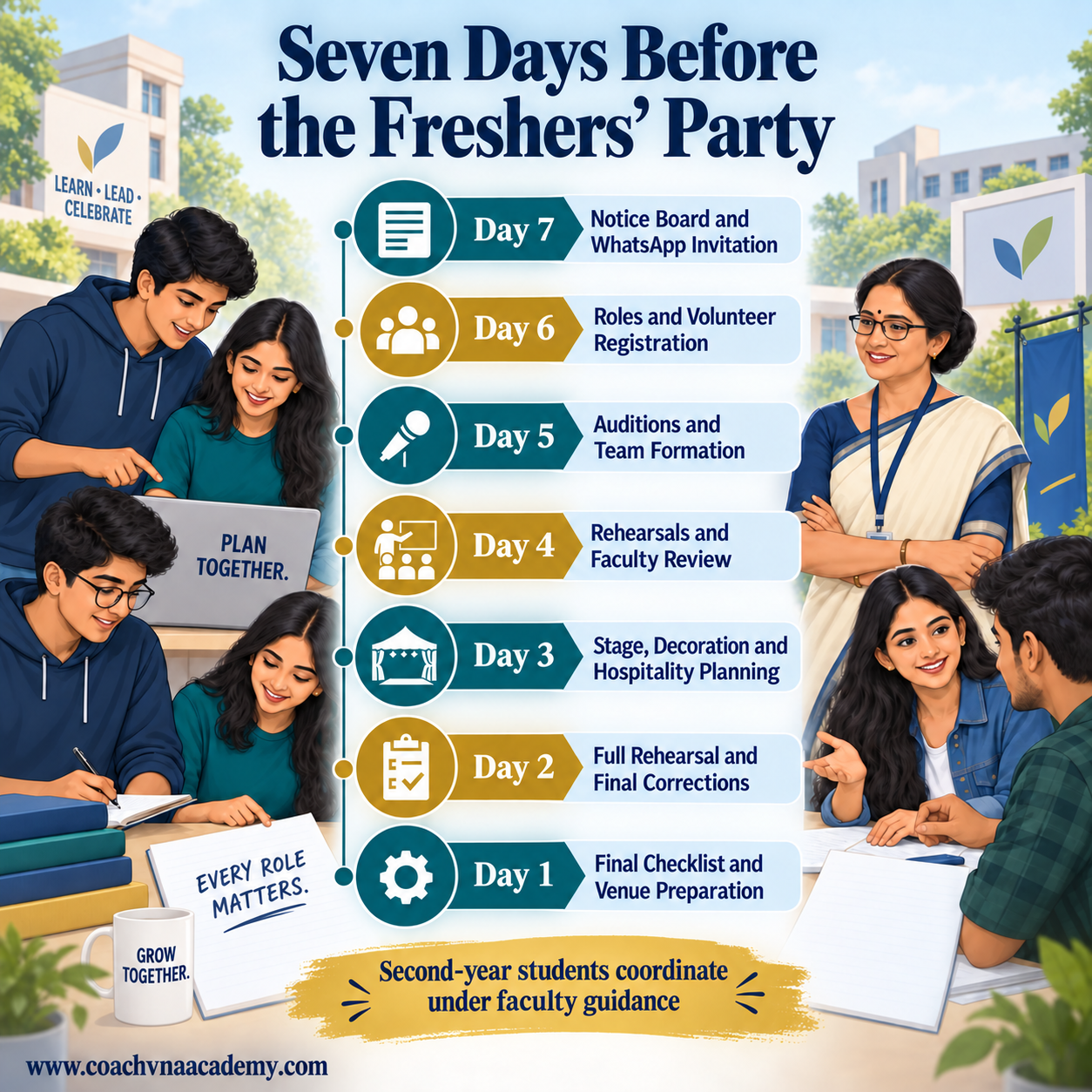
Managing rehearsals, classes and personal responsibilities for an entire week also required effective planning and time management.
Different Students Find Different Ways to Participate
On the fifth day before the event, interested students gathered for performance registration. The confident ones moved towards the dance and music teams. A few students offered to recite poetry. Some remained near the door, watching without registering.
Mehak had practised anchoring in school, but she had never spoken before a college audience. She wrote her name on the anchoring list and then immediately wondered whether she had made a mistake.
Nikhil did not add his name anywhere. As he turned to leave, Ritika asked whether he could help check names at the registration desk during rehearsals.
“Stage par aana zaroori nahi hai,” she told him. “Bas list verify karni hai aur participants ko unka sequence batana hai.”
The task sounded manageable. Nikhil agreed.
His role looked small, but it required him to speak to students from different sections, listen carefully, correct spelling errors and coordinate with second-year volunteers. By the second rehearsal, he no longer needed Ritika to begin every conversation for him.
Faizan and his hostel friends prepared a group performance. Their room became a rehearsal space in the evening. They borrowed a speaker, adjusted steps and argued cheerfully about song selection. Their preparation also taught them that enthusiasm alone did not produce a coordinated performance. They had to arrive on time, accept corrections and practise as a team.
When Preparation Creates Friction
By the third rehearsal, the cheerful disagreement in Faizan’s group had become more serious. Two students wanted more time at the centre of the performance. Another felt that her ideas were being used without giving her a visible role. A fourth member had missed practice but still wanted the group to change the sequence for him.
The disagreement moved to the WhatsApp group that evening. Brief messages sounded harsher than their writers intended. One student threatened to leave, and another began discussing the matter with students outside the group. The performance problem was beginning to affect personal relationships.
Ritika asked the members to meet face to face before the next rehearsal. She did not begin by deciding who was right. She asked each student to explain the responsibility assigned, the work completed, the change requested and the effect of that change on the whole team.
The concerned faculty member joined only when the discussion became difficult to manage. The group agreed on a final sequence, divided the visible roles more fairly and recorded the decision. The solution did not make everyone equally happy, but it allowed the team to continue without personal attacks.
The incident showed that teamwork includes disagreement. Professional behaviour begins when students discuss the work, listen to evidence and avoid turning one decision into a judgment about another person’s character.
Students Lead, Faculty Guide
The concerned faculty members reviewed the programme at key stages. They checked the suitability of performances, the duration of activities and the arrangements for student safety. When two performances exceeded the available time, the faculty coordinator did not rewrite the entire schedule. Instead, the second-year team was asked to decide how to shorten the sequence fairly.
The students discussed the problem, spoke to the performers and revised the timing. This was a practical lesson in negotiation. Every participant valued their own performance, but the coordinators had to protect the schedule for everyone.
Faculty guidance created a safe structure, while student responsibility created learning. Both were necessary.
When the Familiar Campus Looked Different
On the morning of the party, the same college campus felt unfamiliar. The entrance carried a welcome display. Music checks could be heard from the hall. Students who normally arrived with notebooks and laboratory coats now walked in wearing festive clothes.
Nikhil reached early because the registration team had been asked to report before the participants. He checked the list, arranged pens and confirmed the sequence with the stage coordinators. A week earlier, he had worried about entering the hall alone. Now other students were approaching him for information.
Mehak entered with a classmate. She looked towards the stage, saw the microphone and felt her nervousness return. During rehearsal she had spoken before twenty students. The hall now looked much larger.
A second-year anchor noticed her silence and said, “First two lines slowly bolna. Audience ko mat count karna. Bas apne co-anchor se conversation samajhkar start karna.”
The advice did not remove her anxiety, but it gave her something practical to do.
More Than Roll Numbers and Classroom Seats
Regular classes had introduced the students through roll numbers, attendance and seating patterns. The party revealed qualities that had remained hidden.
A quiet student sang with remarkable control. A student who rarely answered questions in class managed stage props calmly. One student who did not want to perform helped a classmate repair a costume. Another noticed that a day scholar was worried about returning home and helped her confirm transport arrangements.
Academic ability still mattered, but it was no longer the only quality visible in the room. Students began noticing patience, creativity, humour, reliability and the ability to help without seeking attention.
Some abilities remain unnoticed when a student is tired, distracted or hesitant to participate in class. The familiar question “Class Mein Present, Lekin Focus Kahan Hai?” also reminds students that presence becomes meaningful when it is supported by attention and participation.
A Small Step Beyond the Comfort Zone
Mehak’s name was announced. Before walking onto the stage, Mehak paused and took two slow breaths. Simple techniques for managing nervousness through slow breathing can help students settle themselves before speaking publicly. She walked towards the centre of the stage with her co-anchor. Her first sentence came out faster than planned, so she paused, looked at her cue card and began again. The second attempt sounded steadier.
She did not become fearless in one minute. She simply continued while feeling nervous. That distinction mattered.
Later, one participant failed to reach the stage on time. Nikhil had the updated list, so a second-year coordinator asked him to inform the next group. He moved quickly, confirmed the change and returned to the desk. The programme continued without an awkward gap.
Nobody in the audience knew about his small intervention. Yet Nikhil knew that he had handled an unexpected situation instead of stepping away from it.
Many Participants but Only a Few Prizes
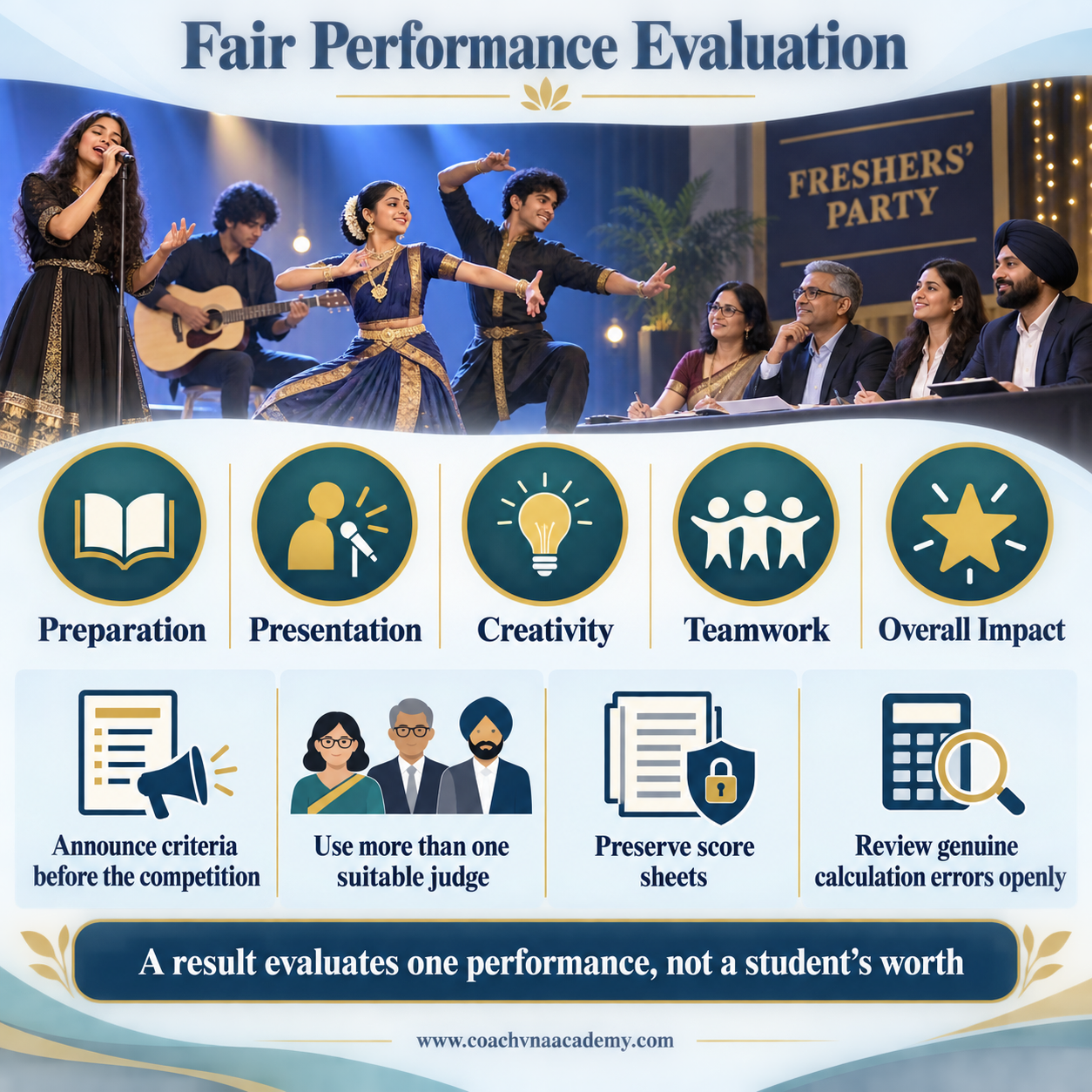
The number of participants was much larger than the number of prizes. Every student had invested time, hope and emotion, but every good performance could not be declared a winner. The second-year coordinators therefore announced the broad evaluation criteria before the competition began.
| Evaluation area | What judges may observe |
| Preparation | Readiness, practice and adherence to the allotted time |
| Presentation | Clarity, confidence and stage coordination |
| Creativity | Originality and suitability of the idea |
| Teamwork | Coordination and balanced participation |
| Overall impact | Completion, audience connection and suitability for the event |
The exact criteria may differ according to the institution and performance type. What matters is that participants know the criteria in advance and that the same standards are applied consistently.
More than one suitable judge evaluated the performances. Coordinators preserved the score sheets until the result was finalized. A student coordinator who was closely connected to a participating team did not influence that team’s evaluation. These steps could not remove every disagreement, but they reduced avoidable doubt.
A Result Some Students Found Difficult to Accept
Faizan’s team did not receive a prize. One member immediately said that another group had won because it knew the organizers. Within minutes, disappointment was turning into an allegation, even though the group had not seen the score or asked for an explanation.
Faizan also felt disappointed, but he requested feedback before reacting publicly. The next day, the team learned that it had lost marks for exceeding the permitted time and for an unclear transition between two parts of the performance.
The explanation did not make the result pleasant, but it replaced a rumour with specific feedback. The students could question the process respectfully without insulting the winning team.
During the review, the coordinators also noticed that one participant’s subtotal had been entered incorrectly. The concerned faculty member checked the original sheets, corrected the total and communicated the correction openly. The final prize positions did not change, but acknowledging the error protected trust better than hiding it would have done.
A competition result describes one performance under particular criteria. It does not turn a student into a loser. The article therefore refers to prize recipients and participants who were not selected, rather than labelling students as winners and losers in life.
Meeting Professionals With Purpose
An invited alumnus who now worked in the healthcare sector attended the programme as a guest. During a brief interaction, he spoke about his first months in college and the communication problems he had faced during his early job interviews.
He explained that classroom knowledge remained essential, but employers also noticed how candidates introduced themselves, listened to questions, worked with teams and responded when plans changed.
After the programme, a small group of students introduced themselves. Mehak asked how students could improve professional communication from the first year. Nikhil listened before asking one short question about internships. The exchange lasted only a few minutes, but it helped them practise speaking respectfully with a professional.
Professional exposure does not mean collecting contact numbers or sending immediate job requests. Students should introduce themselves clearly, ask relevant questions and follow up only when the guest has invited further communication.
When the Event Ends but the Disagreement Continues
Some tensions continued after the celebration. One student stopped responding to teammates because she felt unsupported. Another posted an indirect social-media message about favouritism. A third student congratulated the prize-winning team in person but criticized it in a private group.
These reactions could affect more than one friendship. The same students might later work together on assignments, projects, internships, placement preparation or professional referrals. A public insult written during disappointment can remain long after the emotion has passed.
Ritika organized a short review meeting under faculty guidance. The students separated the result, the process and the relationship. They could ask whether the evaluation process was fair, but they also had to decide how they would treat one another afterwards.
The prize-winning team was encouraged to celebrate without mocking other participants. Students who were not selected could request feedback without attacking the judges or winners. Where an apology was required, it focused on the specific message or behaviour rather than on a vague promise to ‘forget everything.’
Disappointment, comparison and group conflict can affect the mental and emotional well-being of students. Therefore, feedback should address the performance without attacking the individual.
Enjoying the Party With Respect
Music, photographs and informal conversations made the event enjoyable, but responsible behaviour protected that enjoyment. Second-year coordinators reminded students to ask before recording or posting someone’s photograph. Nobody should be teased for clothing, accent, body language or unwillingness to perform.
Students also needed to eat, drink water and follow the scheduled closing time. Practical healthy eating habits for college students can help them maintain energy during rehearsals and long college events. Day scholars confirmed their return arrangements before the programme ended. Friends checked that no student was left alone while waiting for transport.
A positive welcome event allows students to participate without fear of humiliation, unwanted recording or social pressure.

The Photograph at the Edge of the Group
Near the end, students gathered for a group photograph. Nikhil almost returned to the registration desk, but Faizan called him over.
“List baad mein check kar lena. Ab photo mein aa jao.”
Nikhil stood near the edge of the group. He was not in the centre, and he did not try to be. Still, his smile looked natural.
Mehak exchanged numbers with two classmates she had previously known only by face. They had not suddenly become close friends, but the distance between them had reduced.
The programme ended within the planned time. Second-year coordinators stayed back to complete the final checks under faculty supervision. Their work had begun before the celebration and continued after most photographs had been taken.
How These Experiences Shape Future Careers
College events cannot replace academic learning, internships or professional training. They can provide early situations in which students practise useful workplace behaviours, especially when a plan changes, a disagreement develops or a result feels disappointing.
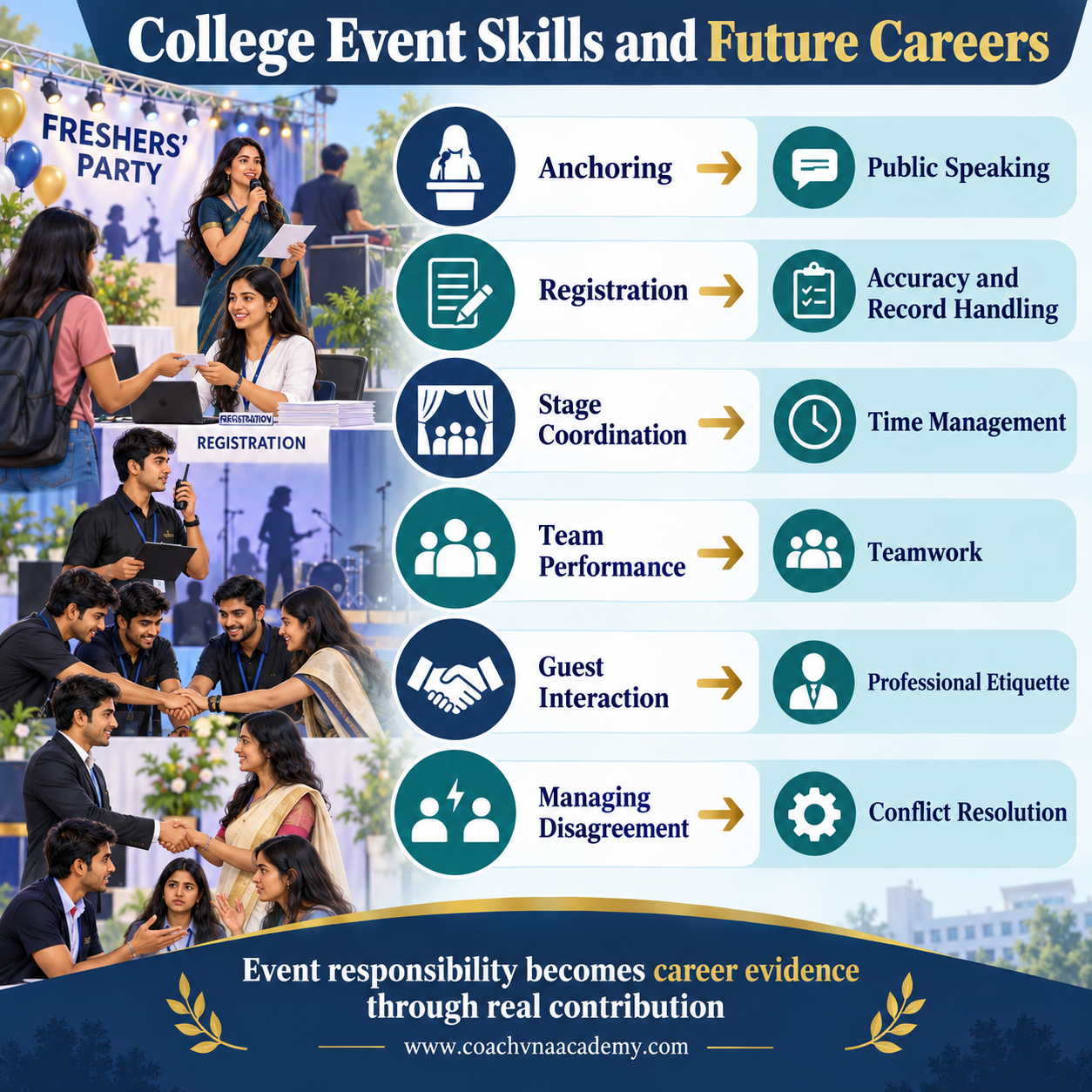
| College responsibility | Skill practised | Career connection |
| Anchoring or introducing participants | Clear speaking and audience awareness | Presentations, interviews and meetings |
| Registration support | Accuracy, listening and record handling | Administrative and coordination work |
| Stage coordination | Time management and rapid communication | Project and operations roles |
| Group performance | Practice, feedback and teamwork | Collaborative workplace assignments |
| Hospitality and guest interaction | Professional etiquette | Client, patient and stakeholder communication |
| Handling last-minute changes | Problem-solving and emotional control | Workplace situations with changing priorities |
| Managing disagreement | Listening, negotiation and documentation | Team projects and workplace conflict |
| Receiving an unfavourable result | Feedback seeking and emotional maturity | Interviews, appraisals and selection decisions |
For first-year students, the main value lies in exposure and practice. For the second-year coordinators, the experience may also demonstrate planning, delegation and accountability because they held defined responsibilities under faculty guidance.
Using Event Experience Honestly on a Resume
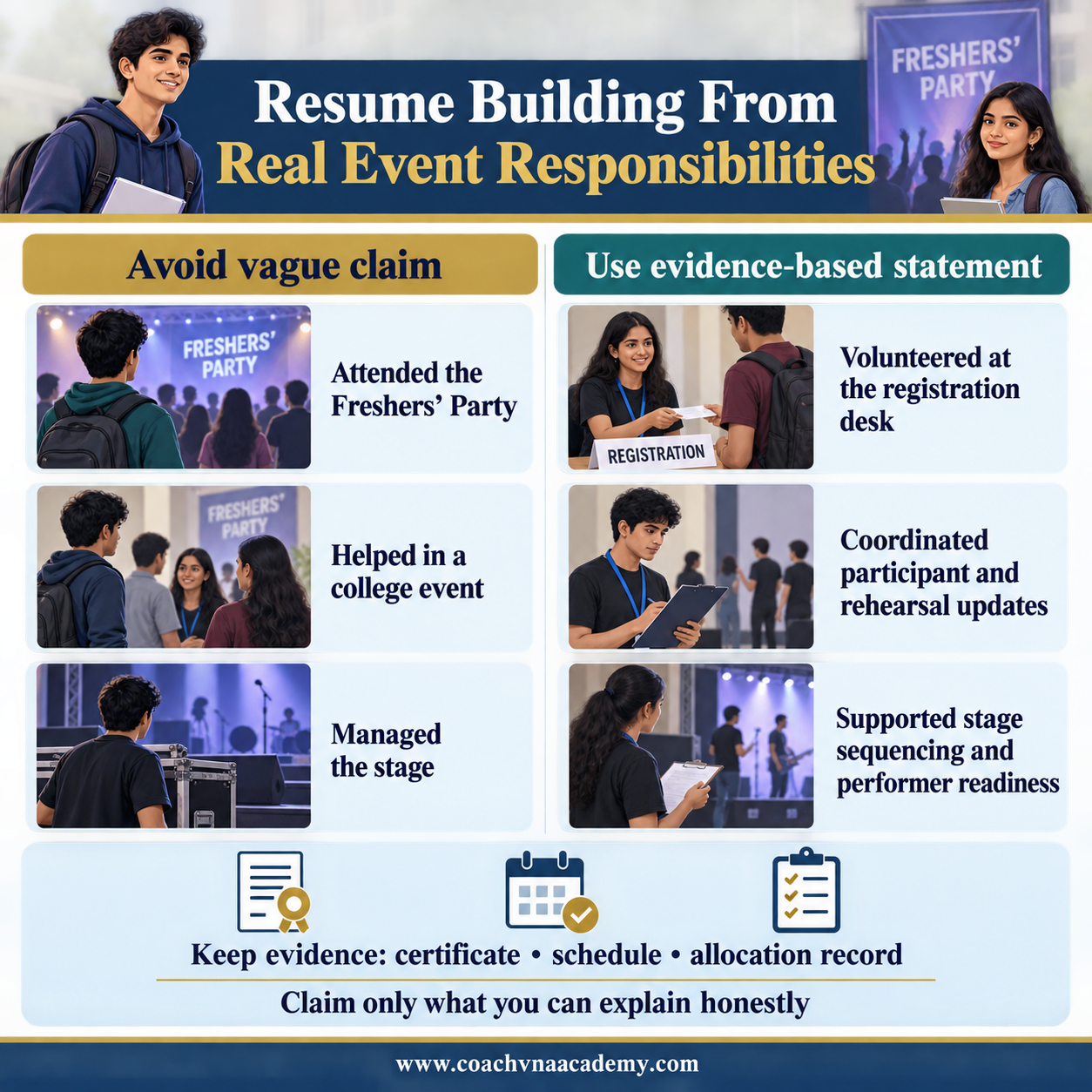
Attending a Freshers’ Party is not a resume achievement by itself. A student should add the experience only when they completed a real responsibility and can explain what they did.
| Weak statement | Evidence based statement |
| Attended the college Freshers’ Party | Volunteered at the registration desk for the first-year welcome programme |
| Helped in a college event | Assisted the second-year coordination team with participant registration and sequence updates |
| Managed the stage | Supported stage sequencing and communicated performer readiness to the anchoring team |
| Organized the Freshers’ Party | Worked with the second-year organizing team under faculty guidance to coordinate rehearsals and event-day activities |
Students should use numbers only when they know them accurately. For example, a coordinator may write that they scheduled 12 performances involving 35 participants only if those figures are correct.
Useful evidence may include an official certificate, appreciation letter, programme schedule, work allocation record or approved event photographs. Students must protect other people’s privacy when saving or sharing photographs.
SWOT Analysis of Freshers Party Participation
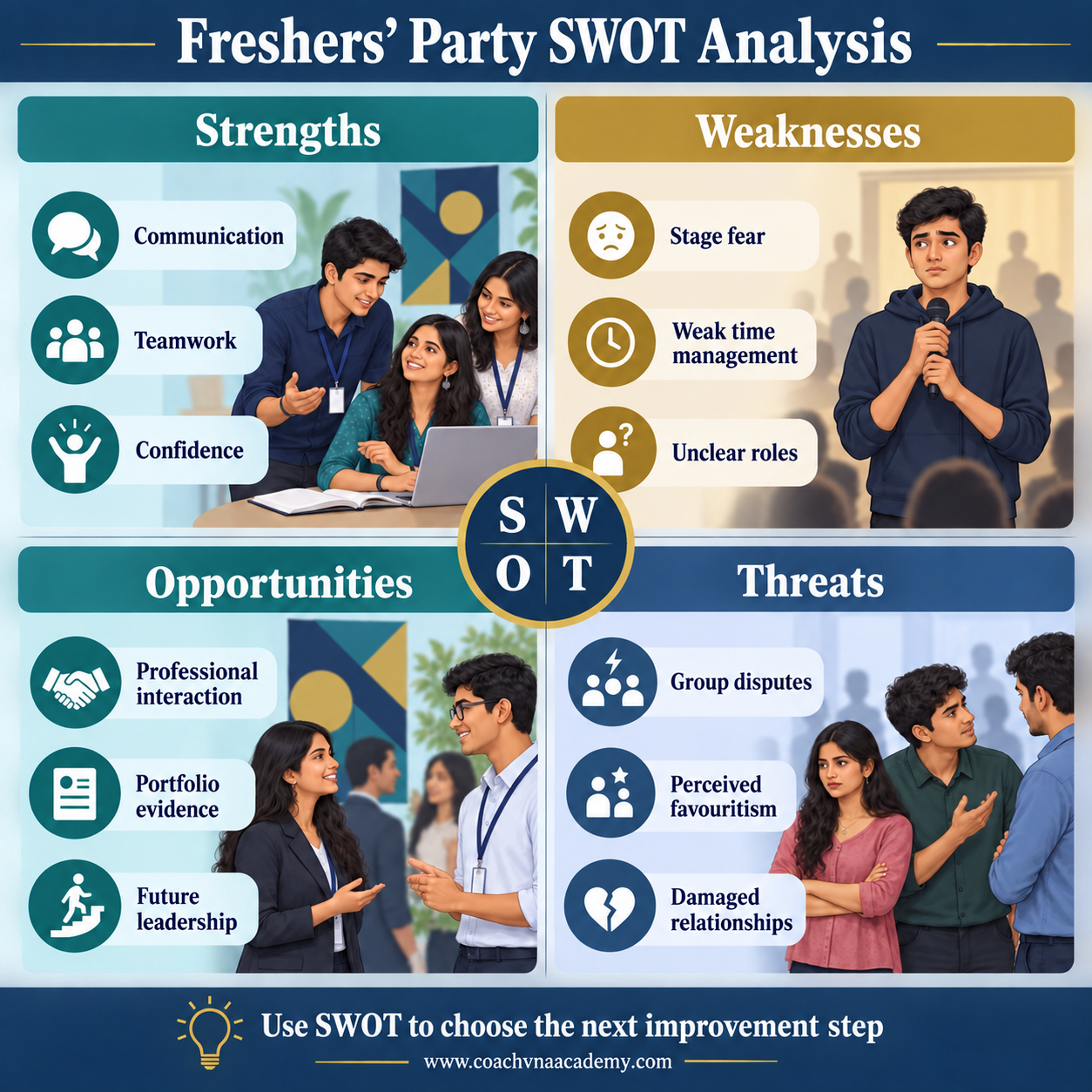
A SWOT analysis helps students review the experience without describing everything as either success or failure. Strengths and weaknesses are usually internal to the student or team. Opportunities and threats arise mainly from the surrounding situation.
| SWOT area | Freshers Party example |
| Strengths | Communication practice, teamwork, creativity, leadership, confidence and evidence of responsibility |
| Weaknesses | Stage fear, weak time management, unclear role allocation, emotional reactions and dependence on a few active members |
| Opportunities | Interaction with seniors, faculty, alumni and professionals; portfolio evidence; feedback; future organizing roles |
| Threats | Group disputes, perceived favouritism, social-media conflict, damaged relationships, privacy concerns and exaggerated resume claims |
The SWOT analysis should lead to action. A student who identifies public speaking as a weakness may volunteer for a short introduction next time. A coordinator who identifies unclear role allocation as a threat may document responsibilities before rehearsals begin. A student who recognizes professional interaction as an opportunity may prepare one relevant question instead of approaching a guest without purpose.
Turning SWOT Findings Into Resume Evidence
A resume should present verified contribution, not the complete SWOT table. Students can use SWOT analysis privately to identify which experience produced credible evidence.
| SWOT finding | Evidence | Resume use |
| Strength in coordination | Schedule, allocation record or appreciation letter | Coordinated participant communication and rehearsal updates |
| Weakness improved through practice | Before-and-after reflection or mentor feedback | Use as an interview learning example, not an unsupported resume claim |
| Opportunity through guest interaction | Event programme and personal learning notes | Mention professional exposure only when relevant; do not imply employment or endorsement |
| Threat managed through conflict resolution | Meeting record or coordinator confirmation | Assisted with role-allocation discussions under faculty guidance |
During an interview, the student can explain the situation, personal responsibility, action and result. They should not reveal private names, exaggerate authority or claim sole credit for resolving a group problem.
Students Who Do Not Enjoy Parties Still Belong
Some students dislike loud music, large gatherings or public performance. Others may have health, sensory, financial, family or travel-related concerns. Their choice deserves respect.
A student may attend only part of the programme, observe performances, help with a quiet supporting task or decide not to participate. Inclusion means providing choices, not measuring every student’s confidence by the same activity.
The aim of a welcome event is to reduce distance among students. Pressure and ridicule would create the opposite result.
How the Event Affects Every Segment
| Segment | Positive effect | Risk requiring attention |
| First-year students | Belonging, confidence, friendship, communication and a safer introduction to campus life | Stage pressure, comparison, disappointment or feeling excluded |
| Second-year coordinators | Leadership, delegation, scheduling, documentation and event management | Group conflict, uneven workload, criticism and accountability for mistakes |
| Faculty members | A chance to mentor, protect fairness and observe student potential | Over-involvement can reduce student ownership, while weak supervision can allow unfairness |
| Prize recipients | Recognition, confidence and motivation to improve further | Pride may damage relationships if celebration becomes comparison or ridicule |
| Participants not selected | Feedback, resilience and a clear improvement plan | Unexplained results may create anger, rumours or distrust |
| Guests and professionals | Meaningful interaction with students and an opportunity to share career guidance | Unplanned approaches or exaggerated networking expectations may feel inappropriate |
| College community | Stronger student connection, visibility of talent and a positive campus culture | Poor discipline, biased evaluation or social-media disputes can harm institutional trust |
The event therefore affects more than the students performing on stage. Its educational value depends on how responsibly every segment communicates, evaluates, celebrates, responds to criticism and repairs relationships after disagreement.
Final Conclusion: From Celebration to Career Learning
On the way home, Nikhil opened the group photograph on his phone. He was standing at the edge, but for the first time he did not feel outside the group.
Mehak told her family that the anchoring had gone well after a nervous beginning. She spoke more about the people she had met than the clothes she had worn.
Faizan returned to the hostel tired after a week of rehearsals. His group performance had not been perfect, but the team had learned how difficult coordination could be.
What Each Group Learned from the Event
For the second-year organizers, the empty hall at the end carried its own lesson. They had turned a notice-board announcement into a complete programme by communicating, correcting mistakes and working under faculty guidance.
The Freshers’ Party did not complete anyone’s adjustment to college life. It revealed several parts of that adjustment at once: the courage to participate, the discipline to prepare, the difficulty of sharing credit, the pain of an unfavourable result and the maturity required to continue a relationship after disagreement.
For first-year students, the week created new friendships, exposure to seniors and a safer first step towards public participation. Second-year coordinators developed planning, fairness, documentation, conflict-management and accountability skills under faculty guidance. Faculty members, meanwhile, identified where students needed support without taking away their responsibility to learn from decisions.
The prizes recognized selected performances, but they could not measure every useful outcome. A student who did not receive a prize may still have improved communication, managed a difficult emotion or discovered a weakness that now has a clear improvement plan. A prize recipient may still need to learn humility and respect for other teams.
A Freshers’ Party is not the only campus activity that develops responsibility. Experiences such as volunteering at a college blood donation camp can also strengthen communication, teamwork, service awareness and professional conduct.
Professional growth appeared in ordinary moments: asking for evidence before spreading a rumour, correcting an evaluation error openly, protecting another student’s photograph, accepting feedback and returning to work with the same classmates after conflict. These behaviours influence trust in college and later in the workplace.
A SWOT analysis helps each student convert the experience into a realistic next step. Strengths can be supported with evidence, weaknesses can guide practice, opportunities can be used responsibly and threats can be managed before they damage relationships. Resume value comes only from genuine contribution that the student can explain honestly.
For some students, the lasting memory was a performance or prize. For others, it was a question asked to a professional, an apology offered after a heated message, a fair explanation of marks, a task completed calmly or a place found in a group photograph. Together, these experiences made the event part of their education rather than only an evening of celebration.
After the celebration, students must return to classes, assignments and examinations. A balanced and effective study routine helps them carry the discipline learned during event preparation into regular academic life.
Frequently Asked Questions
Is attending a Freshers’ Party compulsory
Usually, participation should be voluntary. Students should follow their college’s official instructions and discuss any concern with the designated coordinator or faculty member.
What can a shy student do at the party
A shy student can attend with a trusted classmate, join a small group activity, volunteer for a supporting role or observe without performing.
Can event participation be added to a resume
Attendance alone should not be listed. A genuine organizing, anchoring, registration, hospitality or coordination responsibility may be included with an accurate description.
How can day scholars prepare
They should confirm the ending time, transport, family communication and a safe return plan before the event.
How should students interact with invited professionals
Introduce yourself briefly, ask a relevant question, listen carefully and follow up only when invited to do so.
What should students remember before posting photographs
Ask permission from identifiable people, respect anyone who declines and follow the college’s social-media guidance.