

A story-led guide to noticing stress early and responding with practical habits
College life can bring excitement, pressure and uncertainty at the same time. These simple stress management strategies for college students can help students notice early warning signs, understand the cause of pressure and choose one practical next step.
Harish and the day that felt too full
Harish had a practical record to finish, an attendance shortage to discuss and a family call waiting in the evening. He travelled by bus, reached college late and spent the first lecture worrying about what he had not completed. At lunch he said, “I am stressed,” but he could not explain whether the main problem was tiredness, fear, lack of planning or all of them together.
That evening, Harish noticed a tight jaw, a mild headache, quick replies to his friends and difficulty starting the record. These were useful signals. Instead of trying to solve his whole life in one night, he wrote down the three immediate tasks, took a short breathing break and asked a classmate about the practical deadline. The situation did not become perfect, but it became clearer.
Understanding Stress in Everyday College Life
The word stress is used so often that it can lose its meaning. Students may call any change in routine, unpleasant feeling or difficult task “stress.” A more useful explanation is this: stress is the body and mind responding when a demand feels greater than the time, energy, knowledge, control or support currently available.
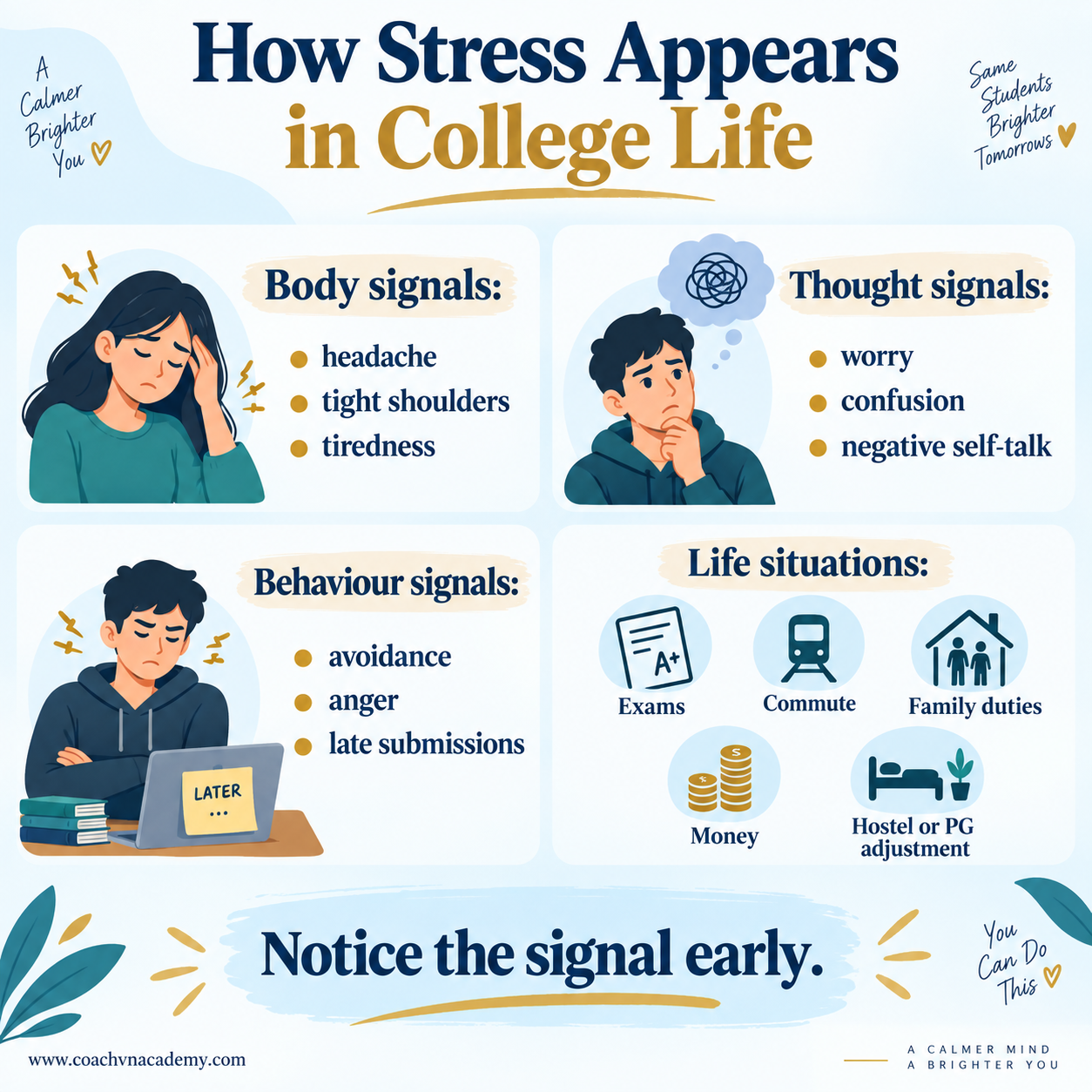
Stress can begin with an obvious event, such as an examination, financial worry, conflict, project deadline or long commute. It can also build quietly through late-night phone use, skipped meals, poor sleep, repeated self-criticism and the feeling that unfinished work is always waiting. The first signal may not be an emotional statement. It may be a headache, muscle tightness, tiredness, stomach discomfort, fast heartbeat, disturbed sleep, appetite change, irritability, restlessness or difficulty concentrating. For a clear general explanation, read the World Health Organization explanation of stress.
Physical symptoms should not automatically be called “only psychosomatic.” Stress can affect the body, but persistent, severe or unusual symptoms deserve proper medical attention. Students should speak with a qualified healthcare professional when symptoms continue, worsen or interfere with daily functioning.
During a demanding situation, the body releases stress hormones such as adrenaline and cortisol. These hormones increase alertness and help a student prepare, focus or act quickly. Stress is not always harmful; a manageable challenge can encourage preparation and growth. However, concern arises when the body remains highly alert for too long, recovery is repeatedly postponed or the student cannot return to a calm state. For a simple explanation, read the World Health Organization guidance on stress.
Stress can change during the college years. First-year students may feel pressure while adjusting to a new campus, hostel, language, timetable, roommates and separation from family. In the middle years, practical classes, attendance, assignments, competition and social expectations may become more demanding. Final-year students often face examinations, major projects, placements, interviews, career decisions and family expectations at the same time. Some students adjust quickly, while others may remain worried, tired or unable to move forward.
Unmanaged stress affects both personal and professional life. A student may withdraw from friends, argue at home, miss messages, lose punctuality, avoid teamwork, make rushed decisions or lose confidence during interviews. The goal is not to remove every challenge. The goal is to notice the signal early, understand the situation and respond before the pressure becomes harder to manage.
The RESET approach
Use RESET as a simple memory aid. It is not a rigid formula; students can begin with the step that fits the moment.
| Step | Simple meaning |
| R — Recognise | Name the signal: “My shoulders are tight,” “I am avoiding the assignment,” or “I am replying angrily.” |
| E — Examine | Ask what is creating pressure: workload, uncertainty, conflict, sleep loss, money, health or lack of support. |
| S — Simplify | Choose the smallest useful action, such as opening the record, sending one message or drinking water and eating something. |
| E — Engage support | Speak to a trusted friend, teacher, mentor, family member or counsellor instead of carrying everything alone. |
| T — Track and tune | Notice what helped, what did not and what needs adjustment tomorrow. |
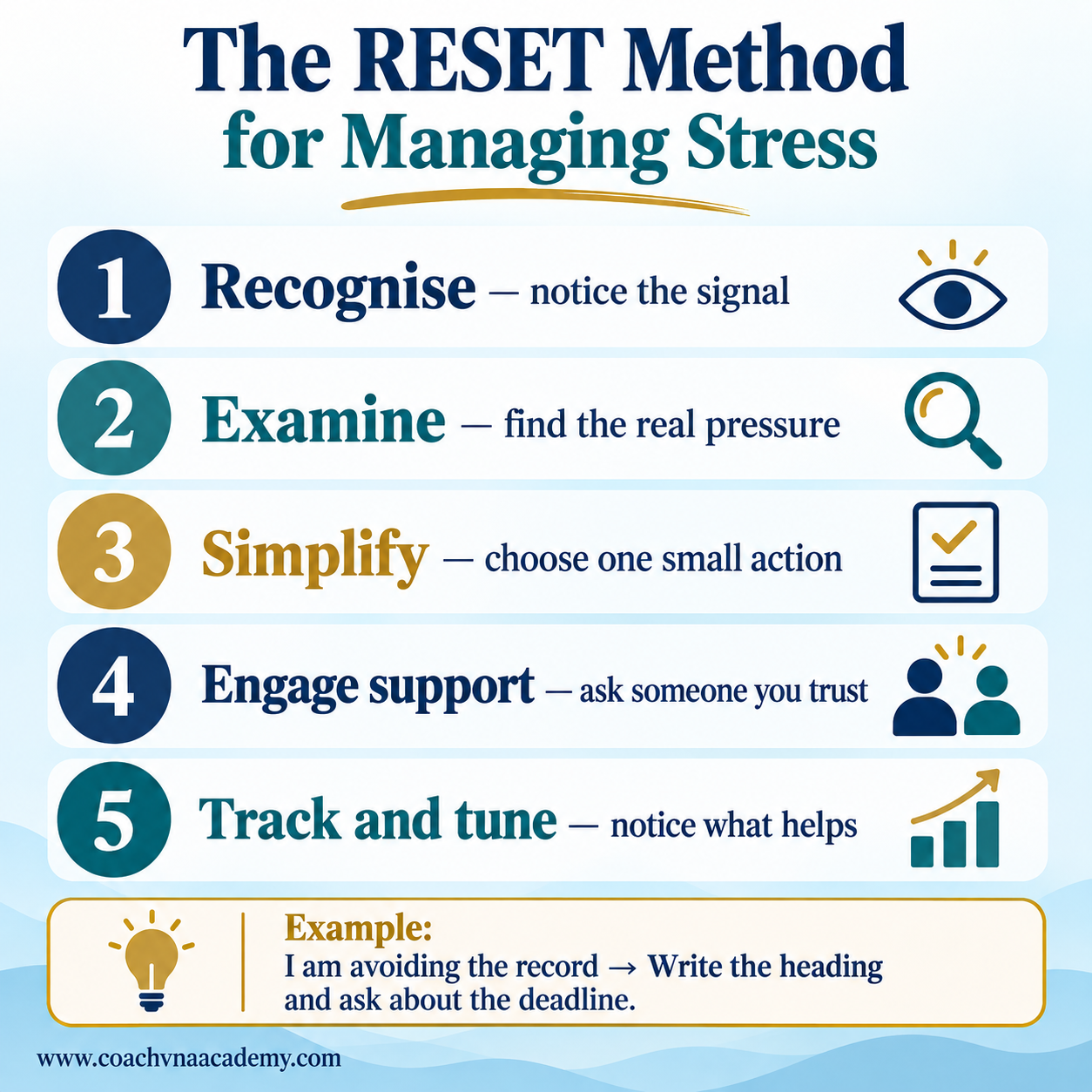
The RESET approach is one of the simplest stress management strategies for college students who feel confused or overloaded.
Practical strategies for real college life
Identify the first signal
For three days, note when tension, tiredness, worry or irritability appears. Do not judge yourself; simply observe the pattern.
Separate the problem from the fear
Write two lines: “What is actually due?” and “What am I imagining?” This reduces a large, unclear worry into a visible task.
Use a small starting action
Set a ten-minute start. For more help with planning, see simple time-management strategies for students. Open the notes, write the heading, solve one question or collect the required material. Starting often reduces avoidance.
Take a short breathing pause
Use short breathing breaks for students by breathing in gently and breathing out a little more slowly for one to two minutes. Stop if you feel dizzy or uncomfortable.
Protect basic needs
Water, a simple meal and a healthy sleep routine are not luxuries. They help the body recover so the mind can work more clearly. A short walk can also help.
Reduce digital overload
Keep nonessential notifications silent during study. Decide when you will check messages instead of checking every few minutes.
Ask for specific help
Say, “I am confused about the deadline; can you help me understand the first step?” Specific questions are easier for others to answer.
Use a quiet music break
Choose calm instrumental relaxation music without lyrics at a comfortable volume for 10–20 minutes. Keep the phone screen away and treat it as a pause, not an escape from every problem.
Review the day without punishment
Write one thing completed, one difficulty and one next step. A review should guide tomorrow, not attack today.
Seek professional support when needed
If distress persists, functioning falls, sleep remains disturbed or symptoms feel serious, speak with a qualified professional.
A practical music break at home, in a hostel or in a room
Students may use a short music break when the room is reasonably quiet and they want to settle their body before returning to study. Choose instrumental music without sudden loud changes. Sit comfortably, lower the volume, keep the screen away and listen for 10–20 minutes. If music increases sadness, worry or distraction, stop and choose silence, gentle breathing or a short walk instead.
Suggested listening link: calm instrumental relaxation music without lyrics
This is a supportive relaxation activity. It is not a cure, and it should not replace professional help when stress is persistent or severe.
Student situations and realistic first steps
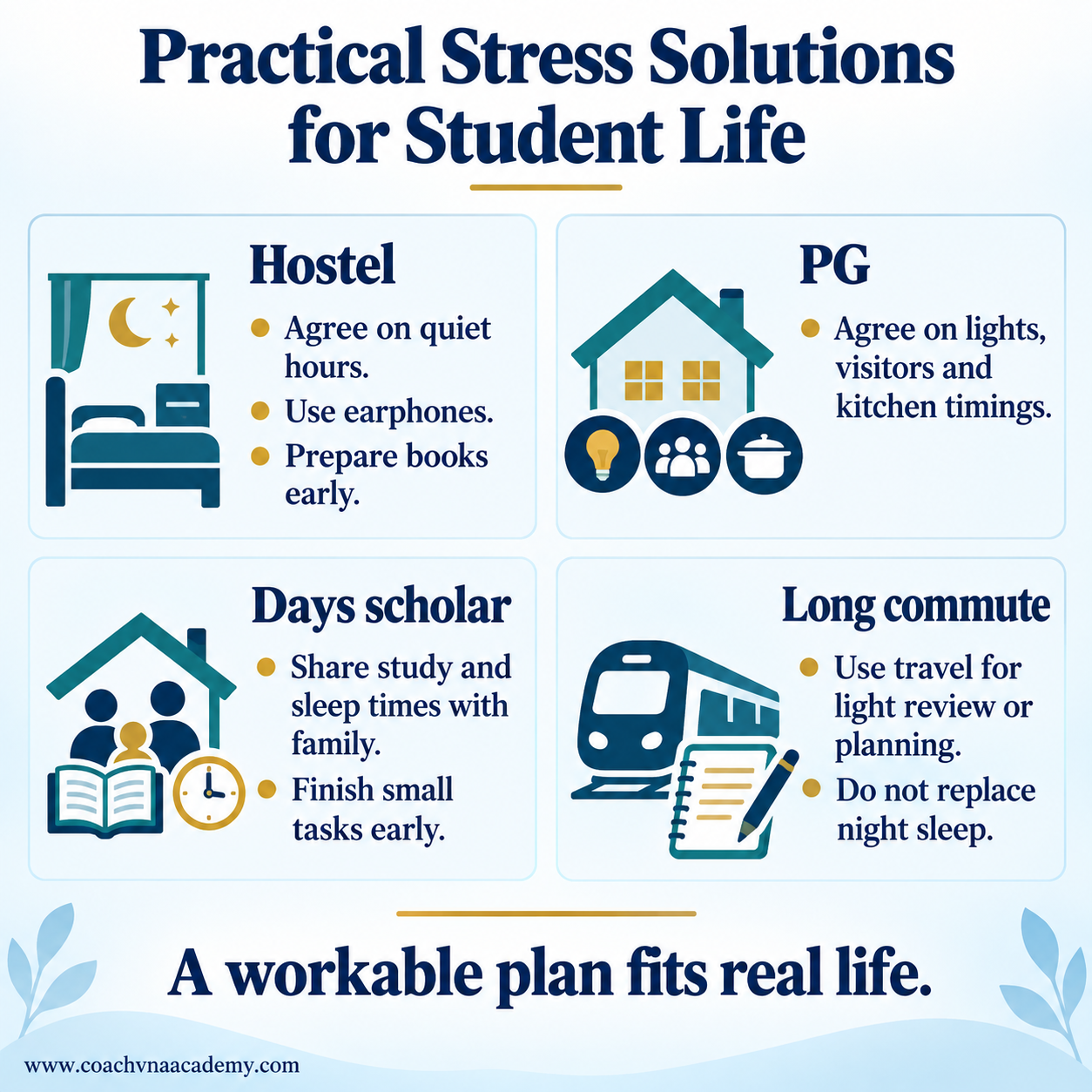
| Student situation | A realistic first step |
| Hostel student | Discuss quiet hours, use earphones after that time and prepare books before bed. |
| PG student | Agree on lights, visitors and kitchen timings with the owner or roommates. |
| Days scholar | Tell family the planned study and sleep time; finish small tasks before the wind-down. |
| Local student living with family | Keep the phone away from the bed and request one quiet period. |
| Student with a long commute | Use the commute for light review or planning, not for replacing night sleep. |
Case study 1: A hostel student who stayed silent
Arjun came from a middle-income family and lived in a hostel for the first time. His roommate studied until midnight with the main light on, while another roommate watched reels and talked to friends. Arjun had an early class but did not want an argument. After several tired mornings, he politely suggested earphones after 11 p.m., a small light after 11:30 p.m. and packing bags before quiet time. The room was not perfect, but a shared rule and respectful conversation made sleep easier.
Coach’s lesson: specific requests work better than blame. “Can we use earphones after 11 p.m.?” is easier to act on than “You always disturb my sleep.”
Case study 2: A days scholar managing family responsibilities
Mehak travelled 90 minutes each way. At home she helped her mother with dinner and looked after her younger brother. She started revision late because the house became quiet only after everyone slept. Instead of blaming her family or abandoning study, she explained her timetable, selected a 30-minute earlier study slot and kept one short revision task for the commute. Her plan was not perfect, but it respected both her responsibilities and her education.
Coach’s lesson: stress management must fit the student’s real environment. A plan that ignores travel, family work or money will be difficult to sustain.
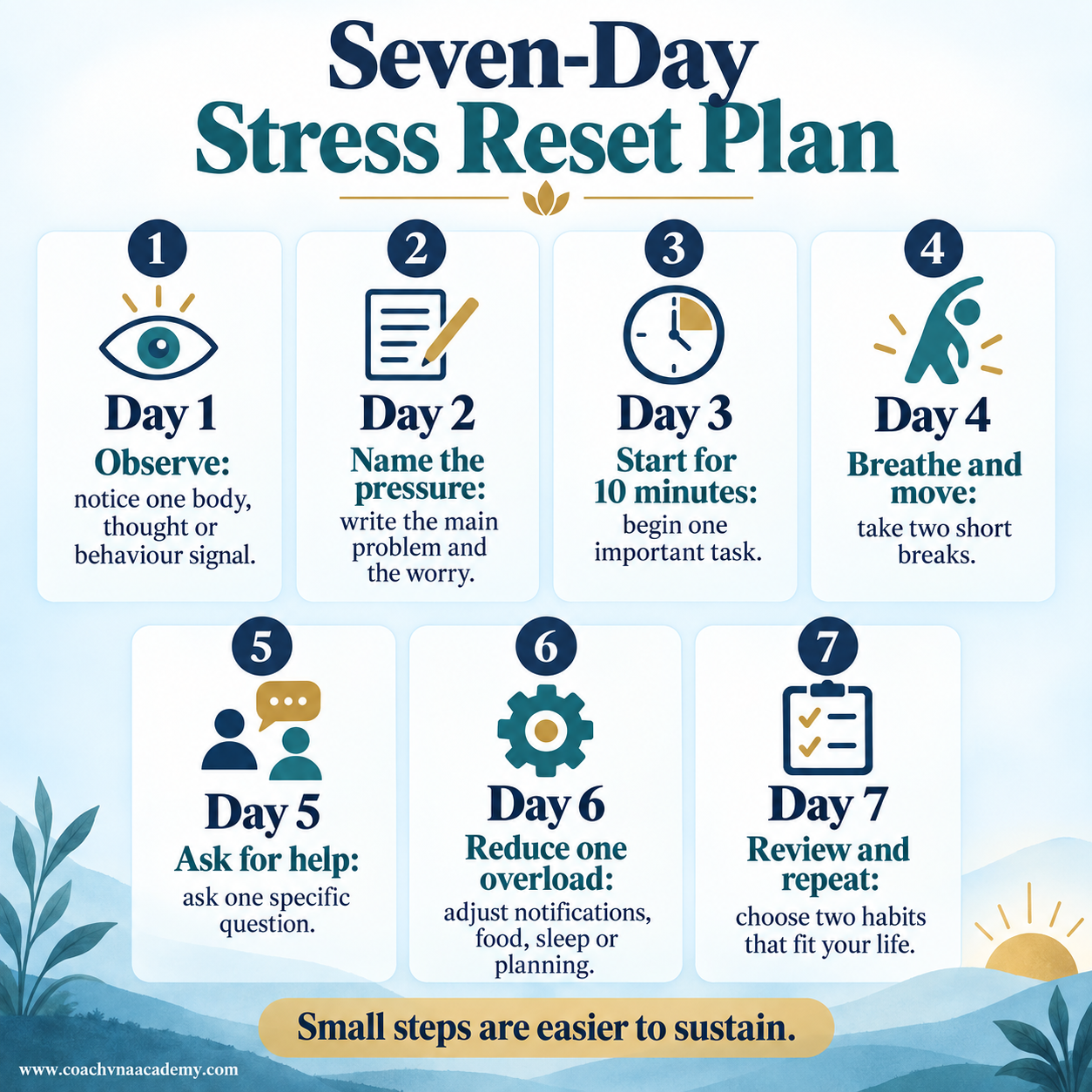
The following stress management strategies for college students can be practised gradually over seven days.
Seven-day stress reset plan
- Day 1 — Observe one physical, emotional or behaviour signal without judging yourself.
- Day 2 — Write the main pressure and divide it into a problem you can act on and a worry you cannot solve today.
- Day 3 — Complete one ten-minute starting action on the most important task.
- Day 4 — Take two brief breathing or movement breaks and drink water regularly.
- Day 5 — Ask one specific question to a teacher, friend, mentor or family member.
- Day 6 — Adjust one source of overload: notifications, late caffeine, skipped food, poor planning or an avoidable conflict.
- Day 7 — Review what helped and repeat only two habits that fit your life.
The aim is not to create a perfect week. It is to make stress easier to notice and slightly easier to respond to.
Myth and fact
| Common belief | More accurate view |
| Myth: All stress is harmful. | Fact: Short-term challenge can support preparation. Prolonged or overwhelming stress needs attention and recovery. |
| Myth: Stress is only an emotional problem. | Fact: Stress can affect thoughts, behaviour, sleep, appetite, muscles and other body sensations. |
| Myth: Strong students should manage everything alone. | Fact: Asking for timely, specific support is a responsible skill. |
| Myth: Music or breathing can solve every stressor. | Fact: They may provide a short pause, but practical problems and persistent symptoms may need wider support. |
When should a student seek professional help?
Self-help strategies can support daily coping, but they cannot diagnose or treat a mental or physical health condition. Consider speaking with a qualified healthcare professional or counsellor when stress persists for several weeks, causes marked daytime impairment, seriously disturbs sleep or appetite, leads to panic-like episodes, produces concerning physical symptoms or creates thoughts of self-harm. In an immediate safety emergency, contact local emergency services or a trusted person without delay.
Closing reflection
Stress is not always weakness, and it is not always danger. It is a signal that the body and mind are responding to a demand. Notice the signal, understand the situation and respond early. Ask yourself: “What is the smallest helpful action I can take in the next ten minutes?”
Effective stress management strategies for college students do not remove every challenge, but they make difficult situations easier to understand and manage.
References and useful links
Relaxation music: Calm instrumental relaxation music without lyrics on YouTube Use at a comfortable volume and stop if it feels distracting or uncomfortable.
Research background: Music Listening and Stress in Daily Life — A Matter of Timing. This supports cautious wording: music may help some people relax, but effects depend on context and purpose.
Health note: This educational article is not a diagnosis or a substitute for medical, psychological or emergency care.