
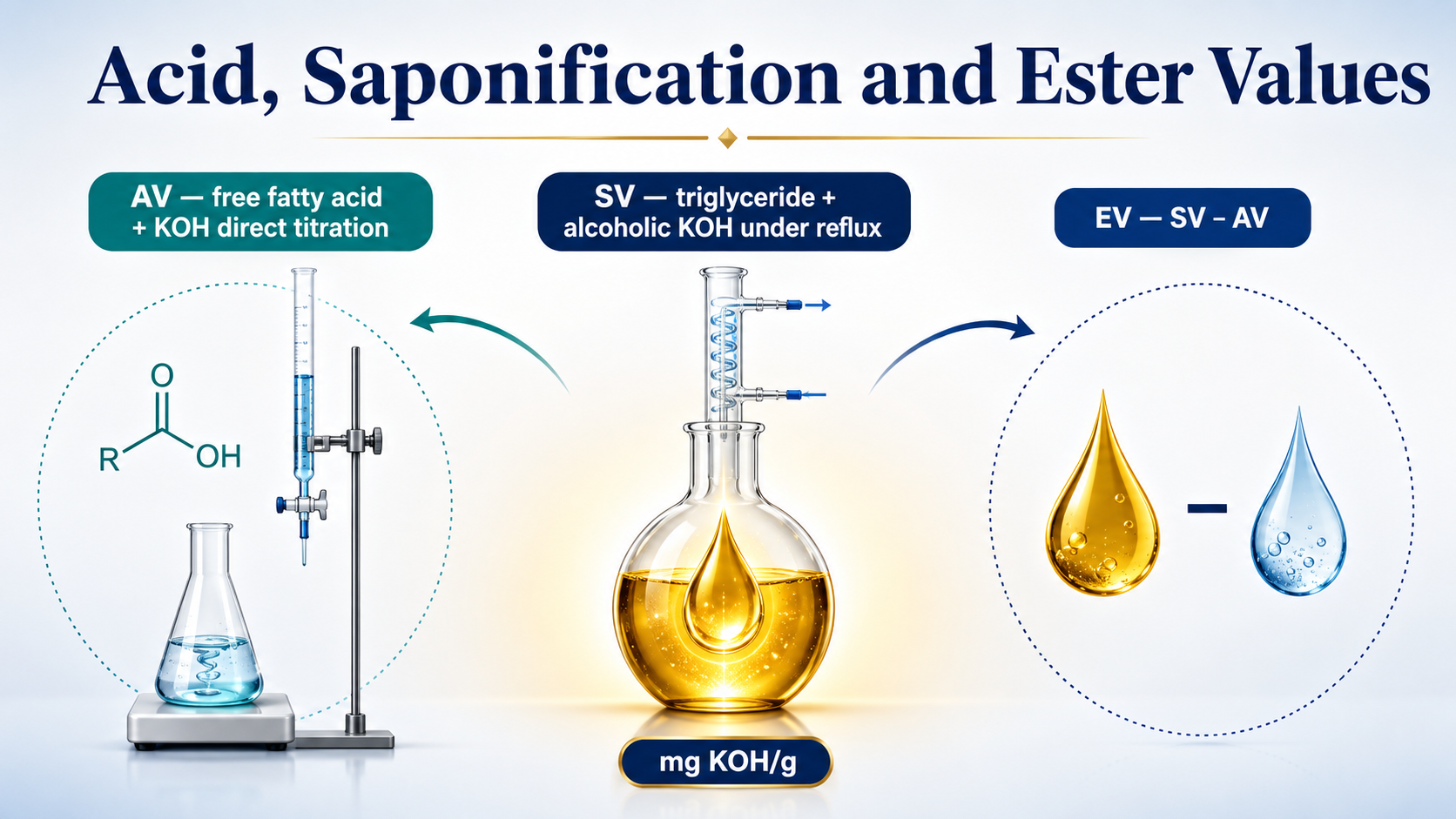
Fats and oils contain mainly triacylglycerols, but they may also contain free fatty acids and other components. Therefore, analysts use physicochemical constants to identify a lipid, evaluate deterioration, compare it with an official specification and detect abnormal composition. Among these constants, acid value, saponification value and ester value are closely related because each expresses the result as milligrams of potassium hydroxide per gram of sample.
The Central Concept
| Analytical value | What it represents | Main operation |
| Acid value (AV) | Free fatty acids | Direct neutralization titration |
| Saponification value (SV) | Free acids + esterified fatty acids expressed through KOH consumption | Reflux with excess alcoholic KOH, then back-titrate |
| Ester value (EV) | Esterified fatty acids | Calculated as SV − AV |
Acid Value
Definition
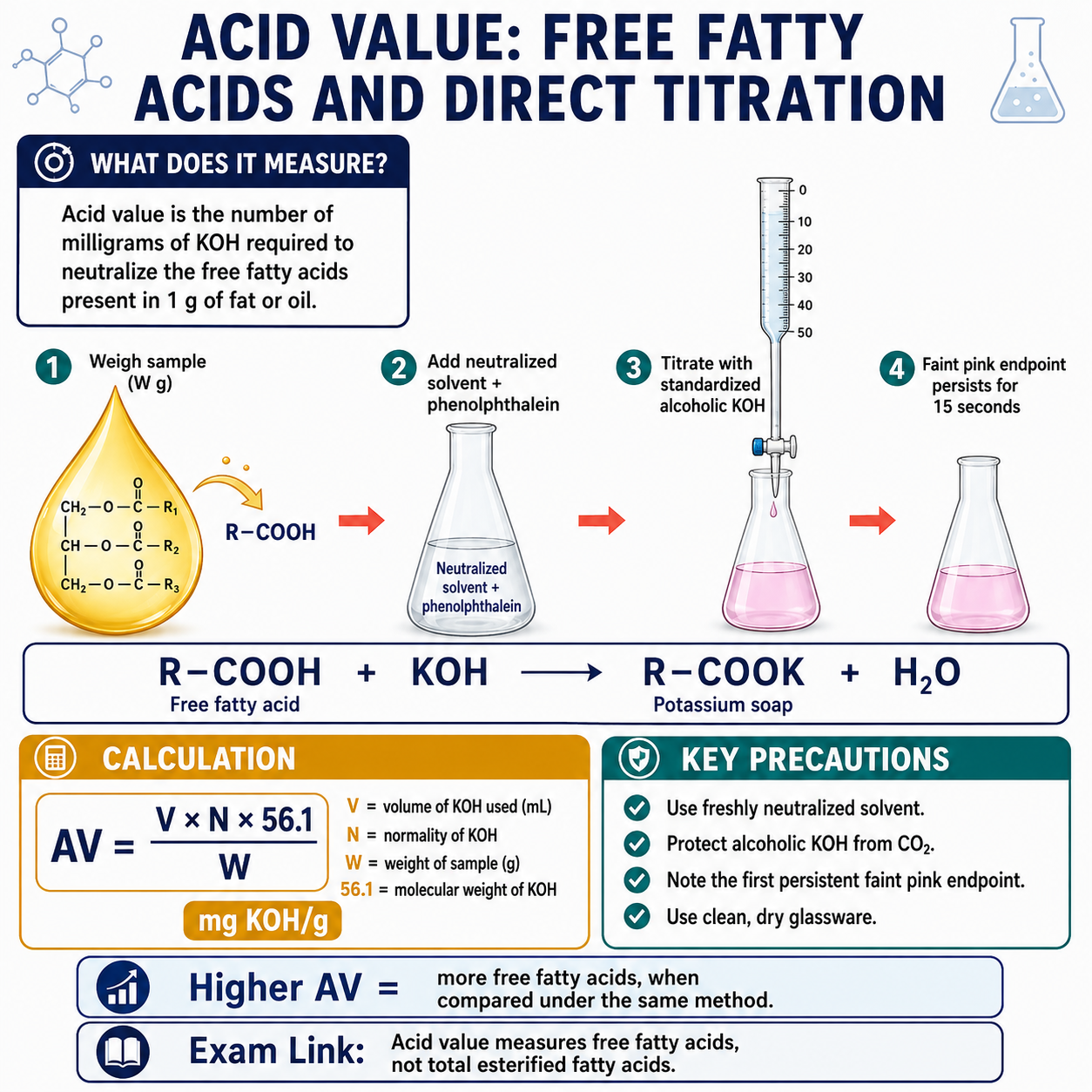
The acid value is the number of milligrams of potassium hydroxide required to neutralize the free fatty acids present in 1 g of fat, oil, wax or related lipid sample.
Principle and Reaction
Fats and oils mainly contain triacylglycerols, but moisture, heat, lipases and unsuitable storage can hydrolyze some ester bonds and release free fatty acids. Acid value measures these unesterified acids; it does not directly measure the fatty acids that remain bound to glycerol.
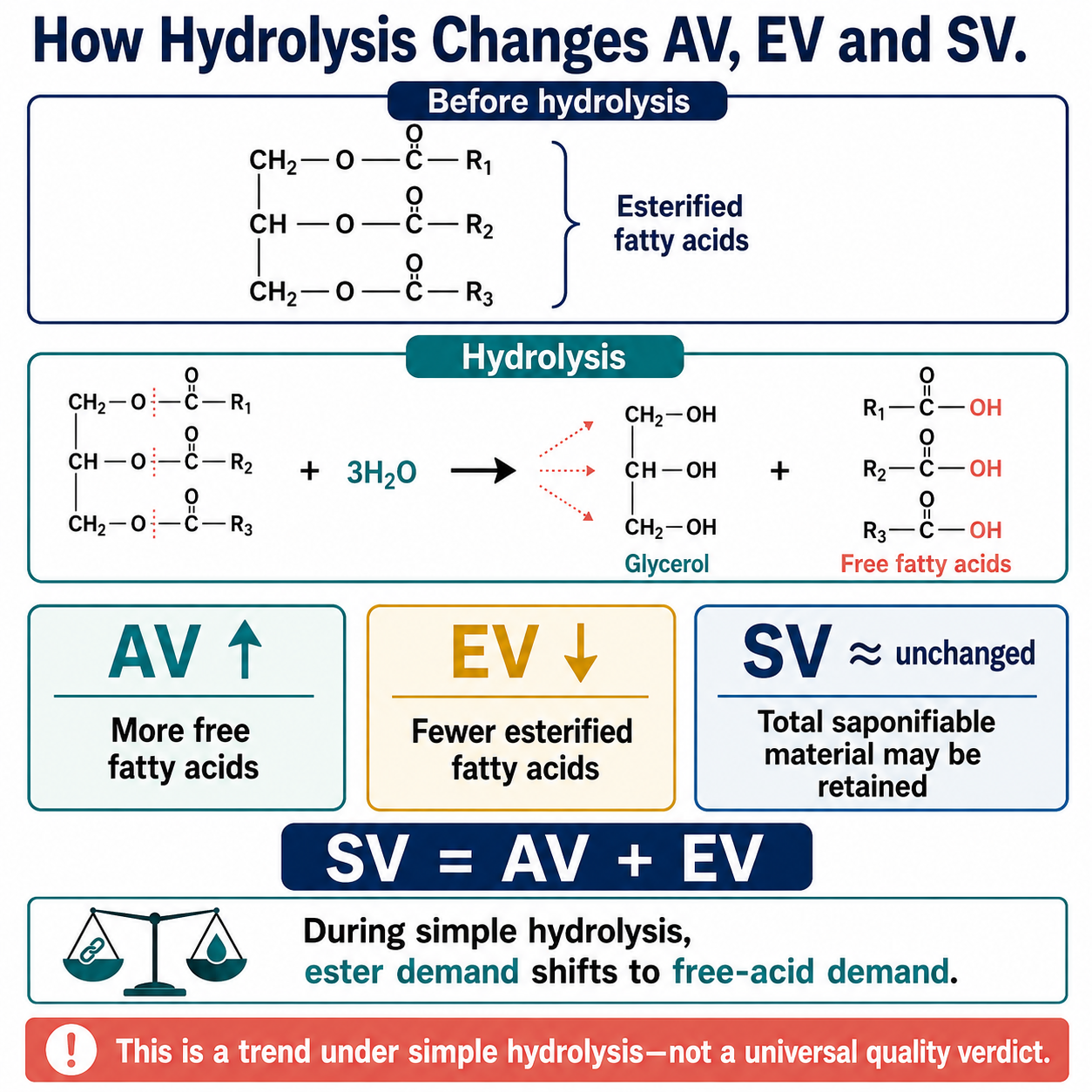
| Triacylglycerol + 3 H₂O → glycerol + 3 R–COOH |
A known mass of sample is dissolved in a suitable, previously neutralized organic solvent (like ethanol, ether, or isopropanol), because oils do not mix uniformly with water. The solvent creates effective contact between the lipid and standardized alcoholic KOH. Each free carboxyl group consumes one equivalent of hydroxide by acid-base neutralization.
| R–COOH + KOH → R–COOK + H₂O free fatty acid + potassium hydroxide → potassium soap + water At the ionic level, R–COOH + OH⁻ → R–COO⁻ + H₂O |
Phenolphthalein remains colorless while free acid is present. The first slight excess of KOH makes the solution weakly alkaline and produces a faint, uniform pink endpoint that commonly persists for about 15 seconds. A dark pink endpoint indicates overshooting.
| ANALYTICAL LOGIC Alcoholic KOH improves contact with the organic sample. The solvent must be neutral so that it neither consumes KOH nor contributes alkalinity. Prolonged heating should be avoided because it may begin ester hydrolysis and falsely increase the apparent acid value. |
General Procedure
- Prepare the specified solvent (like ethanol, ether, or isopropanol) and neutralize its residual acidity with standardized alcoholic KOH using phenolphthalein.
- For neutralized solvent, a few drops of phenolphthalein indicator are added to the solvent mixture. The solvent is then titrated with a dilute base (such as 0.1 M KOH or NaOH) until it turns a faint, persistent pink color.
- Mix the sample thoroughly, accurately weigh a suitable quantity into a clean, dry conical flask and record W in grams.
- Add the prescribed neutralized solvent. Swirl until the sample dissolves or forms a uniform solution; use only gentle warming when necessary.
- Add the specified phenolphthalein indicator unless the method requires potentiometric endpoint detection.
- Titrate with freshly standardized alcoholic KOH while continuously swirling. Near the endpoint, add titrant dropwise.
- Stop at the first faint, uniform pink color that persists for the time specified by the method, commonly about 15 seconds. Record the sample titre Vₛ.
- When required, perform a reagent blank without sample under identical conditions and use the corrected volume V = Vₛ − Vᵦ.
- Calculate and report the acid value in mg KOH/g with appropriate significant figures.
| METHOD NOTE The exact sample mass, solvent composition, KOH strength, endpoint and temperature may vary among pharmacopoeial or validated methods. Follow the applicable monograph for official testing. |
Formula and Symbols
| Acid value = (Vₛ − Vᵦ) × N × 56.1 / W mg KOH/g Vₛ = sample titre; Vᵦ = blank titre; N = normality of KOH; W = sample mass (g) |
Why 56.1? Potassium hydroxide has a molar mass of approximately 56.1 g mol⁻¹. With titration volume in mL and concentration in equivalents per litre, the factor converts the result to milligrams of KOH.
Worked Example
A 4.00 g oil sample requires 1.60 mL of 0.100 N KOH.
| AV = 1.60 × 0.100 × 56.1 / 4.00 AV = 2.244 ≈ 2.24 mg KOH/g |
Significance
- AV estimates free fatty acids and supports the assessment of hydrolytic deterioration or lipolysis.
- A rising AV during storage may indicate moisture, lipase activity, heat-related hydrolysis or unsuitable handling.
- Official specifications may set a maximum AV for a particular oil, fat, wax or pharmaceutical excipient.
- AV helps monitor raw materials and formulations, but it does not directly measure peroxide formation or total oxidation.
Sources of Error and Precautions
- Neutralize the solvent before use so solvent acidity does not increase the titre.
- Standardize KOH and protect it from carbon dioxide and moisture.
- Use clean, dry glassware and dissolve the sample completely.
- Avoid overshooting the endpoint; strongly colored samples may need potentiometric detection.
- Report the result with the correct unit: mg KOH/g, not percent.
Saponification Value
Definition
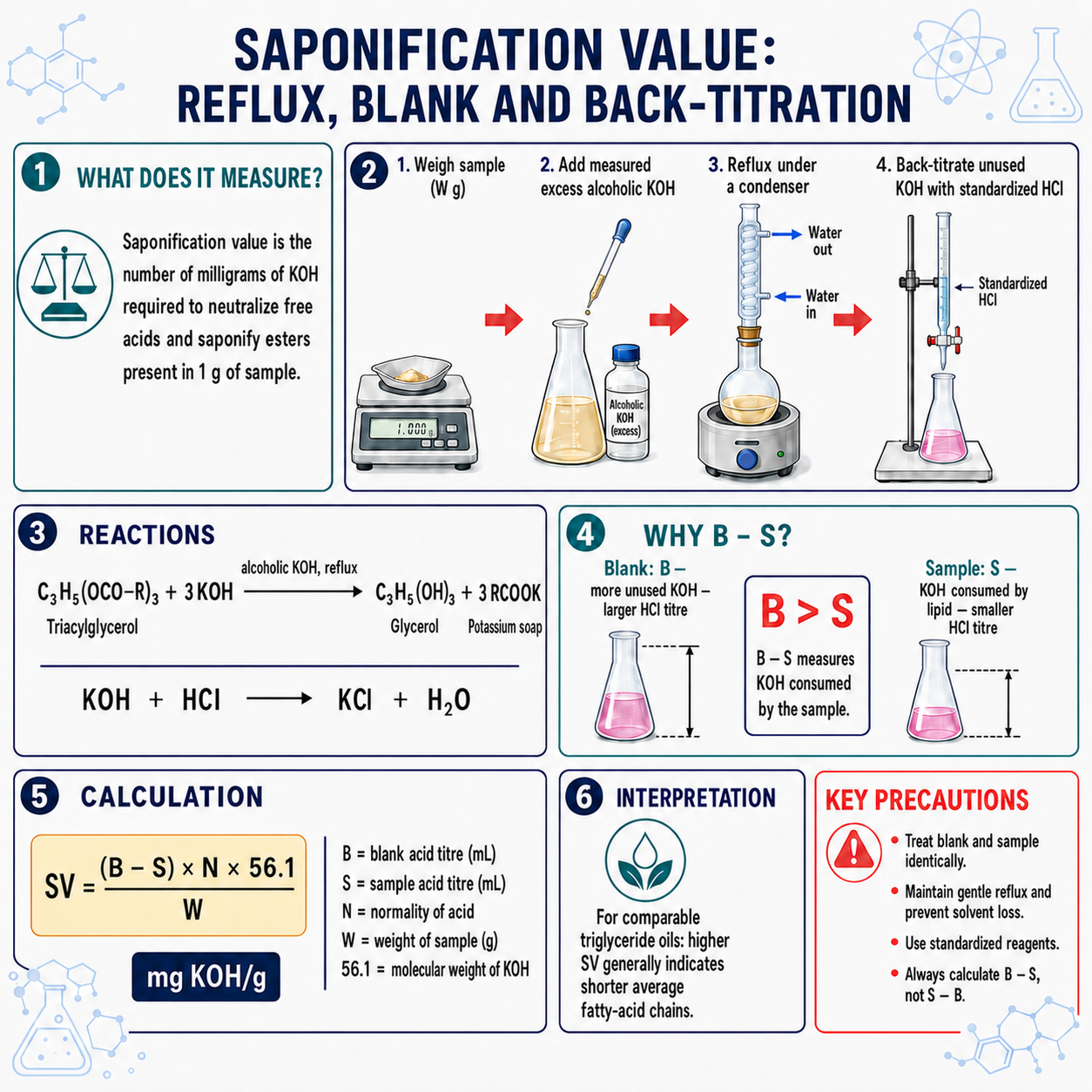
The saponification value is the number of milligrams of potassium hydroxide required to neutralize the free acids and saponify the esters present in 1 g of sample.
Principle and Complete Reaction
Saponification value measures the total KOH consumed by the sample under alkaline hydrolysis conditions. Consequently, it includes KOH used to neutralize pre-existing free fatty acids and KOH used to split saponifiable ester bonds. A precisely measured excess of alcoholic KOH is necessary because the reaction is heterogeneous at first and must proceed to completion.
During reflux, hydroxide attacks the electrophilic carbonyl carbon of each ester group. A tetrahedral intermediate forms, collapses and releases the glyceroxide-derived portion. The fatty-acid product remains as a resonance-stabilized carboxylate salt, which prevents the reverse esterification reaction and drives saponification toward completion. One triacylglycerol molecule normally consumes three moles of KOH for its three ester bonds.
| C₃H₅(OCO–R)₃ + 3 KOH —alcoholic KOH, reflux→ C₃H₅(OH)₃ + 3 RCOOK triacylglycerol + potassium hydroxide → glycerol + potassium salts of fatty acids (soap) |
Any free fatty acid present also consumes KOH directly:
| R–COOH + KOH → R–COOK + H₂O |
Back-titration reaction:
| KOH + HCl → KCl + H₂O |
After reflux, the analyst cannot conveniently titrate the KOH already consumed. Instead, standardized acid measures the KOH that remains. The blank contains the full residual KOH and therefore requires a larger acid titre. The sample has consumed some KOH and requires a smaller titre. Thus, B − S represents the KOH equivalents consumed by the sample.
Why Alcoholic KOH, Reflux and a Blank Are Used?
| Feature | Purpose |
| Alcoholic KOH | Improves contact between the lipid and alkali and supports saponification. |
| Reflux | Provides sustained heating while minimizing solvent loss. |
| Excess KOH | Drives saponification toward completion. |
| Blank flask | Measures the available KOH under the same heating and titration conditions. |
| Back-titration | Measures residual KOH; subtraction gives KOH consumed by sample. |
General Procedure
- Mix the sample thoroughly and accurately weigh the specified quantity into a clean, dry reflux flask. Record the mass W.
- Pipette the prescribed volume of freshly standardized alcoholic KOH into the flask. Add boiling aids if the official method permits them.
- Connect a reflux condenser and heat for the specified time, swirling periodically when directed. Maintain gentle, uniform reflux and prevent solvent loss.
- Prepare a blank containing the same volume and batch of alcoholic KOH but no sample. Reflux it for the same time under identical conditions.
- After reflux, cool the flasks as directed. Add phenolphthalein and titrate the unused KOH with standardized HCl or other specified acid.
- Record the acid volume for the blank as B and for the sample as S. The blank should normally be greater than the sample.
- Calculate (B − S), apply the normality and KOH factor, divide by W and report SV in mg KOH/g.
- Repeat the determination when concordant results are required and investigate any abnormal blank or indistinct endpoint.
Formula and Logic
| Saponification value = (B − S) × N × 56.1 / W mg KOH/g B = blank acid titre (mL); S = sample acid titre (mL) N = normality of acid; W = mass of sample (g) |
| WHY B − S? The blank contains more residual KOH, so it consumes more acid. The sample has already consumed some KOH; therefore, its back-titre is smaller. The positive difference B − S measures KOH consumed by the lipid. |
Worked Example
A 2.00 g oil sample is refluxed with alcoholic KOH. The blank requires 25.00 mL of 0.500 N HCl, whereas the sample requires 11.40 mL.
| SV = (25.00 − 11.40) × 0.500 × 56.1 / 2.00 SV = 190.74 mg KOH/g |
Interpretation
For comparable triacylglycerol oils, every molecule has three ester groups. A lower average molecular mass means that one gram contains more molecules and therefore more ester groups. More KOH is consumed, so SV tends to be higher. Hence, shorter average fatty-acid chains generally produce a higher SV, whereas longer average chains produce a lower SV.
| For an ideal neutral triacylglycerol: approximate molar mass = 3 × 56,100 / SV |
| LIMITATION This inverse relation is an approximation for comparable saponifiable lipids. Free acids, mono- and diacylglycerols, wax esters, unsaponifiable matter, moisture and mixed ester structures affect interpretation. SV does not directly measure unsaturation, oxidation or safety, and one value alone cannot prove identity or adulteration. |
Significance and Uses
- characterization and identification of fixed oils, fats and waxes;
- comparison with pharmacopoeial specifications;
- approximate assessment of average saponifiable molecular mass or chain length;
- support for detecting substitution, adulteration or batch variation when combined with other tests;
- formulation and raw-material quality control.
Precautions
- Use the same reagent volumes, reflux time and temperature for blank and sample.
- Prevent loss of volatile solvent and maintain condenser flow.
- Use standardized, carbonate-minimized alcoholic KOH and standardized acid.
- Ensure complete reflux/saponification before back-titration.
- Read the burette correctly and use B − S, never S − B.
- Follow a validated method for dark samples or difficult endpoints.
Ester Value
Definition and Principle
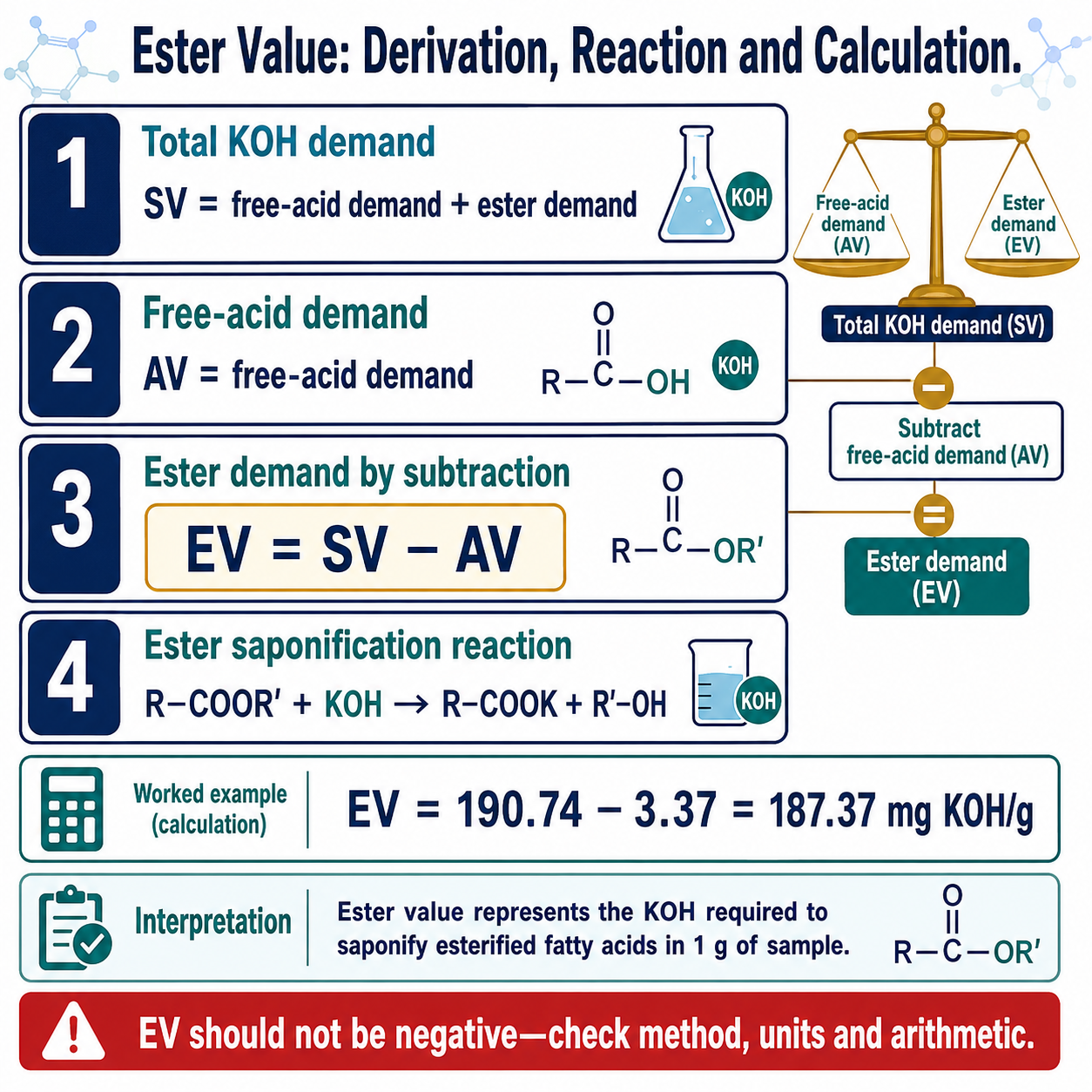
The ester value is the number of milligrams of KOH required to saponify the esterified fatty acids present in 1 g of sample. It is not usually obtained from a third independent titration. Instead, it is derived from two experimentally determined constants measured on representative portions of the same material.
Saponification value includes two contributions: KOH that neutralizes free fatty acids and KOH that hydrolyzes ester bonds. Acid value independently measures the free-fatty-acid contribution. When both values are expressed on the same mg KOH/g basis, subtraction isolates the KOH-equivalent contribution of esterified acids.
| Ester value = Saponification value − Acid value EV = SV − AV (mg KOH/g) |
| DERIVATION SV = free-acid KOH demand + ester KOH demand. AV = free-acid KOH demand. Therefore, SV − AV = ester KOH demand = EV. |
Reaction Represented by Ester Value
EV represents alkaline hydrolysis of esterified fatty-acid residues. For a simple ester, one mole of ester consumes one mole of KOH. For a triacylglycerol, three ester bonds consume three moles of KOH.
| R–COOR′ + KOH → R–COOK + R′–OH ester + potassium hydroxide → potassium carboxylate + alcohol C₃H₅(OCO–R)₃ + 3 KOH → C₃H₅(OH)₃ + 3 RCOOK |
General Calculation Procedure
- Determine AV on a representative portion of the sample using the specified direct-titration method.
- Determine SV on another representative portion using excess alcoholic KOH, reflux, blank correction and back-titration.
- Confirm that both results use the same basis and unit, mg KOH/g.
- Subtract AV from SV: EV = SV − AV.
- Report the calculated EV with sensible significant figures and interpret it with the material specification and analytical context.
| QUALITY CHECK EV should not normally be negative. A negative result suggests experimental error, incorrect blank/sample subtraction, mismatched units or methods, sample inhomogeneity, poor standardization, or transcription/calculation error. |
Worked Example
If an oil has SV = 190.74 mg KOH/g and AV = 3.37 mg KOH/g:
| EV = 190.74 − 3.37 = 187.37 mg KOH/g |
Significance and Interpretation
- EV estimates the esterified fatty-acid contribution.
- A high EV relative to SV indicates that most measurable fatty acids remain esterified and AV is comparatively low.
- During hydrolysis, AV may rise and EV may fall because esterified acids become free acids.
- EV supports comparison of oils, fats, waxes and ester-rich materials, but interpretation requires the relevant specification and complementary tests.
Comparative Study
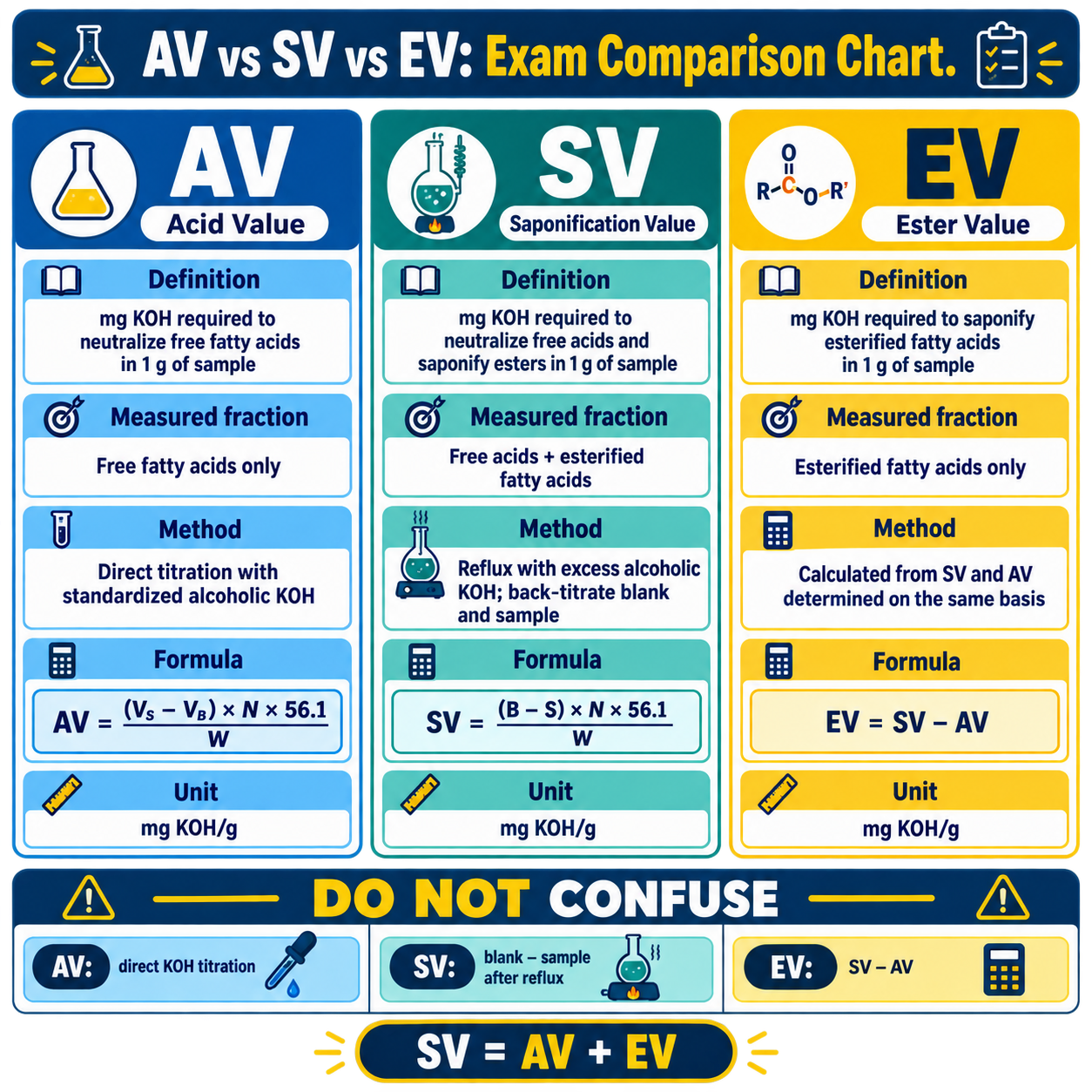
| Feature | Acid value | Saponification value | Ester value |
| Measures | Free fatty acids | Free acids + saponifiable esters | Esterified fatty acids |
| Primary method | Direct titration | Reflux + back-titration with blank | Calculation from SV and AV |
| Formula | VN56.1/W | (B−S)N56.1/W | SV−AV |
| Main chemical process | Neutralization | Neutralization + ester hydrolysis | Difference representing ester saponification |
| Useful for | Hydrolytic deterioration, specifications | Identity/composition, average chain-length indication | Extent of esterified fraction |
| Common unit | mg KOH/g | mg KOH/g | mg KOH/g |
Integrated Numerical
A 2.00 g sample consumes 1.20 mL of 0.100 N KOH for AV. For SV, the blank and sample titres are 25.00 mL and 11.40 mL of 0.500 N HCl.
| AV = 1.20 × 0.100 × 56.1 / 2.00 = 3.37 mg KOH/g SV = (25.00 − 11.40) × 0.500 × 56.1 / 2.00 = 190.74 mg KOH/g EV = 190.74 − 3.37 = 187.37 mg KOH/g |
Interpretation Without Overclaiming
- Compare every result with the correct monograph, specification, method and sample type.
- Use trends across storage time to interpret deterioration more reliably than one isolated value.
- Combine AV/SV/EV with other constants such as iodine value, peroxide value, moisture and unsaponifiable matter where relevant.
- Do not state that a high or low value alone proves purity, adulteration or safety.
- Account for sampling, standardization, endpoint detection and matrix effects.
Common Exam Mistakes
| Mistake | Correct approach |
| Writing g KOH/g | Write mg KOH/g. |
| Using S − B | Use B − S because blank titre is normally greater. |
| Forgetting sample mass | Divide by W in grams. |
| Using 56.1 with molarity blindly | Use concentration and stoichiometry as defined by the validated method; normality is standard in these formulas. |
| Calling AV an oxidation value | AV measures free acidity, not peroxides directly. |
| Saying EV = AV − SV | Write EV = SV − AV. |
| Treating a constant as proof of purity | Compare with specifications and complementary tests. |
Glossary
| Term | Meaning |
| Back-titration | Determination of excess reagent by titrating what remains after reaction with the sample. |
| Blank | A parallel determination containing reagents but no sample. |
| Free fatty acid | A fatty acid present with an unesterified carboxyl group. |
| Saponification | Alkaline hydrolysis of an ester to form an alcohol and a carboxylate salt. |
| Standardized solution | A reagent solution whose exact concentration has been determined. |
| Unsaponifiable matter | Material that does not form soap under the specified saponification conditions. |