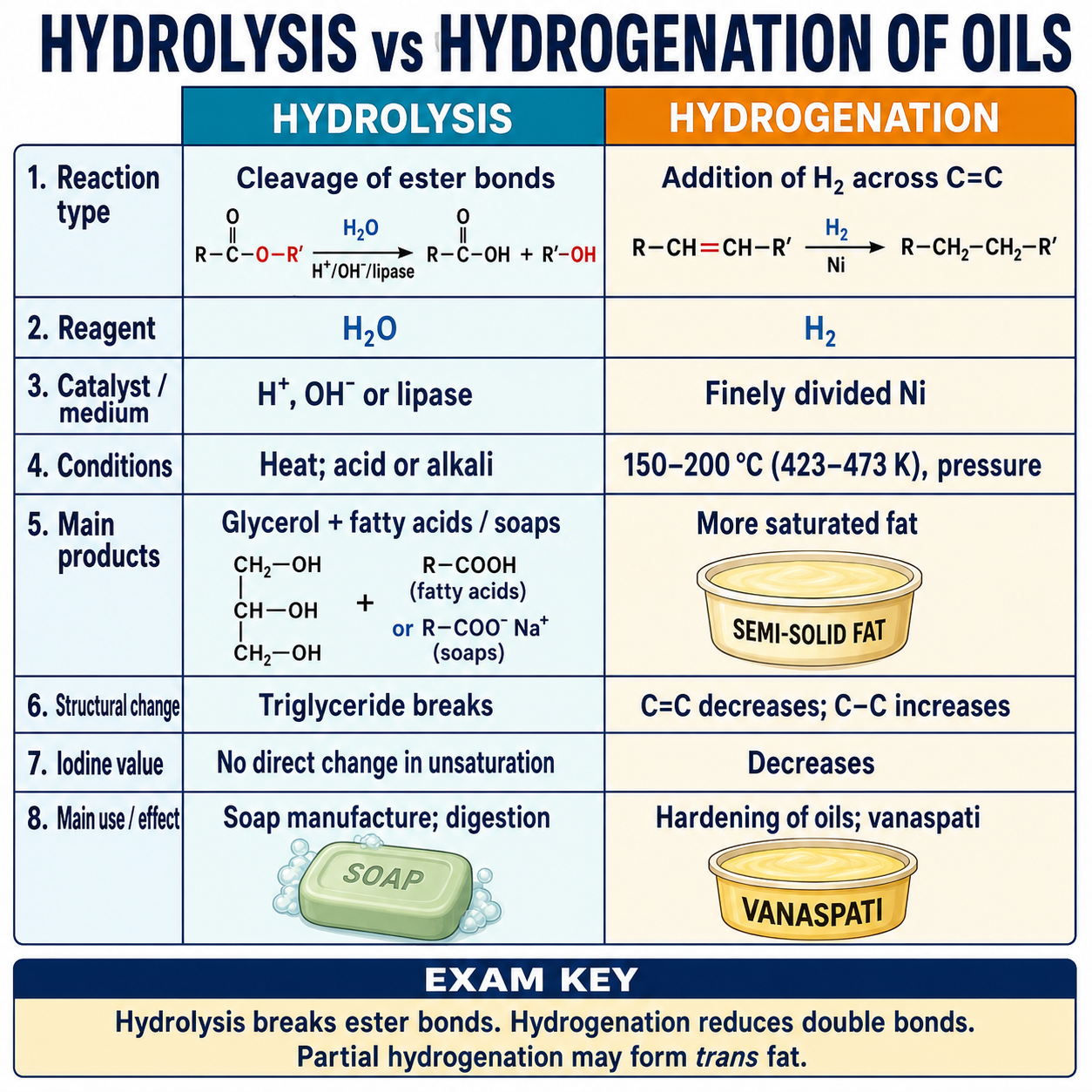
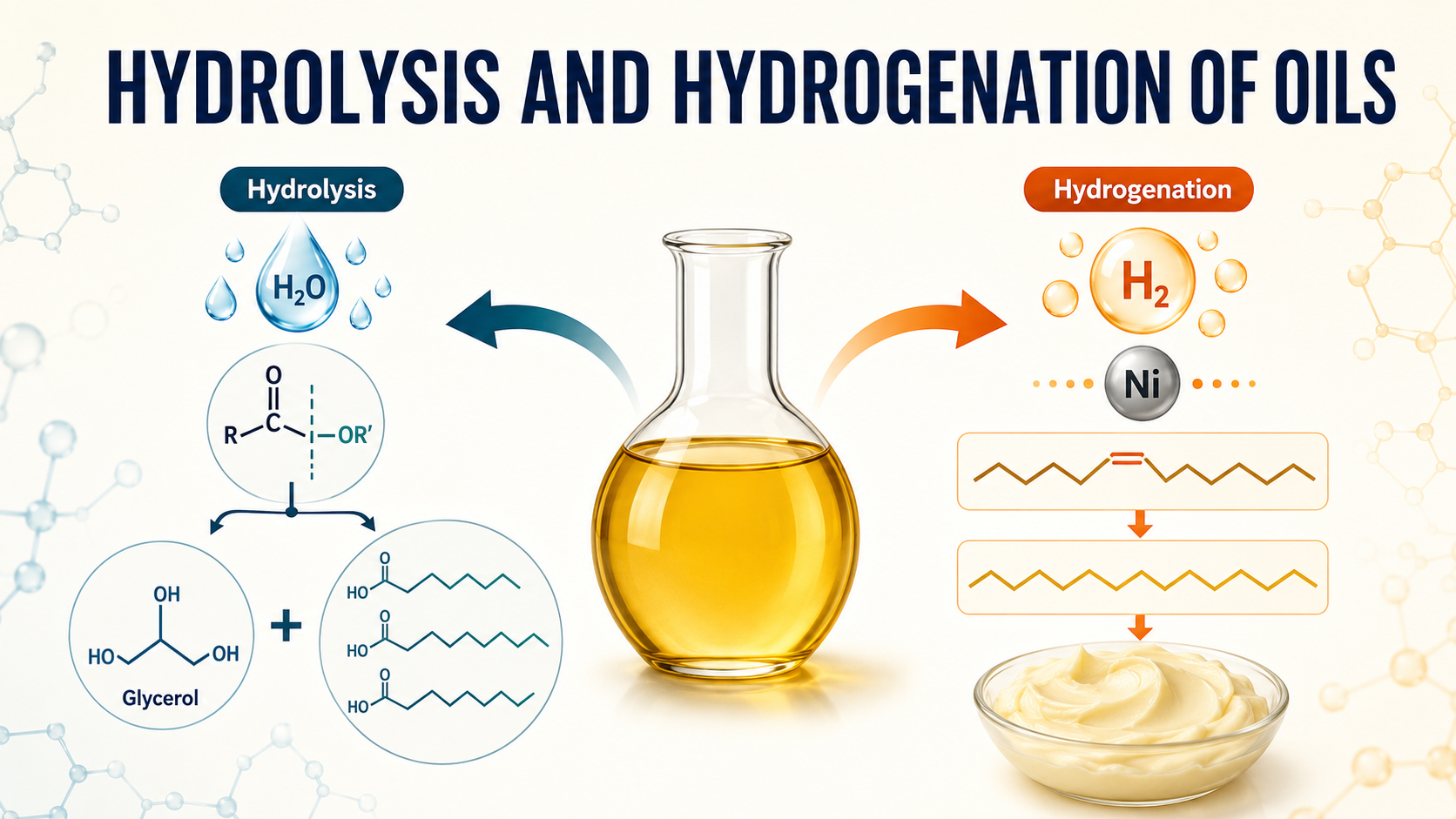
Hydrolysis and hydrogenation are two important reactions of fats and oils. However, they produce entirely different structural and physical changes. Hydrolysis breaks the ester bonds of triglycerides to form glycerol and fatty acids or their salts. In contrast, hydrogenation adds hydrogen across the carbon–carbon double bonds of unsaturated oils and converts them into more saturated, semi-solid, or solid fats. Therefore, understanding their reactions, conditions, products, applications, and effects on iodine value helps students answer both short- and long-answer examination questions.
Essential Background: What Is an Oil?
Oils and fats mainly contain triacylglycerols (triglycerides). A triglyceride is a triester formed when one molecule of glycerol reacts with three molecules of long-chain fatty acids. Therefore, the ester linkages of a triglyceride can undergo hydrolysis, while the carbon–carbon double bonds of unsaturated fatty-acid chains can undergo hydrogenation.
| Glycerol + 3 Fatty acids ⇌ Triglyceride + 3 H₂O |
| Conditions: Esterification; acid catalyst and heat |
| Result: Three ester bonds form in one triglyceride molecule. |
| Memory link: Hydrolysis acts mainly at the ester bond (–COO–), whereas Hydrogenation acts mainly at the carbon–carbon double bond (C=C). |
Hydrolysis of Oils and Fats
Hydrolysis is the cleavage of ester bonds by water. In oils and fats, hydrolysis breaks a triglyceride into glycerol and fatty acids or their salts. The product depends on whether the medium is acidic, alkaline, or enzymatic.
Types of Hydrolysis
Acid Hydrolysis
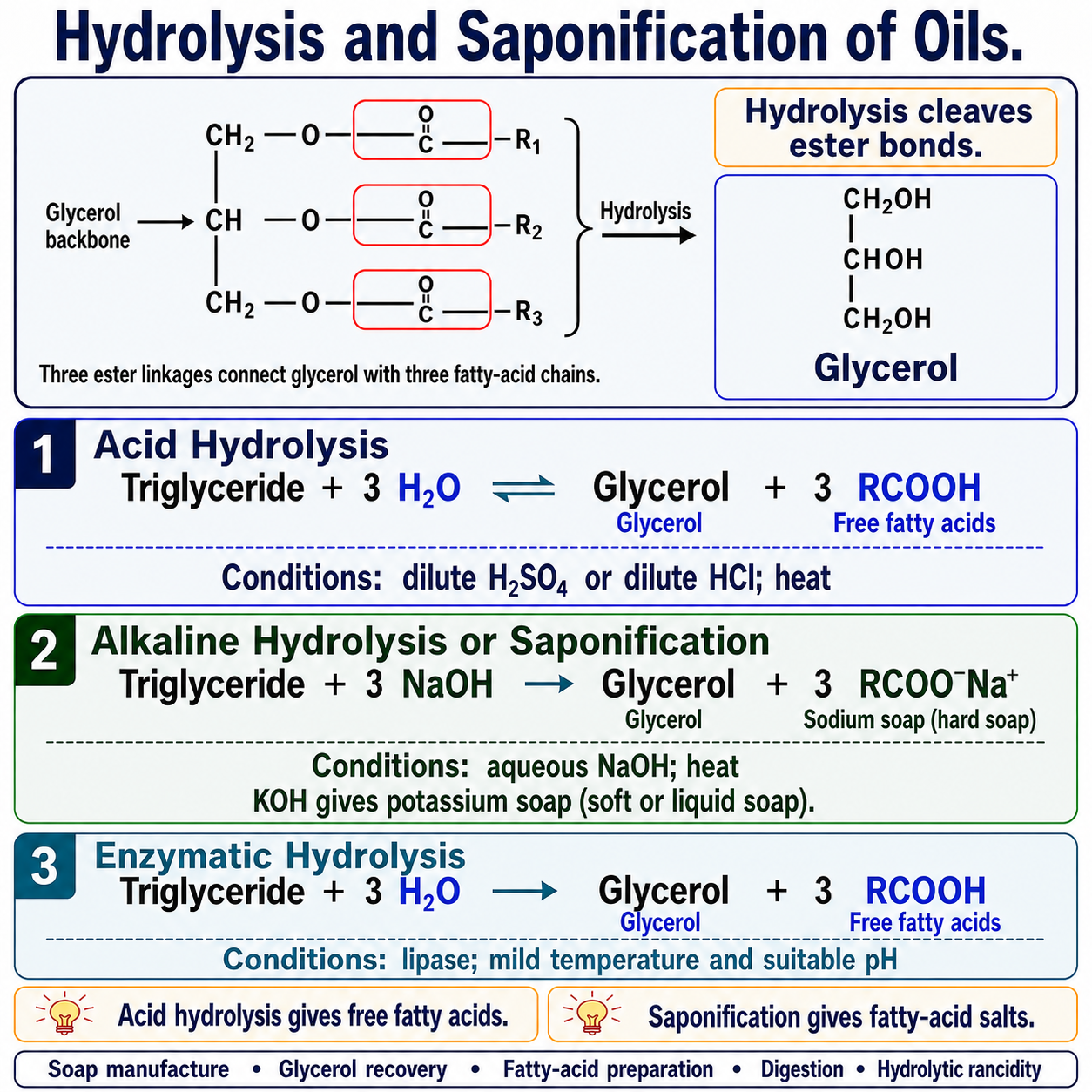
When a triglyceride is heated with water in the presence of a dilute mineral acid, all three ester linkages break. The reaction produces glycerol and three molecules of free fatty acids. Because esterification is reversible, acid hydrolysis is also reversible.
| Triglyceride + 3 H₂O ⇌ Glycerol + 3 RCOOH |
| Conditions: Dilute H₂SO₄ or dilute HCl; heat |
| Result: Free fatty acids are obtained. |
At the molecular level, acid first protonates the ester carbonyl oxygen. Water then attacks the carbonyl carbon, proton transfers occur, and cleavage releases the alcohol portion. The sequence repeats at each of the three ester groups. For most university answers, however, the overall reaction and correct products are more important than the full mechanism.
Alkaline Hydrolysis or Saponification
When an oil or fat is heated with aqueous sodium hydroxide or potassium hydroxide, it gives glycerol and the sodium or potassium salts of fatty acids. These salts are soaps; therefore, alkaline hydrolysis is called saponification.
| Triglyceride + 3 NaOH → Glycerol + 3 RCOO⁻Na⁺ |
| Conditions: Aqueous NaOH; heat |
| Result: Hard soap (sodium soap) forms. |
| Triglyceride + 3 KOH → Glycerol + 3 RCOO⁻K⁺ |
| Conditions: Aqueous KOH; heat |
| Result: Soft or liquid soap (potassium soap) forms. |
| Why is it effectively irreversible?: The fatty acid immediately forms a stable carboxylate salt in alkaline medium. This removal of free acid drives the reaction toward products. |
Enzymatic Hydrolysis
Lipase enzymes hydrolyze triglycerides under mild conditions. During digestion, gastric and pancreatic lipases help convert dietary triacylglycerols into smaller glycerides and free fatty acids. Industrial lipases also provide selective, energy-efficient processing of fats and oils.
| Triglyceride + H₂O → Partial glycerides + Fatty acids |
| Conditions: Lipase; mild temperature and suitable pH |
| Result: Selective hydrolysis may occur stepwise. |
Mechanistic Outline of Saponification
- Hydroxide ion attacks the electrophilic carbonyl carbon of an ester group.
- A tetrahedral intermediate forms.
- The intermediate collapses and the glyceroxide portion leaves.
- Acid–base transfer produces a carboxylate ion and an alcohol group.
- The same sequence occurs at the remaining ester bonds, finally giving glycerol and three fatty-acid salts.
Factors Affecting Hydrolysis
| Factor | Effect on hydrolysis |
| Temperature | Higher temperature generally increases reaction rate. |
| Catalyst or pH | Acid, alkali, or lipase provides a faster reaction pathway. |
| Water availability | Adequate water supports ester cleavage; moisture can also cause undesirable storage hydrolysis. |
| Mixing | Improves contact between the aqueous phase and the oil phase. |
| Chain environment | Steric and interfacial factors can affect access to ester groups. |
Hydrolytic Rancidity
Moisture and lipase can hydrolyze stored fats and release free fatty acids. Short-chain fatty acids often have strong, unpleasant odors; therefore, their release produces hydrolytic rancidity. This process differs from oxidative rancidity, which mainly involves oxygen attack at unsaturated sites.
| Exam distinction: Hydrolytic rancidity = ester cleavage and free-fatty-acid release. Oxidative rancidity = oxidation, especially near C=C bonds, with peroxide and aldehyde formation. |
Significance of Hydrolysis
- Manufacture of sodium and potassium soaps by saponification.
- Recovery of glycerol, an important pharmaceutical and industrial material.
- Preparation and purification of fatty acids for formulations and chemical synthesis.
- Digestion and metabolism of dietary lipids through lipase-catalyzed reactions.
- Quality control: an increased acid value may indicate hydrolysis and deterioration.
Hydrogenation of Oils
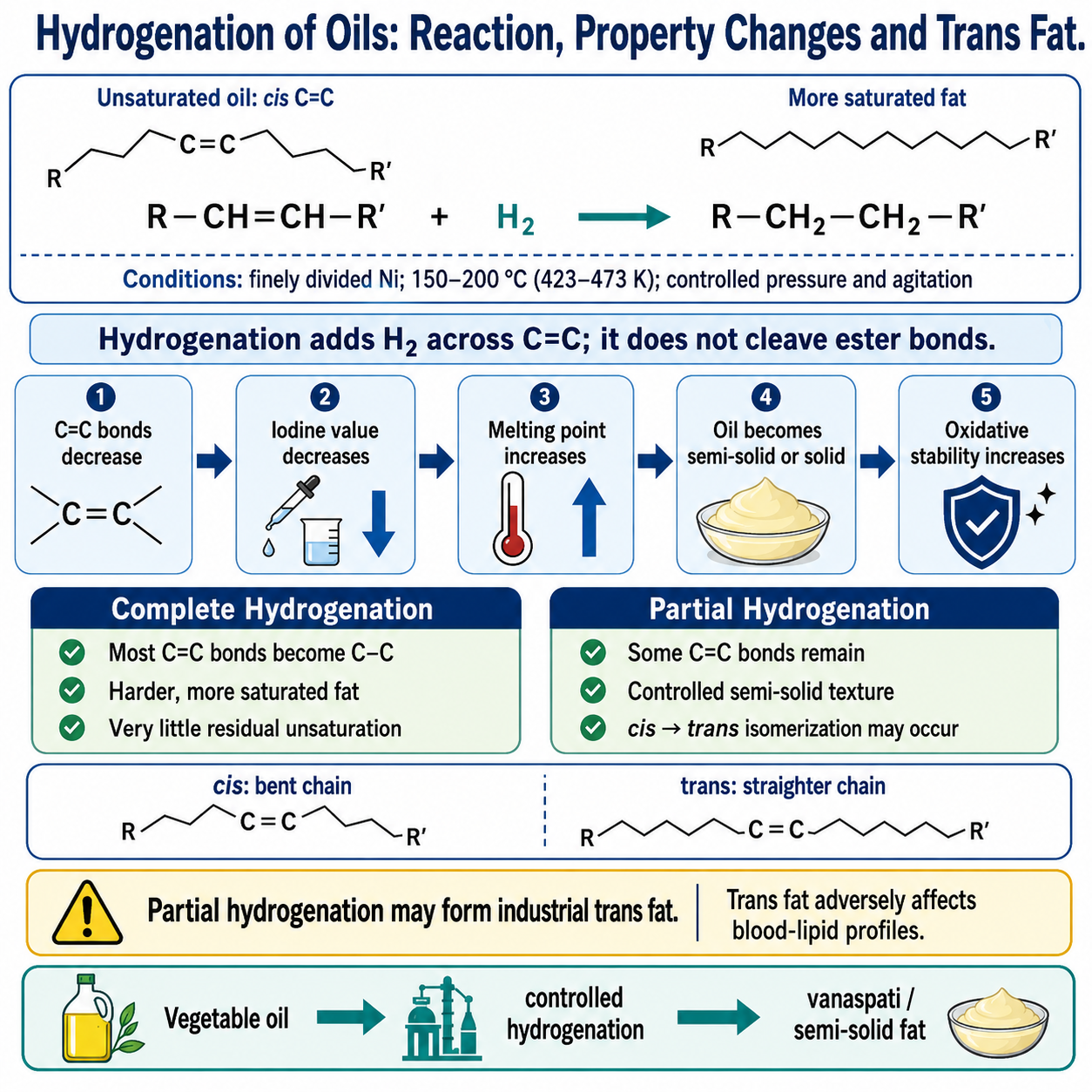
Hydrogenation is the addition of molecular hydrogen across one or more carbon–carbon double bonds of unsaturated fatty-acid chains. It reduces unsaturation and converts liquid oils into products with higher melting points and greater oxidative stability.
| R–CH=CH–R′ + H₂ → R–CH₂–CH₂–R′ |
| Conditions: Finely divided Ni catalyst; approximately 150–200 °C (423–473 K); pressure and agitation |
| Result: One C=C bond consumes one mole of H₂. |
In industrial processing, purified oil, hydrogen gas, and a nickel catalyst are brought into close contact with heating and agitation. Hydrogen and the unsaturated chain adsorb on the metal surface. Hydrogen atoms then add to the two alkene carbons, and the more saturated product leaves the catalyst surface.
Complete and Partial Hydrogenation
| Feature | Complete hydrogenation | Partial hydrogenation |
| Extent | Most or all C=C bonds become C–C bonds. | Only some C=C bonds are hydrogenated. |
| Physical effect | Produces a harder, more saturated fat. | Produces a semi-solid fat with controlled consistency. |
| Iodine value | Falls substantially. | Falls to an intermediate value. |
| Isomerization | Less residual unsaturation remains. | Remaining cis bonds may isomerize to trans bonds. |
| Health concern | High saturated-fat content may be undesirable. | Industrially produced trans fat is the major concern. |
Effect on Physical and Chemical Properties
- Melting point increases because straighter, more saturated chains pack more closely.
- The oil becomes more solid or semi-solid at room temperature.
- Iodine value decreases because fewer C=C bonds remain available to react with halogen.
- Oxidative stability and shelf life generally increase because highly unsaturated sites oxidize readily.
- Excess hydrogenation can reduce nutritional quality by increasing saturation.
Partial Hydrogenation and Trans-Fat Formation
Natural unsaturated fatty acids commonly contain cis double bonds, which introduce bends in their chains. During partial catalytic hydrogenation, some adsorbed double bonds may not become fully saturated. Instead, the geometry may change from cis to trans or the double bond may migrate. Trans chains are straighter and pack more efficiently; consequently, they raise the melting point.
| cis-R–CH=CH–R′ ⇌ trans-R–CH=CH–R′ |
| Conditions: Metal catalyst and heat during partial hydrogenation |
| Result: Geometrical isomerization may accompany incomplete addition of H₂. |
| Health point: Industrially produced trans fats adversely affect blood-lipid profiles. Modern processing therefore favors low-trans or trans-free alternatives such as full hydrogenation followed by blending or interesterification. |
Example: Vegetable Oil to Vanaspati
Vegetable oils contain appreciable amounts of unsaturated triacylglycerols and remain liquid at ordinary temperature. Controlled hydrogenation increases saturation and converts the oil into a semi-solid product such as vanaspati. The process improves texture and keeping quality, but partial hydrogenation must be carefully controlled because it may produce trans fatty acids.
Applications of Hydrogenation of Oils
Controlled hydrogenation changes the degree of unsaturation, melting behavior, consistency, and oxidative stability of an oil. Consequently, manufacturers use it whenever a liquid oil must acquire a defined hardness, plasticity, or improved resistance to oxidation.
- Preparation of vanaspati and semi-solid fats: Controlled hydrogenation converts liquid vegetable oils into semi-solid products with a higher melting point.
- Manufacture of margarine and bakery shortening: Hydrogenated or suitably blended fats provide spreadability, plasticity, aeration, and the required texture in bakery products.
- Improvement of consistency and melting profile: The process allows manufacturers to obtain fats with controlled hardness and melting behavior for specific formulations.
- Improvement of oxidative stability and shelf life: Reduction of highly unsaturated C=C bonds makes the product less susceptible to oxidative rancidity during storage.
- Pharmaceutical and cosmetic bases: Selected hydrogenated vegetable oils serve as stable lipid excipients or consistency agents in ointments, creams, suppository bases, and related formulations, subject to pharmacopoeial quality requirements.
- Specialty fats and lipid excipients: Full hydrogenation followed by blending or interesterification can provide functional fats while limiting industrial trans-fat formation.
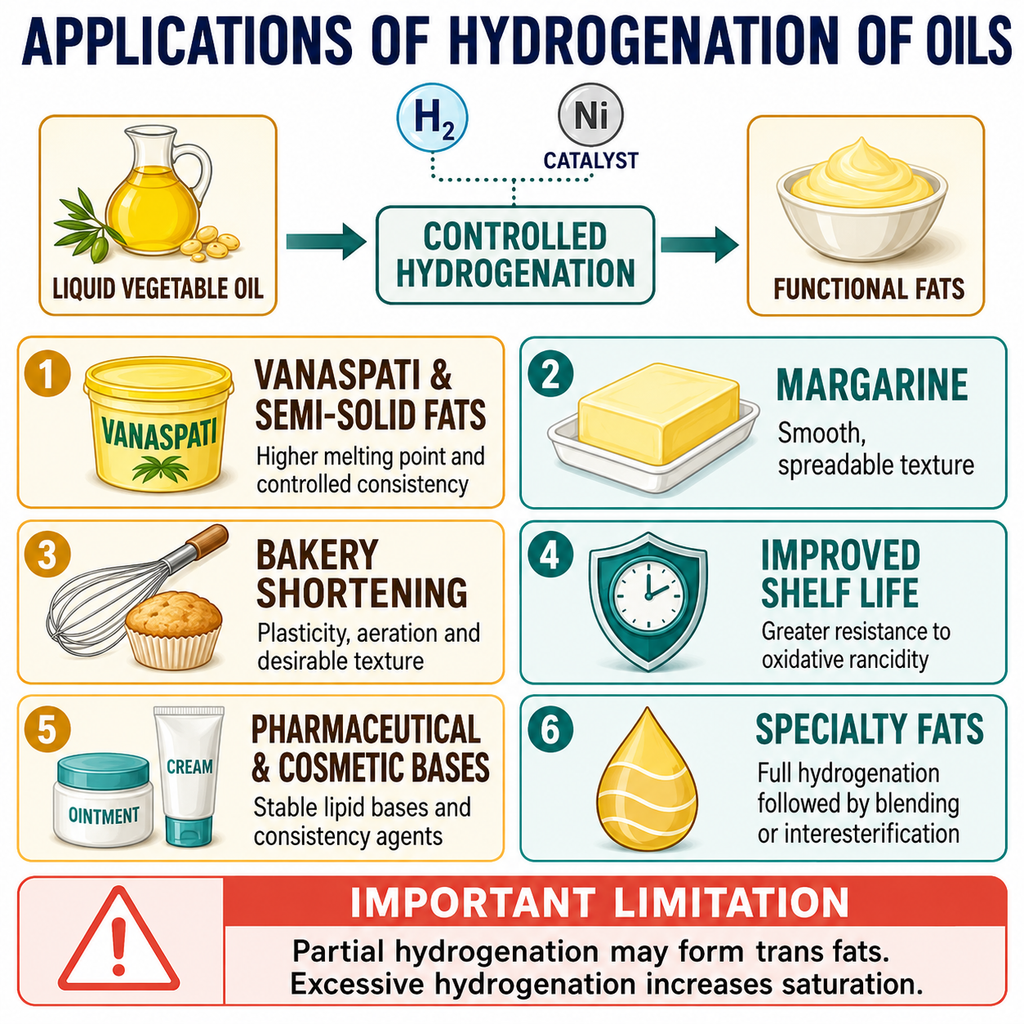
Important limitation: Partial hydrogenation may produce trans fatty acids, whereas excessive hydrogenation increases saturation. Therefore, modern processing carefully controls the reaction and often uses full hydrogenation with blending or interesterification to obtain the required functionality.
Hydrogenation and Analytical Values
| Analytical value | Expected change | Reason |
| Iodine value | Decreases | Hydrogenation consumes C=C bonds, so the product absorbs less iodine. |
| Acid value | Usually not the direct reaction index | Hydrogenation does not primarily create or consume free carboxyl groups. |
| Saponification value | Usually changes little for the same average chain length | The number of ester groups and approximate molecular mass remain broadly similar. |
| Peroxide value | May improve after proper processing/storage | Reduced unsaturation lowers susceptibility to oxidative deterioration. |
Selectivity and Process Control
The degree of hydrogenation depends on temperature, hydrogen pressure, catalyst amount and activity, agitation, reaction time, and the starting oil. Careful process control aims to achieve the desired melting behavior without excessive saturation or trans-isomer formation. Catalyst residues must also be removed from the finished product.
Hydrolysis versus Hydrogenation: High-Yield Comparison
| Basis | Hydrolysis | Hydrogenation |
| Reaction site | Ester linkage of triglyceride | C=C bond of unsaturated chain |
| Main reagent | Water; acid, alkali, or enzyme assists | Hydrogen gas |
| Typical catalyst/condition | Dilute acid + heat, alkali + heat, or lipase | Ni + heat, pressure, agitation |
| Products | Glycerol + fatty acids or their salts | More saturated triglyceride |
| Molecular cleavage | Yes; triglyceride framework breaks | No ester cleavage under normal conditions |
| Iodine value | Not the defining change | Decreases |
| Industrial use | Soap, glycerol, fatty-acid manufacture | Semi-solid fats and improved oxidative stability |